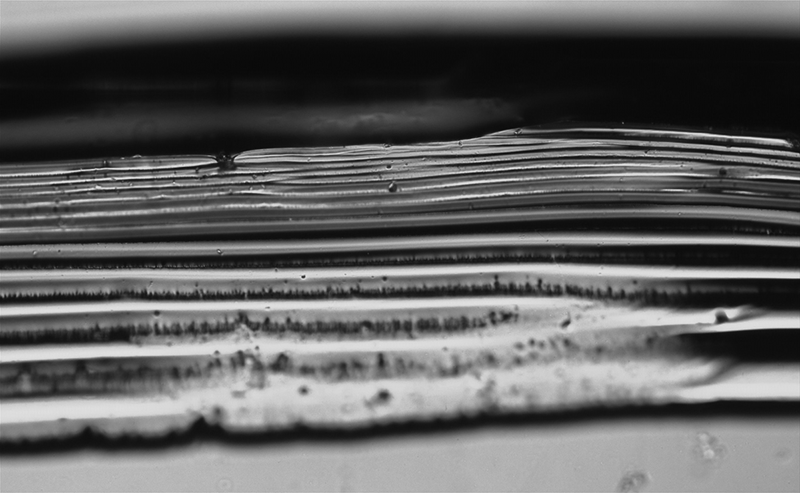
Ice stupas are conical artificial glaciers built with snow cannons; they’re used to store water for spring irrigation. Here, researchers explore a miniaturized lab-grown version made from atomized water droplets. The growing drop breaks and spills, forming frozen fingers in all directions. Further drops flow and freeze as rivulets atop the stupa — or they destabilize and rotate toward another finger, leaving behind a wrinkling shape. Although the formation works very differently (and the scales are completely different) these tiny ice stupas remind me of volcanic flows. (Image credit: D. Papa et al.)
Month: January 2024

Drying Unaffected by Humidity
Water evaporates faster in dry conditions than in humid ones, but the same isn’t true of paint. Instead, paint’s drying time is largely independent of the day’s humidity. That’s because of paint’s long chains of polymers. As water in the paint evaporates, these polymers are drawn to the surface, forming a viscoelastic layer that hinders evaporation and keeps the drying rate independent up to about 80 percent humidity.

Illustration depicting evaporation of water (left) and evaporation of a polymer solution (right). As water evaporates from the polymer solution, it draws polymers to the surface, where they form a layer that hinders evaporation and makes its rate independent of humidity. The polymer layer explains why evaporation isn’t affected by humidity at longer times, but researchers also saw humidity-independent evaporation early in their experiments. Under a microscope, they discovered a thin gel layer (top image) covering the air-polymer interface. They propose that this fast-forming layer further hinders evaporation. Their findings may be significant for virus-laden respiratory droplets, which also contain polymers. (Image and research credit: M. Huisman et al.; see also J. Salmon et al.; via APS Physics)

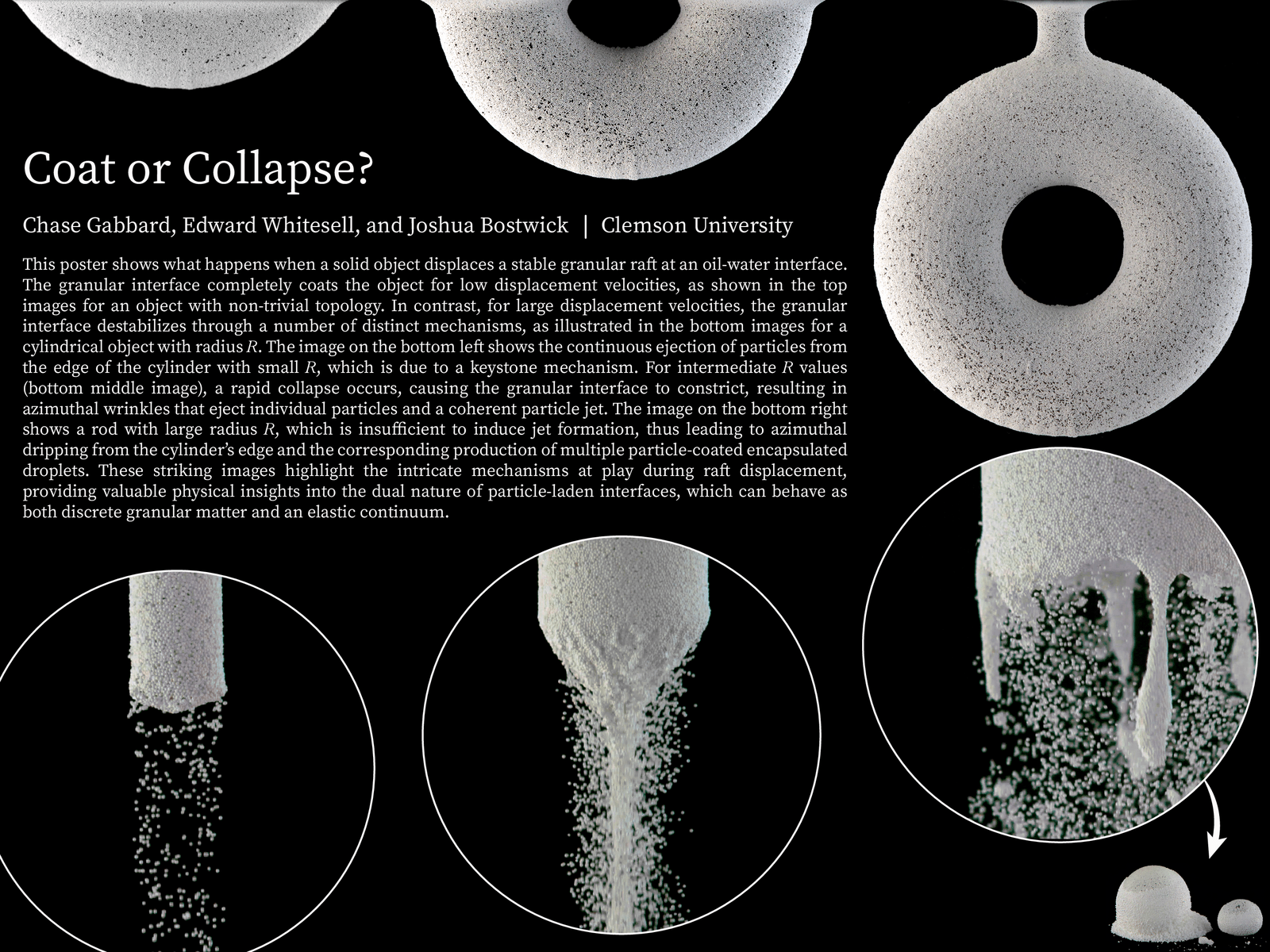
“Coat or Collapse?”
Imagine a layer of particles sitting at the interface between oil and water. Known as a granular raft, these particles can interact in interesting ways with other objects. Here, researchers experiment with allowing different shapes to fall through the raft. At slow speeds, the raft deforms to coat the object, even if it has a complex shape (top images). At higher insertion speeds, however, the granular raft can break up around the object. The lower sequence of images show a cylinder interacting with the raft. Moving from left to right, each image shows a larger cylinder diameter and an increasingly complex break-up of the raft. (Image credit: C. Gabbard et al.)

“Alive”

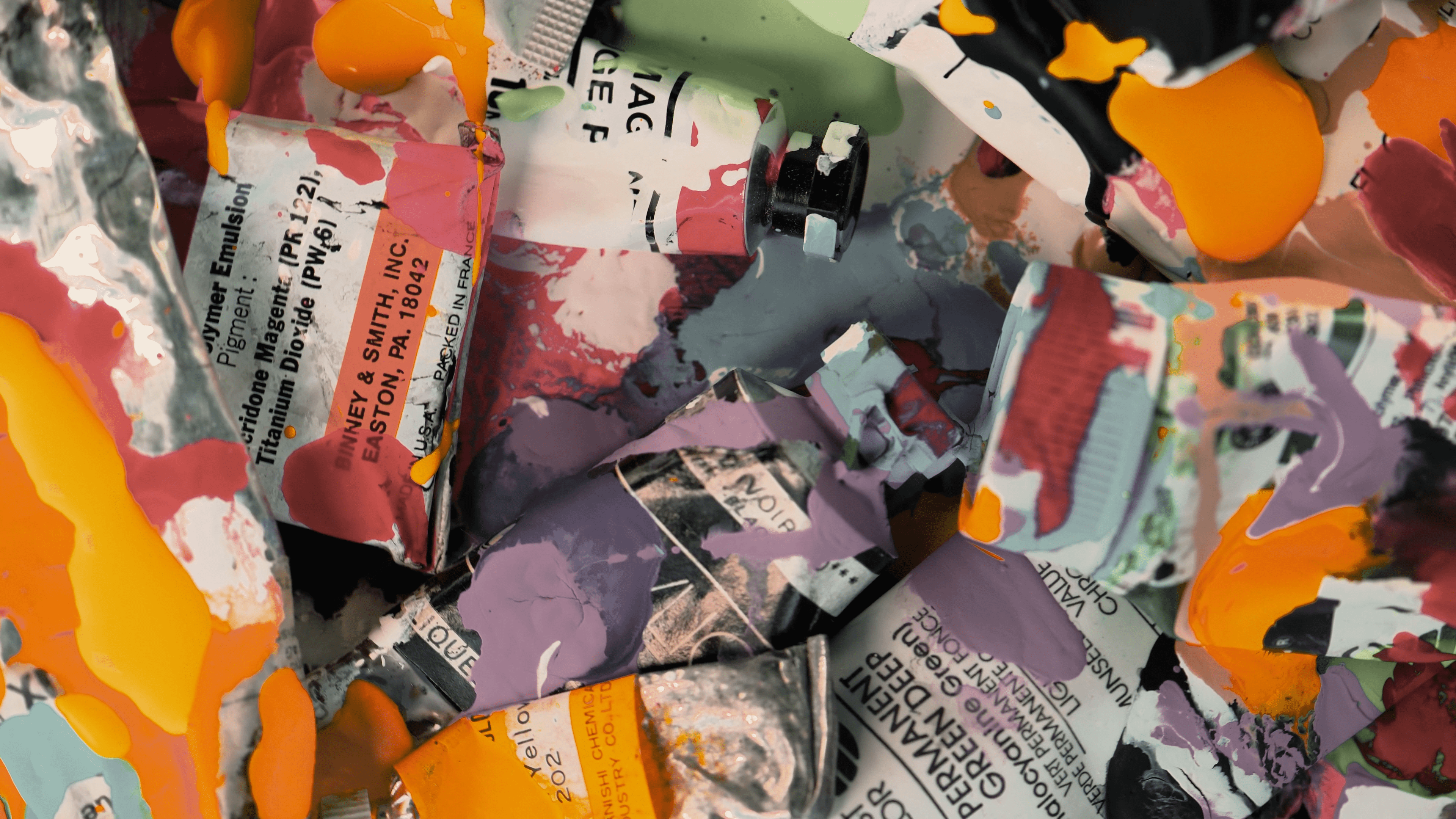


In “Alive,” filmmaker Christopher Dormoy explores acrylic paints and the variety of ways in which the medium can be used. From a fluids perspective, there’s dripping, viscous flow, turbulent eddies, billowing plumes, and “accidental painting” due to density-driven instabilities. It’s a fun tour of fluid phenomena in art. What examples do you spot? (Video and image credit: C. Dormoy)

Thermal Slipping
A particle suspended in a liquid typically jitters haphazardly about as it’s struck randomly by nearby liquid molecules. But when a temperature gradient is applied to the liquid, that random motion instead becomes directional. In a recent study, researchers directly mapped the motions underlying this thermophoresis.
In their experiment, the team placed a 7-micron sphere in water laced with 500-nanometer fluorescent tracers. Using a laser, they optically trapped the sphere, pinning it in place. Then, with a second laser, they heated the water on one side of the sphere and observed, under a microscope, what happened. After a few seconds, the tracers began moving toward the hot region, creating a slip flow along the surface of the sphere. Had the sphere been able to move freely, they found, the flow would have been strong enough to move it. (Image and research credit: T. Tsuji et al.; via APS Physics)

Beneath the Surface
Signs of a ship’s passage can persist long after it’s gone. The churn of its propellers and the oil leaked from its engines leave a mark on the water’s surface that, in some cases, is visible even from orbit. But the frothy wake of a ship is no easy place to measure; there are simply too many bubbles. To reveal the physics behind that froth, these researchers turned to direct numerical simulation, a type of computational fluid dynamics that calculates the full details of a flow, typically using a supercomputer to do so.
In their poster, the blue field of wavy lines shows turbulence under the water’s surface. For (relative) simplicity, the turbulence is statistically uniform — as opposed to matching a particular ship’s wake. The interface between air and water is shown in red. The water surface is complex and undulating, spotted with bubbles trapped below the water and droplets flying through the air. Simulations like these help scientists focus on the detailed mechanisms that connect the turbulent water to the complex air-water surface. Once those are understood, researchers can develop models that approximate the physics for more specific situations, like the passage of a cargo ship. (Image credit: A. Calado and E. Balaras)

Frictional Fingers
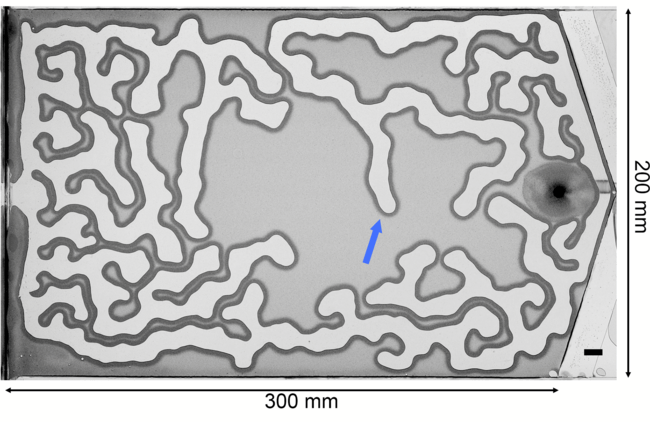
Air pushes into a thin gap filled with water and granular particles in the labyrinth-like image above. The encroaching air pushes grains like a bulldozer’s blade, building up a compacted wall. The invasion continues until the pressure of the air is countered by the combined capillary and frictional forces of the wet grains. Researchers built an analytical model that explains how these frictional fingers form and grow. Unlike Saffman-Taylor fingering patterns, which depend on long-range viscous forces, these patterns depend entirely on short-range forces from surface tension and friction. (Image and research credit: E. Flekkøy et al.)

Inside a Soap Bubble
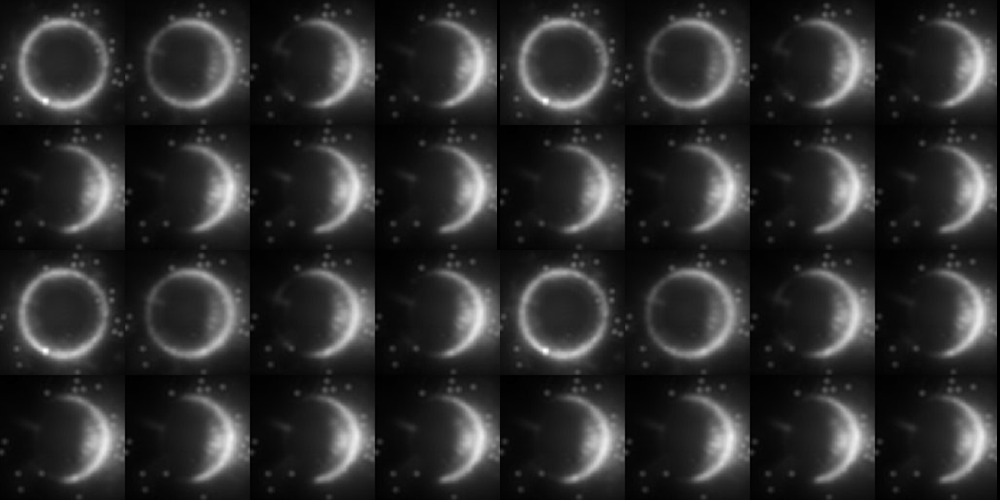
Every child learns to blow soap bubbles, but it’s rare that we have a chance to look inside them and see the flow there. In this poster, researchers seed a growing bubble with olive oil droplets, then illuminate them with a laser. This provides a glimpse inside the bubble. In the center, we see the incoming jet dividing the bubble in two and forming two large, counter-rotating vortices. Along the left side, snapshots show the bubble’s interior as it grows and, eventually, pops. (Image credit: S. Rau et al.)

Icelandic Glow
Solar wind particles slam into the atmosphere near Earth’s poles, creating billowing curtains of glowing plasma known as auroras. Beneath the earth, molten rock seethes and flows, squeezed up fissures to release explosive gases and spurts of lava to the surface world. These natural phenomena are captured in the left and center of this image, respectively. To the right, three plumes of water vapor rise from a geothermal power plant. Three very different phenomena — all fluid dynamical in nature and all captured in a single image of Iceland. It’s no wonder the island is covered in tourists. (Image credit: W. Gorecka; via APOD)

Sliding on Fibers
Water drops slide down spiderwebs, along the spines of desert plants, and across the armored exterior of horned lizards. Thin, grooved surfaces like these pop up frequently in nature when organisms need to direct water. A recent study of droplets sliding on fibers suggests why.
A drop sliding down a fiber is constantly shrinking, leaving a little of itself behind as a thin film that coats the fiber. The thicker a fiber is, the slower the drop moves along it. Similarly, if you bundle multiple fibers together, a drop will travel slower along the thicker bundle. But, to the researchers’ surprise, droplets actually travel faster on bundles than they do along single fibers of the same overall diameter. The key to this result seems to be the tiny grooves between fibers in a bundle. Water fills these areas, creating a “rail” along which the droplets slide more efficiently.
The team hope to put their new insights to use on a water harvester that could help capture precious moisture in arid environments, much like those desert-dwelling plants and lizards do. (Image and research credit: M. Leonard et al.; via Physics World)