Month: December 2022

  • Reflections of the Storm

    Reflections of the Storm

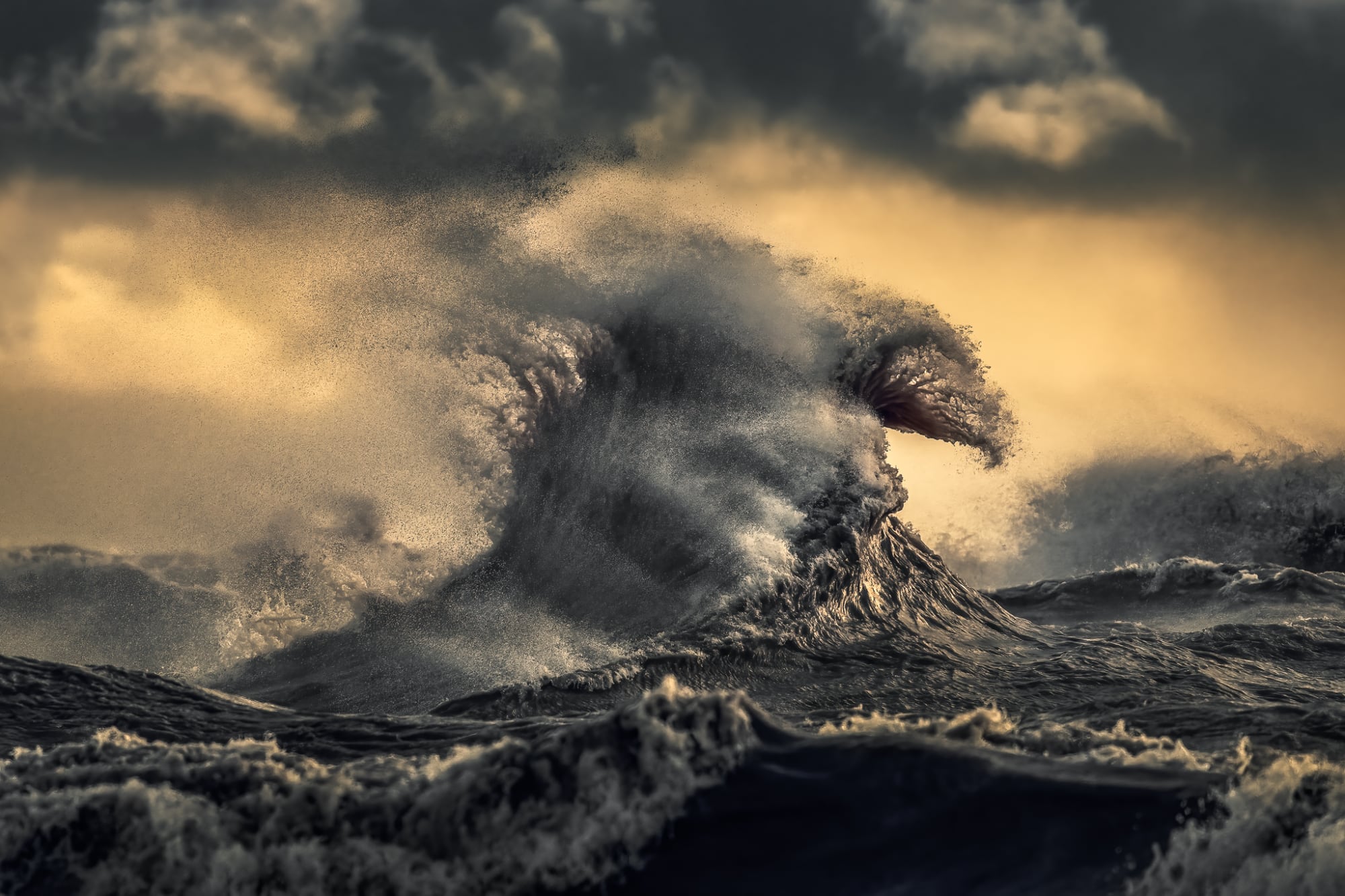
    Fall and winter storms rip Lake Erie with violent waves. Photographer Trevor Pottelberg of Ontario captures the dramatic eruptions of mist and spray from these massive, turbulent waves. It’s amazing how many different characters a wave can take on. Just compare Pottelberg’s waves with those caught by Lloyd Meudell or Ray Collins. It’s almost hard to imagine all of these waves growing from the same wind-driven start. See more from Pottelberg on his website and Instagram. (Image credit: T. Pottelberg; via Colossal)

  • Waves in Liquid Crystals

    Waves in Liquid Crystals

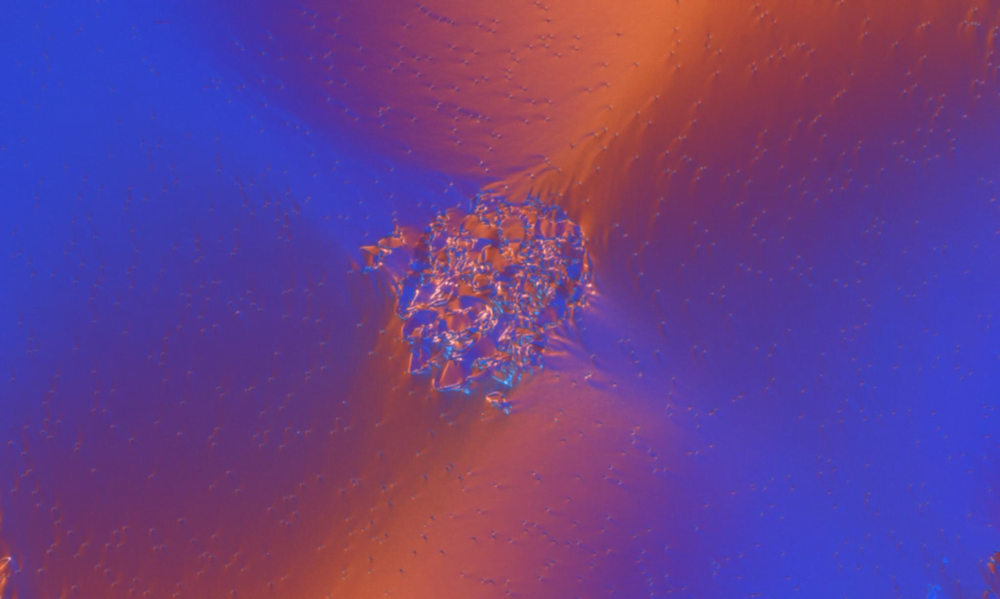
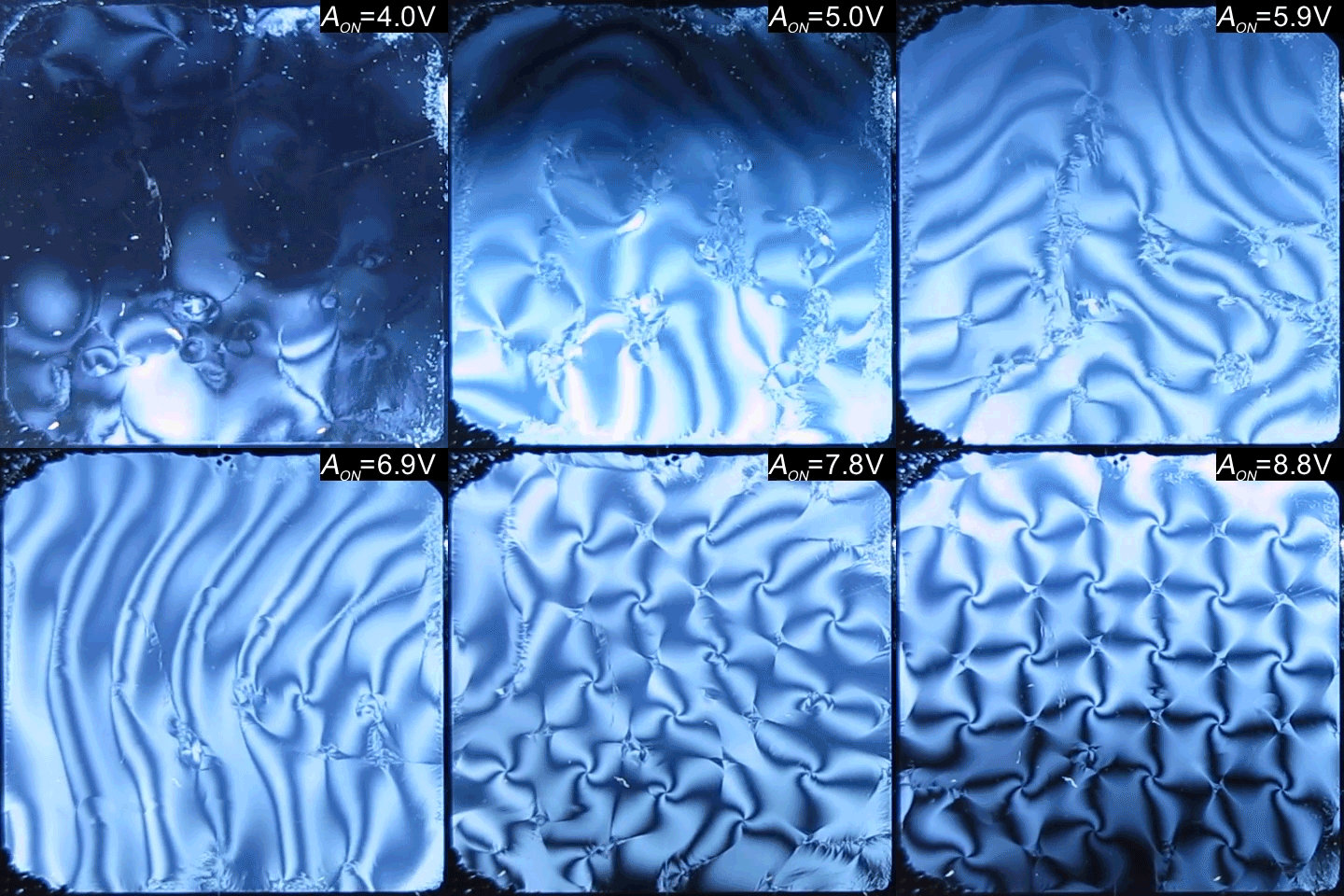
    Liquid crystals are now ubiquitous in displays, but scientists are still discovering new properties for this state of matter. Here, a team explores nematic liquid crystals, whose rod-like shape rotates in three dimensions as they apply a voltage. The layer of liquid crystals is held between polarizing filters, creating regions of light and dark that depend on the liquid crystals’ orientations.

    Traveling waves and other wave patterns form in this liquid crystal as the voltage applied to it increases.
    Traveling waves and other wave patterns form in this liquid crystal as the voltage applied to it increases.

    As the researchers increase the voltage, traveling waves form. With higher voltages, the waves appear to slow a stop. The slowing waves result from the molecules tilting far from a vertical orientation, which makes it harder for individual molecules to rotate since they experience greater resistance from their neighbors. (Image, video, and research credit: V. Panov et al.; via APS Physics)

  • Featured Video Play Icon

    Classifying Waves

    In a lab, researchers create their waves in a long, clear-sided tank, where they can observe how the waves form, travel, and interact. To generate the wave, they use a plate, attached to a piston. Push the water at one end, and a wave forms. The type of wave that forms depends on both the velocity and the stroke length of the piston, as shown in this video. By mapping out these two variables, researchers can observe all different sorts of waves, from peaceful solitary waves to wild, plunging breakers. (Image and video credit: W. Sarlin et al.)

  • Airflow in the Opera

    Airflow in the Opera

    Like so many other performers, the singers and musicians of New York’s Metropolitan Opera House were left without a way to safely perform when the SARS-CoV-2 pandemic began in early 2020. In search of safe ways to perform and rehearse, the Met turned to researchers at nearby Princeton University, who worked directly with the performers to explore aerosol production and airflow in the context of professional opera.

    Through visualization and other experiments, the team found that the highly-controlled breathing of opera singers actually posed a lower risk for spreading pathogens than typical speaking and breathing. Most of a singer’s voiced sounds are sustained vowels, which produce a slow, buoyant jet that remains close to a singer. The exception are consonants, which created rapid, forward-projected jets.

    In the orchestra, the researchers found that placing a mask over the bell of wind instruments like the trombone reduced the speed and spread of air. One of the highest risk instruments they found was the oboe. Playing the oboe requires a long, slow release of air, but between musical phrases, oboists rapidly exhale any remaining air from their lungs and take a fresh breath. That rapid exhale creates a fast, forceful jet of air that necessitates placing the oboist further from others. (Image credit: top – P. Chiabrando, others – P. Bourrianne et al.; research credit: P. Bourrianne et al.; via APS Physics; submitted by Kam-Yung Soh)

  • Featured Video Play Icon

    In a Box, Shaken

    Tidal areas experience lots of oscillating, back-and-forth flow that builds up patterns in the sand below. In this experiment, researchers investigate a similar situation by filling a box with water and spherical particles, then shaking the box from side-to-side. Inside the box, the particles line up in chains that are perpendicular to the direction of oscillation (think sand ripples parallel to a shoreline). In this simplified system, the team can then look at what forces align the particles, how defects in the pattern shift, and what happens when the oscillation gets bigger. (Image and video credit: T. van Overveld et al.)

  • Featured Video Play Icon

    Walking in the Wake

    Flow visualization is an important tool in fluid dynamics, and scientists have many ways to capture and visualize flow information. But our methods are not the only — or even the best — ways to express a flow. Here, engineers teamed up with architects and artists to explore the flow behind an oscillating cylinder. When free to move forward-and-backward the cylinder’s wake takes on three distinctively forms. The team explored many ways to display the wakes — drawings, 3D-printed sculptures, and more — before ultimately building an art installation that lets visitors walk through the wake to experience it. I love the creativity of these interdisciplinary efforts. To see a similar, yet very different, take on the wake of a cylinder, check out this interpretative dance. (Image and video credit: P. Boersma et al.)

  • Why Moths Are Slow Fliers

    Why Moths Are Slow Fliers

    Hawkmoths and other insects are slow fliers compared to birds, even ones that can hover. To understand why these insects top out at 5 m/s, researchers simulated their flight from hovering to forward flight at 4 m/s. They analyzed real hawkmoths flying in wind tunnels to build their simulated insects, then studied their digital moths with computational fluid dynamics.

    During hovering flight, they found that hawkmoths generate equal amounts of lift with their upstroke and downstroke. As the moth transitions into forward flight, though, its wing orientation shifts to reduce drag, and the upstroke stops being so helpful. Instead, the upstroke generates a downward lift that the downstroke has to counter in addition to the insect’s weight. At higher forward speeds, this trend gets even worse.

    The final verdict? Hawkmoths don’t have the flexibility to twist their wings on the upstroke the way birds do to avoid that large downward lift. Since they can’t mitigate that negative lift, the insects have a slower top speed overall. (Image and research credit: S. Lionetti et al.; via APS Physics; submitted by Kam-Yung Soh)

  • Vietnam’s Emerald Isles

    Vietnam’s Emerald Isles

    Vietnam’s Hạ Long Bay is home to more than 1,600 islands, many of them made up of mountainous limestone. The area is famous for its karst features, a type of terrain formed from highly porous, water-soluble rock. Over time, water dissolves and fractures the limestone, creating karst landscapes full of caves, springs, sinkholes, and fluted rock outcroppings. The area’s erosion also produces highly fertile soil, leading to a verdant ecosystem with many unique and endemic species. (Image credit: N. Kuring/NASA/USGS; via NASA Earth Observatory)

  • Never Break the Chain

    Never Break the Chain

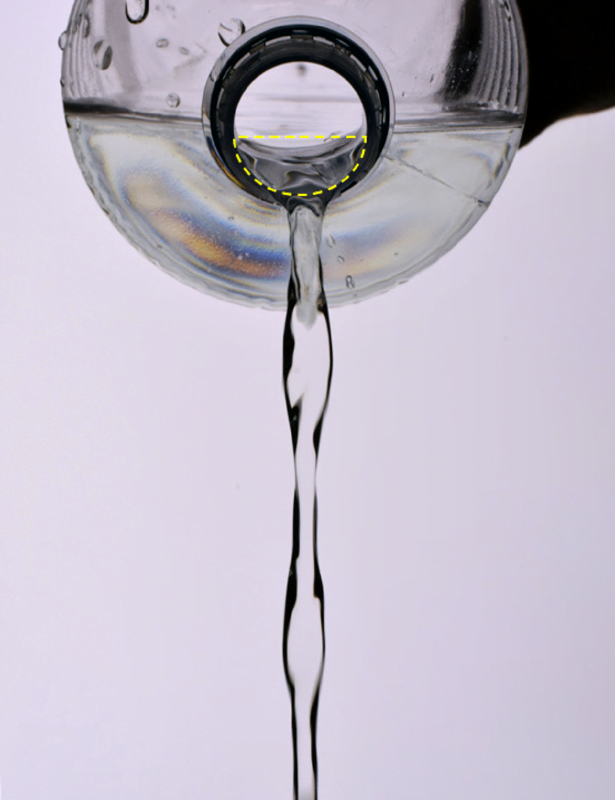
    Pour water out of a bottle, and you’ll see a jet with a shape that resembles chain links. Sometimes known as a “liquid chain,” this phenomenon occurs when water pours through a non-circular hole. It’s quite a complex behavior, as shown in this recent study of the nonlinear effect. Even so, the authors found that the amplitude and wavelength of the chain’s sections are tied directly to the shape of the opening. Current models of the effect don’t account for the viscosity of the liquid, though, so future experiments will have to explore how fluids other than water behave. (Image and research credit: D. Jordan et al.; via APS Physics; submitted by Kam-Yung Soh)

    A comparison of oscillating jet shapes and metal chains.
    A comparison of an oscillating jet’s shape and metal chains. Each view is rotated 45 degrees from the one before.
  • Featured Video Play Icon

    Pumping With Faraday Waves

    Vibrate a liquid pool vertically, and it will form a pattern of standing waves known as Faraday waves. Here, researchers confine those waves to a narrow ring similar in size to the wave. The confinement causes a type of secondary flow — a streaming flow — beneath the water surface. As a result, the wave pattern rotates around the ring. The applications of this rotation are pretty neat. As the team demonstrates, it can drive complex fluid networks and even create a pump! (Image and video credit: J. Guan et al.)