Month: January 2022

  • Swept Along

    Swept Along

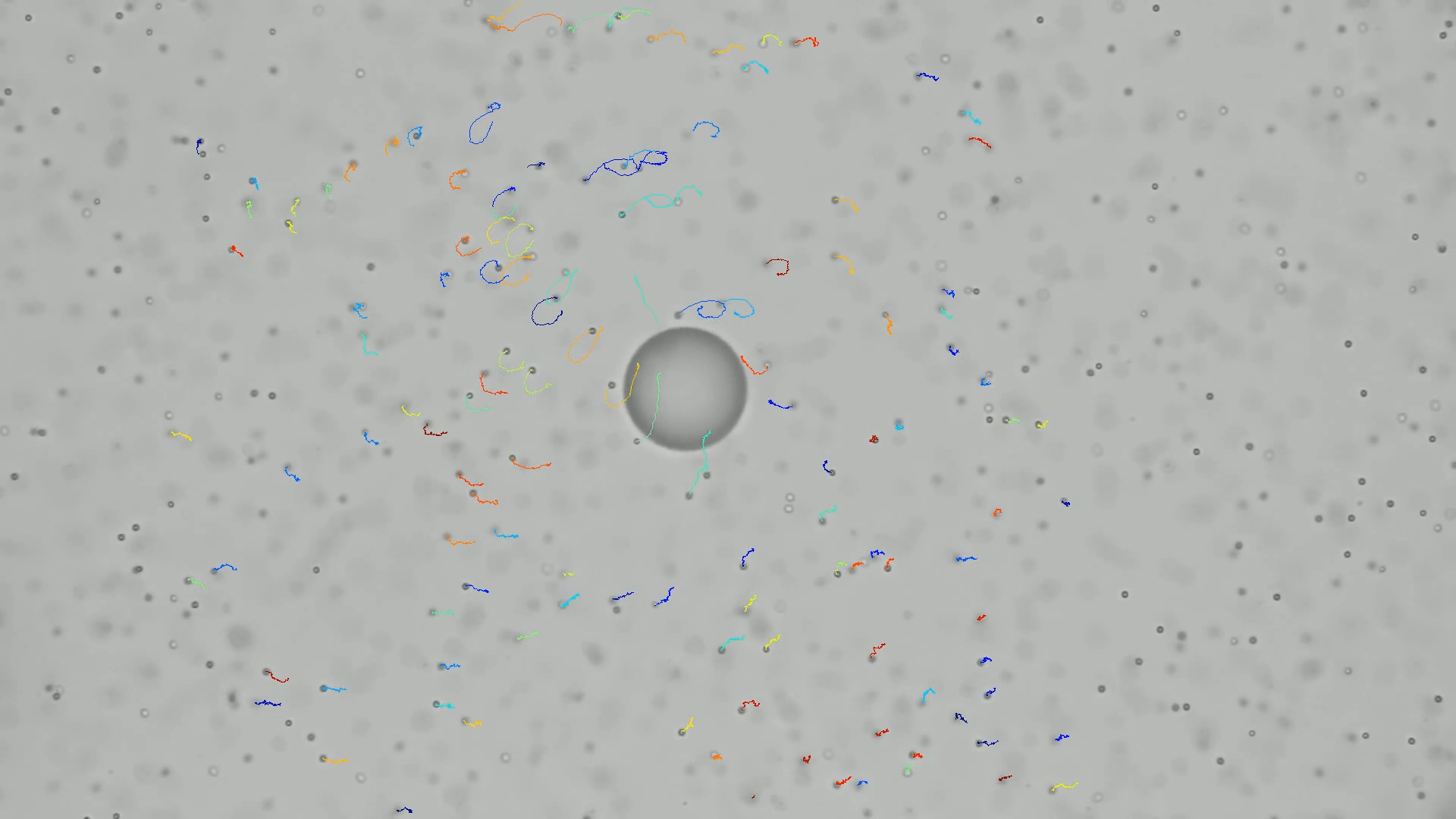
    When a car drives over a leaf-strewn autumn road, it pulls leaves up with its passage. This tendency to drag fluid along when an object passes is called entrainment, and it may be a key to transporting loads like medicine in microfluidic applications.

    As shown above, a self-propelled microswimmer — in this case, an oil droplet — pulls the surrounding fluid and tracer particles with it (Image 1). Researchers modeled this single-swimmer entrainment (Image 2) to quantify just how much fluid the droplet pulls with it. Then they studied what happens when many swimmers pass through an area (Image 3). They found that the droplet swarm entrained ten times the volume of fluid compared to the fluid entrained by the same number of isolated droplets. The fluid volume pulled along was also far larger than any payload the droplets themselves could carry. So future microswimmer swarms may simply sweep their cargo along in their wake. (Image and research credit: C. Jin et al.; via APS Physics)

  • Featured Video Play Icon

    “Halo”

    Fluids create mesmerizing practical effects in this new experimental film from the Julia Set Lab. I love how the visuals mess with your sense of scale. Some of the sequences look like they could be a solar firestorm or disintegrating sea ice, though in reality the camera’s field of view is probably smaller than your palm. The filmmakers provide no information on the fluids they use, but I spy some hints of partially miscible ingredients, some chemical reactions, and plenty of Marangoni action. (Video and submission credit: S. Bocci/Julia Set Lab)
  • Featured Video Play Icon

    The Assassin’s Teapot

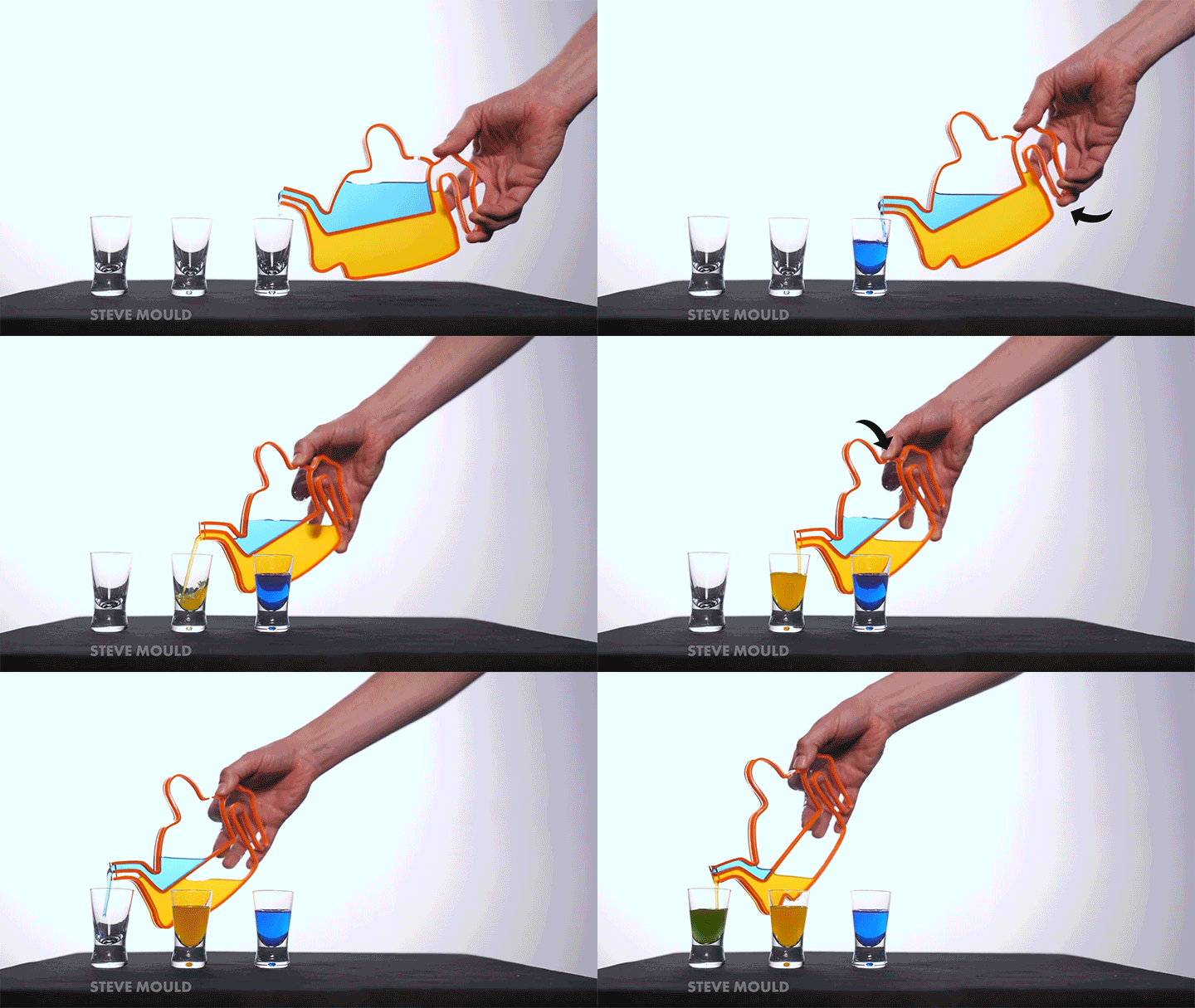
    The assassin’s teapot is a cleverly designed container that can pour from different reservoirs depending on how it’s held. Steve Mould digs into the physics in this video, and he builds a transparent cutaway version of the pot to show exactly how it works. This design uses two separate reservoirs, each with two holes — one in the spout and one concealed near the pot’s handle. By covering this breather hole, the server blocks air from flowing into the teapot, which also keeps the liquid inside from flowing out.

    What holds the liquid in? Air pressure, with an assist from surface tension. Atmospheric pressure is enough to hold the fluid inside the pot, provided air has no separate way in. To get in through the spout, air would have to push into the pot at the same time as water coming out. Surface tension prevents that, though, because the spout is too narrow. The same physics keeps water inside a larger bottle with a wire mesh over its mouth. The mesh’s tiny holes are smaller than the capillary length of water, which is the length scale at which surface tension and gravity balance one another. As long as the spout and holes are smaller than that length, surface tension will keep the liquid from deforming enough to get out. (Video and image credit: S. Mould)

  • Elastic Turbulence

    Elastic Turbulence

    Decades ago, engineers pumping polymer-filled drilling liquids into porous rock noticed sudden and dramatic increases in the viscosity of the liquid. Within the tiny pores of the rock, conventional (i.e., inertial) turbulent flow should be impossible — the Reynolds number is simply too low. Now a new experiment points to the source of the high viscosity: elastic turbulence.

    To observe the phenomenon, researchers watched flow in the spaces between glass beads packed into a narrow channel. Videos of flow through one of these pores — roughly 250 microns across — are shown below. When flow rates are low (left), the fluid moves smoothly through the pore, but at higher flow rates (right), chaotic fluctuations emerge, creating the dramatic increase in apparent viscosity. In their analysis, the researchers found that the polymers’ motions generated the flow fluctuations, but most of the viscosity increase was inherent to the fluid’s movement, not to the polymers’ resistance to stretching. (Image credit: top – M. van den Bos, pore flow – Datta Lab; research credit: C. Browne and S. Datta; via Quanta Magazine; submitted by Kam-Yung Soh)

    Video of smooth flow through a pore (left) and flow with elastic turbulence (right).
    At low flow rates (left), the fluid moves smoothly through the tiny pores, but at higher flow rates (right), the polymers in the flow generate elastic turbulence that greater increases the fluid’s apparent viscosity.
  • Featured Video Play Icon

    The Yarning Droplet

    Marangoni bursting takes place in alcohol-water droplets; as the alcohol evaporates, surface tension changes across the liquid surface, generating a flow that tears the original drop into smaller droplets. Here researchers add a twist to the experiment using PMMA, an additive that dissolves well in alcohol but poorly in water. As the alcohol evaporates, the PMMA precipitates back out of the water-rich droplet, forming yarn-like strands. (Image and video credit: C. Seyfert and A. Marin)

  • Viscosity and Quantum Mechanics

    Viscosity and Quantum Mechanics

    Viscosity describes a fluid’s resistance to changing its shape. Like surface tension, it’s a fundamental property of a fluid that comes from the interactions between molecules. But viscosity is a slippery beast, and especially so for liquids. There is no generic way to calculate a liquid’s thermodynamic properties from quantum dynamical first principles. But that hasn’t stopped theoretical physicists from making progress on deducing the connections between quantum mechanics and liquids.

    Although viscosity changes with temperature, all liquids have a minimum viscosity, and those minima are all fairly close to the same value as water’s (excluding any superfluids, which are their own brand of quantum weirdness). Why would liquids share a similar minimum viscosity? Because it turns out the minimum viscosity is quantum! Physicists found that the minimum viscosity is set by an equation depending on Planck’s constant and the mass of an electron — both fundamental constants.

    Physicists sometimes like to conjecture about the habitability of the universe if fundamental quantities like Planck’s constant had a different value. This work shows that changing that value would alter water’s viscosity, completely changing the viability of microscopic life! (Image credit: A. Rozetsky; research credit: K. Trachenko and V. Brazhkin; via Physics Today)

  • Moody Waves

    Moody Waves

    Lines of waves emerge from thick morning fog in this series by photographer Raf Maes. The eerie, slightly surreal images were captured in Venice, near Los Angeles. So often ocean photography features huge, turbulent breaking waves. I find it really neat to see these long, unbroken wave crests appearing from the mist. (Image credits: R. Maes; via Colossal)

  • The Return of the Ice Disk

    The Return of the Ice Disk

    Maine’s giant, spinning ice disk is taking shape again. In 2019, it reached about 91 meters across, rotating slowly in the Presumpscot River. How exactly these features form is still a matter of debate, but scientists have worked out a few relevant mechanisms. The spinning of the disk seems to depend on a vortex that forms beneath the ice as melting water sinks. (One of water’s peculiarities is that it’s densest around 4 degrees Celsius, so newly melted water is actually denser than ice. Otherwise ice wouldn’t float!) The plume of sinking water sets up a vortex that drags the ice disk with it as it spins in the river beneath. (Image credit: R. Bukaty/AP; via Gizmodo)

  • Laser-Induced Jet Break-Up

    Laser-Induced Jet Break-Up

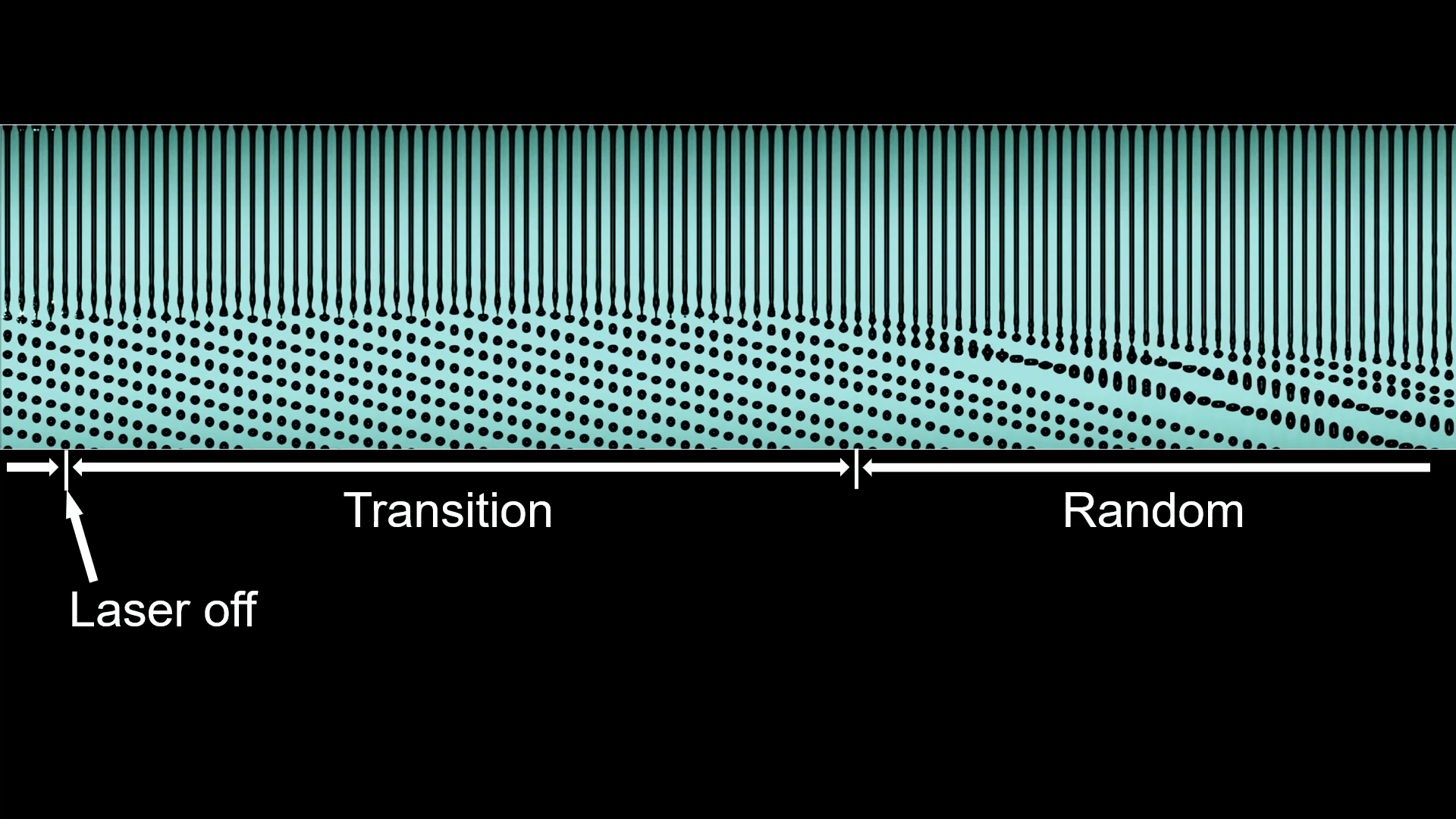
    A falling stream of water will naturally break up into droplets via the Plateau-Rayleigh instability. Those droplets are random, unless something like vibration of the nozzle sets their size. In this study, though, researchers found that shining a laser beam on the stream can trigger an orderly break-up with droplets that are consistent in size and spacing.

    The optofluidic phenomenon depends on a few different effects. The changing curvature of the liquid stream reflects the laser light, some of which undergoes total internal reflection and travels up the jet as if it were a fiber optic cable. Look closely in the right side of the second image, and you’ll see a periodic flicker of green light at the mouth of the nozzle. Those flashes of green reveal that the liquid jet is guiding the light upstream in bursts, each of which exerts an optical pressure that triggers the Plateau-Rayleigh instability.

    When the laser first turns on, there’s a transition period before the orderly break-up begins, and, likewise, turning the laser off triggers a transition from orderly to random (top image). (Image and research credit: H. Liu et al.; via APS Physics; submitted by Kam-Yung Soh)

  • Volcanic Shocks

    Volcanic Shocks

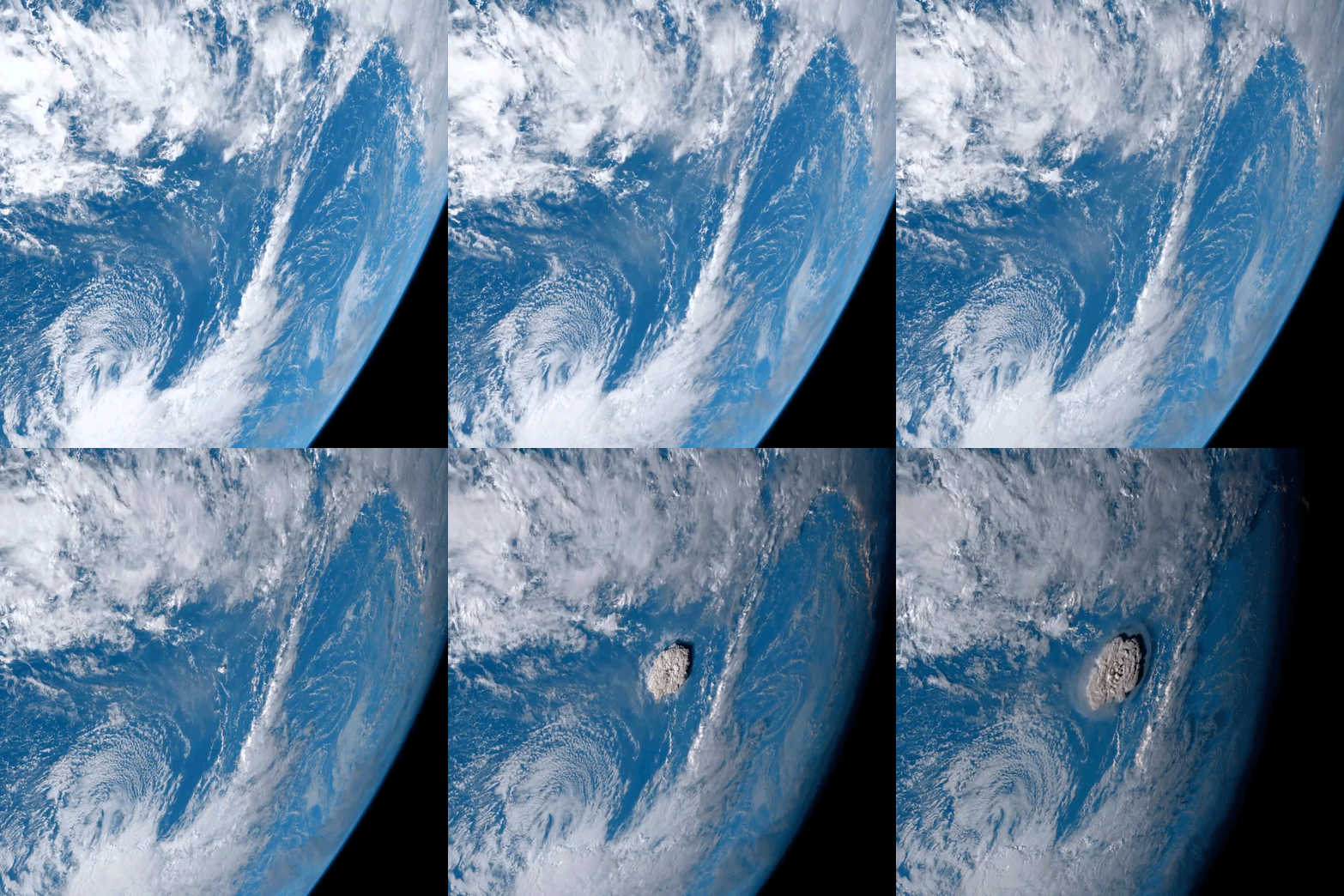
    A violent underwater eruption at the Hunga Tonga-Hunga Ha’apai caldera on January 15th sent literal shock waves around the world. This animation, based on satellite images from Japan’s Himawari 8, shows the fast-moving shock waves and the growing ash plume coming from the uninhabited island. Although most recent eruptions from this volcano have been small, experts suspect that this latest eruption is part of a major event, similar to the volcano’s last big eruption about 1,000 years ago.

    The explosiveness of the eruption comes from the interaction of seawater and fresh magma. When the magma erupts quickly underwater, the hot liquid contacts seawater directly rather than forming a protective layer of vapor (as in the Leidenfrost effect). The resulting explosion tears the magma apart, exposing more hot surfaces to the cold water and further driving the chain reaction. (Image credit: S. Doran/Himawari 8; submitted by jpshoer; see also S. Cronin)