Year: 2020

  • Why Slicing Tomatoes Works

    Why Slicing Tomatoes Works

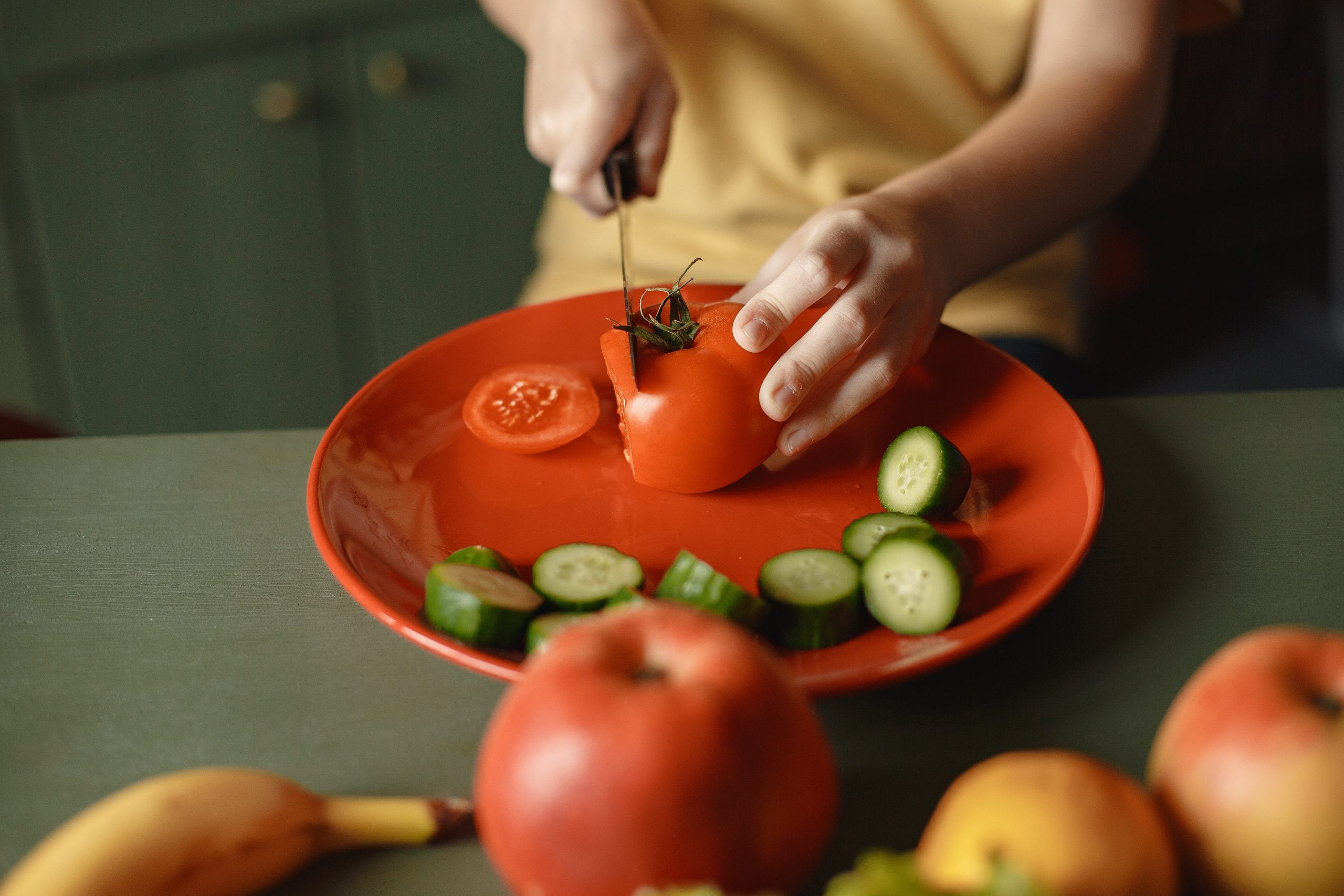
    Picture it: a nice, ripe tomato. Your not-so-recently sharpened kitchen knife. You press the blade down into the soft flesh and… it explodes. Soft solids – like a tomato – don’t react well to cutting, but they slice just fine. Examining why that’s the case is at the heart of this model.

    Tomatoes are essentially a gel encased in a thin skin. Gels are a kind of hybrid material — not quite liquid and not quite solid. They consist of a network of particles or polymers bonded together and immersed in a liquid. To cut that network apart, the downward force of the blade has to strain the gel past its limits, which squeezes out the surrounding liquid.

    The researchers found that this liquid layer is key to how force from the knife’s motion gets transmitted. In particular, they found that the horizontal motion of a slice is necessary to initiate a cut, and that the gel parts most easily when the downward knife velocity is no more than 24% of the horizontal cutting speed. Press down any faster and the strain propagation fluctuates, creating that unfortunate tomato explosion. (Image credit: G. Fring; research credit: S. Mora and Y. Pomeau; via Ars Technica; submitted by Kam-Yung Soh)

  • Featured Video Play Icon

    Why Aren’t Trees Taller?

    Trees are incredible organisms, with some species capable of growing more than 100 meters in height. But how do trees get so big and why don’t they grow even taller? The limit, it turns out, is how far fluid forces can win over gravity.

    To live and grow, trees must be able to transport nutrients between their roots and their highest branches. As explained in the video, there are three forces that enable this transport inside trees: transpiration, capillary action, and root pressure. Of these, you are probably most familiar with capillary action, where intermolecular forces help liquids climb up the inside of narrow spaces, like the straw in your drink. Capillary action can’t lift liquids more than a few centimeters against gravity, though.

    Similarly, root pressure is limited in how far it can raise liquids. Functionally, it’s pretty similar to the way a column of water or mercury can be held up by atmospheric pressure acting at the base of a barometer. But atmospheric pressure can only hold up 10.3 meters of water, so what’s a tree to do?

    This is where transpiration — the most important force for sap transport in the tree — comes in. As water evaporates out of the tree’s leaves, it creates negative pressure that — along with water’s natural cohesion — literally drags sap up from the roots. It’s this massive pull that drives the flow and enables most of a tree’s height. (Image and video credit: TED-Ed)

  • Two Views of Ocean Eddies

    Two Views of Ocean Eddies

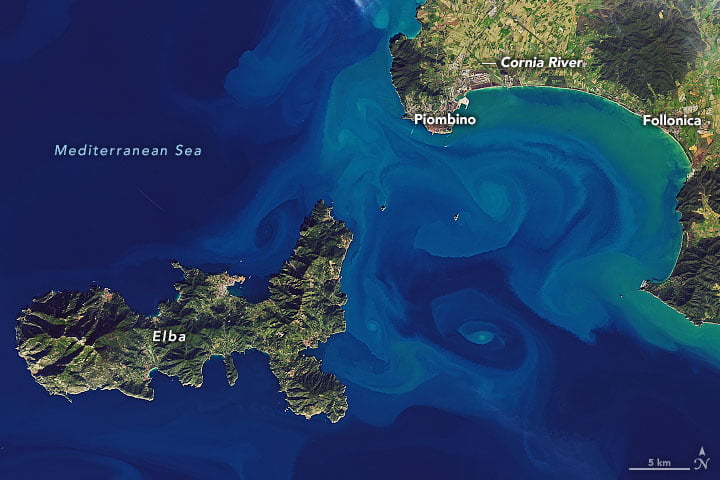
    Colorful, sediment-laden eddies swirl off the Italian coast in this satellite image. These small-scale eddies — less than 10 km in diameter — can be short-lived and are often difficult to capture in numerical models, but remote sensing can help scientists better understand their impact on oceanic mixing, especially when we capture more than one view of the same event.

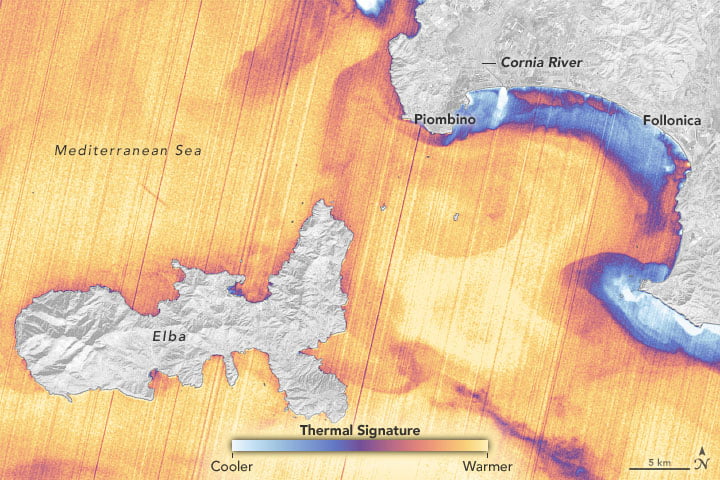
    The image below shows the same eddies in an infrared (thermal) view. The resolution on this instrument is not as fine as the natural color one, but we can still make out some of the same swirling motions. It’s also worth comparing the features we don’t see in both images. For example, the Cornia River discharges in infrared as a bright, white plume of cooler water, but it’s barely visible in the color-image, suggesting that the river is not contributing much sediment to the bay. (Image credit: USGS; via NASA Earth Observatory)

    Infrared satellite image of waters off the coast of Italy.
  • Shear in Shaken Sands

    Shear in Shaken Sands

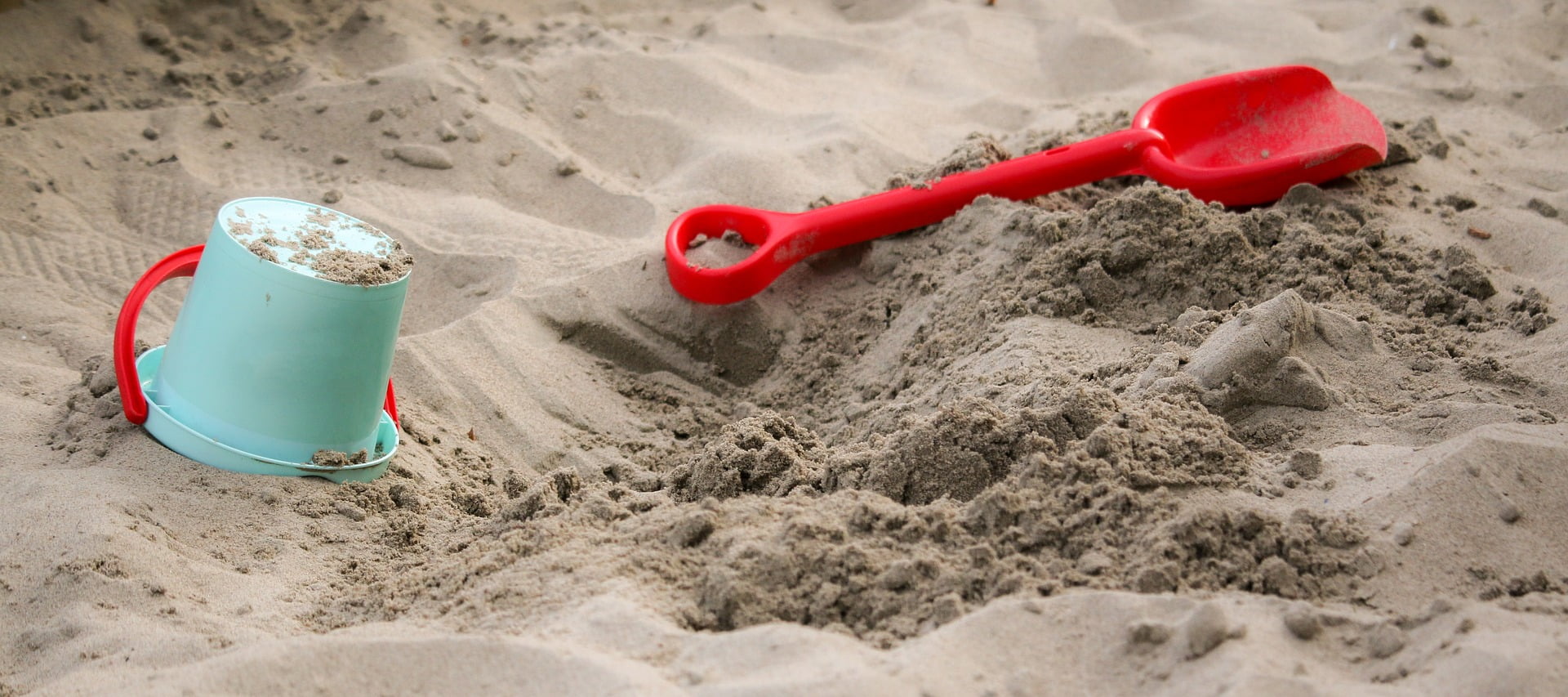
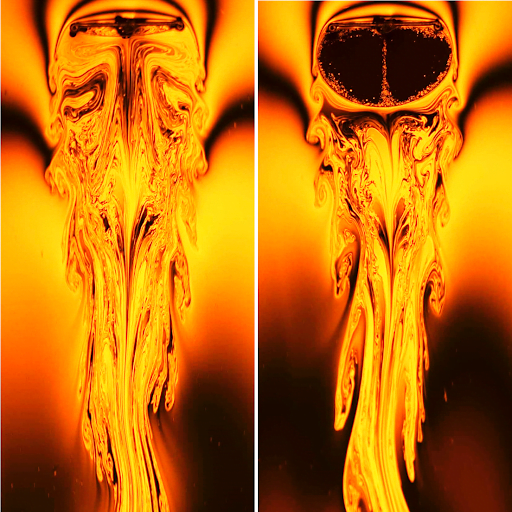
    The dynamics inside a shaken granular material, like sand, are fascinatingly complex. In this study, researchers used x-ray radiograms to peer inside a horizontally-shaken container of sand. They found that the sand soon formed bands of lower density (seen as yellow in the radiogram) near the center of the container. Because these bands show a lot of horizontal movement between grains, they’re known as shear bands.

    The shear bands don’t simply stay still, though. One remains more or less stationary at the center, but others split and rise through the upper half of the container. The researchers suggest this migration happens due to gravity; because the shear band is less dense than the material above, it cannot support the weight. Sand sinks into the void, making the less dense region effectively migrate upward. They also suggest that these moving shear bands are responsible for the fluctuations in sand height seen at the surface. (Image credit: beach – RAMillu, radiogram – J. Kollmer et al.; research credit: J. Kollmer et al.)

  • Featured Video Play Icon

    Painting on Water With Ebru

    Ebru is the South West Asian art of painting atop water, similar to suminagashi in Japan or paper marbling in European culture. This video takes you inside the studio of Garip Ay, a Turkish ebru artist, letting you observe some of the tools and techniques he uses. Ay’s painting are incredibly dynamic, transforming from one image to something entirely different as he applies more dye, adds a surfactant, or draws a clean brush through the liquid. (Video and image credit: Great Big Story; artist: G. Ay; via Colossal)

  • Featured Video Play Icon

    Digging Droplets

    A droplet on a surface much hotter than its boiling point will skate on a layer of its own vapor, thanks to the Leidenfrost effect. But if that surface is, instead, a granular mixture like this glass powder, the droplet will dig itself a hole.

    As in the usual Leidenfrost situation, the heat of the powder causes part of the drop to vaporize. But as that vapor flows away, it carries powder with it. At the same time, the vaporization process causes the droplet to vibrate violently, which frees more powder and helps the drop dig deeper. Eventually, the drop will vaporize completely, leaving a volcano-like crater in the powder. (Image and video credit: C. Kalelkar and H. Sai)

    A water droplet falls on heated glass powder, which it then digs its way into.
  • Flexible Filament Reduces Drag

    Flexible Filament Reduces Drag

    Most shapes aren’t streamlined for fluid flow. We call these bulky, often boxy shapes, bluff bodies. Above, we see two examples of a bluff body, a flat plate, in a soap film. On the left, the plate sits perpendicular to the soap film’s top-to-bottom flow. Two large, counter-rotating vortices form behind the plate and a wide wake stretches behind it.

    On the right, we see the same flat plate but now a long, flexible filament is attached to either end. As the flow moves past, it deforms the filament, creating a rounded shape. Researchers found that, under the right conditions, this flexible afterbody could reduce drag on the object by up to 10%. (Image and research credit: S. Gao et al.)

  • Featured Video Play Icon

    Ventilation and Respiratory Disease

    In 1977, one passenger with the flu infected 38 people onboard a flight with malfunctioning ventilation. In this video, Dianna digs into the physics of respiratory disease transmission and just why ventilation is so key to preventing it.

    There are three primary modes of transmission for respiratory diseases like influence or SARS-CoV-2: 1) touching an infected surface and then oneself, i.e., self-inoculation; 2) inhaling virus-filled droplets larger than 5 nm; and 3) inhaling virus-filled droplets smaller than 5 nm. That size cut-off may seem a little arbitrary, but it’s how scientists distinguish between droplets that fall quickly to the ground and ones that can persist on buoyant air currents.

    That airborne persistence is one of the reasons ventilation — in other words, replacing the air — is so important. So many people on that 1977 flight got sick because there was no system removing the infected air and bringing in fresh air. For more on the fluid dynamics disease transmission, check out these posts. Curious about those bacterial bubble bursts? I’ve covered that, too. (Video and image credit: Physics Girl)

  • Featured Video Play Icon

    Sundews Weaponize Viscoelasticity

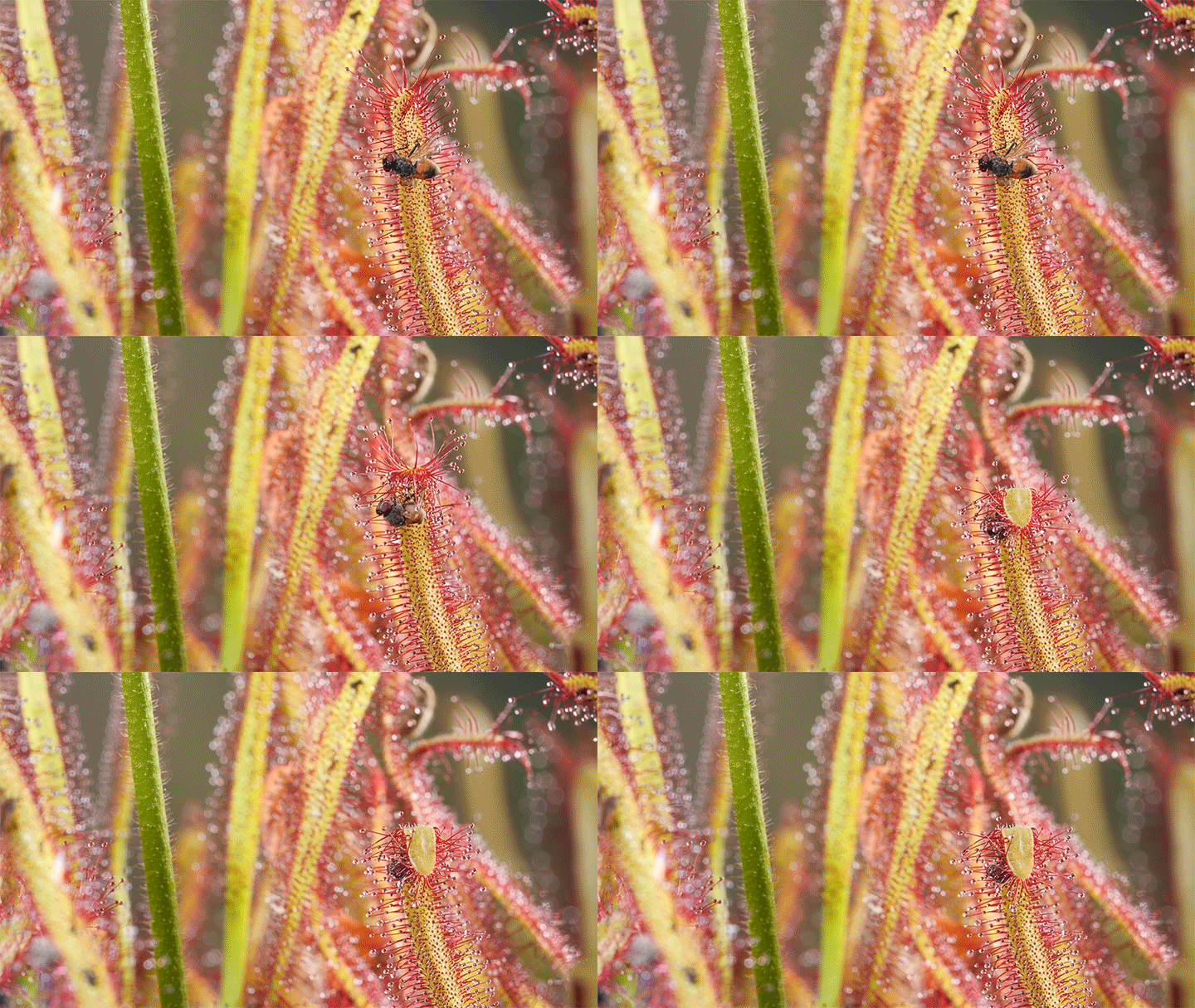
    In nutrient-poor soils, carnivorous plants like the cape sundew supplement their diets by eating insects. To entice their prey, the cape sundew secretes droplets of sugary water. But unwary insects who land to feed soon find themselves unable to pull away from this viscoelastic liquid. Complex molecules in the fluid grant it elasticity, so when insects pull against it, the liquid stretches and pulls back instead of breaking up. Other carnivorous plants, like the pitcher plant, use similar non-Newtonian tricks to trap insects. (Video and image credit: Deep Look)

  • Ferrofluid Snakes

    Ferrofluid Snakes

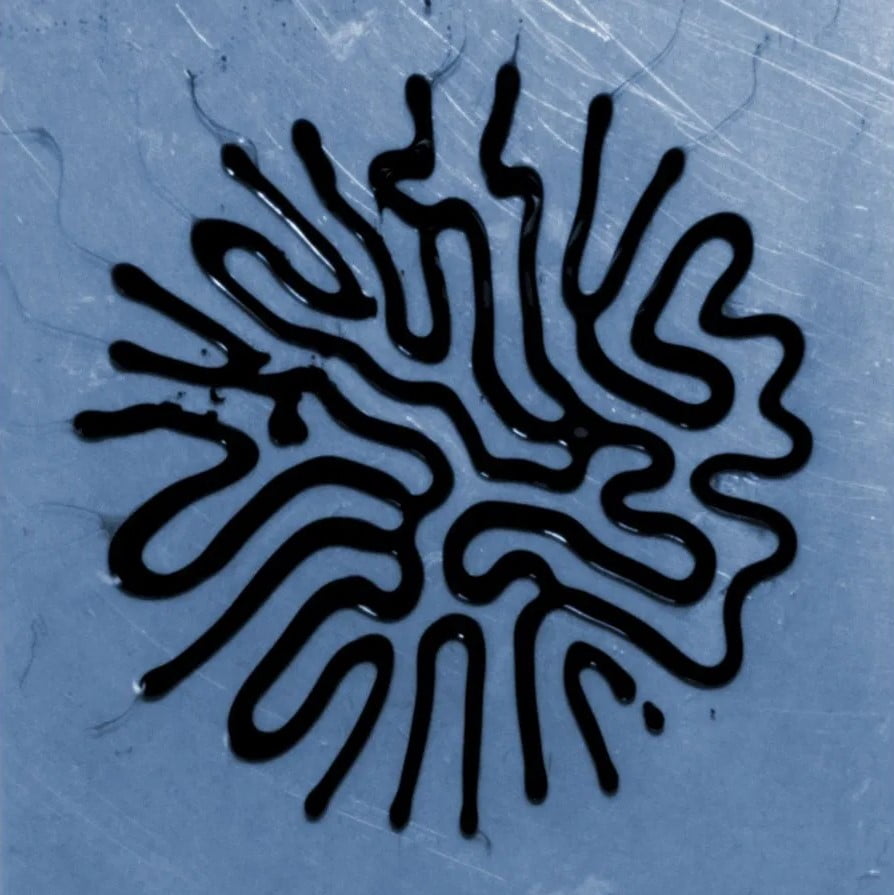
    We’re used to seeing ferrofluids — with their suspended iron nanoparticles — as spiky fluids when exposed to a magnetic field. But this is not always the case. Here, the ferrofluid is immersed in a thin liquid layer — window cleaner, in this case — and when a magnet is brought near, it forms snake-like, labyrinthine lines. (Image credit: M. Carter et al.)