Month: May 2019

  • Pluto’s Subsurface Ocean

    Pluto’s Subsurface Ocean

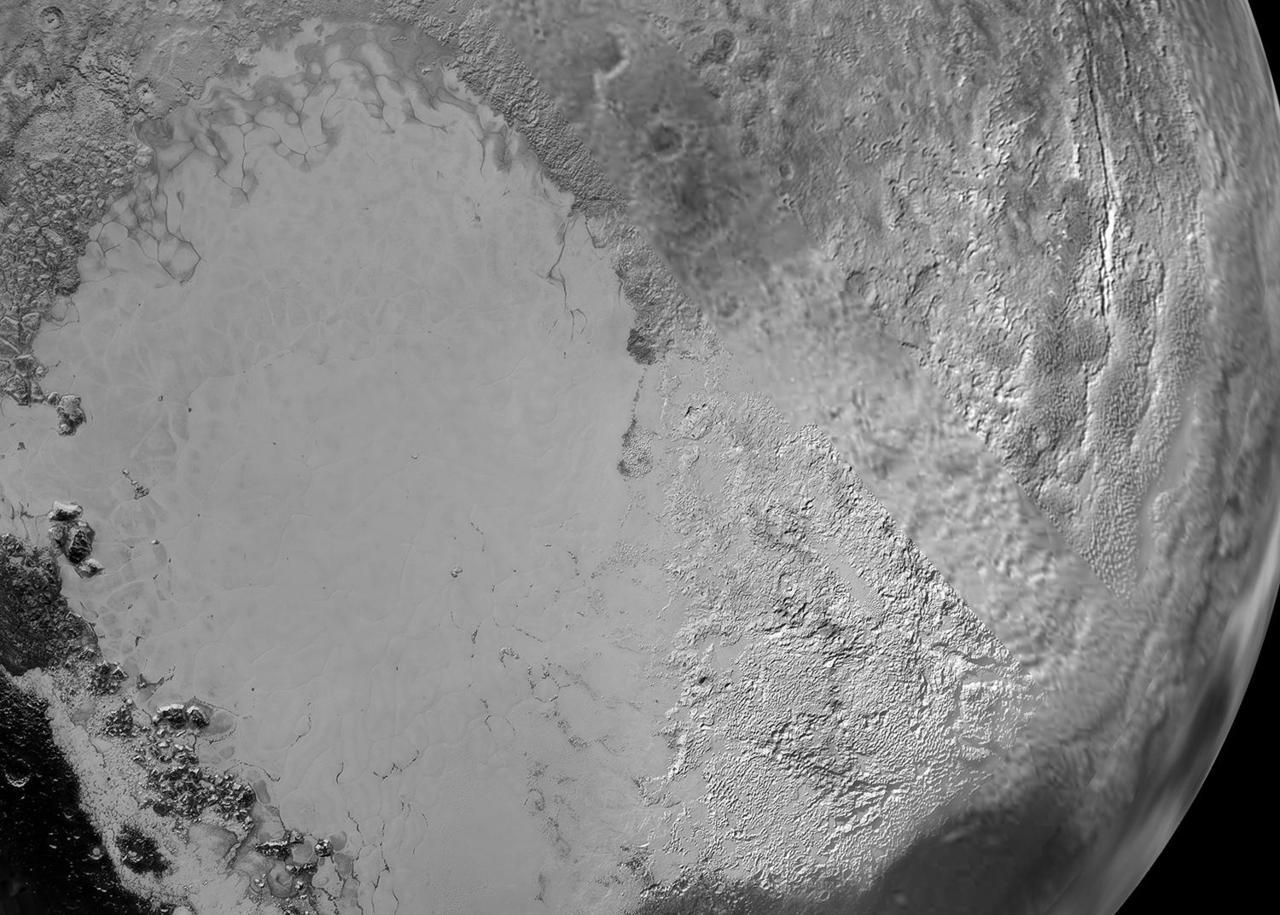
    Since the New Horizons probe visited Pluto in 2015, scientists have suspected that Sputnik Planitia (a.k.a. Pluto’s Heart), shown above, may hide a subsurface ocean. But it’s tough to explain how that ocean could stay warm enough to be liquid while the surface ice remains cold and viscous enough to support the variations in thickness we see. One theory cites the possibility of ammonia in the ocean, essentially serving as anti-freeze, but that would require much higher concentrations of ammonia than have been observed in comets – which, like Pluto, spend most of their time in the icy, frigid regions of the Kuiper Belt.

    A new study suggests another theory: a layer of gas-trapping hydrates between the liquid ocean and its icy cap. A thin layer of clathrate hydrates, as proposed by the authors, would trap gases like methane and create a thermally-insulating layer between a warm ocean and much colder ice cap. Because heat would struggle to cross the insulation layer, the water beneath would stay above the freezing point without the cold ice above leeching all of its warmth away.

    It would likely require future missions to Pluto or other potential ocean worlds to confirm the presence of such a hydrate layer, but, for now, the theory provides a possible new explanation for how icy objects like Pluto maintain liquids. (Image credit: NASA/JHU Applied Physics Laboratory/SwRI; research credit: S. Kamata et al.; via Gizmodo)

  • Guiding Particles with Chladni Patterns

    Guiding Particles with Chladni Patterns

    During the 19th century, Ernst Chladni and Michael Faraday independently explored the patterns formed by particles of different sizes placed on a vibrating plate. Faraday found that large particles accumulated at nodes of the plate, where there was no vertical vibration, whereas smaller particles moved toward anti-nodes, where air currents caused by the large vibration amplitude lifted them up.

    The situation becomes a little different if you submerge the vibrating plate in water. Then large, heavy particles gather at the anti-nodes. Drag keeps the particles on the plate, while acoustic forces and gravity conspire to move the particles horizontally toward the anti-nodes (top). Because anti-node patterns change with frequency, this actually provides a way to manipulate particle’s trajectories. The researchers demonstrated this by steering a particle through a maze (bottom) as well as by manipulating an entire swarm of beads. (Image and research credit: K. Latifi et al.; via Physics World; submitted by Kam-Yung Soh)

  • Giving Chocolate that Smooth Finish

    Giving Chocolate that Smooth Finish

    Anyone who’s tried to make chocolate confections at home can tell you that achieving that perfect smooth consistency isn’t easy. It was only after Rodolphe Lindt invented the process of conching in 1879 that anyone enjoyed smooth chocolate. Conching is what allows granular solids like sugar, milk and cocoa powders to mix with liquid cocoa butter into a smooth, homogeneous liquid. Although the process has been known for more than a century, it’s only recently that researchers have unraveled the underlying physics that enables it.

    One of the key parameters to conching is the a mixture’s jamming volume fraction; in other words, the point where the fraction of solid particles in the mixture is too high for it to flow freely. In the first stage of conching, the solid particulates and a small amount of liquid are stirred and slowly heated. The mechanical action of stirring breaks up aggregates and raises the jamming volume fraction. By the end of the dry conche, the mixture could flow, in theory, except that it fractures at a lower stress than what’s necessary to flow.

    At this point, chocolatiers add the remainder of the liquid ingredients. That infusion of moisture decreases the friction between solid particles and further raises the jamming volume fraction. With the system now far below that jamming point, the mixture transforms into a freely-flowing, smooth fluid. By understanding the intricacies of the process, scientists hope to reduce the energy necessary in chocolate production and similar industrial processes.  (Image credit: A. Stein; research credit: E. Blanco et al.; via Physics World; submitted by Kam-Yung Soh)

  • Featured Video Play Icon

    Reader Question: Inside a Vortex

    Reader embersofkymillo asks:

    Hey FYFD, could you do some analysis/explanations behind the physics of this vortex stuff? I love when you do spots on Slow Mo Guys vids and figured I’d share a recent one w you 

    I enjoy doing that, too! So let’s talk a little about vortices. What Dan’s tea stirrer is doing is creating a low-pressure core for a vortex. We can see just how strong that low pressure region is by the way it sucks the air-water interface down toward the spinning arms. Eventually the interface and stirrer meet, and what was once a single, smooth(ish) surface gets torn into a myriad of bubbles. (As an aside, those bubbles get loud.) 

    I also like the sequence of sugar cube drops because they make for some very cool splashes. Notice how the orientation of the cube’s edges as it hits determines the shape of the inital splash curtain. The asymmetry borne out of that impact actually follows through all the way through the seal of the cavity behind the cube. It reminds me of this oldie-but-goodie video on drops hitting different shapes. (Video and image credit: The Slow Mo Guys; submitted by embersofkymillo)

  • The Leidenfrost Crack

    The Leidenfrost Crack

    In 1756, Leidenfrost reported on the peculiar behaviors of droplets on surface much hotter than the liquid’s boiling point. Such droplets were highly mobile, surfing on a thin layer of their own vapor and were prone to loud cracking noises.

    More recently, scientists have observed that drops with an initially small radius eventually rocket off the hot surface whereas larger drops end their lives in an explosion (above) – the source of Leidenfrost’s crack. Now researchers have explained why drops of different sizes have such different fates. The key is their level of contamination.

    To reach the take-off radius, the drop has to evaporate a significant portion of its volume. For an initially-large drop, that’s tough because any solid contaminants in the drop will build up along the surface of the drop as it shrinks. Eventually, they restrict the liquid from evaporating, which thins the vapor layer the drop sits on. It sinks until a part of it touches the surface. The sudden influx of heat from the surface explosively destroys whatever remains of the drop. (Image and research credit: S. Lyu et al.; via Brown University; submitted by gdurey)

  • Featured Video Play Icon

    Drinking Coffee in Space

    You probably don’t give much thought to the forces involved in drinking here on Earth. That’s because gravity’s effects dominate over everything else. Our cups are designed to hold a liquid until we use gravity to pour it into our mouths. But that technique doesn’t work in microgravity. There other forces govern how liquids flow: specifically surface tension and capillary action.

    Both of these forces are the result of intermolecular attractions. In the case of surface tension, it’s the attraction that the molecules of a liquid feel for one another that keeps them in a cohesive bunch. Capillary action is similar, but it’s an attraction between the liquid molecules and those of the solid they’re wetting. When you combine them both, you get the ability for liquids to climb up a narrow gap and pull more liquid up behind them. That’s the key science behind every version of the “space cup” developed by astronaut Don Pettit and his collaborators. 

    To hear more about the development and engineering of the cup (and exactly why it makes drinking coffee so much more enjoyable in space than it would be otherwise) check out the full video. And, in case you’re wondering, there’s a special microgravity champagne flute, too! (Image and video credit: It’s Okay to Be Smart)

  • Wrapping Rivulets

    Wrapping Rivulets

    Tea lovers have long been frustrated by the tendency of liquid jets to adhere to solid surfaces – the so-called teapot effect that makes the last vestiges of every pour drip down the spout. By investigating the effect with vertical rods, researchers found that, at low enough flow rates, a liquid jet is able to adhere completely, forming a liquid helix that coils around the rod. The authors were also able to construct a mathematical model to capture the behavior. They concluded that both the wettability of a surface and the curvature of the solid are critical to determining whether or not a liquid jet will stick. (Image and research credit: E. Jambon-Puillet et al.; via APS Physics; submitted by Kam-Yung Soh)

  • Inside an Evaporating Drop

    Inside an Evaporating Drop

    The evaporation of a simple droplet holds far more complexity than one would expect. If you look closely at the edge of the drop, there’s a tiny, beautiful display at work. It begins with small variations in surface tension at the contact line where solid, liquid, and gas meet. These could be caused by local temperature or concentration differences; either way, the gradient in surface tension creates a flow. It starts out as a series of microjets spaced evenly around the contact line (left). 

    As the microjets strengthen, they merge into larger and larger vortical structures (right). This kind of feature – large structures emerging from smaller ones – is known as an inverse cascade. Fluid dynamicists have traditionally studied the classic (turbulent) energy cascade, where kinetic energy moves from large scales into smaller ones, but researchers are beginning to recognize more situations where the inverse cascade occurs, such as in the storms of Jupiter. (Image and research credit: A. Ghasemi et al., source)

  • How Rain Can Spread Pathogens

    How Rain Can Spread Pathogens

    Rainfall can help spread pathogens from an infected plant to healthy ones. This transfer can happen both through droplets and by dry-dispersal of pathogen spores (top). When a raindrop hits a leaf, its initial spread triggers a vortex ring of air that can lift thousands of dry spores into a swirling trajectory (bottom). That boost in height carries spores beyond the slower wind speeds of the plant’s boundary layer and into faster air streams that disperse it toward healthy plants. (Image and research credit: S. Kim et al.)

  • Featured Video Play Icon

    Fighting Resonance

    Resonance is a funny creature, as Dianna discovered when she tried to sing a rising scale through a tube. At certain notes, everyone who attempted to do it had their voices crack. Tracking down the source of the mystery means digging into what exactly resonance is and what the differences are between driving a system just before, at, and after resonance. Check out the video for the full acoustic story. (Video credit: Physics Girl)