Month: May 2019

  • Plant Week: Bunchberry Dogwood

    Plant Week: Bunchberry Dogwood

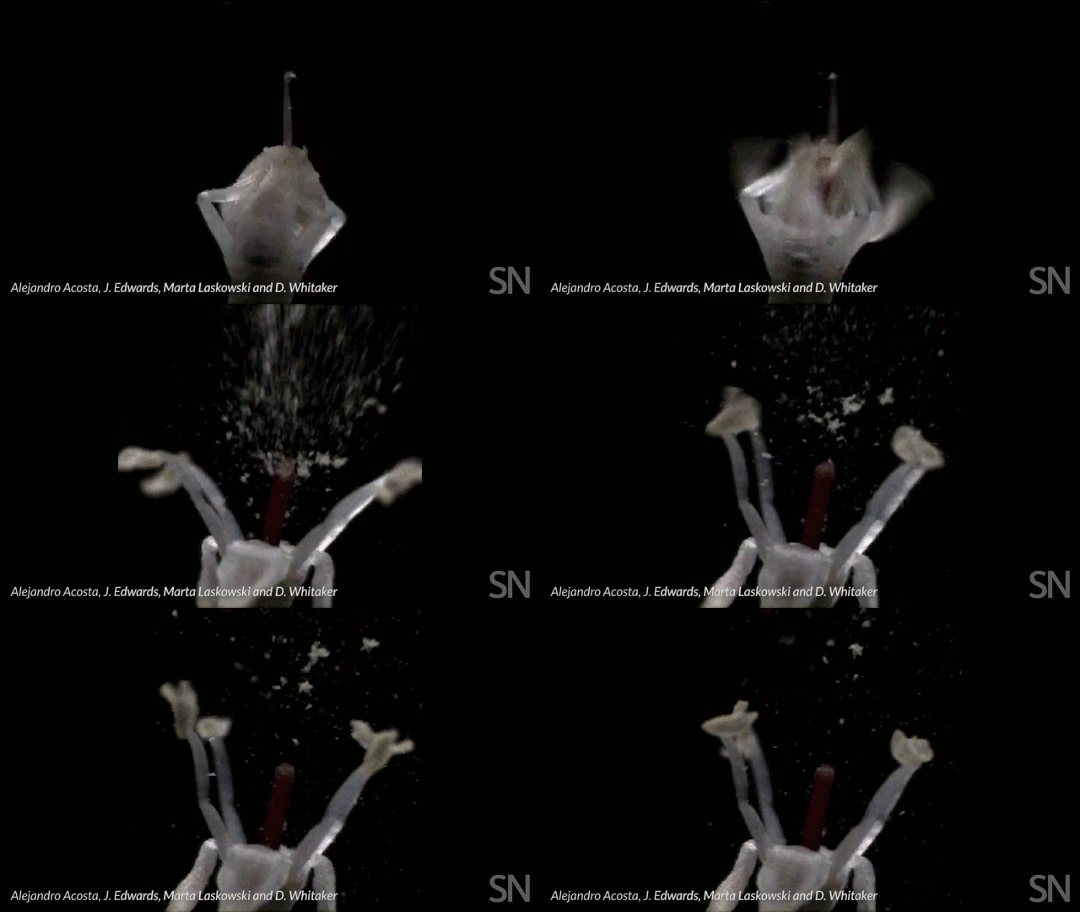
    The bunchberry dogwood, unlike its taller relatives, is a low-lying subshrub that spreads along the ground. But it sports some of the fastest action of any plant, requiring 10,000 frames per second to capture! When young buds form in the bunchberry flower, their four petals are fused, completely hiding the stamens. As the plant matures, the pollen-carrying stamens grow faster than the petals, causing them to peek out the sides of the bud. But the petals stay attached at the tip, holding the stamens in while pressure inside the stamens creates a store of elastic energy.

    When disturbed, the petals break loose and the stamens spring up and out. The anthers at their tips hold the pollen in place until the stamen reaches its maximum vertical velocity, at which point the anthers swing out to release the pollen upward. In essence, the flower works in the same manner as a trebuchet, flinging pollen with an acceleration 2,400 times greater than gravity. That’s enough to coat pollen onto nearby insects and to launch the remainder high enough for the wind to catch it. (Image and research credit: D. Whitaker et al., source; via Science News; submitted by Kam-Yung Soh)

    And with that, FYFD’s Plant Week is a wrap! Missed one of the previous posts? You can catch up with them here.

  • Plant Week: Citrus Jets

    Plant Week: Citrus Jets

    Bartenders and citrus lovers the world over are familiar with the mist of oil that bursts from a bent citrus peel. These microjets are about the width of a human hair, but they can spray at nearly 30 m/s in some citrus species. That’s an acceleration g-force of more 5,100, comparable to a bullet fired from a gun!

    The key to the jets is the structure of the fruit’s peel. Citrus fruits have a relatively thick, soft inner material, known as the albedo, which houses the oil reservoirs. The thin, stiff outer layer of the peel, called the flavedo or zest, covers that. When the peel is bent, the albedo compresses, increasing the pressure inside the oil reservoirs up to an additional atmosphere’s worth. Meanwhile, the flavedo is stretched. When that outer layer fails, it releases the oil pressure and a jet spurts out. For more on this work, including some awesome high-speed videos, check out my interview (starting at 2:59) with one of the authors in the video below. (Image and research credit: N. Smith et al.; video credit: N. Sharp and T. Crawford)

    FYFD is celebrating Plant Week all this week. Check out our previous posts on how moisture lets horsetail plant spores walk and jump, the incredible aerodynamics of dandelion seeds, and the ultra-fast suction bladderworts use to hunt.

  • Plant Week: Jumping Spores

    Plant Week: Jumping Spores

    You might think that plants are pretty stationary, but they have evolved a myriad of ways of moving, especially when it comes to spreading their seeds and spores. Shown above is the spore of the horsetail plant, a spherical pod with four, ribbon-like elators that are moisture-sensitive. When exposed to water, the elators curl around the spore, but as they dry out, they unfurl (top). Repeated cycles of this allows the spores to “walk” short distances (middle). And, if the elators deploy quickly, the spore can even “jump” (bottom). Researchers recorded jumps high enough for the spores to catch a breeze and disperse further. For similar moisture-driven plant action, check out this seed that buries itself! (Image and research credit: P. Marmonttant et al., source; via Science News; submitted by Kam-Yung Soh)

    We’re celebrating botanically-based physics all this week with Plant Week. Check out our previous posts on the ultra-fast suction of carnivorous bladderworts and the incredible flight of dandelion seeds.

  • Plant Week: Bladderworts

    Plant Week: Bladderworts

    Carnivorous plants live in nutrient-poor environments, where clever techniques are necessary to keep their prey from getting away. The aquatic bladderwort family nabs their prey through ultra-fast suction. This starts with a slow phase (top) in which water is pumped out of the trap. Because the internal pressure is lower than the external hydrostatic pressure, this compresses the walls of the trap, and it leaves the trap’s door narrowly balanced on the edge of stability. A slight perturbation to the trigger hairs around the door will cause it to buckle. 

    That’s when things get fast. As the door buckles and the trap expands to its original volume, water gets sucked in, pulling whatever prey was nearby with it. The door reseals as the pressure inside and outside the trap equalizes, and, in only a couple milliseconds total, the bladderwort has its snack. It secretes digestive enzymes to break down what it’s caught, and over many hours, it pumps out the trap to reset it. (Image and research credit: O. Vincent et al.; submitted by David B.)

    All this week, FYFD is celebrating Plant Week. Check out our previous post on how dandelion seeds fly tens of kilometers.

  • Featured Video Play Icon

    Plant Week: Dandelions in Flight

    To kick off Plant Week here on FYFD, we’re taking a closer look at that ubiquitous flower: the dandelion. Love ‘em or hate ‘em, these little guys manage to get just about everywhere, thanks in part to their amazing ability to stay windborne for up to 150 km! To do that, the dandelion uses a bristly umbrella of tiny filaments, known as a pappus, that can generate more than four times the drag per area of a solid disk. Its porosity – all that empty space between the filaments – is also key to its stability; it helps create and stabilize a separated vortex ring that the seed uses to stay aloft. Check out the full video below! (Image and video credit: N. Sharp)

  • Plant Week: Introduction

    Plant Week: Introduction

    Spring has sprung! The trees have leaves, the flowers are in bloom, and snow is (almost) a distant memory.* And here at FYFD, we’re getting ready to kick off a full week of celebrating the intersection of fluid dynamics and plants.

    To get you into the mood, here’s a look at some previous plant-filled posts:

    How trees use negative pressure to hydrate
    The catapulting seeds of the hairyflower wild petunia
    Seeds that self-dig
    How desert moss drinks from the air
    The swimming of zoospores

    Stay tuned all next week for lots more plant physics!

    *Confession: it’s still snowing at my house as I type this. But the trees do have leaves and there are flowers blooming. Poor things. – Nicole

    (Original image: Pixabay)

  • Earth, Moon, and Magma Ocean

    Earth, Moon, and Magma Ocean

    Among objects in our solar system, the Moon is rather unusual. It’s the only large moon paired with a rocky planet, and only Pluto’s Charon boasts a larger size relative to its planet. Chemically speaking, the Moon is also extremely similar to the Earth, which is part of why scientists theorized that the moon coalesced after the proto-Earth collided with a Mars-sized object. But lingering questions remained, like why the Moon is rich in iron oxide compared to the Earth.

    A new study tweaks the idea of the giant impactor by adding a magma ocean to the proto-Earth. In the early days of the solar system, collisions were so common that larger bodies (> 2*Mars) probably maintained a molten ocean. By simulating collisions with and without a magma ocean and studying the final composition of these simulated Earth-Moon-systems, the researchers found that a molten ocean not only matches the expected size and orbital characteristics of the two bodies, but the results reflect the actual chemical make-up of the  real Earth and Moon, too! (Image credits: moon – N. Thomas, impact simulation – N. Hosono et al.; research credit: N. Hosono et al.; via Ars Technica; submitted by Kam-Yung Soh)

  • Granular Instabilities

    Granular Instabilities

    Granular mixtures show surprising similarities to fluids, even though their underlying physics differ. The latest example of this is a Rayleigh-Taylor-like instability that occurs when heavy particles sit atop lighter ones. By combining vertical vibration and an upward gas flow, researchers found that the lighter particles form fingers and bubbles that seep up between the heavier grains (upper left). Visually, it looks remarkably similar to a lava lamp or other Rayleigh-Taylor-driven instability (upper right).

    But the physics behind the two are distinctly different. In the fluid, buoyancy drives the instability while surface tension acts as a stabilizing force. There’s no surface tension in a granular material, though. Instead, the drag force from gas flowing upward provides the vertical impetus while friction between the grains – essentially an effective viscosity – replaces surface tension as a stabilizing influence.

    The similarities don’t stop there, though. When the researchers tested a “bubble” of heavy grains suspended in lighter ones (lower left), they found that, instead of sinking, the granular bubble split in two and drifted downward on a diagonal. Eventually, those daughter bubbles also split. Again, visually, this looks a lot like what happens to a drop of ink or food coloring falling through water (lower right), but the physics aren’t the same at all. 

    In the fluid, the breakup happens when a falling vortex ring splits. In the granular example, gas moving upward tends to channel around the heavy grains because they’re harder to move through. Eventually, this builds up a solidified region under the bubble. When the heavy grains can’t move directly down, they split and sink through the surrounding suspended particles until they build up another jammed area and have to split again. (Image credits: granular RTI – C. McLaren et al.; RTI simulation – M. Stock; bag instability – D. Zillis; research credit: C. McLaren et al.; submitted by Kam-Yung Soh)

  • The Bouncing Drop

    The Bouncing Drop

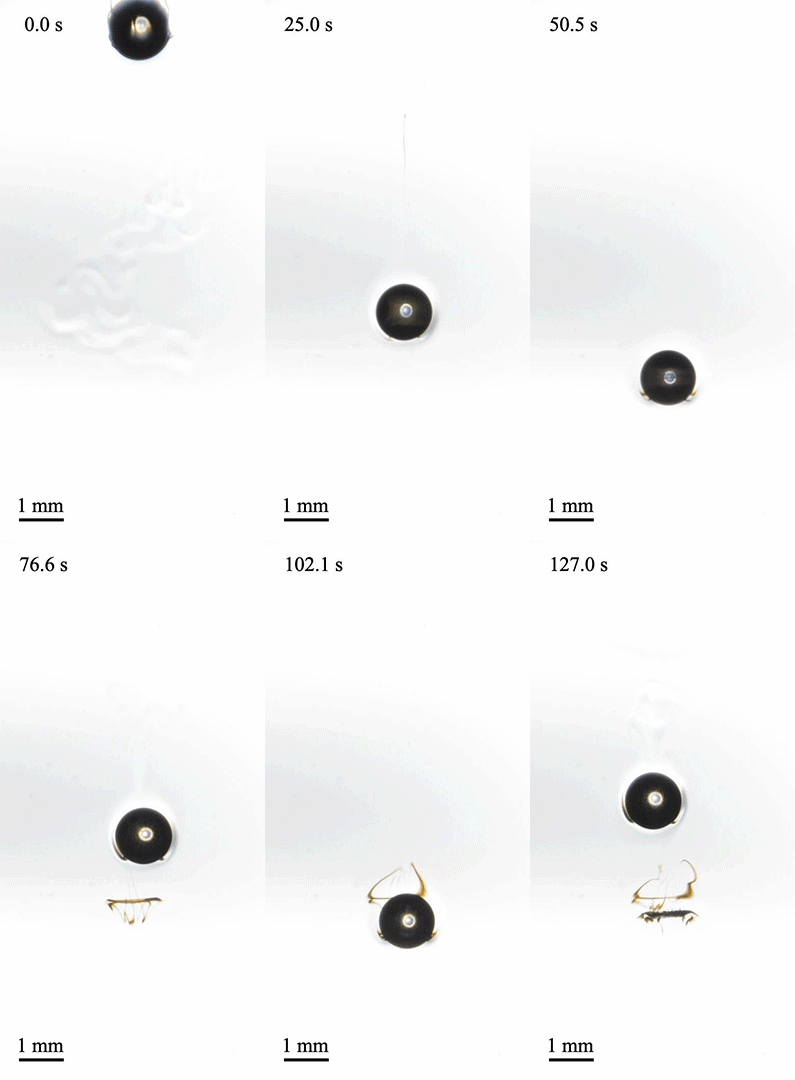
    For a droplet to bounce, we expect it to hit a wall or a sharp interface of some kind. But in a new study, researchers demonstrate a droplet that bounces with neither. Shown above is an oil droplet sinking through a stratified mixture of ethanol (toward the top) and water (toward the bottom). Because the oil is heavier than ethanol, it initially sinks, dragging some of the ethanol with it as it falls. Over time, some of that ethanol rises again, forming what’s known as a buoyant jet.

    Simultaneously, the gradient of ethanol to water between the top and bottom of the drop creates an imbalance in surface tension. The ethanol near the top of the drop has a lower surface tension than the water at the bottom. This creates a downward Marangoni flow along the drop interface.

    The bounce itself happens quickly after a long, slow sinking period. As the drop’s sinking slows, the buoyant jet weakens until it disappears completely. At the same time, the downward Marangoni flow pulls fresh ethanol-rich fluid toward the top of the drop. That increases the surface tension difference and strengthens the Marangoni flow, creating a positive feedback loop. In less than a second, the Marangoni flow increases by two orders of magnitude, pulling so hard that the drop shoots upward.

    That resets the cycle by weakening the Marangoni flow and strengthening the buoyant jet. The droplet can continue bouncing for about 30 minutes until the concentration gradient is so well-mixed that the cycle can’t continue. (Image and research credit: Y. Li et al.; via APS Physics; submitted by Kam-Yung Soh)

  • Featured Video Play Icon

    360 Splashes

    Beautiful as a splash is, why only enjoy it from a single angle? In this video, the artists behind Macro Room offer a 360-degree perspective on various splashes and fluid collisions. I especially enjoy watching the splash crowns falling back over and out of the various containers they use. What’s your favorite part? (Image and video credit: Macro Room)