Month: May 2019

  • Tornado from a Drone

    Tornado from a Drone

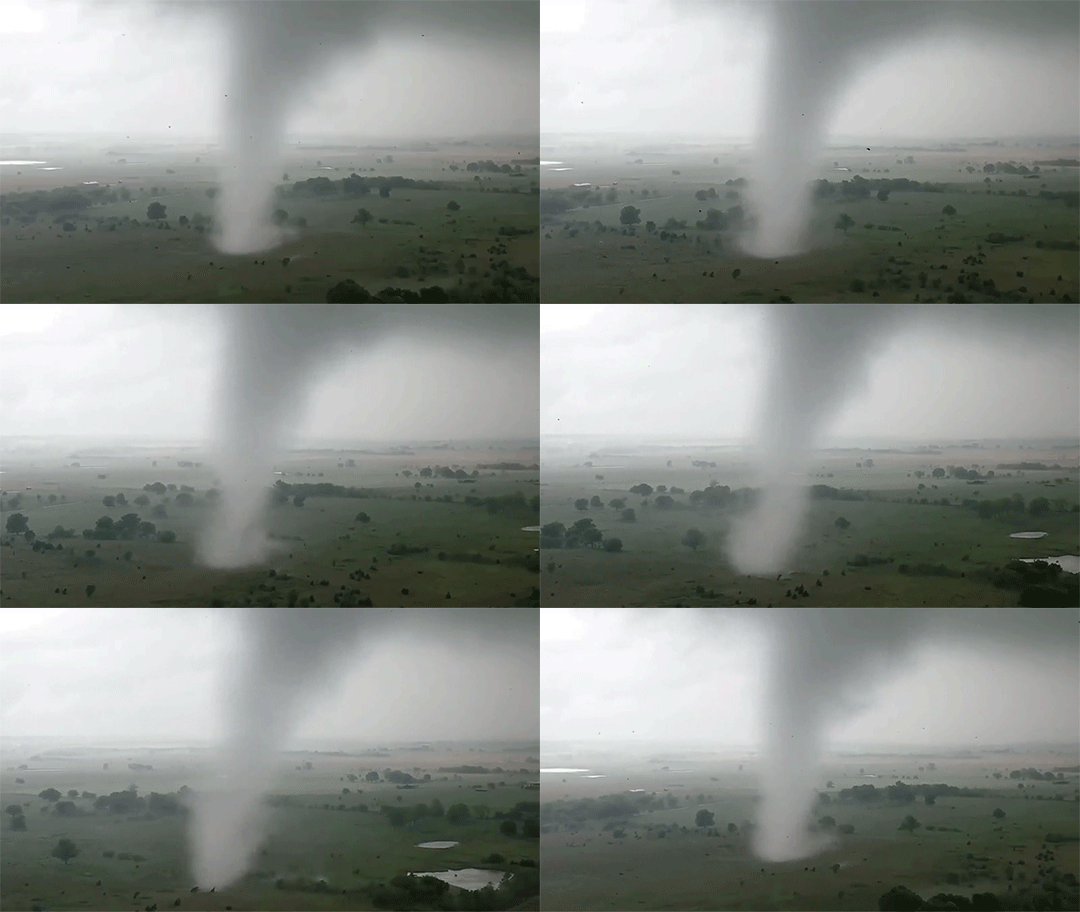
    One of the challenges in studying tornadoes is being in the right place at the right time. In that regard, storm chaser Brandon Clement hit the jackpot earlier this week when he captured this footage of a tornado near Sulphur, Oklahoma from his drone. He was able to follow the twister for several minutes until it apparently dissipated.

    Scientists are still uncertain exactly how tornadoes form, but they’ve learned to recognize the key ingredients. A strong variation of wind speed with altitude can create a horizontally-oriented vortex, which a localized updraft of warm, moist air can lift and rotate to vertical, birthing a tornado. These storms most commonly occur in the central U.S. and Canada during springtime, and researchers are actively pursing new ways to predict and track tornadoes, including microphone arrays capable of locating them before they fully form. (Image and video credit: B. Clement; via Earther)

  • Ice Labyrinths

    Ice Labyrinths

    Pattern formation is extremely common in nature, from the dendritic growth of trees and snowflakes to the stripes of a tiger. A new paper describes how a thin layer of ice in a liquid can form labyrinthine patterns when illuminated with near-infrared light. Both the liquid and ice are maintained at a constant temperature below the melting point, but the ice absorbs the near-infrared light more effectively than the water. This means that parts of the ice that are far from the liquid warm and melt faster, creating holes that can then allow a pocket of liquid to seep in and reduce the absorption rate. The ice crystals themselves thin and expand across the surface at the expense of more holes, which eventually create larger channels that pock the ice. (Image and research credit: S. Preis et al.; via Nature; submitted by Kam-Yung Soh)

  • Reshaping the Wake to Decrease Drag

    Reshaping the Wake to Decrease Drag

    When it comes to the aerodynamics of cars, there’s only so much streamlining one can do. In the end, most cars have a certain boxy-ness as a matter of practicality; they do, after all, have to carry people and things. But that doesn’t mean we’re stuck with the level of drag those shapes entail.

    For cars and other non-streamlined objects, much of their drag comes from their wake, which usually contains a large, asymmetric, and unsteady recirculation region. In a new wind tunnel study, scientists used air blasts to reshape this wake, making it more symmetrical, even when the wind direction did not align with the car model. That reduced the drag by 6%. They’re now experimenting with adding additional nozzles along the non-windward edges of the model to see if they can reduce drag even further.

    Although this appears to be the first time this technique has been tested for road vehicles, the idea of blowing air to improve aerodynamics is well-established, particularly in aviation. (Image credit: V. Malagoli; research credit: R. Li et al., submitted by Marc A.)