Year: 2017

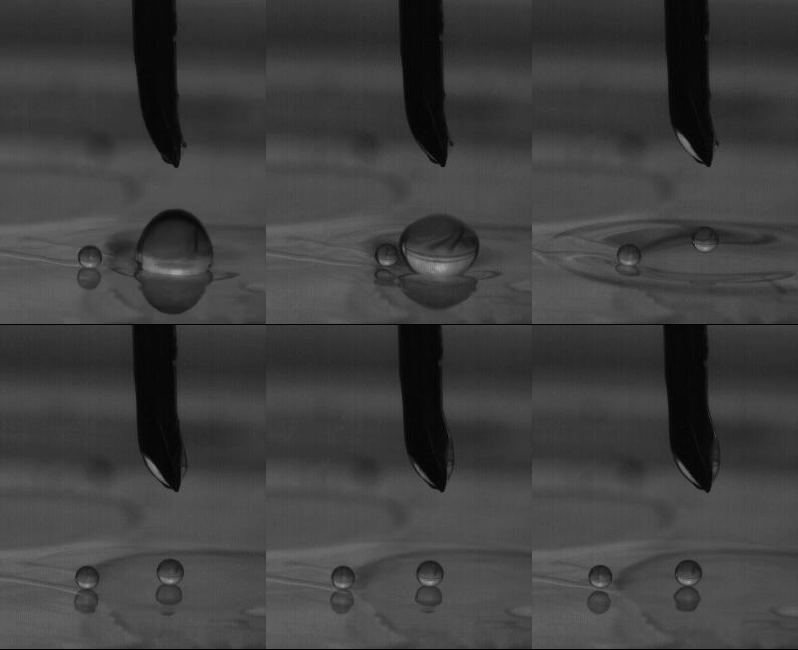
  • Growing Droplets on a Trampoline

    Growing Droplets on a Trampoline

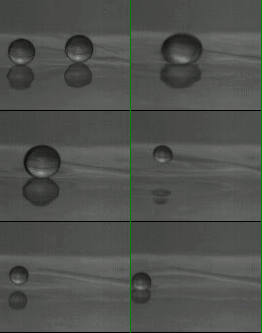
    Droplets on a liquid surface will typically coalesce, thanks to gravity and the low viscosity of the air layer between them and the pool. In certain cases, droplets will partially coalesce, producing smaller and smaller droplets until they finally coalesce completely. Vibrating the liquid surface can help prevent this coalescence but only when droplets are small.

    In fact, if the pool is more viscous than the droplets, bouncing can be used to produce droplets of a desired size, as shown above. Because the droplets are less viscous, they deform more than the pool does – behaving somewhat like a bouncy ball hitting a rigid wall. In this system, large droplets are unstable and will undergo partial coalescence until they are small enough to bounce stably. The size of stable drops is determined by the frequency and acceleration of the bouncing bath; by tuning these parameters, researchers can select what size droplets they want to end up with. (Research credit: T. Gilet et al.; images and submission by N. Vandewalle)

  • When Vortices Collide

    When Vortices Collide

    In a new ad campaign for paint manufacturer Sherwin-Williams, the production team at Psyop show off some awesome fluid dynamics by swirling and injecting paint underwater. You can see one sequence above, where red and blue paint vortex rings collide head-on before breaking down into a purple turbulent cloud. (What a great way to demonstrate the mixing power of turbulence, right?) Here’s the full 30-second ad clip. Impressively, everything in the video is a practical effect, even the segment that flies past multicolored turbulent plumes. You can see how they filmed everything in their behind-the-scenes featurette below. In the meantime, enjoy the mesmerizing beauty of real-world physics and check out FYFD’s “fluids as art” tag for more examples. (Image and video credit: Psyop for Sherwin-Williams; submitted by Alan B.)

  • Gravity Waves on Mars

    Gravity Waves on Mars

    It may look like grainy, black and white static from a 20th-century television, but this animation shows what may be the first view of gravity waves seen from the ground on another planet. The animation was stitched together from photos taken by the Mars Curiosity rover’s navigation camera, and it shows a line of clouds approaching the rover’s position.

    Gravity waves are common on Earth, appearing where disturbances in a fluid propagate like ripples on a pond. In the atmosphere, this can take the form of stripe-like wave clouds downstream of mountains; internal waves under the ocean are another variety of gravity wave. If these are, in fact, Martian gravity waves, they are likely the result of wind moving up and over topography, much like their Terran counterparts. (Image credit: NASA/JPL-Caltech/York University; research credit: J. Kloos and J. Moores, pdf; via Science; h/t Cocktail Party Physics)

  • Featured Video Play Icon

    The Flying Draco

    Nature includes many animals that are so-called fliers: flying squirrels, flying snakes, and draco lizards, to name a few. These animals aren’t true fliers like birds, bats, or insects, though. Instead, they are expert gliders, able to produce enough lift to control their descent and land safely at a distance far greater than a normal leap could carry them. Like the flying squirrel, the draco lizard extends a thin membrane that acts as its wings. The additional area provides enough lift that the lizards can glide as far as 60 m (200 ft) while only losing 10 m (33 ft) in altitude. That’s an impressive glide ratio – about 3 times better than the Northern flying squirrel and twice as good as a wingsuit. (Video credit: BBC/Planet Earth II)

  • How We Sweat

    How We Sweat

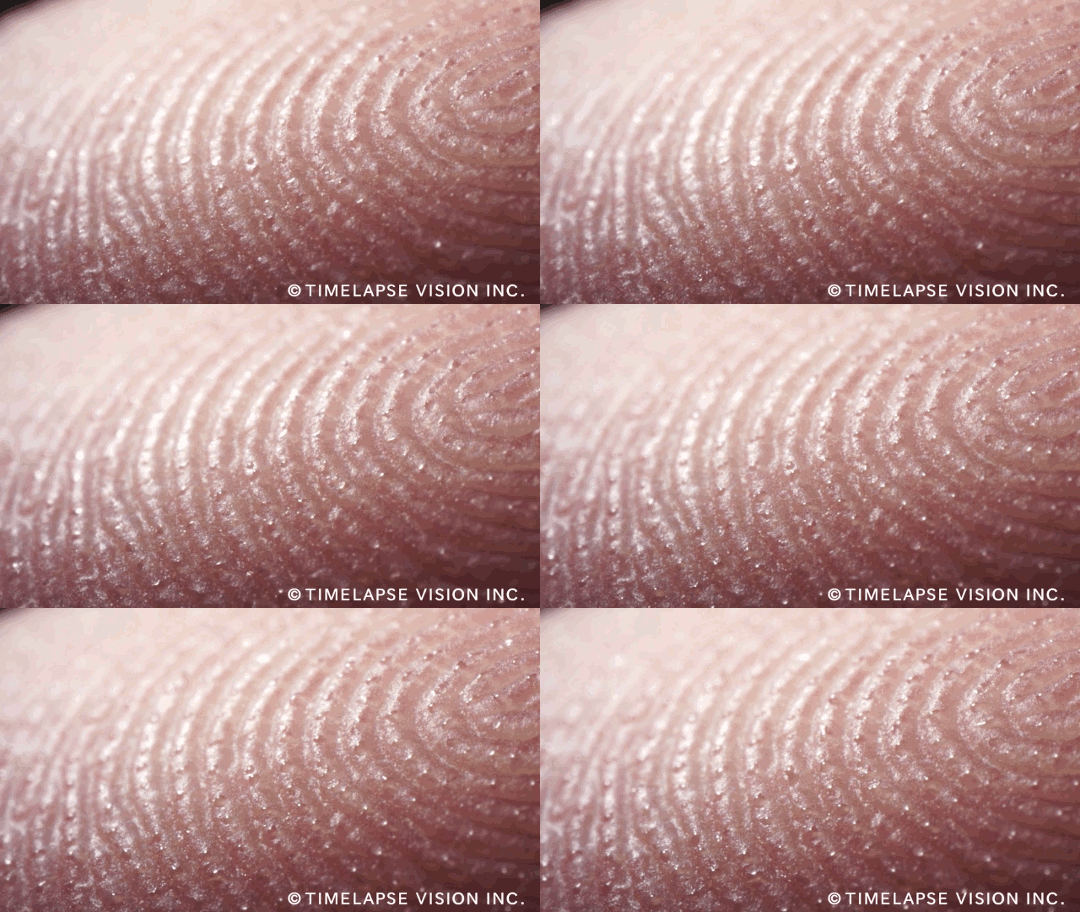
    Sweat plays a critical role in controlling body temperature for humans. Most of the sweat glands on our bodies are eccrine sweat glands, which pump out a mixture of water and electrolytes in response to temperature changes or emotional stimuli. Beneath the surface, these glands consist of three major areas, the tightly bunched secretory coil, where the cells that produce sweat are located; a long dermal duct that transports sweat to the skin surface; and the upper coiled duct just below the pore where sweat exits. Eccrine glands can produce an impressive amount of pressure – about 70 kN/m^2, equivalent to 70% of sea-level atmospheric pressure – to help drive sweat up and out onto the skin. Flow from pores is not steady; like many other biological processes, sweat flow is pulsatile. (Image credit: Timelapse Vision Inc., source; Z. Sonner et al.; submitted by Marc A.)

    image
  • Avoiding Coalescence

    Avoiding Coalescence

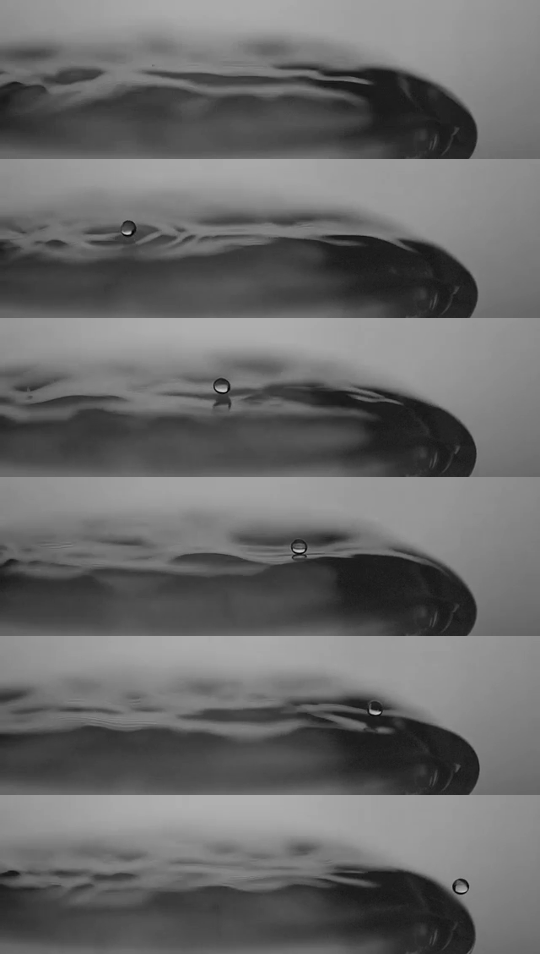
    Droplets hitting a liquid surface don’t always coalesce. Above you can see a tiny droplet bounce and skate along the surface of a larger, vibrating drop. The smaller droplet doesn’t coalesce because a tiny layer of air sits between it and the vibrating drop. To actually contact and coalesce, the droplet has to sit still long enough for that air layer to get squeezed out. Instead, the vibration of the larger drop bounces it upwards, refreshing the air layer and scooting the droplet along until it falls off the vibrating drop. (Image credit: C. Kalelkar and S. Phansalkar, source)

  • Reducing Drag with Bubbles

    Reducing Drag with Bubbles

    Large ships experience a great deal of drag due to friction between their hull and the water. One method shipbuilders are considering to combat this drag is the use of bubbles, which have been found to reduce drag by up to 40%. The physical mechanism behind this drag reduction is not yet understood, but a recent study suggests that bubble size and bubble coalescence play an important role.

    Researchers introduced surfactants into bubbly boundary layers and found that the reductions in drag evaporated as soon as the surfactants spread. Adding only 6 parts per million of the surfactant decreased average bubble size from 1 mm to 0.1 mm and helped prevent the bubbles from growing via coalescence. The implications are that bubble-induced drag reduction could be extremely sensitive to water conditions. (Image credit: G. Kiss; research credit: R. Verschoof et al.)

  • Featured Video Play Icon

    Hawaii’s Lava

    Sometimes the best way to appreciate a flow is standing still. In “Hawaii – The Pace of Formation” filmmakers explore how the Big Island is constantly changing, from fresh lava flows to towering waterfalls. Much of the footage presented is timelapse, which gives viewers a different perspective on familiar subjects; it highlights the similarities between clouds and the ocean, and it reminds us that a lava flow and the syrup flowing down a stack of pancakes have a lot in common. To me, this is one of the most beautiful parts of fluid dynamics: physics of flows on different length-scales and time-scales – even in different fluids – are still very much the same. (Video credit: A. Mendez et al.)

  • Cavity Collapse

    Cavity Collapse

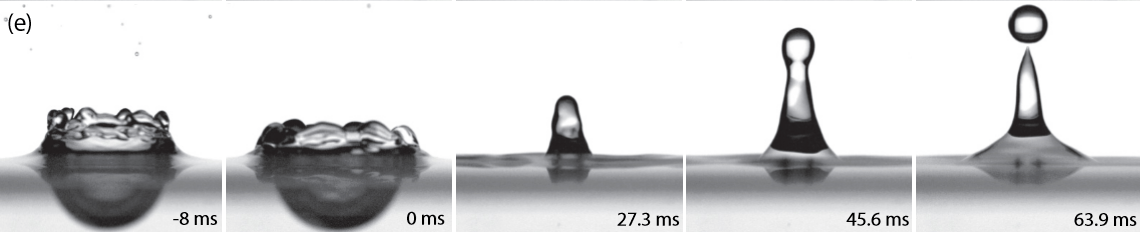
    One of the most iconic images in fluid dynamics is that of a drop impacting a liquid. When a drop hits a pool, it creates a crater, or cavity. That cavity expands and then collapses to form a jet that rebounds above the pool’s surface. If the jet is fast enough, it will eject one or more droplets before it falls back into the pool. Faster droplets, like the one that formed the cavity and jet shown above, actually create slower and fatter jets. In this regime, the complicated interplay of surface tension and gravity effects results in a jet velocity that is independent of impact speed and the liquid’s viscosity. Understanding this jet and splash dynamics is important for many industrial applications, including ink-jet printing. (Image credit: G. Michon et al.)

  • Water Skiing Beetles

    Water Skiing Beetles

    Waterlily beetles employ an unusual method of getting around: they skim across the water surface. The beetles are mostly covered in tiny hairs that help make their body hydrophobic (water-repellent) – a common adaptation for insects that spend their time sitting on the water’s surface – but the beetles also have hydrophilic claws on their legs that help anchor them to the water’s surface. When they need to move quickly, the beetles lean upright and start flapping their wings, creating thrust that helps push them along the interface. Between water’s viscosity and drag from the waves the insect generates, it has to expend a lot of energy for this method of travel – more than these insects do flying in air – but researchers suspect that staying at the surface could remain beneficial for the beetles because it’s easier to locate their floating food sources this way. (Image credit: H. Mukundarajan et al., source; via New Scientist)