Scientists have known for years that Mars once had liquid water on its surface, and they have many contemporary examples of frozen water ice on the Red Planet. But this week NASA announced the strongest evidence yet that liquid water still flows on Mars. Researchers have observed from orbit dark line-like features called recurring slope lineae (RSL) that develop, darken, and grow seasonally in many locations on Mars. The appearance of these features coincides with warmer surface temperatures (above -23 degrees Celsius), and the lines fade again when temperatures cool. Although scientists suspected the dark lines might be related to flowing water, the evidence remained circumstantial until spectral observations of multiple sites indicated that the darker features contained hydrated salts. In other words, briny salt water is still flowing at or near the Martian surface. (Image credits: NASA)
Month: September 2015

Healing Soap Films
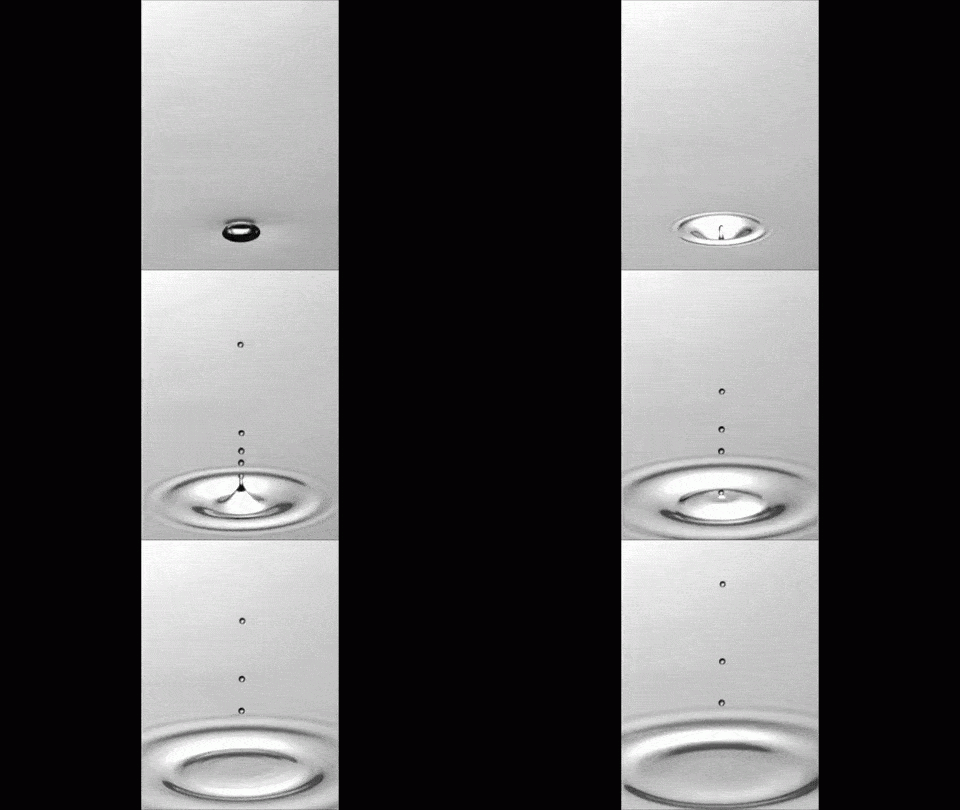
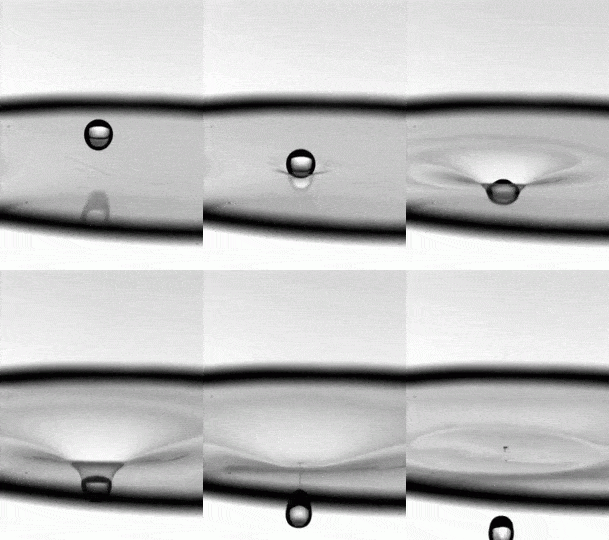
As fragile as a soap bubble seems, these films have remarkable powers of self-healing. The animation above shows a falling water droplet passing through a soap film without bursting it. An important factor here is that the water droplet is wet–passing a dry object through a soap film is a quick way to burst it, as those who have played with bubbles know. The droplet’s inertia deforms the soap film, creating a cavity. If the drop’s momentum were smaller, the film could actually bounce the droplet back like a trampoline, but here the droplet wins out. The film breaks enough to let the drop through, but its cavity quickly pinches off and the film heals thanks to the stabilizing effect of its soapy surfactants. (Image credit: H. Kim, source)

Phytoplankton Bloom
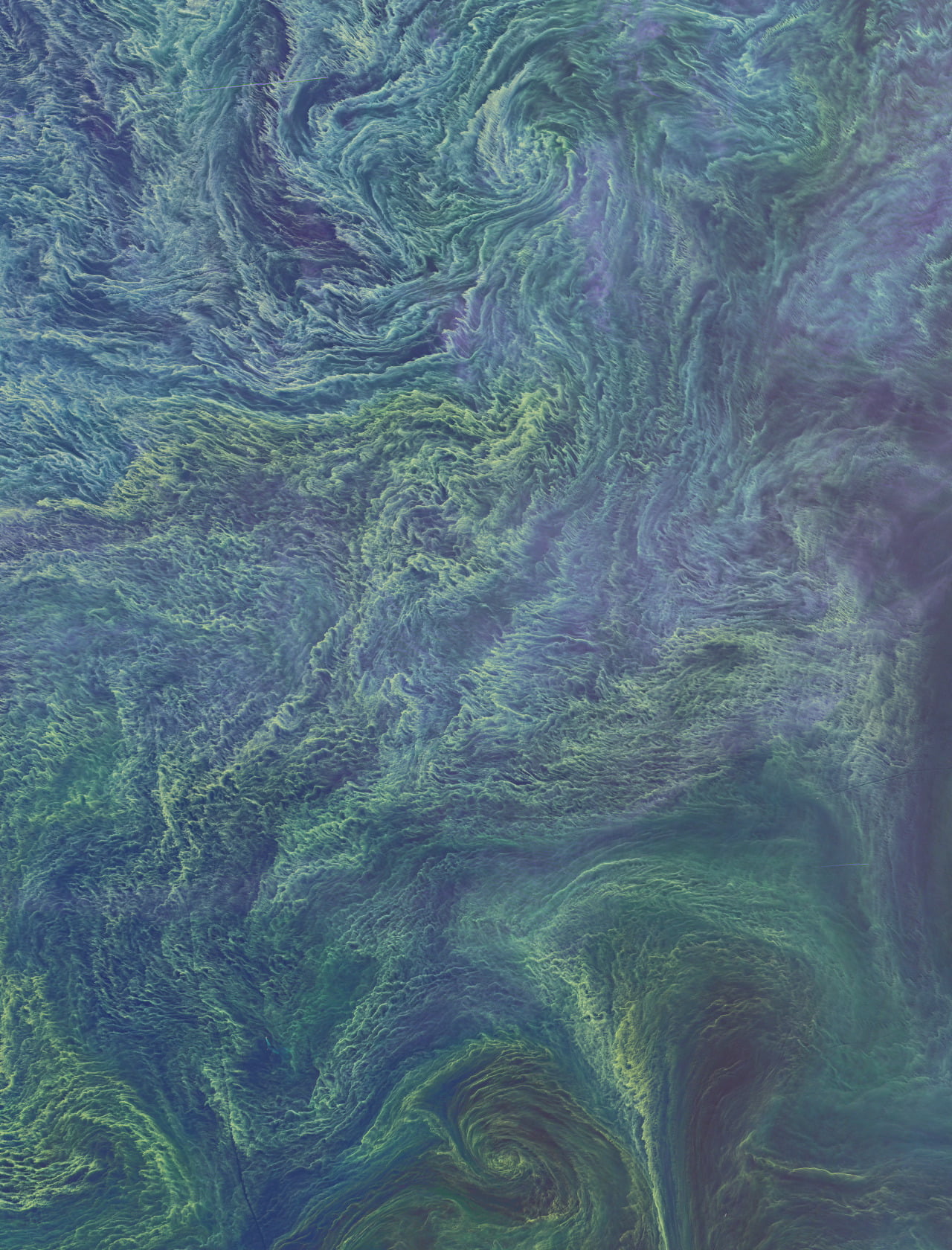
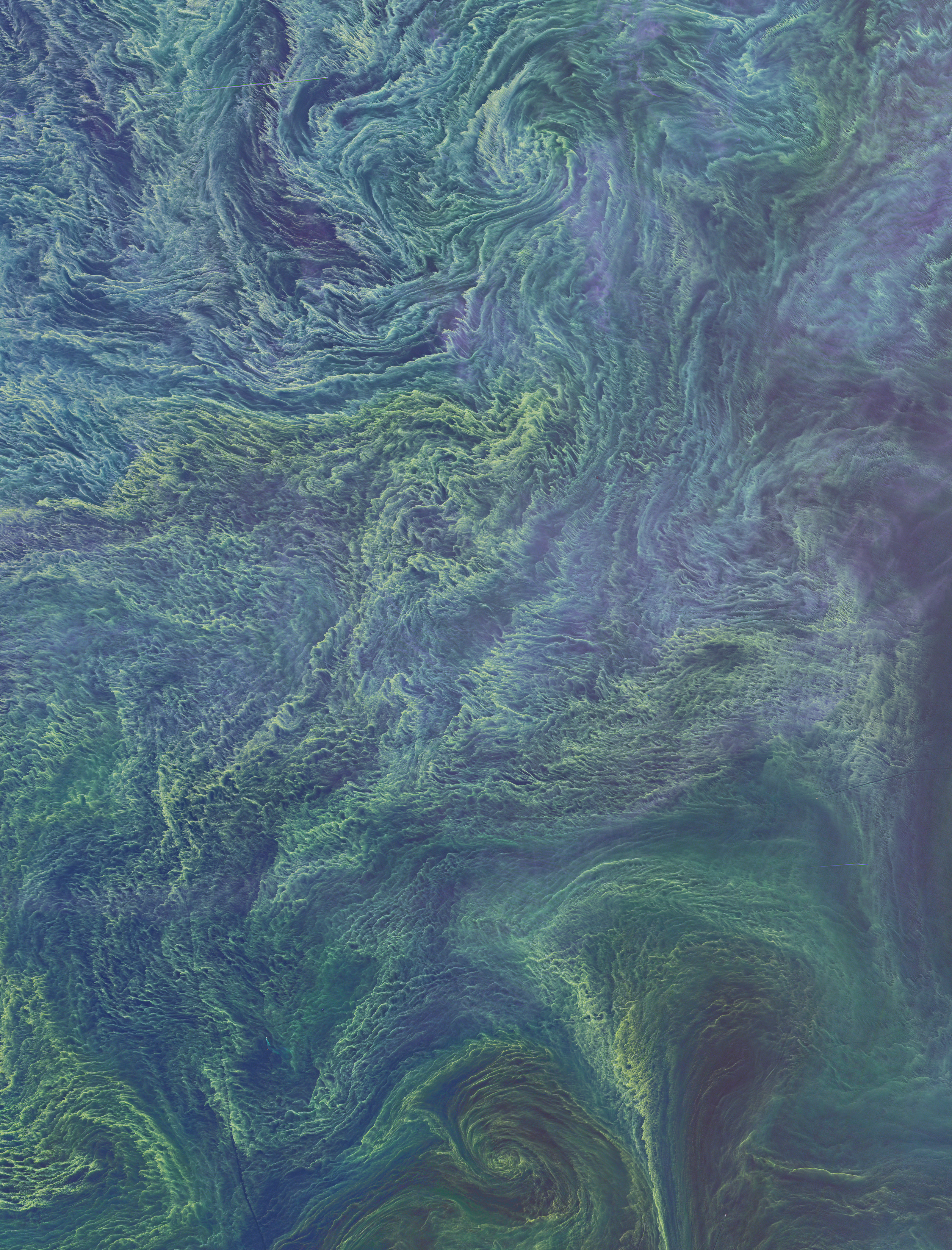
This incredible false-color satellite image shows a cyanobacteria phytoplankton bloom in the Baltic Sea. The image is roughly 900 km across and is beautifully detailed. Check out the full resolution version. The tiny phytoplankton act like tracer particles in the flow, sketching out the massive whorls as well as the tiny lacy wisps that make up the turbulent sea. Beautiful as they appear from orbit, such massive blooms can be dangerous to animal life, depriving large areas of the oxygen other animals need to survive. In recent years more and more large phytoplankton blooms are happening around the world as agricultural and industrial run-off supply waters with excess nitrogen and other nutrients favored by the phytoplankton. (Image credit: NASA Earth Observatory)

Sandscapes
Many of us have played with sand art–the rotating frames filled with water, sand, and air. In this video, Shanks FX demonstrates some of the realistic and surrealistic landscapes you can create using this toy. It also makes for a neat fluid dynamics demonstration. The buoyancy of the trapped air bubbles lets the sand sift slowly down instead of falling immediately. And the sand descends in a variety of ways–sometimes laminar columns and other times wilder turbulent plumes. (Video credit and submission: Shanks FX/PBS Digital Studios)

Self-Pouring Fluids

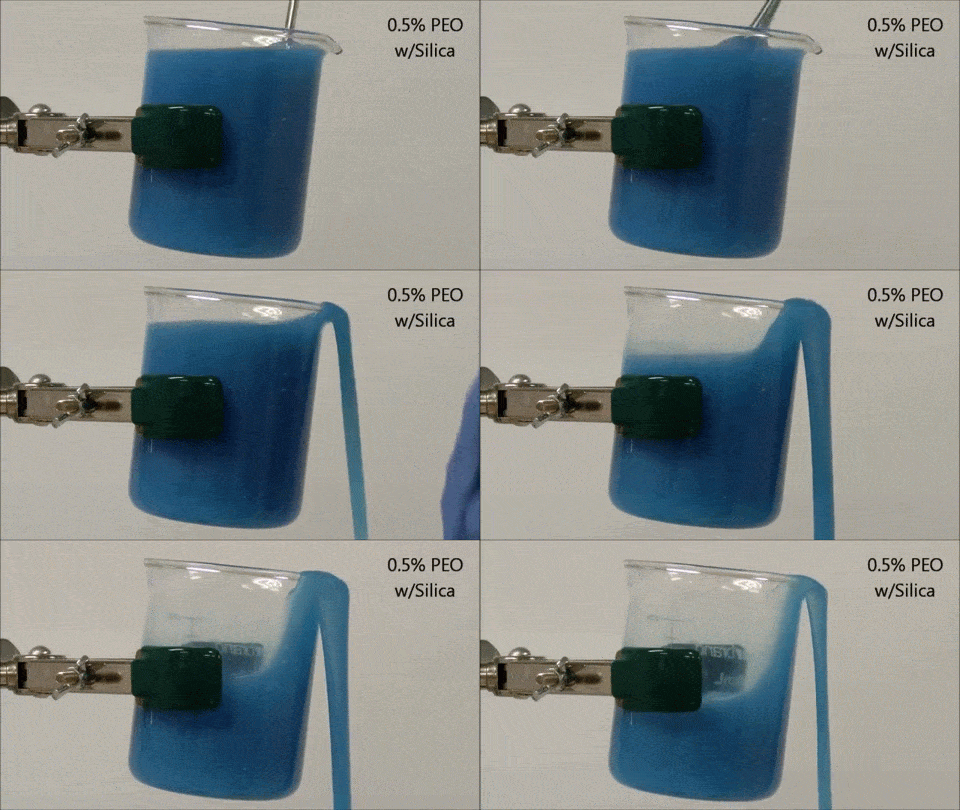
Non-Newtonian fluids are capable of all kinds of counter-intuitive behaviors. The animations above demonstrate one of them: the tubeless or open siphon. Once the effect is triggered by removing some of the liquid, the fluid quickly pours itself out of the beaker. This is possible thanks to the polymers in the liquid. The falling liquid pulls on the fluid left behind in the beaker, which stretches the polymers in the fluid. When stretched, the polymers provide internal tension that opposes the extensional force being applied. This keeps the fluid in the beaker from simply detaching from the falling liquid. Instead, it flows up and over the side against the force of gravity, behaving rather more like a chain than a fluid! (Image credit: Ewoldt Research Group, source)

Miniature Bursting Bubbles

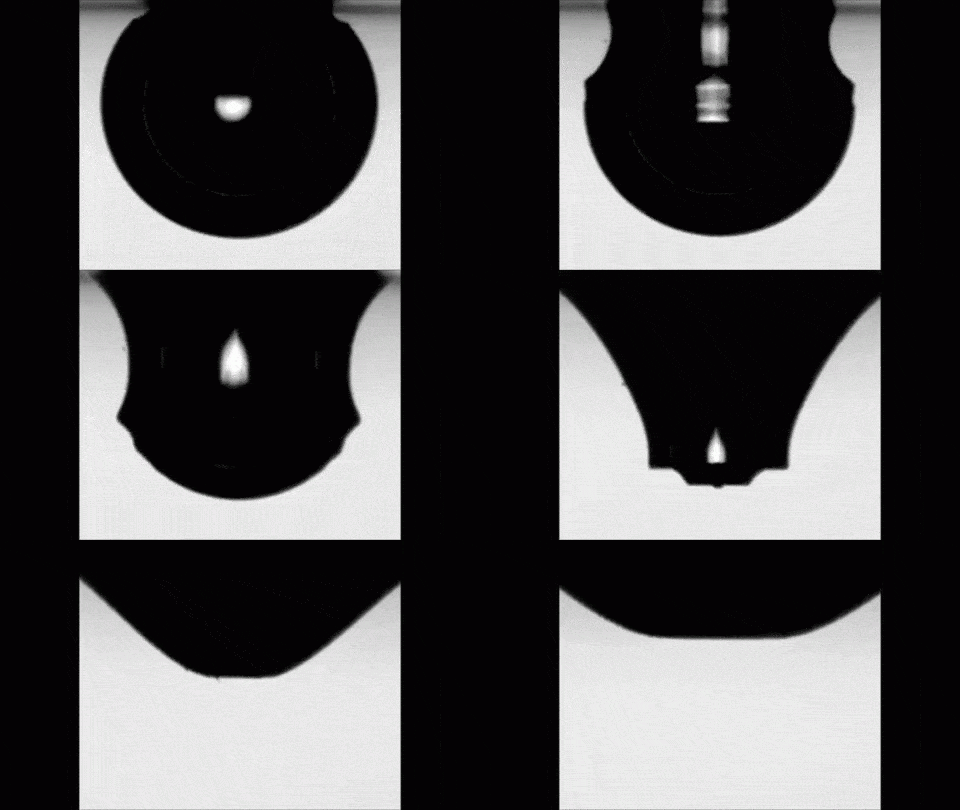
Fizzy drinks like soda or champagne contain dissolved carbon dioxide which forms bubbles when the pressure inside its container is released. The tiny bubbles rise to the surface where the liquid film covering them can rupture, creating a small cavity at the surface. The cavity collapses in a matter of milliseconds (bottom animation). Above the surface, the cavity reverses its curvature to create a liquid jet (top animation) which can expel multiple tiny droplets. These droplets can tickle a drinker who hovers too close, but they also carry and distribute the aroma molecules that are part of the experience of a drink like champagne. (Image credit: E. Ghabache et al., source)
(Today’s topic brought to you by my impending nuptials to my favorite physicist/spacecraft engineer.)

The Inverted Glass Harp
You may be familiar with the glass harp, the instrument created by rubbing the rim of a partially-filled wine glass. But did you know that you can create the same effect by immersing an empty glass in water? In this video, Dan Quinn explains the physics behind both types of glass harps and why the pitch changes as you add or remove water. Vibration is the driving factor (as with most sound), and the key to the shifting pitches has to do with the change in mass of the material being vibrated. For more great physics, also be sure to check out Quinn’s previous video on tears of wine. (Video credit: D. Quinn)

Printing in Glass
A group at MIT have created a new 3D printer that builds with molten glass. This allows them to manufacture items that would difficult, if not impossible, to create with traditional glassblowing or other modern techniques. One of the coolest aspects of this technique is that it can use viscous fluid instabilities like the fluid dynamical sewing machine to create different effects with the glass. You can see this around 1:56 in the video. Varying the height of the head and the speed at which it moves will cause the molten glass to fall and form into different but consistent coiling patterns. All in all, it’s a very cool application for using some nonlinear dynamics! (Video credit: MIT; via James H. and Gizmodo)

Io’s Magma Ocean
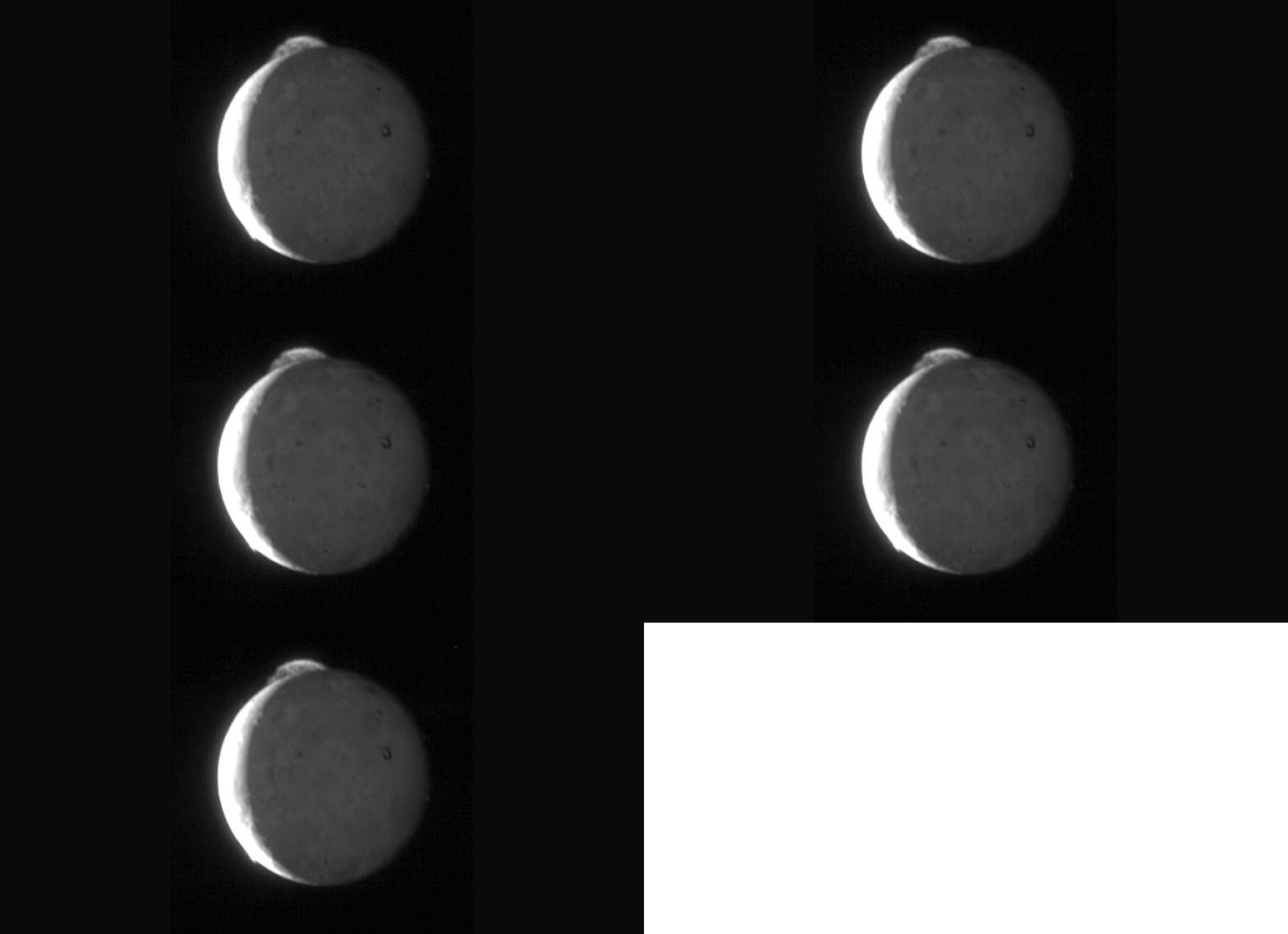
Jupiter’s moon Io is the most volcanically active world in our solar system. The energy that drives its geological activity comes from tidal forces the moon experiences from Jupiter and from other Jovian moons. These forces flex the moon and heat its interior via friction. Previous models of Io’s tidal heating assumed a solid body, but their results predicted volcanoes in locations that did not match observations of the moon. A new study suggests that the missing piece of the puzzle is a subsurface ocean of magma. Highly viscous liquids like magma also generate heat when deformed by tidal forces, and applying this model to Io allowed scientists to better match the volcano distribution actually seen on the world. For more, check out NASA’s article. (Image credit: NASA; via Gizmodo; submitted by jshoer)
The Angle of Repose
[original media no longer available]
Granular materials like sand tend to form heaps when poured. The steepness of the heap at rest is described by the angle of repose, which is determined by a balance between gravity, normal force, and friction on the grains. When a heap of grains is disturbed, it can trigger an avalanche. As can be seen in the video above, avalanches are a surface phenomenon, only moving the top few layers of grain while most of the heap remains stationary. (Video credit: Peddie School Physics)