Month: September 2015

  • How Dogs and Cats Drink

    How Dogs and Cats Drink

    We humans do our hands-free drinking via suction, using the shape of our lips and mouths to create low pressure that draws liquids in. Dogs and cats, on the other hand, have no cheeks and, therefore, no suction. Instead, both cats (top) and dogs (bottom) drink using adhesion, or the tendency of a liquid to stick to a surface. Both species flatten part of their tongue against the water surface, then pull it up rapidly. This draws a column of water up after their tongue, which they then snap their jaws closed around. Although they use the same method, cats are daintier drinkers than dogs, which sometimes leads to the misconception that the animals drink differently. (Image credits: NYTimes, source; research credit: S. Jung et al.)

  • Boiling Water in Oil

    Boiling Water in Oil

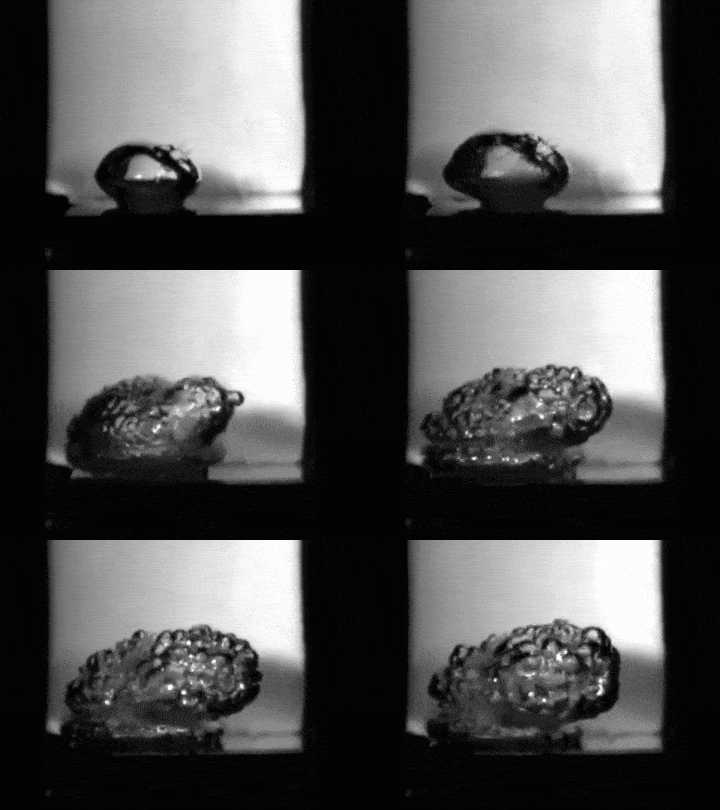
    Most people know that throwing water into hot oil is a bad idea. But, as dramatic as the results can be, the boiling of a water droplet submerged in oil is remarkably beautiful, as seen in the animations above. The initial water droplet expands as it shifts from liquid to vapor (top). At a critical volume, the expansion occurs explosively (middle), causing the bubble to overexpand relative to the pressure of the surrounding fluid. The higher pressure of the oil around it collapses the drop, which then re-expands, creating the cycle we see in the final two animations. This oscillation triggers a Rayleigh-Taylor type instability along the bubble’s interface, causing the surface corrugations observed. The vapor bubble will continue to rise through the oil, eventually breaking the surface and scattering hot oil droplets.  (Image credits: R. Zenit, source)

  • The Challenges of Micro Air Vehicles

    The Challenges of Micro Air Vehicles

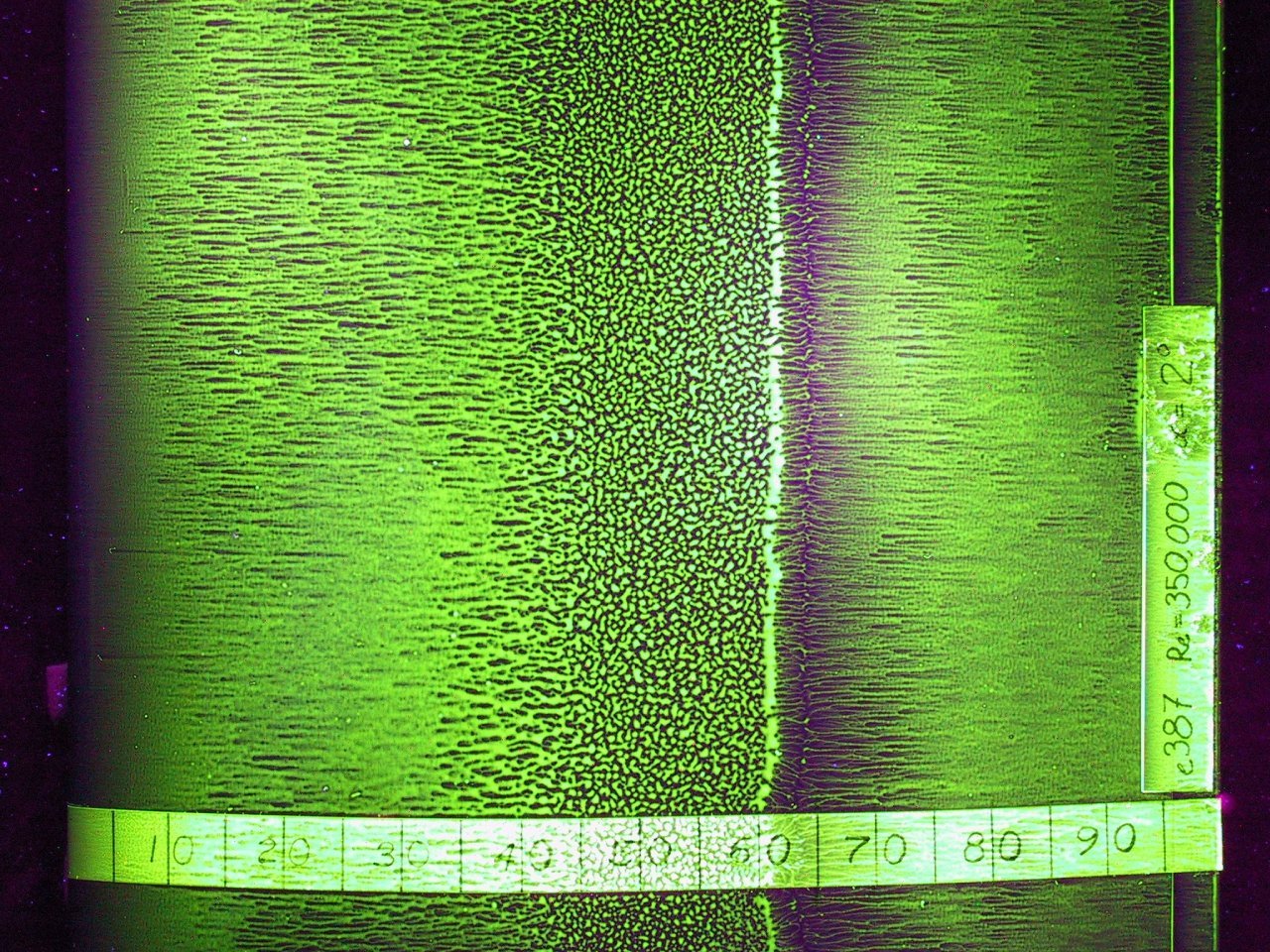
    Interest in micro-aerial vehicles (MAVs) has proliferated in the last decade. But making these aircraft fly is more complicated than simply shrinking airplane designs. At smaller sizes and lower speeds, an airplane’s Reynolds number is smaller, too, and it behaves aerodynamically differently. The photo above shows the upper surface of a low Reynolds number airfoil that’s been treated with oil for flow visualization. The flow in the photo is from left to right. On the left side, the air has flowed in a smooth and laminar fashion over the first 35% of the wing, as seen from the long streaks of oil. In the middle, though, the oil is speckled, which indicates that air hasn’t been flowing over it–the flow has separated from the surface, leaving a bubble of slowly recirculating air next to the airfoil. Further to the right, about 65% of the way down the wing, the flow has reattached to the airfoil, driving the oil to either side and creating the dark line seen in the image. Such flow separation and reattachment is common for airfoils at these scales, and the loss of lift (and of control) this sudden change can cause is a major challenge for MAV designers. (Image credit: M. Selig et al.)