Aerogel is an extremely light porous material formed when the liquid inside a gel is replaced with gas. When combined with water, aerogel powders can have some wild superhydrophobic effects. Here water condensed on a liquid nitrogen cooler has dripped onto a floor scattered with aerogel powder from the nitrogen’s shipping container. The result is that the water gets partially coated in aerogel powder and takes on some neat properties. Its contact angle with the surface increases – in other words, it beads up – which is typical of superhydrophobicity. When disturbed, the water breaks easily into droplets which do not immediately recombine upon contact. With sufficient distortion, they can rejoin. You can see some other neat examples of aerogel-coated water behaviors in this second video as well. (Video credit: ophilcial; submitted by Jason I.)
Month: March 2014

The Kaye Effect
The Kaye effect is particular to shear-thinning non-Newtonian fluids – that is, fluids with a viscosity that decreases under deformation. The video above includes high-speed footage of the phenomenon using shampoo. When drizzled, the viscous liquid forms a heap. The incoming jet causes a dimple in the heap, and the local viscosity in this dimple drops due to the shear caused by the incoming jet. Instead of merging with the heap, the jet slips off, creating a streamer that redirects the fluid. This streamer can rise as the dimple deepens, but, in this configuration, it is unstable. Eventually, it will strike the incoming jet and collapse. It’s possible to create a stable version of the Kaye effect by directing the streamer down an incline. (Video credit: S. Lee)

Sneezes Vs. Coughs
Sneezing and coughing are major contributors to the spread of many pathogens. Both are multiphase flows, consisting of both liquid droplets and gaseous vapors that interact. The image on the left shows a sneeze cloud as a turbulent plume. The kink in the cloud shows that plume is buoyant, which helps it remain aloft. The right image shows trajectories for some of the larger droplets ejected in a sneeze. Like the sneeze cloud, these droplets persist for significant distances. The buoyancy of the cloud also helps keep aloft some of the smaller pathogen-bearing droplets. Researchers are building models for these multiphase flows and their interactions to better predict and counter the spread of such airborne pathogens. For similar examples of fluid dynamics in public health, see what coughing looks like, how hospital toilets may spread pathogens, and how adjusting viscoelastic properties may counter these effects. For more about this work, see the Bourouiba research group’s website. (Image credit: L. Bourouiba et al.)
Harnessing Ocean Waves
Ocean waves contain substantial amounts of energy, and many projects are underway to harness them as renewable energy sources. Most of these projects use the motion caused by waves to generate electrical energy. In this example, a flexible carpet is attached to hydraulic pumps. As the waves move over the carpet, it oscillates, raising and lowering the piston of the pumps. This adds hydraulic pressure to the discharge lines that run from the wave carpet to the shore. Once on dry land, that hydraulic pressure can be converted to electrical energy. This design addresses one of the major challenges in ocean-wave-energy technologies–namely how to safely transmit power from the wave farm to the shore. (Video credit: University of California Television)

Supernova Core Collapse
A core-collapse, or Type II, supernova occurs in massive stars when they can no longer sustain fusion. For most of their lives, stars produce energy by fusing hydrogen into helium. Eventually, the hydrogen runs out and the core contracts until it reaches temperatures hot enough to cause the helium to fuse into carbon. This process repeats through to heavier elements, producing a pre-collapse star with onion-like layers of elements with the heaviest elements near the center. When the core consists mostly of nickel and iron, fusion will come to an end, and the core’s next collapse will trigger the supernova. When astronomers observed Supernova 1987A, the closest supernova in more than 300 years, models predicted that the onion-like layers of the supernova would persist after the explosion. But observations showed core materials reaching the surface much faster than predicted, suggesting that turbulent mixing might be carrying heavier elements outward. The images above show several time steps of a 2D simulation of this type of supernova. In the wake of the expanding shock wave, the core materials form fingers that race outward, mixing the fusion remnants. Hydrodynamically speaking, this is an example of the Richtmyer-Meshkov instability, in which a shock wave generates mixing between fluid layers of differing densities. (Image credit: K. Kifonidis et al.; see also B. Remington)

Freshwater Flux
These satellite images show the effects of a sudden influx of warm freshwater on sea ice in the Arctic Ocean. On the left are natural color satellite images of Canada’s Mackenzie River delta where it enters the Beaufort Sea. On the right are temperature maps of the ice and water surface temperatures for the same regions. In June 2012, the coastal sea ice that had been blocking the river’s delta broke, releasing a massive discharge of river water. The natural color images show brown and tan sediment reaching far out from the river delta, but the temperature maps on the right are even more dramatic. Warmer river water has spread many hundreds of kilometers from the delta, melting sea ice and raising the open water surface temperatures by an average of 6.5 degrees Celsius. The effects of river discharge on sea ice melt are increasing as inland Arctic areas warm more in the summers and the sea ice becomes thinner and more vulnerable each year. (Image credits: NASA Earth Observatory)
How Dogs Drink
This high-speed footage shows how a dog drinks. The dog’s tongue curls backwards, creating a large area of surface contact with the water. When the dog pulls its tongue back up, water adheres to it and is drawn upward in a column. The dog then closes its mouth around the water before it falls. Fundamentally, this is the same mechanism as the one cats use. Part of the reason that dogs are messier drinkers, though, is that the backwards curl of their tongue picks up extra water. Because the dog has no cheeks, there’s no way to move this water from the underside to the top of the tongue and so the water just falls back out. (Video credit: Oxford Scientific Films; submitted by Carolyn W.)
Ice in Engines
Ice build-up is a major hazard on airplane wings and control surfaces, but ice can accrete on internal engine components, too. When this happens, the turbofan jet engine can lose power. Such incidents have been observed in high-altitude flight even when pilots observed little to no inclement weather. Researchers think this ice accretion may occur when the plane flies through a cloud of tiny ice crystals. These ice crystals get ingested into the engine, where they hit the warmer internal surfaces and melt. Over the course of the flight, the engine components cool off due to this influx of ice and water. Eventually, ice begins to form and grow inside the engine, ultimately resulting in power loss. Researchers have recreated such ice cloud conditions in a facility at NASA Glenn Research Center and tested a full-scale jet engine for ice accretion. They aim to gather the data necessary to improve commercial engine capabilities under ice ingestion. (Video credit: NASA Glenn Research Center)

Dust Storm in Texas
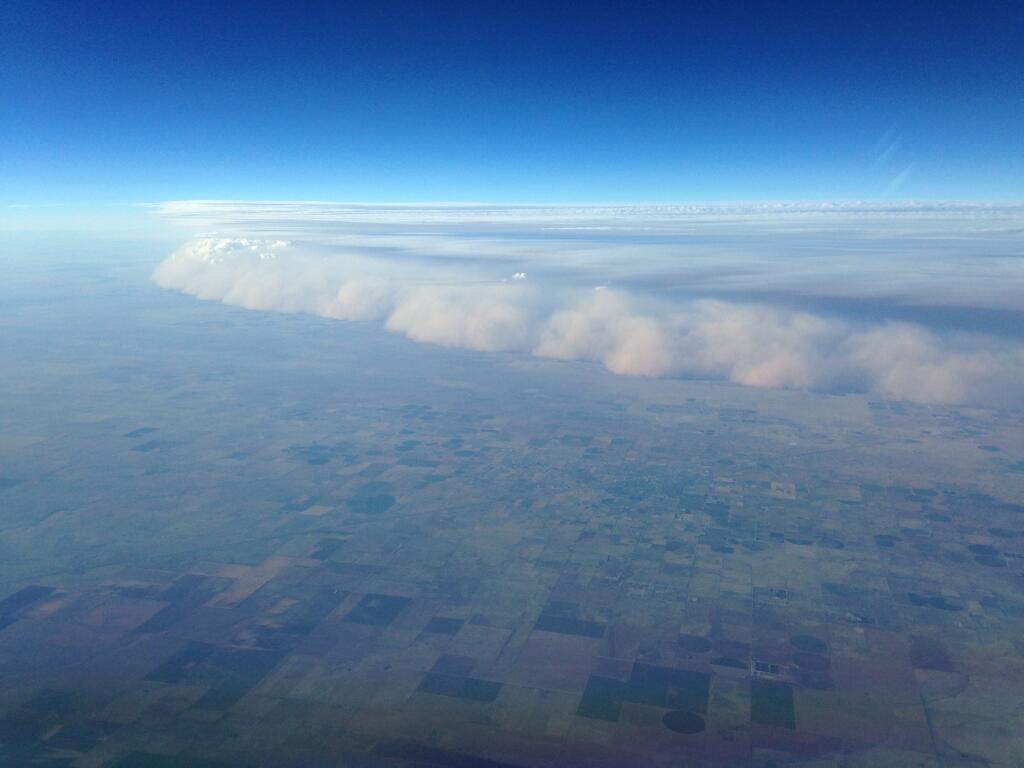
This aerial photo shows the leading edge of a haboob–an intense dust storm–sweeping across Texas last week. Although dust can be stirred up under many circumstances, haboobs are a specific meteorological phenomenon with winds as high as 100 kph and towering clouds of dust kilometers high. This particular storm swept through five US states last week along an incoming cold front. The winds accompanying the cold front swept up silt, dirt, and dust from the drought-ridden Southwest and carried it along to envelope towns and cities along the way. Although the term is Arabic in origin, haboobs occur throughout the world, typically at the leading edge of a cold front or thunderstorm. (Photo credit: R. Scott)
Flowing Uphill
Science Friday takes an inside look at self-propelled Leidenfrost droplets like those we’ve featured previously. The Leidenfrost effect takes place when a liquid comes in contact with a surface much, much hotter than its boiling point. Part of the liquid is vaporized, creating a thin gas layer that both insulates the remaining liquid and causes it to move with very little friction. Over a flat surface, this underlying vapor will spread in any direction. But by covering the surface with ratchets, it’s possible to direct the vapor in a particular direction, which propels the droplet in the opposite direction. Check out the video and our previous posts for more! (Video credit: Science Friday; via io9 and submitted by Urs)