Every year Chicago dyes its river green in honor of St. Patrick’s Day. This timelapse video shows this year’s dyeing, including several passes from a boat distributing the green dye. The color is remarkably slow to diffuse. The boat’s passage does little to affect the motion of the dye already in the river. This is because the boat mainly disturbs the surface and most of the color comes from dye spread throughout the water. It’s like if you tried to stir milk into your coffee just by tapping the surface with your spoon. Instead, the slower, large-scale turbulent motion of the river distributes the dye. For more St. Patrick’s Day physics, be sure to check out Guinness physics and why tapping a beer makes it foam. (Video credit: P. Tsai; submitted by Bobby E.)
Month: March 2014

“Demersal”


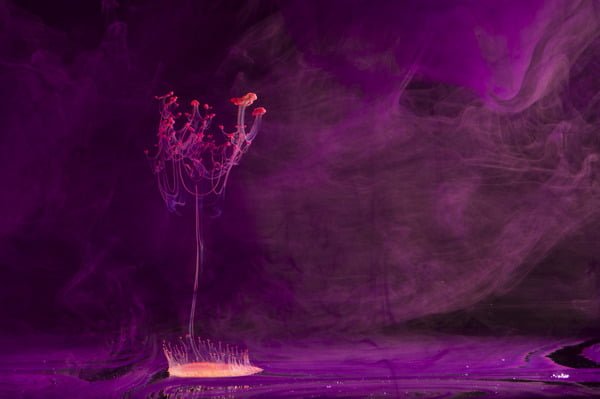

The ethereal shapes of inks and paints falling through water make fascinating subjects. Here the ink appears to rise because the photographs are upside-down. The fluid forms mushroom-like plumes and little vortex rings. The strands that split apart into tiny lace-like fingers are an example of the Rayleigh-Taylor instability, which occurs when a denser fluid sinks into a less dense one. Similar fingering can occur on much grander scales, as well, like in the Crab Nebula. These images come from photographer Luka Klikovac’s “Demersal” series. (Photo credit: L. Klikovac)

Vortex Ring Tricks
Vortex rings are wonderful at maintaining coherent vorticity while moving over significant distances. If you stand several meters from a foam cup and try blowing to knock it over, it’s not likely to budge. But move the air impulsively with a vortex cannon, and you can knock it over from the opposite side of the room. The same principle works underwater with added visual effect. Here an impulsive burst of air exhaled by the diver forms a bubble ring with vorticity strong enough to knock over a stack of rocks. It may look like a superpower, but this is science! Dolphins and whales are also known to play with this trick. For the non-scuba-divers among you, it’s also possible to learn to do it in a swimming pool. (Video credit: DjDeutchTv; h/t to coolsciencegifs)
Australian Fire Tornado
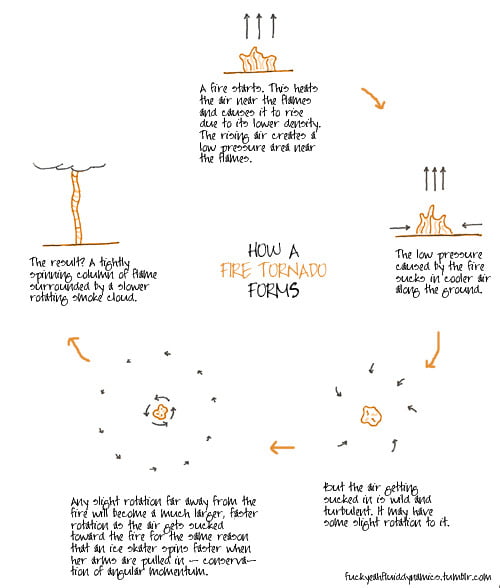
The fire tornado is one of nature’s most impressive and terrifying examples of fluid dynamics. Although they are relatively common phenomena, it’s rare to get such a clear glimpse of them since they usually occur in the midst of giant wildfires. The fire tornado is driven by a combination of updraft from the fire and rotation from the surrounding flow. Take a look at how they form:

There are artificial fire tornadoes as well, including homemade ones. That said, please do not try this at home without full safety measures and extreme caution. In general, watching YouTube videos is a much safer way to enjoy this phenomenon. (Video credit: C. Tangey; h/t to Flow Visualization)

Glacier Flows
These astronaut photos show Patagonian glaciers as seen from space. Glaciers form over many years when snow accumulates in larger amounts than it melts or sublimates. Over time the snow collects and is compacted into a dense ice which slowly flows downslope due to gravity. Many of the dark streaks in the photos are moraines, sediment formations deposited by the movement of the ice. Lateral moraines often line the edges of a glacier, and when two or more glaciers flow together, like in the lower left corner of both photos, the lateral moraines of each of the glaciers combine to form a medial moraine running through the combined glacial flow. (Photo credits: M. Hopkins and K. Wakata)
Hawk in Flight
For a little more than century, mankind has taken flight in fixed-wing aircraft. But other species have flown for much longer using flapping techniques, the details of which humans are still unraveling. To really appreciate flapping flight, it helps to have high-speed video, like this beautiful footage of a goshawk attacking a water balloon. The motion of the hawk’s wings is far more complex than the simple up and down flapping we imitate as children. On the downstroke, the wings and tail stretch to their fullest, providing as large an area as possible for lift. During steady flight, the bird flaps while almost horizontal for minimal drag, but as it approaches its target, it rears back, allowing the downstroke to both lift and slow the bird. In the upstroke, the bird needs to avoid generating negative lift by pushing air upward. To do this, it pulls its wings in and simultaneously rotates them back and up. Its tail feathers are also pulled in but to a lesser extent. Leaving them partially spread probably maintains some positive lift and provides stability. At the end of the upstroke, the hawk’s wings are ready to stretch again, and so the cycle continues. (Video credit: Earth Unplugged/BBC; h/t to io9)

“Aurora”
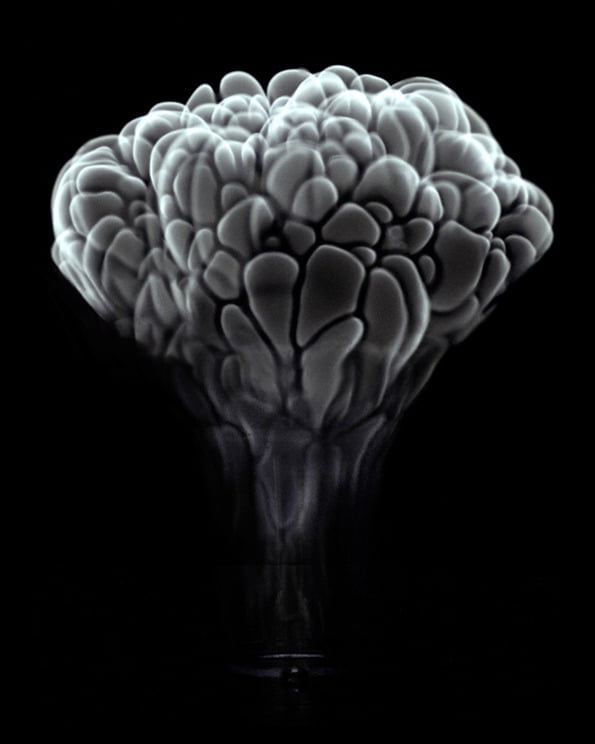
This bulbous, ethereal shape is a spreading flame front captured by artist Fabian Oefner in his new “Aurora” series. Oefner used a few alcohol droplets in a glass vessel and ignited the volatile vapors, capturing the propagating flame. Take a look at it in action. Because the air inside the vessel is mostly still, the chemical reactions in the combustion occur much faster than the air’s motion. As a result, the flame spreads as a thin sheet instead of a uniform, widespread flame. The wrinkled and corrugated look of the flame front is due local turbulence distorting the flame. (Photo credit: F. Oefner)
When Turbulence Is Desirable
One of the common themes in aerodynamics, especially in sports applications, is that tripping the flow to turbulence can decrease drag compared to maintaining laminar flow. This seems counterintuitive, but only because part of the story is missing. When a fluid flows around a complex shape, there are actually three options: laminar, turbulent, or separated flow. An object’s shape creates pressure forces on the surrounding fluid flow, in some cases causing an increasing, or unfavorable, pressure gradient. When this occurs, fluid, especially the slower-moving fluid near a surface, can struggle to continue flowing in the streamwise flow direction. Consider the video above, in which the flow moves from left to right. Near the surface a turbulent boundary layer is visible, where fluid motion is significantly slower and more random. Occasionally the flow even reverses direction and billows up off the surface. This is separation. Unlike laminar boundary layers, turbulent boundary layers can better resist and recover from flow separation. This is ultimately what makes them preferable when dealing with the aerodynamics of complex objects. (Video credit: A. Hoque)

Viscosity’s Impact
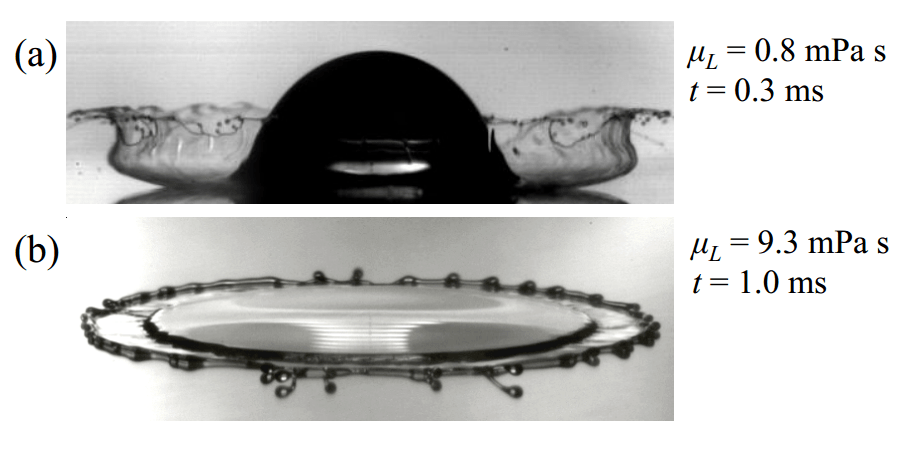
Everyone has seen drops of liquid falling onto a dry surface, yet the process is still being unraveled by researchers. We have learned, for example, that lowering the ambient air pressure can completely suppress splashing. Viscosity of the fluid also clearly plays a role, but the relationship between these and other variables is unclear. The images above show two droplet impacts in which the viscosity differs. The top image shows a low viscosity fluid, which almost immediately after impact forms a thin expanding sheet of fluid that lifts off the surface to create a crownlike splash. In contrast, the higher viscosity fluid in the bottom image spreads as a thick lamella with a thinner outer sheet that breaks down at the rim. Researchers found that both the high- and low-viscosity fluids have splashes featuring these thin liquid sheets, but the time scales on which the sheet develops differ. Moreover, lowering the ambient pressure increases the time required for the sheet to develop regardless of the fluid’s viscosity. (Image credit: C. Stevens et al.; submitted by @ASoutIglesias)
When Jets Collide
When two jets of a viscous liquid collide, they can form a chain-like stream or even a fishbone pattern, depending on the flow rate. This video demonstrates the menagerie of shapes that form not only with changing flow rates but by changing how the jets collide – from a glancing impingement to direct collision. When just touching, the viscous jets generate long threads of fluid that tear off and form tiny satellite droplets. At low flow rates, continuing to bring the jets closer causes them to twist around one another, releasing a series of pinched-off droplets. At higher flow rates, bringing the jets closer to each other creates a thin webbing of fluid between the jets that ultimately becomes a full fishbone pattern when the jets fully collide. The surface-tension-driven Plateau-Rayleigh instability helps drive the pinch-off and break-up into droplets. (Video credit: B. Keshavarz and G. McKinley)