Wind tunnel testing is an important step in designing new aircraft. This video shows footage of visualization tests of the 21-ft wingspan Boeing X-48C model in NASA Langley’s Full-Scale Tunnel. The X-48C is a blended wing body design capable of higher lift-to-drag ratios than conventional aircraft, which should lead to a higher range and greater fuel economy. The video shows some smoke visualization that illustrates airflow around the airfoil-shaped craft. The long probe sticking forward from the starboard wing is used to measure air pressure, angle of attack, and sideslip angle of the model. Notice how smoke from the wand is pulled from below the leading edge of the wing up and over the top of the wing. This is because there is lower pressure over the top of the wing than the bottom, and, like an electrical charge seeking the path of least resistance, fluids flow preferentially toward lower pressures. (Video credit: NASA Langley)
Year: 2013

Ferrofluid Thrusters
Ferrofluids–magnetically-sensitive fluids made up of a carrier liquid and ferrous nanoparticles–may soon have a new application as a miniature thruster on nanosatellites. Microspray thrusters use tiny hollow needles to electrically spray jets of liquid that propel a satellite. But manufacturing the fragile microscopic needles used to disperse the propellant is expensive. Instead researchers are now using ferrofluids to create both the needle-like structures and to serve as the propellant. A ring of ferrofluid is placed on the thruster surface and a magnetic field applied to create the ferrofluid’s distinctive spikes. Then, when an electric force is applied, tiny jets of ferrofluid spray out from each tip, creating thrust. Unlike the conventional needles, the ferrofluid spikes are robust and can reform after being disturbed. (Photo credit: L. B. King et al.; submitted by jshoer)

Liquids Pinching Off
There is a surprising variety of forms in the pinch-off of a liquid drop. This short video shows three examples, and you’ll probably find yourself replaying it a few times to catch the details of each. On the left, a drop of water pinches off in air. As the neck between the nozzle and the drop elongates, the drop end of the neck thins to a point around which the drop’s surface dimples. This is called overturning. When the drop snaps off, the neck disconnects and rebounds into a smaller satellite droplet. The middle video shows a drop of glycerol, which is about 1000 times more viscous than water. This droplet stretches to hang by a thin neck that remains nearly symmetric on the nozzle end and the drop end. There is no satellite drop when it breaks. The rightmost video shows a polymer-infused viscoelastic liquid pinching off. This liquid forms a very long, thin thread with a fat satellite drop still attached. When gravity eventually becomes too great a force for the stresses generated by the polymers in the liquid, the drops break off. (Video credit: M. Roche)

Spiraling Break-up
Instabilities in fluids are sometimes remarkable in their uniformity. Here we see a hollow spinning cup with a thin film of fluid flowing down the interior. The rim of fluid at the cup’s lip stretches into long, evenly spaced, spiraling threads. These filaments stretch until centrifugal forces overcome surface tension and viscous forces and break the liquid into a multitude of tiny droplets. This process is called atomization and is vital to everyday applications like internal combustion and inkjet printing. (Photo credit: R. P. Fraser et al.)

Fluids Round-up – 7 September 2013
Lots of great links in this week’s fluids round-up!
- Scientific American discusses how dogs use adhesion of water to their tongues to drink. We’ve mentioned this previously, as well as how it’s the same method cats use.
- Wired has a great look inside the NASA Ames Vertical Gun Range and how it’s used for impact cratering studies.
- Artist Fabian Oefner, whose work we’ve featured previous (1, 2, 3), gave a TEDx talk on mixing art and science, using acoustics and ferrofluids.
- Veritasium’s video on vibrating oobleck on a speaker has some nice visuals, and his suggestion of the behavior of highway traffic as a non-Newtonian fluid is intriguing. I generally consider such traffic to be a prime example of compressible flow, but that’s a whole post in and of itself.
- GE’s 6secondscience fair challenges participants to fit their science into 6 seconds of video. There are some great fluids examples, as seen in this compilation video. (submitted by jshoer) For a breakdown of each scientific concept, check out It’s Okay to be Smart’s list.
- I don’t know about you, but this bus window would keep me entertained for my whole commute. It’s like a 2D lesson in Newton’s laws and sloshing. (submitted by Erik M)
- There are some epic and beautiful examples of fluid dynamics in this collection of Red Bull Illume photo contest winners. (via +Jennifer Ouellette)
- Finally, this week’s lead image is a collage of gorgeous microfluidic multi-fluid emulsions. Learn more about them over at Physics in Drops.
(Photo credit: L. L. A. Adams)
Rebounding Jets

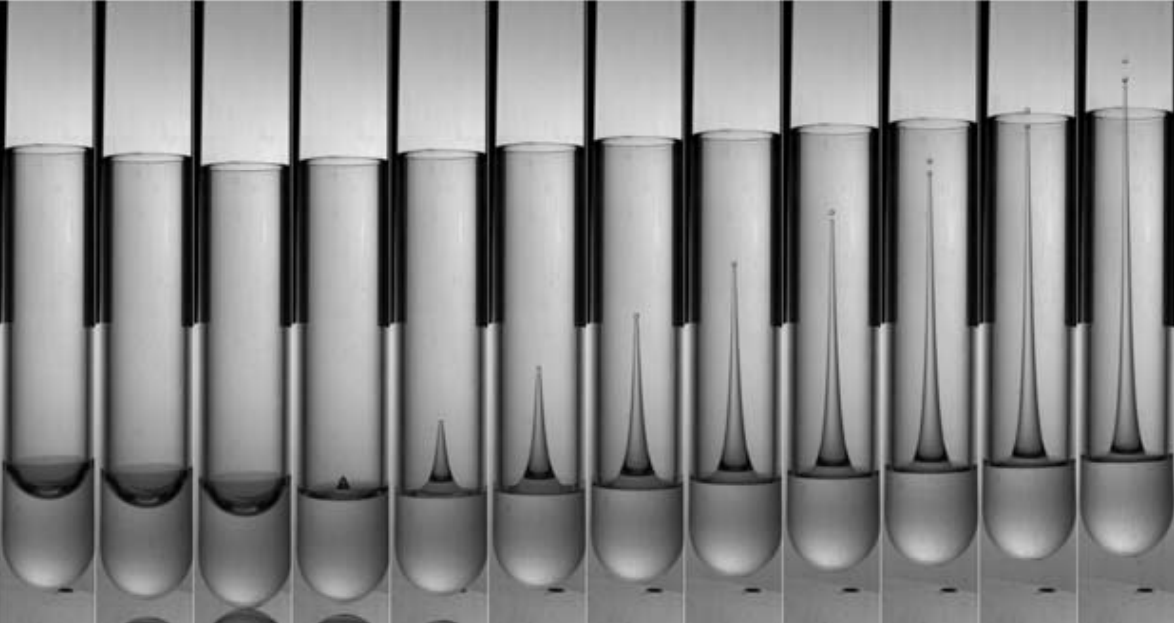
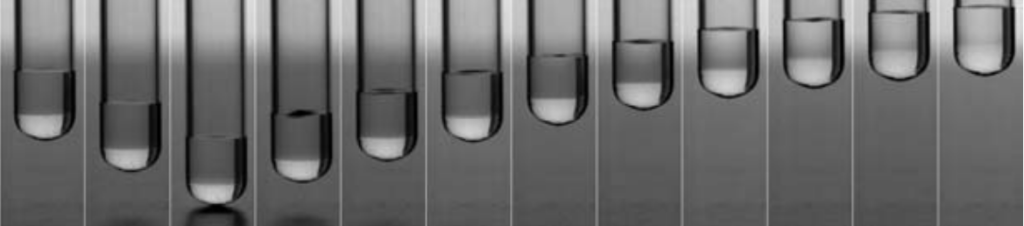
The photo sequence in the upper image shows, left to right, a fluid-filled tube falling under gravity, impacting a rigid surface, and rebounding upward. During free-fall, the fluid wets the sides of the tube, creating a hemispherical meniscus. After impact, the surface curvature reverses dramatically to form an intense jet. If, on the other hand, the tube is treated so that it is hydrophobic, the contact angle between the liquid and the tube will be 90 degrees during free-fall, impact, and rebound, as shown in the lower image sequence. The liquid simply falls and rebounds alongside the tube, without any deformation of the air-liquid interface. (Photo credit: A. Antkowiak et al.)
Stingray Wakes
This numerical simulation shows a swimming stingray and the vorticity generated by its motion. Stingrays are undulatory swimmers, meaning that the wavelength of their motion is much shorter than their body length. Manta rays, in contrast, move their fins through a wavelength longer than their body length, making them oscillatory swimmers. Observe the difference in this video. To swim faster, stingrays increase the frequency of their undulation, not the amplitude. This is quite common among swimmers because increasing the amplitude also increases projected frontal area, which causes additional drag. Increasing the frequency of motion does not affect the projected area, making it the more efficient locomotive choice. (Video credit: G. Weymouth; additional research credit: E. Blevins; submitted by L. Buss)
Also, FYFD now has a Google+ page for those who prefer to follow along and share that way. – Nicole

Ink Diffusion


Alberto Seveso’s gorgeous high-speed photos of ink diffusing in water have a dramatic sense of texture to them. Though still delicate, the whorls of fluid seem almost solid enough to touch. Watch the edges, though, and you can see thin wisps of color and hints of instabilities. Like cream poured into coffee, these ink sculptures are short-lived. Some of his works are available as prints or wallpapers (zip file). (Photo credit: Alberto Seveso)

The Real Raindrop
What is the shape of a falling raindrop? Surface tension keeps only the smallest drops spherical as they fall; larger drops will tend to flatten. The very largest drops stretch and inflate with air as they fall, as shown in the image above. This shape is known as a bag and consists of a thin shell of water with a thicker rim at the bottom. As the bag grows, its shell thins until it ruptures, just like a soap bubble. The rim left behind destabilizes due to the surface-tension-driven Plateau-Rayleigh instability and eventually breaks up into smaller droplets. This bag instability limits the size of raindrops and breaks large drops into a multitude of smaller ones. The initial size of the drop in the image was 12 mm, falling with a velocity of 7.5 m/s. The interval between each image is 1 ms. (Photo credit: E. Reyssat et al.)
10 Years of Weather
This timelapse video captures the past 10 years’ worth of weather as seen by the GEOS-12 satellite during its service. It’s a mesmerizing look at the large-scale convective flow of Earth’s atmosphere. The prevailing winds for each region are clear from the motion of the clouds, but short-term effects are visible as well. June through November marks the Atlantic hurricane season, and you can see as storm after storm gets generated near western Africa and shoots westward toward North and Central America. You can also see the pattern tracks of these storms in these maps, which show 170 years’ worth of worldwide hurricane tracks. (Video credit: NOAA; via Scientific American)