Year: 2013

  • Fluids Round-up – 21 September 2013

    Fluids Round-up – 21 September 2013

    First off, I’d like to give a special shout-out to FYFD’s friends at Pointwise, who were kind enough to invite me for a visit this week. For any readers looking for CFD grid-generation software, check them out; they are a fantastic bunch and very good at what they do.

    My thanks again to everyone who donated this week to help get me to the APS conference. The campaign is still open if anyone wants to get in on the FYFD wallpapers and stickers on offer to donors. As a reminder, any funds beyond conference costs will go toward improving FYFD, including getting equipment to make FYFD videos. On to the fluids round-up!

    (Photo credit: L. Gilman)

  • Other Ig Nobel Fluids

    Other Ig Nobel Fluids

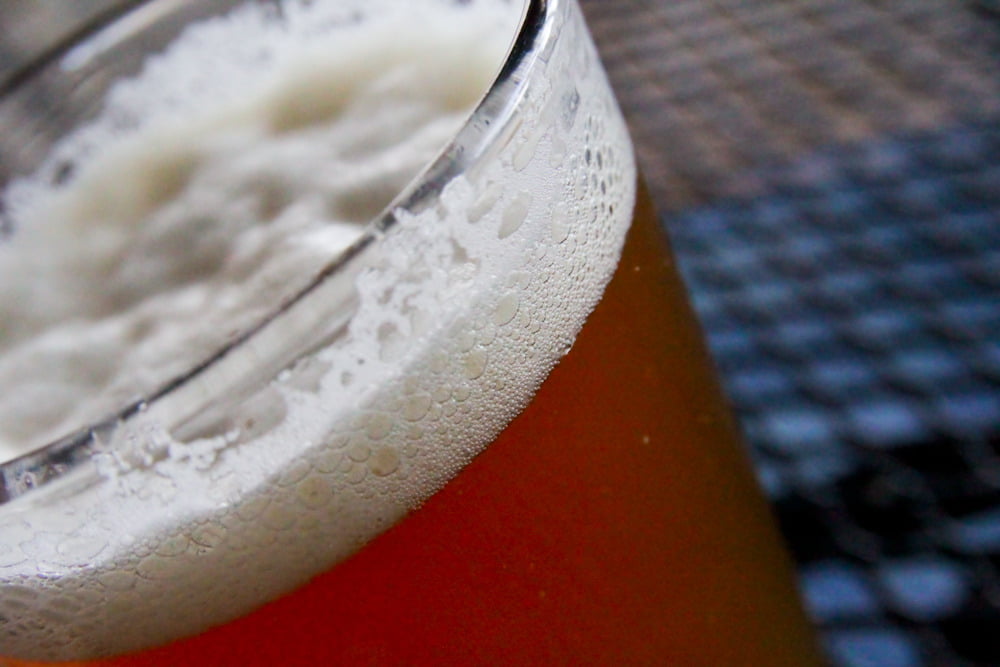
    To round out our series on fluid dynamics in the Ig Nobel Prizes (which are not the same thing as the actual Nobel Prizes), here are some of the other winners. Last year Mayer and Krechetnikov won for a study on coffee sloshing when people walk. We’ve mentioned the pitch-drop experiment measuring the viscosity of an extremely viscous fluid a couple times; Mainstone and Parnell won a 2005 Ig Nobel for that (on-going) work. Another 2005 prize went to Meyer-Rochow and Gal for calculating the pressures involved in penguin defecation. (Yes, seriously.) A avian-related award was also handed out to B. Vonnegut for estimating tornado wind speeds by their ability to strip a chicken of its feathers. And, finally, for those looking to interest undergraduate lab students in mathematics and fluid dynamics, I suggest following the lead of 2002 winner A. Leike who demonstrates laws of exponential decay with beer head. (Photo credit: S. Depolo)

  • Ig Nobel Fluids: Shower Curtain Science

    Ig Nobel Fluids: Shower Curtain Science

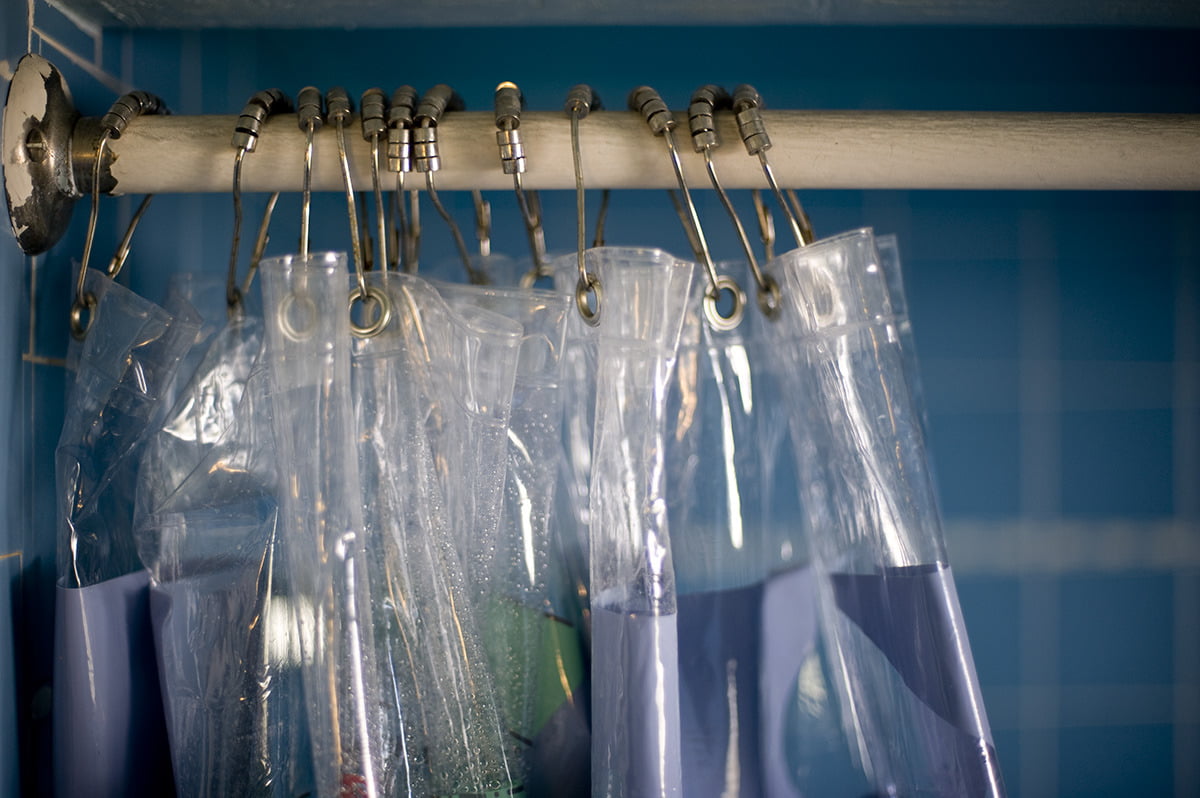
    Nearly everyone has faced the frustration of a shower curtain billowing inwards to stick to one’s leg. Various explanations have been offered to explain the effect, but David Schmidt won the 2001 Ig Nobel Prize in Physics for a numerical simulation suggesting that the spray of droplets from the shower head drives a horizontal vortex whose axis of rotation is perpendicular to the shower curtain. Since vortices have a low-pressure region in their core, this weak shower vortex has the power to suck a light curtain inward, much to the chagrin of the shower’s occupant. Of course, a heavier or weighted shower curtain will help avoid the effect. This post is part of a series on fluids-related Ig Nobel Prizes. (Photo credit: W. Taylor; research credit: D. Schmidt)

  • Ig Nobel Fluids: Swimming in Syrup

    Ig Nobel Fluids: Swimming in Syrup

    Does a person swim faster in water or syrup? One expects the more viscous syrup would offer a swimmer greater resistance, but, at the same time, it could also provide more to push against. Gettelfinger and Cussler put this to a test experimentally with competitive and recreational swimmers in a pool of water and in one with a fluid measuring roughly twice the viscosity of water. Their results showed no significant change in swimming speed. When you consider that human swimming is highly turbulent, however, the result makes sense. In fluid dynamics, the dimensionless Reynolds number represents a ratio between inertial forces and viscous forces in a flow. The researchers estimate a Reynolds number of a typical human in water at 600,000, meaning that inertial effects far outweigh viscous effects. In this case, doubling the viscosity only reduces the Reynolds number by half, leaving it still well inside the turbulent range. Thus, swimming in syrup has little effect on humans. The Mythbusters also tackled this problem, with similar conclusions. This is a continuation of a series on fluids-related Ig Nobel Prizes. (Photo credit: Mythbusters/Discovery Channel; research credit: B. Gettelfinger and E. L. Cussler, winners of the 2005 Ig Nobel Prize in Chemistry)

  • Thank You!

    Thank You!

    I have the best readers in the world. Seriously, everyone one of you is amazing. In less than 23 hours, you have blown past the goal I set. I will be going to the APS Division of Fluid Dynamics meeting thanks to you. THANK YOU!

    For those of you reading who will be at APS, I plan to do my utmost to be available to grab a coffee between sessions, hang out, discuss research, talk outreach, go out to dinner – whatever! For those of you who won’t be there, I want to share as much of the experience as possible with you through social media. Prepare to be inundated at the end of the November. Without all of you, I wouldn’t be at APS, and I’d like everyone who contributed to have a chance to enjoy the experience.

    Per IndieGoGo’s terms, the campaign will remain open until its October 11th deadline. Any contributions I receive above and beyond my APS costs, I plan to set aside for improvements to FYFD. The reader survey indicated lots of you would like me to make my own videos, and I aim to. Extra funds will first go toward equipment for that purpose.

    Thank you again to each and every one of you, whether you contributed your money or helped spread the word. I appreciate everything you’ve done for me and will continue striving to bring the best of fluid dynamics to FYFD every weekday. Thank you all!

  • Ig Nobel Fluids: Cookie Dunking

    Ig Nobel Fluids: Cookie Dunking

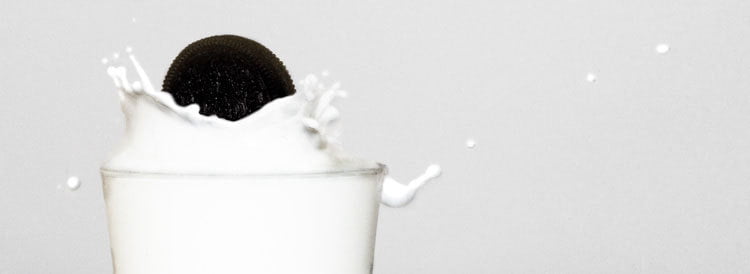
    Back in 1999 Len Fisher earned an Ig Nobel Prize in Physics for explaining the physics of dunking a biscuit or cookie in a liquid. The cookie is porous, with many tiny, interconnecting channels run throughout it. When dipped in a liquid, capillary action pulls the fluid up into these channels against the force of gravity. As most people discover, this wetting can soften the cookie to the point of collapse. The optimal manner of dunking then is to hold the cookie at a shallow angle; this allows the lower surface to soak in milk (or the hot beverage of your choice) while keeping the upper surface dry and structurally sound. Fisher further argued that Washburn’s equation, which describes the time necessary for capillary action to draw a liquid up a given length of a cylindrical pore gives a good estimate of the length of time for a cookie dunking. This proved so popular he even wrote a book about it. This is a part of a series on fluids-related Ig Nobel Prizes. (Photo credit: C. Lindberg; research credit: L. Fisher)

  • Featured Video Play Icon

    Help FYFD Get to APS DFD 2013

    Readers, I need your help! Funding for my project got cancelled prematurely thanks to sequester-induced budget cuts and my research group no longer has the funds to send me to the American Physical Society’s Division of Fluid Dynamics meeting where I am scheduled to give two talks, one about FYFD and one about my research. APS’s DFD meeting is the big fluid dynamics conference of year, where thousands of researchers, professionals, and students come together to present their work. It’s always a major source of beautiful, interesting, and exciting photos and videos for FYFD. I’m asking you to help me raise the $2000 I need to attend. Watch the video, check out the perks available for donors over at IndieGoGo, and please help me spread the word by reblogging, retweeting, etc. Thank you!

  • Featured Video Play Icon

    Ig Nobel Fluids: Running on Water

    While insects are small enough to use surface tension to stay atop water, larger species like the basilisk lizard run on water by slapping their feet against the surface hard enough to generate the force to stay above the surface. A. Minetti and colleagues won this year’s Ig Nobel Prize in Physics for demonstrating that humans, too, can achieve this feat – when outfitted with stiff, large area fins and exposed to gravity less than 22% of Earth’s. The researchers adapted a model for the running lizard to human scales and then tested the model using subjects suspended by harness and running in place atop a wading pool while subjected to various lighter-than-earth simulated gravities. Both the model and experiment agreed that human muscles were unable to produce sufficient force to stay above the water at higher than 0.22g. Interestingly, the authors also observed that the water-running gait for both lizards and humans has more in common with the pedaling motion of cycling than a human’s bouncing gait for terrestrial running. (Video credit: A. Minetti et al.)

  • Fluid Dynamics and the Nobel Prize

    Fluid Dynamics and the Nobel Prize

    Last night marked the 2013 Ig Nobel Prize Award Ceremony, in which researchers are honored for work that “makes people LAUGH and then THINK”. Historically, the field of fluid dynamics has been well-represented at the Ig Nobels with some 13 winners across the fields of Physics, Chemistry, Mathematics, and–yes–Fluid Dynamics since the awards were introduced in 1991. This is in stark contrast to the awards’ more famous cousins, the Nobel Prizes.

    Since the introduction of the Nobel Prize in 1901, only two of the Physics prizes have been fluids-related: the 1970 prize for discoveries in magnetohydrodynamics and the 1996 prize for the discovery of superfluidity in helium-3. Lord Rayleigh (a physicist whose name shows up here a lot) won a Nobel Prize in 1904, but not for his work in fluid dynamics. Another well-known Nobel laureate, Werner Heisenberg, actually began his career in fluid dynamics but quickly left it behind after his doctoral dissertation: “On the stability and turbulence of fluid flow.”

    This is not to suggest that no fluid dynamicist has done work worthy of a Nobel Prize. Ludwig Prandtl, for example, revolutionized fluid dynamics with the concept of the boundary layer (pdf) in 1904 but never received the Nobel Prize for it, perhaps because the committee shied from giving the award for an achievement in classical physics. General consensus among fluid dynamicists is that anyone who can prove a solution for turbulence using the Navier-Stokes equation will likely receive a Nobel Prize in addition to a Millennium Prize. In the meantime, we carry on investigating fluids not for the chance at glory, but for the joy and beauty of the subject. (Image credits: Improbable Research and Wikipedia)

  • Selective Suction

    Selective Suction

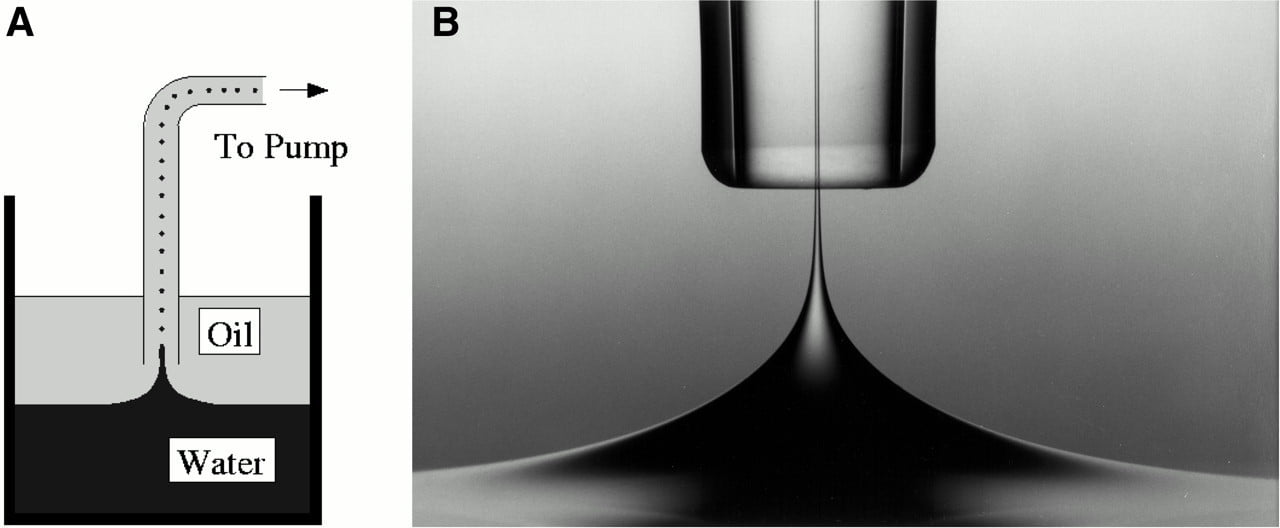
    A thin spout of water is drawn up through a layer of oil in the photo on the right. This simple version of the selective withdrawal experiment is illustrated in Figure A, in which a layer of viscous oil floats above a layer of water. A tube introduced in the oil sucks fluid upward. At low flow rates, only the oil will be drawn into the tube, but as the flow rate increases (or the tube’s height above the water decreases), a tiny thread of water will be pulled upward as well. The viscous outer fluid helps suppress instabilities that might break up the inner fluid, and their relative viscosities determine the thickness of the initial spout. In this example, the oil is 195 times more viscous than the water. (Photo credit: I. Cohen et al.)