Year: 2011

  • Tour de France Physics: Pelotons

    Tour de France Physics: Pelotons

    July is well underway and for cycling fans around the world that means it’s time for the Tour de France. This week at FYFD we’re going to do something a little different: in honor of cycling’s biggest race, every post this week will focus on some of the fluid dynamics involved in the sport.

    On a bicycle, except when climbing, the majority of a rider’s energy goes toward overcoming aerodynamic drag. Riders wear close-fitting clothes to reduce skin friction and loss to flapping fabric, but most of their drag is pressure-based. A blunt object disturbs the airflow around it, usually resulting in separated flow in its wake. A high pressure region forms in front of the rider and a low pressure region forms in the separated flow behind them. This pressure difference literally pulls the rider backwards. Since drag goes roughly as speed squared, adding a headwind makes matters even worse for a cyclist.

    In races, especially on flat stages, the majority of the riders will stay in a large group called a peloton in order to counteract these aerodynamics. By riding in the wakes of those in the front, riders in the peloton experience a much smaller front-to-back pressure difference and thus much less drag. For a rider in the midst of the peloton, the drag reduction can be as great as 40% (#). This allows riders to conserve energy for solo efforts near the end of the race or stage, like breaking away from the peloton in the final kilometers or winning a sprint for the finish line. (Photo credit: Wade Wallace)
  • STS-135: The Final Shuttle Flight

    STS-135: The Final Shuttle Flight

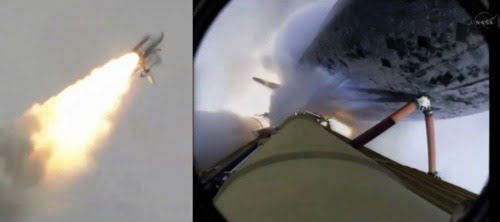
    Condensation clouds form around sections of Atlantis as STS-135–the final space shuttle flight–launches from Cape Canaveral this morning. These clouds, also called Prandtl-Glauert singularities or vapor cones, form at transonic speeds when air accelerates around the vehicle. The area just behind these shock waves experiences a drop in pressure and temperature that brings a localized portion of the flow below the dew point. Rapid condensation of the moisture in the air results. Miss the launch? Watch it here.

  • Featured Video Play Icon

    High Hopes

    This gorgeous high-speed video captures bubbles, droplets, wakes, cavitation, coalescence, jets, and lots of surface tension at 7000 fps. The authors unfortunately haven’t indicated whether this is air in water or something more viscous, but regardless there are some great phenomena on display here. # (via Gizmodo)

  • Wind Tunnel Testing

    Wind Tunnel Testing

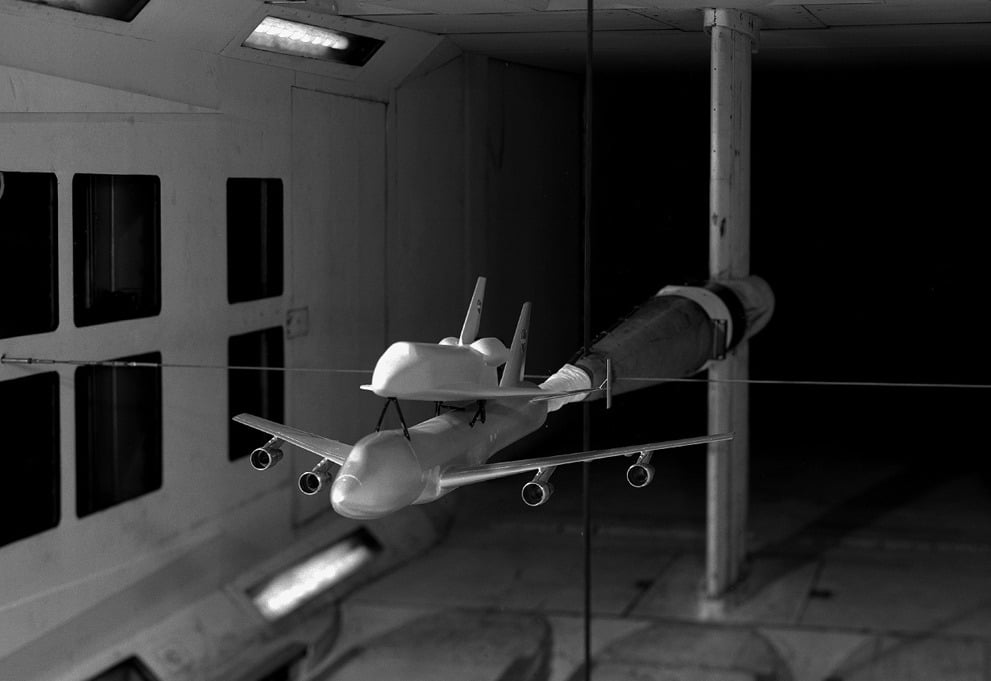
    A scale model of the Space Shuttle attached to its modified 747 carrier hangs in a NASA wind tunnel. Wind tunnel tests can be used for flow visualization, lift and drag measurements, control system checks and so forth, but mounting models correctly and safely in the tunnel is crucial. Many models use sting mounts that project forward, as this one does, in order to expose the model to freestream flow unimpeded by the mounting mechanism. Any mounts and models must also be sturdy enough that all or part of them does not break off mid-test and fly into the wind tunnel’s fans. #

  • Featured Video Play Icon

    High-Res Rayleigh-Taylor Instability

    When a heavy fluid sits atop a lighter fluid, the interface between the two breaks down through the Rayleigh-Taylor instability. This computation of a 2D interface shows the near fractal behavior of this instability as whorls and eddies of all different scales form and mix the fluids. (submitted by @markjstock)

  • Whipping Instability

    Whipping Instability

    A droplet of glycerol coalescing in silicone oil while subjected to strong electric fields exhibits a whip-like instability reminiscent of fireworks. Check out videos of the phenomenon or see the paper for more information. Happy Independence Day to our American readers!

    For more fun, holiday-themed high-speed video, check out PopSci’s fireworks videos.

  • Featured Video Play Icon

    Triggering Avalanches

    Humans often trigger avalanches purposefully before natural ones can occur. Either way, avalanches begin when external stresses on the snow pack exceed the strength within the snow pack or at the contact between the snow and the ground. Acceleration of the snow is gravity-driven. If the snow mixes with air, powder clouds can form that carry snow even further than the main slab. Although the snow itself is not a fluid, once an avalanche gets moving, its behavior can be better modeled as a fluid than as a solid.

  • Evolving Flight

    Evolving Flight

    Flapping wings while running may have helped the evolutionary ancestors of birds develop flight. Experiments with modern birds show that flapping wings while running helps even flight-capable birds ascend slopes and uses only 10% as much power as actual flight along a 65-degree incline. #

  • Rocket Diamonds

    Rocket Diamonds

    The exhaust of a Pratt and Whitney J58 shines with Mach diamonds, a series of shock waves and expansion fans that form to equalize the exhaust and ambient pressures. This pattern can occur any time an engine nozzle operates at its non-ideal altitude.

  • Featured Video Play Icon

    Propeller Cavitation

    Cavitation occurs in moving liquids when the local pressure–in this case, at the tip of the propeller–drops below the vapor pressure. The fast-moving fluid transitions to a gas phase, creating a tip vortex of water vapor even though the propeller is completely submerged.