High-speed video of a tank firing at 18000 fps shows shock waves made visible due to light distortion. When the air density changes (due to temperature or compression), it’s index of refraction changes, causing the background to appear distorted. Most of the video shows the subsonic development of the turbulent exhaust plume. Note the speed at which the exhaust moves relative to the airborne shrapnel. (submitted by Stephan)
Year: 2011

Shear-Thinning at Home
Shear-thinning isn’t just confined to canned whipped cream. It’s also a feature of such non-Newtonian fluids as ketchup, shampoo, latex paint, and blood. The NASA research on shear-thinning the video author refers to is here and comes from the Critical Viscosity of Xenon-2 (CVX-2) experiment flown on the final mission of Columbia. Surprisingly, almost all of the experimental data was recovered from the crash. #
Liquid Rope Coiling
Some liquids, when falling in a stream into a pool, tend to coil into a liquid rope. This video shows honey, but the effect can also be observed in syrups and silicone oil. The rate of coiling is dependent on the height from which the liquid falls. Other factors governing coiling include viscosity, density, and flow rate.

Drafting Flags
Wired Science has published a gallery of fluid dynamics photos and videos, several of which have been featured here previously. There’s some neat stuff there, well worth checking out. #
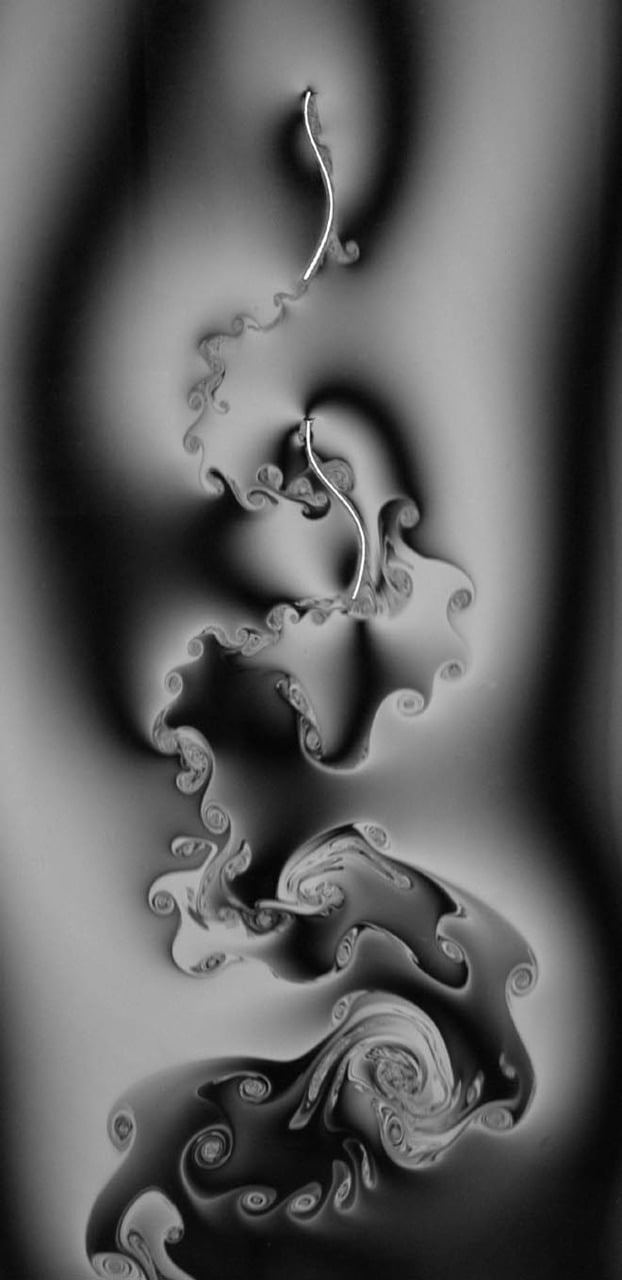
This image shows two flags oriented in line with a film flowing top to bottom. The second flag interrupts the wake of the first one, which reduces the drag experienced by the first flag and increases that on the second. This is called inverted drafting and occurs because the flags are passive objects that bend to every change in the flow. #

Stall-Sensing Hairs
Bats use tiny hairs on their wings to sense the direction and speed of air flow. Researchers found that removing these hairs caused bats to fly faster and make wider turns, likely because the bat believed it was on the verge of stalling and losing lift. Engineers are considering whether artificial versions made of flexible polymers that respond to strain could provide improved stall sensing on fixed-wing aircraft. # (Photo credit: justynk)
Solutal Convection
Solutal convection, rather than relying on temperature gradients, can occur due to gradients in concentration or in surface tension. While less spectacular than this previously posted video, this video contains a nice simplified explanation of the mechanism. And, as noted in the video, this is a demo you can do yourself at home.

Beluga Whale Bubble Rings
Beluga whales and dolphins in captivity have taken to blowing bubble rings to entertain themselves. You can learn how to do the same in the pool. #

X-51A Scramjet Test Flight
The X-51A Waverider hypersonic aircraft had its second test flight earlier this week. Unfortunately, its supersonic combustion ramjet (scramjet) engine failed to transition from its start-up fuel to its primary fuel. According to the US Air Force Research Laboratory:
A US Air Force B-52H Stratofortress released the experimental vehicle from an altitude of approximately 50,000 feet. After release the X-51A was initially accelerated by a solid rocket booster to a speed just over Mach 5. The experimental aircraft’s air breathing scramjet engine lit on ethylene and attempted to transition to JP7 fuel operation when the vehicle experienced an inlet un-start. The hypersonic vehicle attempted to restart and oriented itself to optimize engine start conditions, but was unsuccessful. The vehicle continued in a controlled flight orientation until it flew into the ocean within the test range. #
Un-starting is the term used when supersonic flow is lost in an engine or wind tunnel. If the pressure or temperature in the engine deviates too far from the ideal conditions, the upstream mass flow through the engine will be greater than the downstream mass flow and the engine will choke (video). A shock wave forms and travels upstream, leaving subsonic flow in its wake. Loss of supersonic flow inside the engine would likely also result in losing ignition of the fuel/air mixture, resulting in flameout. #
If you haven’t guessed already, engineers like to make up words.
Droplet Impact
As a droplet impacts a pool, it deforms the surface before rebounding in a Worthington jet and releasing secondary droplets as ejecta. Although we witness this act dozens of times a day, seeing it at 5,000 fps drastically alters one’s perspective.

Cloud Wakes Off Islands
This satellite image shows the cloud wakes of two small, volcanic islands off the coast of Chile. The disruption in airflow caused by the islands results in 100 km long cloud-free V-shaped wakes, even though the islands themselves are barely visible in the image. Such variation in the size of the obstacle compared to its effect is not unusual in fluid mechanics, but the scale, in this case, is impressive. #