Ground effect vehicles (a.k.a. wing-in-ground-effect vehicles) rely on their proximity to a flat surface to inhibit the wingtip vortices that create lift-induced drag. This effectively increases the lifting capabilities of the vehicle in comparison to regular flight, but only so long as the vehicle remains close enough to the ground. This video features many model gliders that rely on ground effect.
Year: 2011

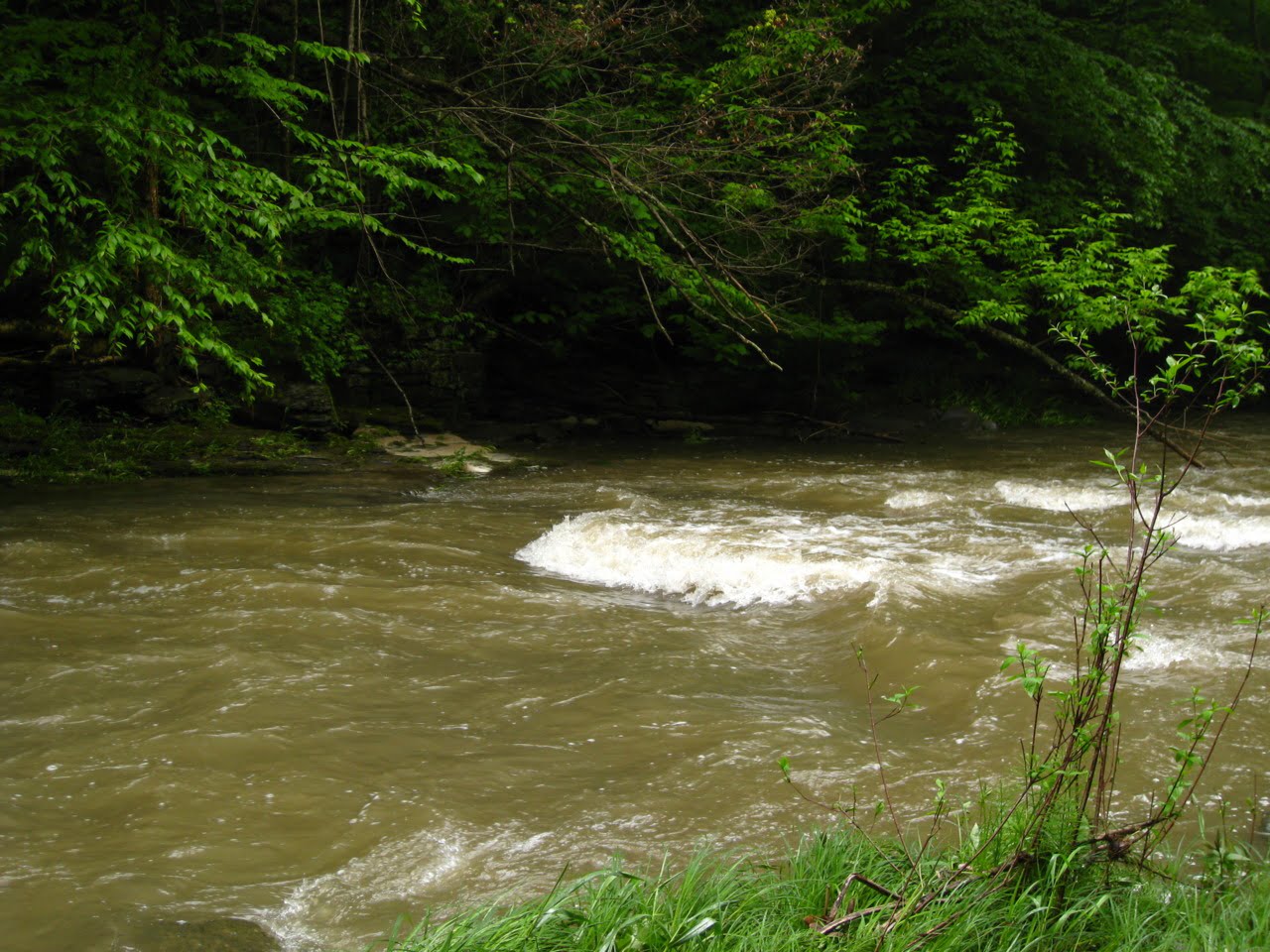
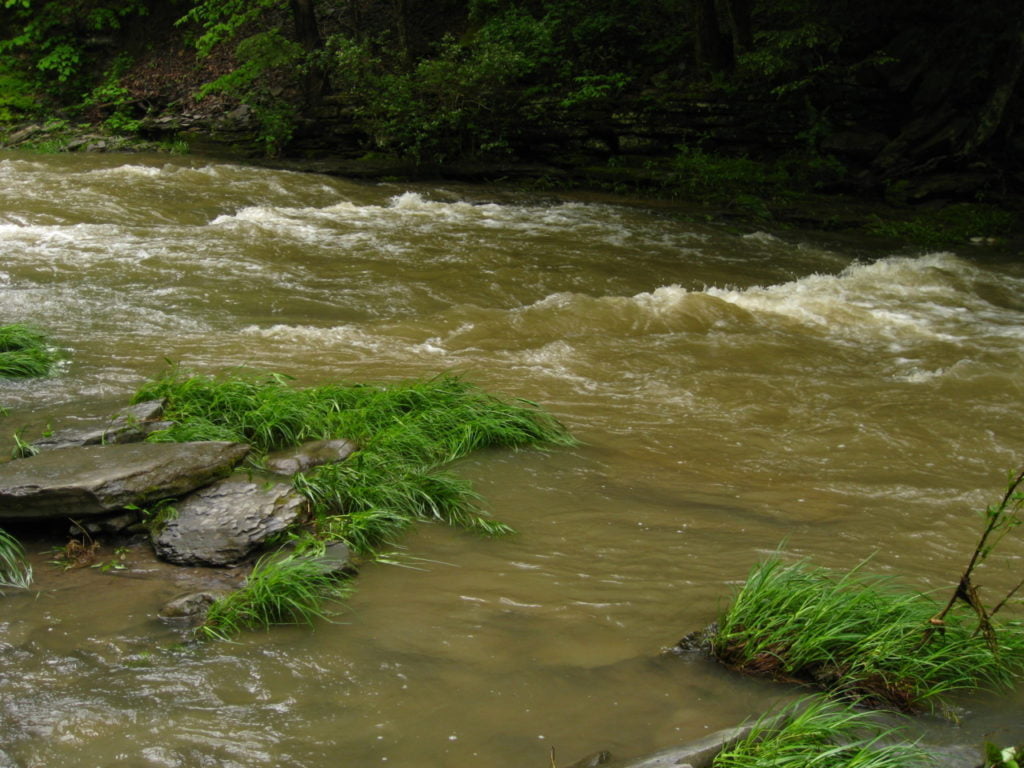
River Jumps

Hydraulic jumps occur when a high velocity liquid runs into an area of low velocity liquid. The faster moving liquid decelerates rapidly and increases in height, effectively trading kinetic energy for potential energy. The phenomenon is frequently observed in open channel flow, like in spillways or along rivers, as in the photos above. In nature, the hydraulic jump will often be laminar upstream and turbulent downstream. #

Vortex Shedding from a Hot Cylinder
This numerical simulation shows vortex shedding behind a hot cylinder. The behavior is very similar to what one sees behind an unheated cylinder, until the coefficient of thermal expansion increases and the von Karman vortex street is completely distorted. Describing the particulars of the computation, jessecaps writes (links added):
I wrote an incompressible flow solver to simulate flow past a heated cylinder. The Navier-Stokes equations are discretized on a Cartesian grid and solved explicitly in time. The pressure-Poisson equation is solved implicitly using a bi-conjugate gradient method. The Boussinesq approximation was used (density is constant everywhere except for the gravity term) to account for buoyancy. Reynolds number = 250, Froude number = 1 (gravity is pointing down). The two simulations show the effect of the coefficient of thermal expansion. Each video shows a plot of velocity and temperature.
(submitted by jessecaps)
Coronal Waves
NASA’s Solar Dynamics Observatory has found evidence of Kelvin-Helmholtz waves in the sun’s corona. These waves, which occur between two fluids of different densities or moving at different speeds, are similar to the iconic waves surfers ride. Researchers suspect that this turbulent motion may help explain why the corona is 1,000 times hotter than the surface of the sun. #

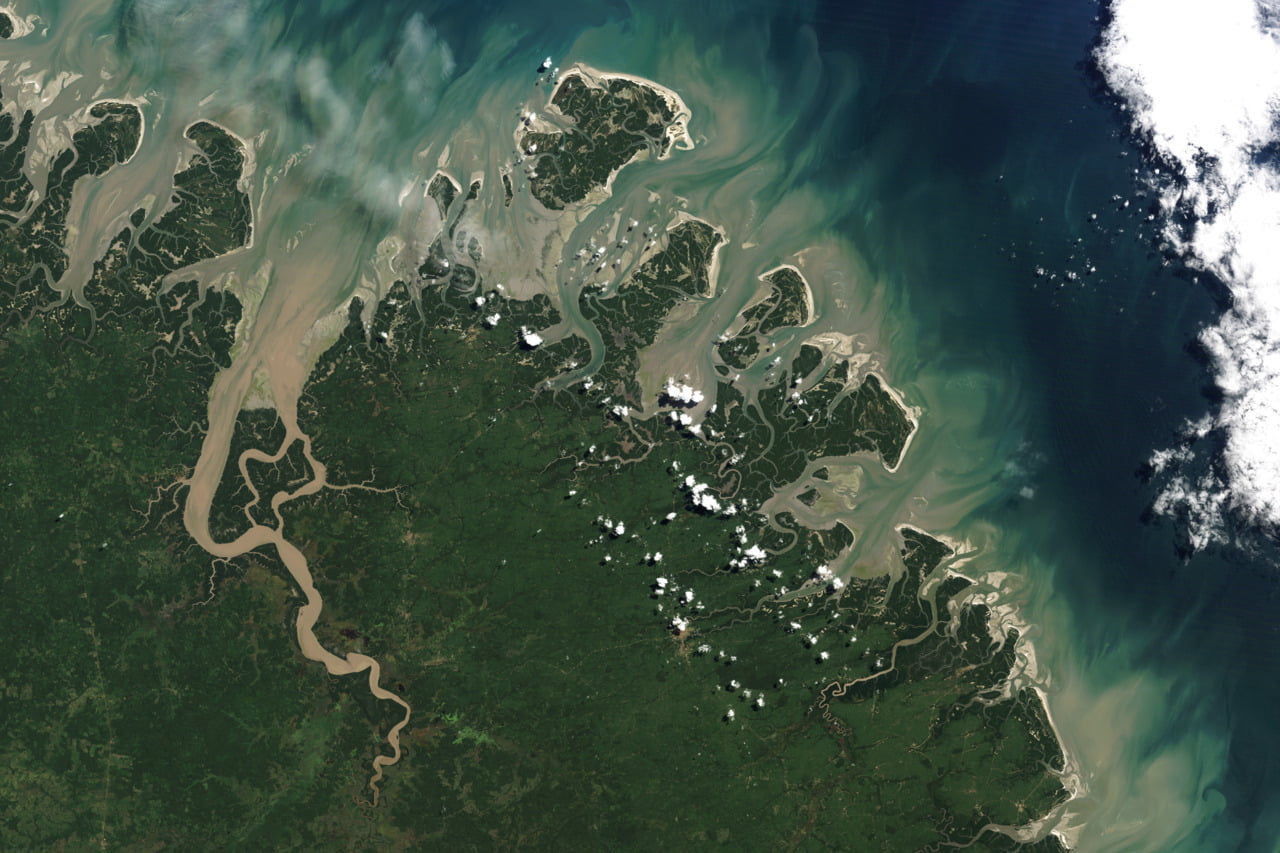
Brazilian Barrier Islands
Barrier islands are in a constant state of flux due to the currents, tides, and winds that surround and shape them. This satellite image of islands off the Brazilian coast shows meandering waterways and the mixing of sediment from the land into the sea. Often, secondary flows are responsible for shaping of these sorts of geographic features. #
Landslide
Landslides, despite their inclusion of solid materials, function essentially as gravity-driven fluid flows. This timelapse video shows a recent earthflow in Wyoming near the Snake River. Rapid snowmelt and heavy rainfall combined to cause a seven day landslide over the highway and into the river. # (via Bad Astronomy)
Hot Spheres Sink Faster
New research shows that the Leidenfrost effect–which causes water droplets to skitter across a hot pan–can drastically reduce the drag on objects moving through a liquid. When raised to a high enough temperature, a sphere falling water will be coated in a protective layer of vapor (see video above) that acts like a lubricant as the sphere moves through the water. If the temperature of the object drops too low, the vapor layer will dissolve into a mess of bubbles (~35 secs into video). One way that this mechanism reduces drag is by keeping flow attached to the sphere for longer as shown in this video. Preventing this flow separation increases the pressure recovered after the point of lowest pressure (the shoulders of the sphere), which reduces overall drag.
See also:
- PRL Article and Supplemental Materials
- Wired article
- The Photonist
Water-Walking Basilisks
Some animals, like the common basilisk (a.k.a. the Jesus Christ lizard) are capable of running across water for short distances. The basilisk accomplishes this feat by slapping the water with sufficient force and speed to keep its body above the surface. This slap also creates a pocket of air around its foot. The lizard propels itself forward by kicking its leg back, then lifting its foot out of the water before the air bubble collapses. Water birds like the Western Grebe and tail-walking dolphins rely on similar physics to stay above the water line. # (submitted by Simon H)

Space Shuttle Flow Viz
When a space shuttle lands, a lucky few will hear twin sonic booms as it passes overhead. The double boom occurs due to the shock waves from in front of the shuttle and just behind it passing the observer on the ground. The colorized schlieren photograph above shows shock waves on a model of an early shuttle prototype. The fore and aft shocks that run from the craft to the ground are even clearer on this photo of a T-38 in flight. (Photo credit: Gary Settles)
Shock Waves from a Trombone
Shock waves emanating from a trombone have been captured on video for the first time using schlieren photography. With a harsh blast from the mouthpiece, it’s possible for pressure waves inside the trombone to build into a weak shock wave traveling about 1% faster than the speed of sound. It’s possible that musicians sitting in front of the trombones could receive hearing damage from these shock waves or similar ones from trumpets. # (submitted by jessecaps)