Year: 2011

  • Cornstarch Monsters

    [original media no longer available]

    Shaking a fluid surface often results in standing waves known as Faraday waves, but with a non-Newtonian fluid like oobleck, at some frequencies it’s possible to incite other behaviors. Oobleck is shear-thickening, meaning that its viscosity increases when force is applied. This is what allows it to develop finger-like protrusions under high frequency vibrations.

  • Colliding Jets

    Colliding Jets

    Two fluid jets with diameter 0.85 mm collide, creating a fantastical and unstable fluid structure. Fluid mechanics and art overlap. #

  • Featured Video Play Icon

    Carboy Combustion

    Lighting a thin layer of ethyl alcohol in a jug produces some beautiful pulse jets and a moving wall of flame that shifts and flows according to the changing pressures inside the jug. Like the video’s author, we do NOT recommend trying this combustion demo yourself.

    As for the video’s questions, firstly, blowing into the jar helps the flame because humans do not exhale pure CO2. With regard to the second question, the interior of the jug is initially thinly coated in ethyl alcohol vapor. Combustion starts at the top of the jug and the sheet of flame moves downward as the fuel at the top is spent. As that flame moves downward, however, it’s heating the air inside the jug, which expands and is forced out the opening. When the flame goes out in the upper part of the jug, that does not mean all of the fuel has combusted, simply that the ratio of air/fuel is insufficient for continued combustion. I suspect the flame persists at this opening because the air/fuel mixture is concentrated at that point. Any residual ethyl alcohol in the container is forced out through that narrow opening, and the resulting concentration of fuel there may be high enough to keep the flame burning there. (idea submitted by davidbenque #)

  • Shuttlecock Flow Viz

    Shuttlecock Flow Viz

    The flow around a shuttlecock is visualized in a water channel using fluorescent dye illuminated by laser light ultraviolet LEDs. Note the recirculation zone on the upper shoulder. Experimenters can match flow characteristics in water to that in air by matching the Reynolds numbers. (Photo credit: Rob Bulmahn)

    Updated, thanks to information from the photographer. Thanks!

  • Featured Video Play Icon

    Starting Vortices

    Whenever a wing stops or starts in a fluid, it produces a vortex. This 2D numerical simulation shows an airfoil repeatedly starting and stopping, shedding a vortex each time. Note how the line of vortices drifts downward in the wake; this is an indication of downwash. (submitted by jessecaps)

  • Featured Video Play Icon

    Skydiving Indoors

    Vertical wind tunnels like this one simulate the experience of skydiving with air speeds up to 270 km/h (168 mph). Here expert freefallers perform a routine similar to synchronized skydiving. By changing the angle and shape of their body with respect to the air flow, they are able to control their lift and drag to produce complex motion in three dimensions.

  • Reader Question: Similar Blogs?

    thegreatfenceof-deactivated2013 asks:

    Hello! I was wondering if you follow any similar blogs to your awesome blog? I like the idea of learning about awesome mechanical engineering stuff without learning so if you know of anything please help me out.

    As you might imagine, I started this blog because I didn’t know of any that were doing something similar. Fluid dynamics is kind of an overlooked discipline falling somewhere between classical physics and  practical engineering. However, I do follow some similar Tumblrs on different topics, such as physicsphysics, fuckyeahmath, fyeahchemistry, and freshphotons. Beyond Tumblr, there are lots of (general) science blogs like those on Discover magazine, Wired Science, or Scientific American.

    Anyone else have some suggestions? Sound off in the comments.

  • Featured Video Play Icon

    Un-Mixing a Fluid Demo

    Not only is this demonstration one of my favorites, it’s a reader favorite, too. Even though I posted it nearly a year ago, I’ve had it resubmitted over and over. Here’s what I originally wrote:

    Laminar flow (as opposed to turbulence) has the interesting property of reversibility. In this video, physicists demonstrate how flow between concentric cylinders can be reversed such that the initial fluid state is obtained (to within the limits of molecular diffusion, of course!)

    For more examples, see the first half of this video.

    The results of those videos might be surprising, but they highlight the difference between laminar flow and turbulence. In laminar flow, the motion of the dye is caused by molecular diffusion and momentum diffusion, the latter of which is exactly reversible. In turbulence, much of the fluid motion is tied up in momentum convection, which is irreversible. This is why you can “unstir” the glycerin but not the milk in your coffee.

  • Paint Vibrations

    Paint Vibrations

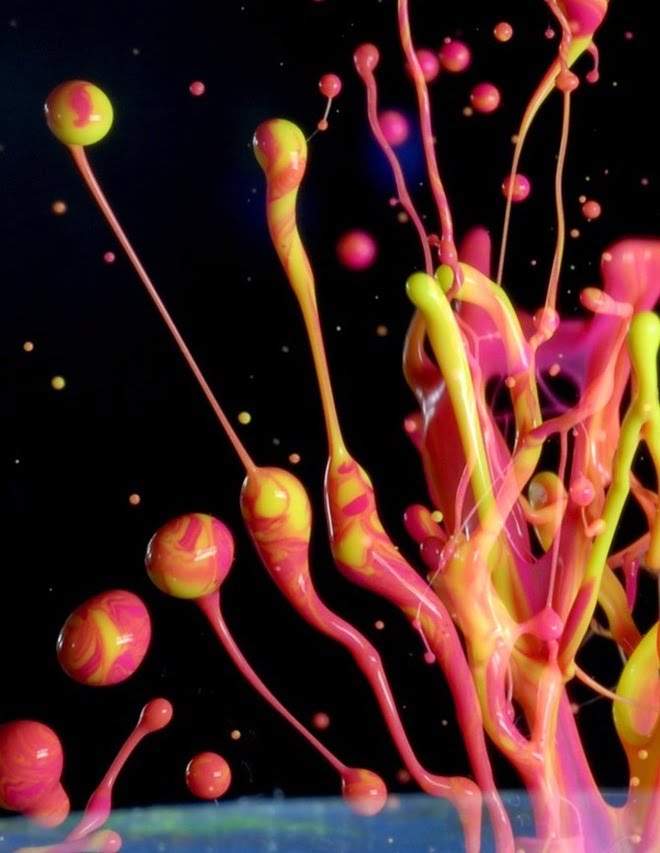
    Paint vibrated on a loud speaker explodes in multi-colored jets and droplets. Most paints are shear-thinning non-Newtonian fluids (like ketchup, shampoo, or whipped cream), meaning that their viscosity decreases as they are sheared. This allows them to flow more readily once they are perturbed. #

  • Happy Birthday, FYFD!

    Today marks the one year anniversary of FYFD! I’d like to thank each of you for reading, commenting, submitting posts and asking questions. It’s been fun, and, hopefully a bit educational, too. Next week, in addition to new content, I want to feature some favorites from the archives. So take a gander at the past year of FYFD and comment with your favorites. What deserves a re-visit? What would you like to see in the future?