In this video, the HouseholdHacker heads to the kitchen and uses milk, food coloring, and dish soap to create some solutal convection much like this one with cream and liqueur. The food coloring serves as a tracer for the fluid motion; it’s really the interaction of the milk and the dish soap that drives the motion. The dish soap lowers the surface tension of the milk, causing motion via the Marangoni effect. That motion redistributes some of the dish soap as well, causing further motion in the form of a surface tension instability. As with the cream and liqueur experiment, the fat in the milk is important; you won’t see much (if any) effect with fat free milk because its surface tension properties aren’t as dissimilar to dish soap. (via misterhonk.de)
Month: December 2010

Marangoni Convection in Space
In this Saturday Morning Science video, astronaut Don Pettit demonstrates Marangoni convection in microgravity using a water film with tracer particles, a soldering iron, and a flashlight. This same effect occurs on earth but is masked behind the much stronger effect of buoyant convection.

Vortex Street
A flow visualization behind a cylinder shows the formation of a von Karman vortex street. The frequency of vortex shedding in the wake is directly related to the speed of the airflow–the higher the velocity, the faster vortices will shed from the cylinder. This relationship is expressed in the Strouhal number, which remains constant for any cylinder. (via freshphotons)
Waves on Cornstarch
A thin layer of the non-Newtonian fluid oobleck on a vibrating surface (in this case, a speaker) is a great way to show off nonlinear standing waves known as Faraday waves. The waves form because, under these circumstances, the flat surface of the air/oobleck interface has actually become unstable.

Frosting on Superhydrophobic Surfaces
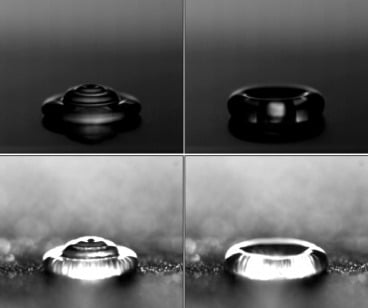
Icing on airplane wings can be disastrous for lift and control, and thus how ice initially forms on a wing is an active area of research. New work shows that superhydrophobic (water-fearing) surfaces may actually promote ice buildup. Superhydrophobic surfaces are prone to frosting–collecting ice that forms directly from a vaporous state–and that fine layer of frost is conducive to further ice buildup from a liquid state. The photo above shows a water droplet striking a dry superhydrophobic surface (top) and a frosted superhydrophobic surface (bottom). (via Gizmodo) #

Droplet Impact in 3D
This stereo photo of a droplet by John Hart shows the formation of a crown and droplet breakup. It’s possible to see the picture in 3D by crossing one’s eyes. #
Thermal Convection
This video turbulent convection in a vertical channel. Buoyancy and the density variations caused by small differences in temperature are what drive the behavior.

The Roaming Rocks of Death Valley
The dry lake beds of Death Valley National Park in California are home to a perplexing phenomenon: roaming rocks. These rocks, some of which weigh hundreds of pounds, leave long furrows in the dirt but have no obvious means of propulsion. One theory posits that the rocks glide on collars of ice around their base. The ice acts like a flotation device when rain wets the valley and then the rocks slide so easily that high winds can move them across the surface. #
Steering Water Droplets
At the microscale, fluid behavior can be quite different than what we witness in everyday life. Mechanisms that have little effect on the macroscale suddenly become extremely important in a channel only a few hundred microns wide. Here, water droplets in oil are steered and controlled using lasers.
Starting a Rocket
This computational fluid dynamics (CFD) simulation shows the start-up of a two-dimensional, ideal rocket nozzle. Starting a rocket engine or supersonic wind tunnel is more complicated than its subsonic counterpart because it’s necessary for a shockwave to pass completely through the engine (or tunnel), leaving supersonic flow in its wake. Here the situation is further complicated by turbulent boundary layers along the nozzle walls. (Video credit: B. Olson)