Does a person swim faster in water or syrup? One expects the more viscous syrup would offer a swimmer greater resistance, but, at the same time, it could also provide more to push against. Gettelfinger and Cussler put this to a test experimentally with competitive and recreational swimmers in a pool of water and in one with a fluid measuring roughly twice the viscosity of water. Their results showed no significant change in swimming speed. When you consider that human swimming is highly turbulent, however, the result makes sense. In fluid dynamics, the dimensionless Reynolds number represents a ratio between inertial forces and viscous forces in a flow. The researchers estimate a Reynolds number of a typical human in water at 600,000, meaning that inertial effects far outweigh viscous effects. In this case, doubling the viscosity only reduces the Reynolds number by half, leaving it still well inside the turbulent range. Thus, swimming in syrup has little effect on humans. The Mythbusters also tackled this problem, with similar conclusions. This is a continuation of a series on fluids-related Ig Nobel Prizes. (Photo credit: Mythbusters/Discovery Channel; research credit: B. Gettelfinger and E. L. Cussler, winners of the 2005 Ig Nobel Prize in Chemistry)
Galleries

Thank You!
I have the best readers in the world. Seriously, everyone one of you is amazing. In less than 23 hours, you have blown past the goal I set. I will be going to the APS Division of Fluid Dynamics meeting thanks to you. THANK YOU!
For those of you reading who will be at APS, I plan to do my utmost to be available to grab a coffee between sessions, hang out, discuss research, talk outreach, go out to dinner – whatever! For those of you who won’t be there, I want to share as much of the experience as possible with you through social media. Prepare to be inundated at the end of the November. Without all of you, I wouldn’t be at APS, and I’d like everyone who contributed to have a chance to enjoy the experience.
Per IndieGoGo’s terms, the campaign will remain open until its October 11th deadline. Any contributions I receive above and beyond my APS costs, I plan to set aside for improvements to FYFD. The reader survey indicated lots of you would like me to make my own videos, and I aim to. Extra funds will first go toward equipment for that purpose.
Thank you again to each and every one of you, whether you contributed your money or helped spread the word. I appreciate everything you’ve done for me and will continue striving to bring the best of fluid dynamics to FYFD every weekday. Thank you all!

Ig Nobel Fluids: Cookie Dunking
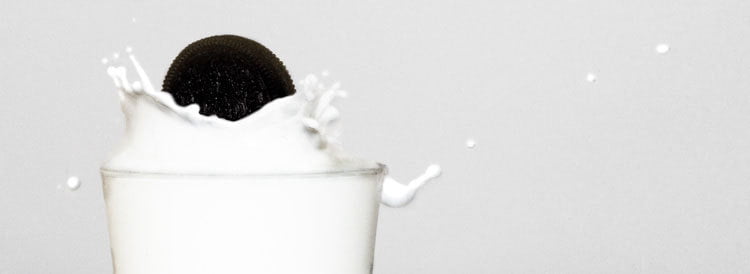
Back in 1999 Len Fisher earned an Ig Nobel Prize in Physics for explaining the physics of dunking a biscuit or cookie in a liquid. The cookie is porous, with many tiny, interconnecting channels run throughout it. When dipped in a liquid, capillary action pulls the fluid up into these channels against the force of gravity. As most people discover, this wetting can soften the cookie to the point of collapse. The optimal manner of dunking then is to hold the cookie at a shallow angle; this allows the lower surface to soak in milk (or the hot beverage of your choice) while keeping the upper surface dry and structurally sound. Fisher further argued that Washburn’s equation, which describes the time necessary for capillary action to draw a liquid up a given length of a cylindrical pore gives a good estimate of the length of time for a cookie dunking. This proved so popular he even wrote a book about it. This is a part of a series on fluids-related Ig Nobel Prizes. (Photo credit: C. Lindberg; research credit: L. Fisher)

Fluid Dynamics and the Nobel Prize

Last night marked the 2013 Ig Nobel Prize Award Ceremony, in which researchers are honored for work that “makes people LAUGH and then THINK”. Historically, the field of fluid dynamics has been well-represented at the Ig Nobels with some 13 winners across the fields of Physics, Chemistry, Mathematics, and–yes–Fluid Dynamics since the awards were introduced in 1991. This is in stark contrast to the awards’ more famous cousins, the Nobel Prizes.
Since the introduction of the Nobel Prize in 1901, only two of the Physics prizes have been fluids-related: the 1970 prize for discoveries in magnetohydrodynamics and the 1996 prize for the discovery of superfluidity in helium-3. Lord Rayleigh (a physicist whose name shows up here a lot) won a Nobel Prize in 1904, but not for his work in fluid dynamics. Another well-known Nobel laureate, Werner Heisenberg, actually began his career in fluid dynamics but quickly left it behind after his doctoral dissertation: “On the stability and turbulence of fluid flow.”
This is not to suggest that no fluid dynamicist has done work worthy of a Nobel Prize. Ludwig Prandtl, for example, revolutionized fluid dynamics with the concept of the boundary layer (pdf) in 1904 but never received the Nobel Prize for it, perhaps because the committee shied from giving the award for an achievement in classical physics. General consensus among fluid dynamicists is that anyone who can prove a solution for turbulence using the Navier-Stokes equation will likely receive a Nobel Prize in addition to a Millennium Prize. In the meantime, we carry on investigating fluids not for the chance at glory, but for the joy and beauty of the subject. (Image credits: Improbable Research and Wikipedia)

Selective Suction
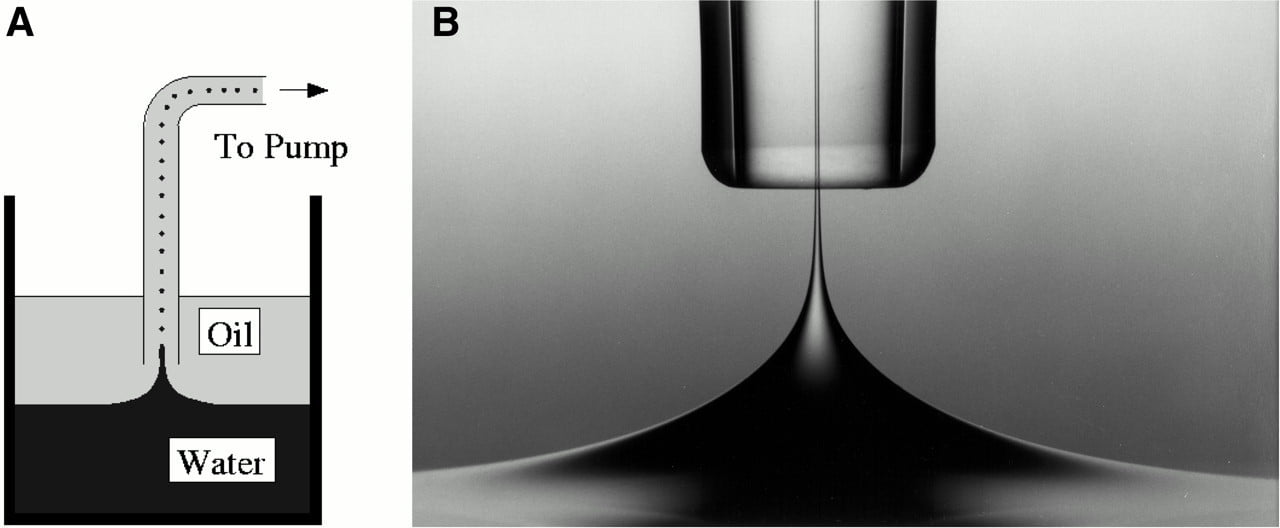
A thin spout of water is drawn up through a layer of oil in the photo on the right. This simple version of the selective withdrawal experiment is illustrated in Figure A, in which a layer of viscous oil floats above a layer of water. A tube introduced in the oil sucks fluid upward. At low flow rates, only the oil will be drawn into the tube, but as the flow rate increases (or the tube’s height above the water decreases), a tiny thread of water will be pulled upward as well. The viscous outer fluid helps suppress instabilities that might break up the inner fluid, and their relative viscosities determine the thickness of the initial spout. In this example, the oil is 195 times more viscous than the water. (Photo credit: I. Cohen et al.)

Ferrofluid Thrusters
Ferrofluids–magnetically-sensitive fluids made up of a carrier liquid and ferrous nanoparticles–may soon have a new application as a miniature thruster on nanosatellites. Microspray thrusters use tiny hollow needles to electrically spray jets of liquid that propel a satellite. But manufacturing the fragile microscopic needles used to disperse the propellant is expensive. Instead researchers are now using ferrofluids to create both the needle-like structures and to serve as the propellant. A ring of ferrofluid is placed on the thruster surface and a magnetic field applied to create the ferrofluid’s distinctive spikes. Then, when an electric force is applied, tiny jets of ferrofluid spray out from each tip, creating thrust. Unlike the conventional needles, the ferrofluid spikes are robust and can reform after being disturbed. (Photo credit: L. B. King et al.; submitted by jshoer)

Spiraling Break-up
Instabilities in fluids are sometimes remarkable in their uniformity. Here we see a hollow spinning cup with a thin film of fluid flowing down the interior. The rim of fluid at the cup’s lip stretches into long, evenly spaced, spiraling threads. These filaments stretch until centrifugal forces overcome surface tension and viscous forces and break the liquid into a multitude of tiny droplets. This process is called atomization and is vital to everyday applications like internal combustion and inkjet printing. (Photo credit: R. P. Fraser et al.)

Rebounding Jets

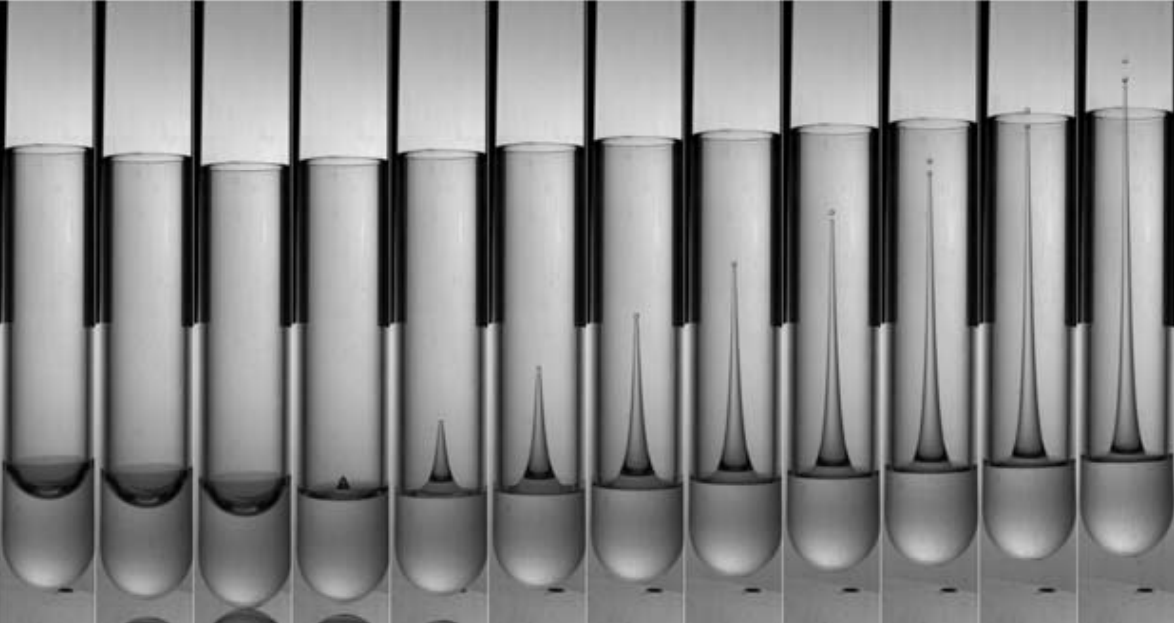
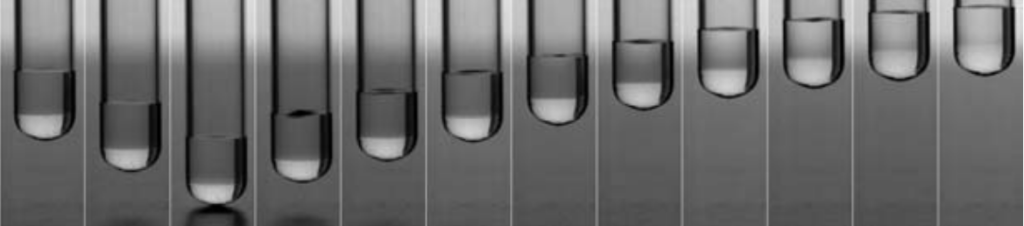
The photo sequence in the upper image shows, left to right, a fluid-filled tube falling under gravity, impacting a rigid surface, and rebounding upward. During free-fall, the fluid wets the sides of the tube, creating a hemispherical meniscus. After impact, the surface curvature reverses dramatically to form an intense jet. If, on the other hand, the tube is treated so that it is hydrophobic, the contact angle between the liquid and the tube will be 90 degrees during free-fall, impact, and rebound, as shown in the lower image sequence. The liquid simply falls and rebounds alongside the tube, without any deformation of the air-liquid interface. (Photo credit: A. Antkowiak et al.)

Ink Diffusion


Alberto Seveso’s gorgeous high-speed photos of ink diffusing in water have a dramatic sense of texture to them. Though still delicate, the whorls of fluid seem almost solid enough to touch. Watch the edges, though, and you can see thin wisps of color and hints of instabilities. Like cream poured into coffee, these ink sculptures are short-lived. Some of his works are available as prints or wallpapers (zip file). (Photo credit: Alberto Seveso)

The Real Raindrop
What is the shape of a falling raindrop? Surface tension keeps only the smallest drops spherical as they fall; larger drops will tend to flatten. The very largest drops stretch and inflate with air as they fall, as shown in the image above. This shape is known as a bag and consists of a thin shell of water with a thicker rim at the bottom. As the bag grows, its shell thins until it ruptures, just like a soap bubble. The rim left behind destabilizes due to the surface-tension-driven Plateau-Rayleigh instability and eventually breaks up into smaller droplets. This bag instability limits the size of raindrops and breaks large drops into a multitude of smaller ones. The initial size of the drop in the image was 12 mm, falling with a velocity of 7.5 m/s. The interval between each image is 1 ms. (Photo credit: E. Reyssat et al.)