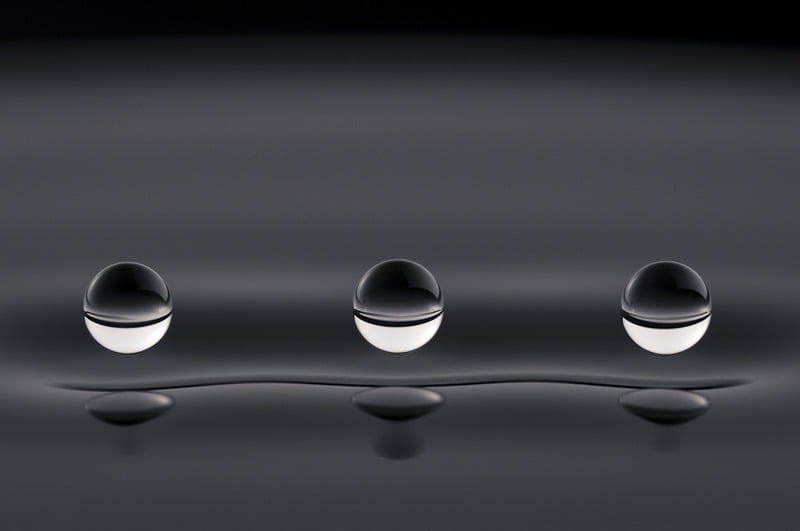
When slowed down, everyday occurrences, like a drop of water falling into a pool, can look absolutely extraordinary. When a falling drop has low momentum, it doesn’t simply disappear into the puddle. It sits on the surface, separated from the main pool by a very thin layer of air. Given time, the air drains away and the droplet cascades its way into the pool via smaller and smaller droplets. By vibrating the surface, the droplet bounces, with each bounce refreshing the layer of air that separates it from the main pool. Minute Lab’s video does a great job of explaining the process from beginning to end, accompanied with wonderful video of each step in action. For even more mind-boggling, check out how these bouncing droplets can demonstrate quantum mechanical behaviors. (Video credit: Minute Laboratory; submitted by Pascal)
Tag: vibration

Fluids Round-up – 21 September 2013
First off, I’d like to give a special shout-out to FYFD’s friends at Pointwise, who were kind enough to invite me for a visit this week. For any readers looking for CFD grid-generation software, check them out; they are a fantastic bunch and very good at what they do.
My thanks again to everyone who donated this week to help get me to the APS conference. The campaign is still open if anyone wants to get in on the FYFD wallpapers and stickers on offer to donors. As a reminder, any funds beyond conference costs will go toward improving FYFD, including getting equipment to make FYFD videos. On to the fluids round-up!
- Wired takes us behind the scenes of the creation of Games of Thrones’ dragons. Believe it or not, the VFX team actually did digital simulations of the dragons flying in a wind tunnel.
- Nature dissects whether a submarine at relativistic speeds sinks or floats. (via io9) Note that Nature article says the submarine is in water but the original paper simply says that the submarine is immersed in a fluid and makes no account for the compressibility (or lack thereof) of that fluid.
- Add some excitement to your day with liquid-nitrogen-induced explosions from Distort (via io9).
- Flow Viz shows off a great picture of condensation-induced flow visualization on an airplane wing.
- Check out this awesome video of vibrating lycopodium powder from Susi Sie. (via io9)
- National Geographic considers whether Hawaii’s molasses spill is more or less environmentally damaging than an oil spill.
- Finally, our lead image shows a natural visualization of flow around a kayaker. The foam atop the water forms when air and water mix with the gas produced by decomposing leaves. The photo by Lucas Gilman appeared in Outside Magazine earlier this summer. (via Flow Visualization)
(Photo credit: L. Gilman)

Vibrating Droplets
When still, water drops sitting on a surface are roughly hemispherical, drawn into that shape by surface tension. But on a vibrating surface, the same water drop displays many different shapes, like those in the video above. Researchers have observed more than 30 different mode shapes by varying the driving frequency. The metal mesh placed beneath the glass on which the drops sit helps the researchers determine the drop’s shape. As the drop deforms, the mesh appears to distort due to the refraction of light through the changing shape of the drop’s water-air interface. The distortion allows observers to visualize (and in some experiments even reconstruct) the shape of the drop’s surface. Understanding this kind of droplet behavior is valuable for many applications, including ink-jet printing and microfluidic devices. (Video credit: C. Chang et al.; via Science)
Granular Gases
Vibrating particles or granular materials can produce many fluid-like behaviors. In this video, researchers demonstrate how a granular gas made up of particles of two sizes behaves at different conditions. By tweaking the amplitude of the vibration, they alter how the particles cluster in a divided container. At large vibrational amplitudes, the particles behave much like a gas–energetic and spread out. At lower amplitudes, though, the particle density and the number of particle collisions increases. Each collision dissipates some of a particle’s energy; more collisions means less energy available to escape. As a result, the particles cluster, forming an attractor that draws in additional particles over time. (Video credit: R. Mikkelson et al.)

Bouncing in Lockstep
Droplets of silicone oil bounce on a pool of the same thanks to the vibration provided by a loudspeaker. Each droplet’s bounce causes ripples in the pool and the interference between these ripples fixes the droplets in lockstep with one another. As long as the vibration continues to feed the thin layer of air that separates the droplets from the pool during each bounce and no impurities break the surface tension at the interface, the droplets will bounce indefinitely on their liquid trampoline. Such systems can be used to observe quantum-mechanical behavior like wave-particle duality on a macro-scale. (Photo credit: A. Labuda and J. Belina)

Dancing Jets
Vibrating a gas-liquid interface produces some exciting instability behaviors. The photo above shows air and silicone oil vibrated vertically within a prism. For the right frequencies and amplitudes, the vibrations produce liquid jets that shoot up and eject droplets as well as gas cavities and bubble transport below the interface. To see a similar experiment in action, check out this post. (Photo credit: T. J. O’Hern et al./Sandia National Laboratories)
Reader Question: Non-Coalescing Droplets
Reader ancientavian asks:
I’ve often noticed that, when water splashes (especially as with raindrops or other forms of spray), often it appears that small droplets of water skitter off on top of the larger surface before rejoining the main body. Is this an actual phenomenon, or an optical illusion? What causes it?
That’s a great observation, and it’s a real-world example of some of the physics we’ve talked about before. When a drop hits a pool, it rebounds in a little pillar called a Worthington jet and often ejects a smaller droplet. This droplet, thanks to its lower inertia, can bounce off the surface. If we slow things way down and look closely at that drop, we’ll see that it can even sit briefly on the surface before all the air beneath it drains away and it coalesces with the pool below. But that kind of coalescence cascade typically happens in microseconds, far too fast for the human eye.
But it is possible outside the lab to find instances where this effect lasts long enough for the eye to catch. Take a look at this video. Here Destin of Smarter Every Day captures some great footage of water droplets skittering across a pool. They last long enough to be visible to the naked eye. What’s happening here is the same as the situation we described before, except that the water surface is essentially vibrating! The impacts of all the multitude of droplets create ripples that undulate the water’s surface continuously. As a result, air gets injected beneath the droplets and they skate along above the surface for longer than they would if the water were still. (Video credit: SuperSloMoVideos)

Fluids Round-up – 9 June 2013
It’s time for some more fluidsy fun around the Internet! Here are some fun links I’ve come across since our last round-up.
- NPR reviews how dolphins and others play with vortex rings.
- Lawrence Berkeley National Laboratory/UC Berkeley offer some insight into simulating bubbles popping. (Hint: it requires supercomputers.)
- FlowViz shares some awesome accidental Rayleigh-Taylor instabilities you can replicate at home.
- PhysicsBuzz brings us a podcast on tornado physics.
- Reader Cedric Vella sent in his fluids-featuring trailer.
- io9 pointed out some great cymatics footage that shows off how granular materials and vibration creates beautiful patterns.
- And finally: what happens when you drop hot charcoal into liquid oxygen? The Periodic Table of Videos shows us, in high speed! (via Flow Visualization)
(Photo credit: L. L. A. Adams et al., multi-fluid double emulsions)

Fluids Round-up – 25 May 2013
Sometimes I come across cool links and stories about fluid dynamics that don’t quite fit into a typical FYFD post, but I’d like to start sharing those semi-regularly with round-up posts. Here’s some fun stuff I’ve seen lately:
- We’ve talked before about penguins and fluid dynamics, but this IOP talk from Helen Czerski is a great take on how they use fluids to escape predators.
- Over at FlowViz, Richard has a great video demonstrating deep versus shallow water waves side-by-side.
- io9 shows off the vibrational modes of mercury as well as explaining why birds can be good at flying or swimming but not both.
- Giant paint explosions (specifically here) may be fun to watch but the dangers are not for squeamish viewers.
- Dylan G sent us this 512K real-time fluid particle simulation that’s a fun distraction.
- xckd’s Randall Munroe answers all kinds of physics questions at his What If? blog, but occasionally there are some fluids ones. Two of my favorites consider a hypersonic steak and what happens if the glass is literally half full.
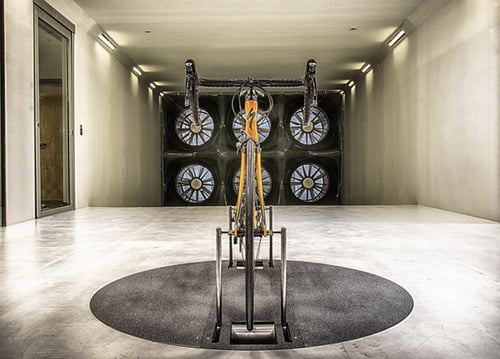
- Finally, for the cyclists and triathletes among you, the recent news that bicycle manufacturer Specialized has built its own wind tunnel has generated lots of discussion of aerodynamics in sport. Mark Cote (@MITAeroBike) and Chris Yu (@chrisyuinc) of Specialized’s aero R&D have been answering questions on Slowtwitch, Twitter, and in live chats.
And, yes, that last Specialized video chat includes an FYFD shout-out about 49 minutes in. 🙂
(Photo credit: Specialized)
Bouncing on a Pool
There’s something wonderfully serene about watching water droplets skate their way across the surface of a pool. Here the pool of water is being vibrated at a frequency just below the Faraday instability – meaning that no standing waves form on the surface. Instead, the bounce is just enough to create a thin layer of air between the droplet and the pool to prevent coalescence. With each bounce, gravity’s effect on the water tries to drain the air away, but each rebound lets more air rush in to hold the droplet up. Eventually, gravity wins and the droplets coalesce into the pool. In high-speed that process is mesmerizing, too. (Video credit: K. Welch)