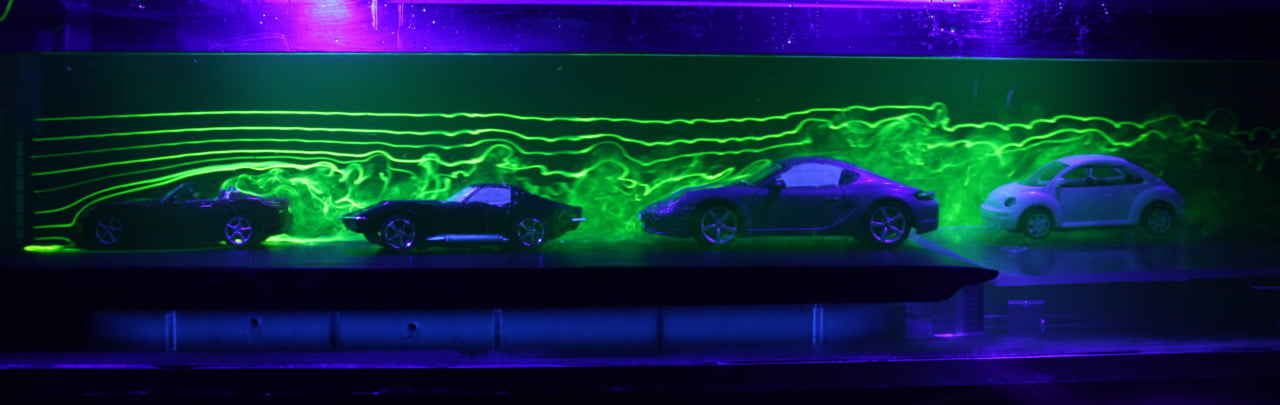
Flow visualization in a water tunnel shows what the flow around a line of traffic looks like. Note the progressively more turbulent flow around each car as it sits in the wake of the car before it. Turbulent flow is usually associated with increased drag forces, but because turbulence can actually help prevent flow separation it is sometimes desirable as a method for decreasing drag. In the case of these cars drafting on one another, it is clear that the cars further back in the line cause less effect on the fluid–and thus have less drag to overcome–than the front car. (Photo credit: Rob Bulmahn)
Tag: turbulent flow

Structures in Turbulence
Despite its appearance, there is order in the chaos of turbulence. These snapshots from a turbulent channel flow simulation outline these coherent structures in black. The top photo shows a top view looking down on the channel and the bottom image shows a side view of the channel. It is thought that studying these coherent structures may help shed light on turbulence and its formation, which remains one of the great open questions of classical physics. (Photo credit: M. Green)

Transition to Turbulence
Smoke introduced into the boundary layer of a cone rotating in a stream highlights the transition from laminar to turbulent flow. On the left side of the picture, the boundary layer is uniform and steady, i.e. laminar, until environmental disturbances cause the formation of spiral vortices. These vortices remain stable until further growing disturbances cause them to develop a lacy structure, which soon breaks down into fully turbulent flow. Understanding the underlying physics of these disturbances and their growth is part of the field of stability and transition in fluid mechanics. (Photo credit: R. Kobayashi, Y. Kohama, and M. Kurosawa; taken from Van Dyke’s An Album of Fluid Motion)

Smoke Transition
Smoke issuing from a round jet undergoes transition from laminar to turbulent flow. As the smoke moves past the unmoving ambient air, the friction between these two layers creates shear and triggers a Kelvin-Helmholtz instability, recognizable by the formation and roll up of vortices along the edges of the jet. Those vortices then roll together in pairs, detach, and devolve into a generally turbulent flow. Because turbulence is far more efficient at mixing than a laminar flow is, the smoke seems to disappear.
Laminar and Turbulent Flows from a Faucet
Here laminar and turbulent flows, basic concepts in fluid mechanics, are demonstrated in the kitchen sink! While laminar flow is often desirable for decreasing drag due to friction, most practical flows are turbulent. The hissing the video author associates with the onset of turbulence is not a coincidence either. The chaotic motion of turbulent flows can produce aerodynamic noise like the roar produced by airplane propellers or the hum of electrical lines in the wind.
Simulating Turbulence
Turbulent flows are complicated to simulate because of their many scales. The largest eddies in a flow, where energy is generated, can be of the order of meters, while the smallest scales, where energy is dissipated, are of the order of fractions of a millimeter. In Direct Numerical Simulation (DNS), the exact equations governing the flow are solved at all of those scales for every time step–requiring hundreds or thousands of computational hours on supercomputers to solve even a small domain’s worth of flow, as on the airplane wing in the video. Large Eddy Simulation (LES) is another technique that is less computationally expensive; it calculates the larger scales exactly and models the smaller ones. The video shows just how complicated the flow field can look. The red-orange curls seen in much of the flow are hairpin vortices, named for their shape, and commonly found in turbulent boundary layers.
Un-Mixing a Fluid Demo
Not only is this demonstration one of my favorites, it’s a reader favorite, too. Even though I posted it nearly a year ago, I’ve had it resubmitted over and over. Here’s what I originally wrote:
Laminar flow (as opposed to turbulence) has the interesting property of reversibility. In this video, physicists demonstrate how flow between concentric cylinders can be reversed such that the initial fluid state is obtained (to within the limits of molecular diffusion, of course!)
For more examples, see the first half of this video.
The results of those videos might be surprising, but they highlight the difference between laminar flow and turbulence. In laminar flow, the motion of the dye is caused by molecular diffusion and momentum diffusion, the latter of which is exactly reversible. In turbulence, much of the fluid motion is tied up in momentum convection, which is irreversible. This is why you can “unstir” the glycerin but not the milk in your coffee.

Osborne Reynolds and Transition

How and when flow through a pipe becomes turbulent has been a conundrum for fluid mechanicians since the days of Osbourne Reynolds (~1870s):
Typically, the laminar-to-turbulence transition is studied mathematically by linearizing the Navier-Stokes equations, the governing equations of fluid dynamics, then perturbing the system. These perturbations will gradually disappear in laminar flow, but if the flow is turbulent, they’ll grow and produce chaotic motion. The transition, then, is the critical point between these two.
However, for pipe flows, this linearized approach shows that the perturbations decay for all Reynolds numbers, even though this doesn’t happen in actual experiments. In the real world, as the Reynolds number increases, small, turbulent puffs begin to split and interact, and their lifetimes increase. Eventually, these puffs carry enough turbulence to transition the flow entirely. # (submitted by David T)

River Jumps

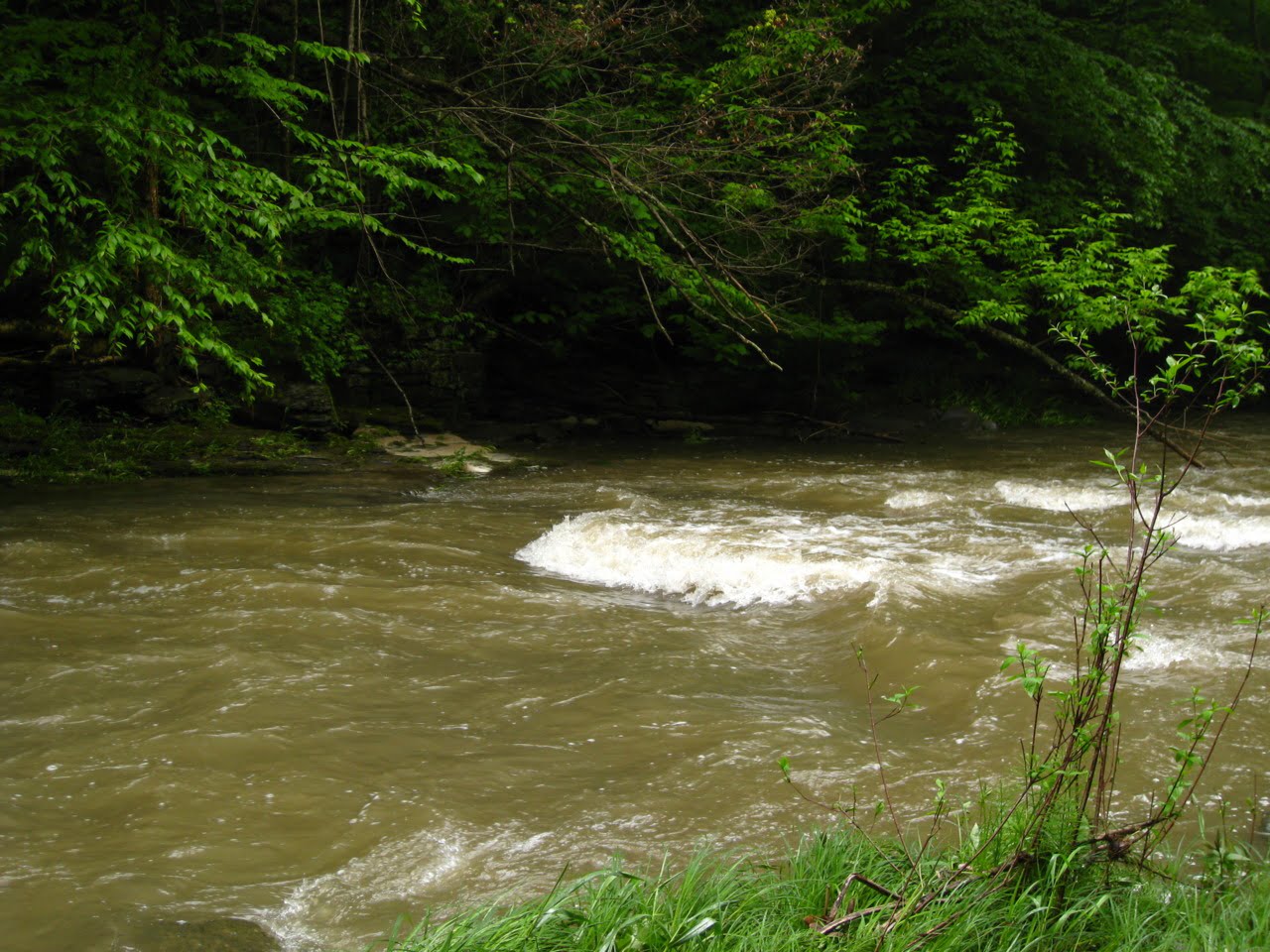
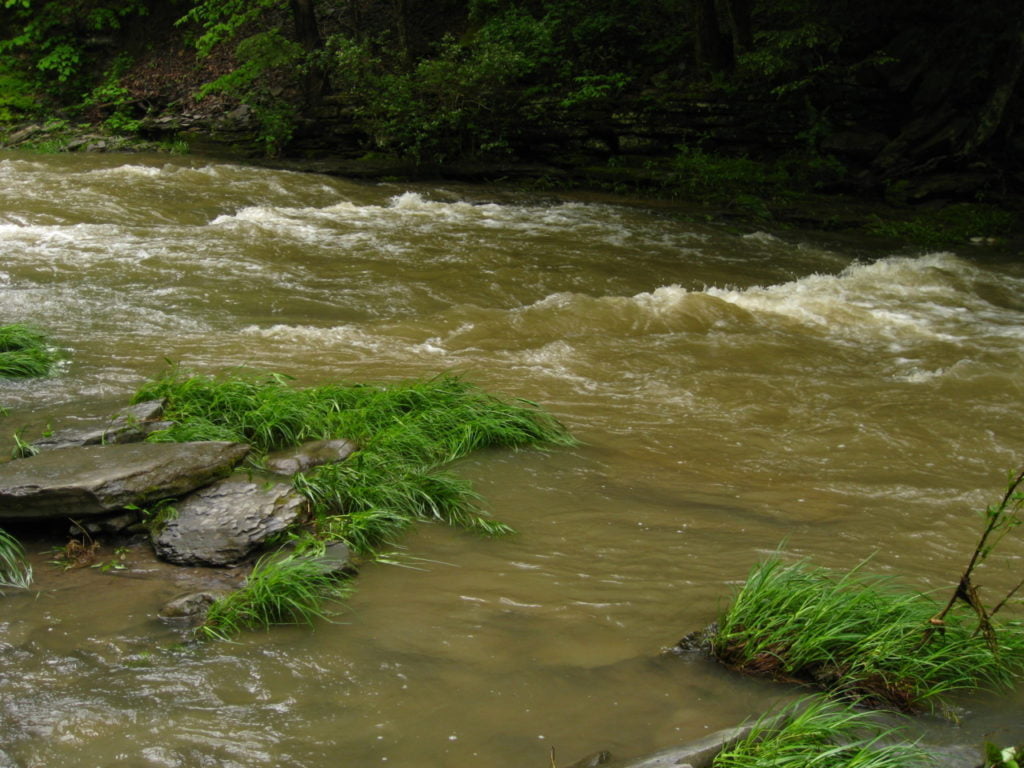
Hydraulic jumps occur when a high velocity liquid runs into an area of low velocity liquid. The faster moving liquid decelerates rapidly and increases in height, effectively trading kinetic energy for potential energy. The phenomenon is frequently observed in open channel flow, like in spillways or along rivers, as in the photos above. In nature, the hydraulic jump will often be laminar upstream and turbulent downstream. #