Anyone who’s painted a room at home is familiar with the frustration of drips. At certain inclinations, practically every viscous liquid develops these gravity-driven instabilities. They’re troublesome in manufacturing as well, where viscous films are often used to coat components and unexpected drips can ruin the process.
To avoid this, researchers are adding electric fields into the mix. For dielectric fluids — liquids sensitive to electric fields — this addition acts like extra surface tension, stabilizing the film and preventing drips from forming. The researchers’ mathematical models predict the electric field strength necessary for a given fluid layer depending on its inclination. (Image credit: stux; research credit: R. Tomlin et al.; via APS Physics)
Whether young or old, everyone enjoys blowing soap bubbles, and the bigger the bubble, the more impressive it is. Researchers have been on a quest to discover how bubbles can survive with volumes measured in the tens of meters and thicknesses of mere microns.
The key to these behemoth bubbles are the polymer chains inside them. The long molecules of polymers get entangled with one another and resist further stretching, which strengthens the soap film. The researchers found that a mixture of polymer lengths are even better for long-lasting bubbles because they entangle more fully than polymers that are all the same size.
But if what you really want are practical results, I have good news for you: the researchers have released their recommended recipe for making the best giant soap bubbles. It’s included in the video below, but I’ve also reproduced it in text for easier recreation (with thanks to Ars Technica):
Giant Soap Bubble Solution From the Burton Lab, via Ars Technica
Ingredients 1 liter of water (about 2 pints) 50 milliliters of Dawn Professional Detergent (a little over 3 TBSP) 2-3 grams of guar powder, a food thickener (about 1/2 heaping TSP) 50 milliliters of rubbing alcohol (a little more than 3 TBSP) 2 grams of baking powder (about 1/2 TSP)
Directions Mix the guar powder with the alcohol and stir until there are no clumps.
Combine the alcohol/guar slurry with the water and mix gently for 10 minutes. Let it sit for a bit so the guar hydrates. Then mix again. The water should thicken slightly, like thin soup or unset gelatin.
Add the baking powder and stir.
Add the Dawn Professional Detergent and stir gently to avoid causing the mixture to foam.
Dip a giant bubble wand with a fibrous string into the mixture until it isf fully immersed and slowly pull the string out. Wave the wand slowly or blow on it to create giant soap bubbles.
The brilliant and beautiful colors of a bubble are directly related the the thickness of the soap film surrounding it. When light shines on the soap film, some rays are reflected from the upper surface of the film, while others are refracted through the film and reflect off its lower surface. These reflected rays have different phase shifts and their interference is what causes the colors we observe. The color patterns themselves reveal the interior flow of the soap film, in which gravity tries to thin the film and surface tension tries to distribute the film evenly. (Photo credit: R. Kelly, A. Fish, D. Schwichtenberg, N. Travers, G. Seese)
Astronaut Don Pettit delivers more “Science Off The Sphere” in his latest video. Here he demonstrates diffusion and convection in a two-dimensional water film in microgravity. He notes that the viscous damping in the water is relatively low and that, left undisturbed, mixing in the film will continue for 5-10 minutes before coming to rest, which tells us that the Reynolds numbers of the flow are reasonably large. The structures formed are also intriguing; he notes that drops mix with mushroom-like shapes that are reminiscent of Rayleigh-Taylor instabilities and cross-sectional views of vortexrings. It would be interesting to compare experiments from the International Space Station with earthbound simulations of two-dimensional mixing and turbulence, given that the latter behaves so differently in 2D.
Stuck here on Earth, it’s hard to know sometimes how greatly gravity affects the behavior of fluids. Fortunately, astronaut Don Pettit enjoys spending his free time on the International Space Station playing with physics. In his latest video, he shows some awesome examples of what is possible with a thin film of water–not a soap film like we make here on Earth–in microgravity. He demonstrates vibrational modes, droplet collision and coalescence, and some fascinating examples of Marangoni convection.
Droplets of oleic acid spread across a thin film of glycerol on a silicon wafer. The shapes here are driven by hydrodynamic instabilities, particularly Marangoni effects due to the differences in surface tension between the two fluids. (Photo credit: A. Darhuber, B. Fischer and S. Troian)
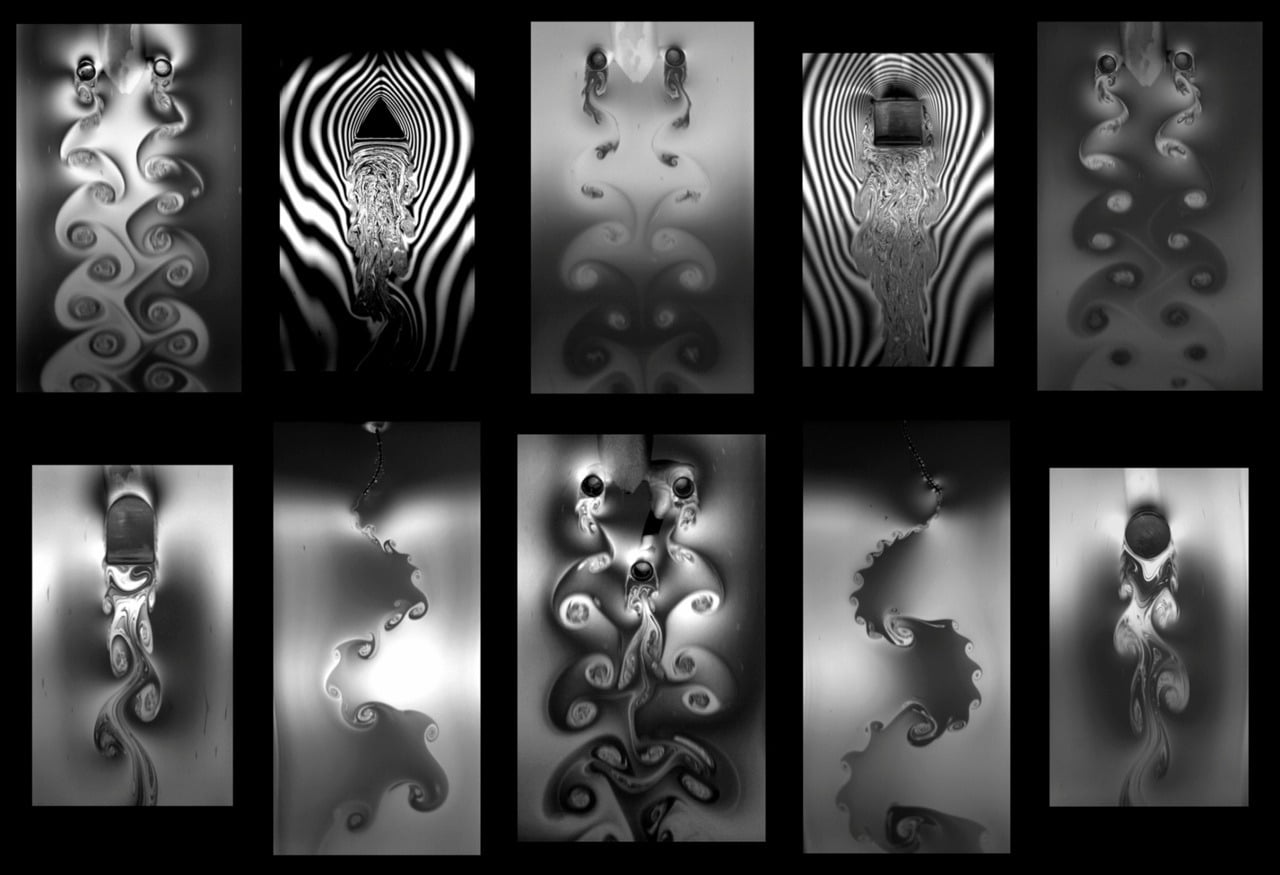
Flowing soapfilms provide an educational and beautiful method for visualizing the wakes of objects in two-dimensional flows. High-speed photography highlights the interference patterns on the soap film, providing detail without the necessity for the particulate tracking of other flow visualization methods. Highlights here include wakes behind bluff bodies, interacting cylinders, and flapping flags. (pdf) #
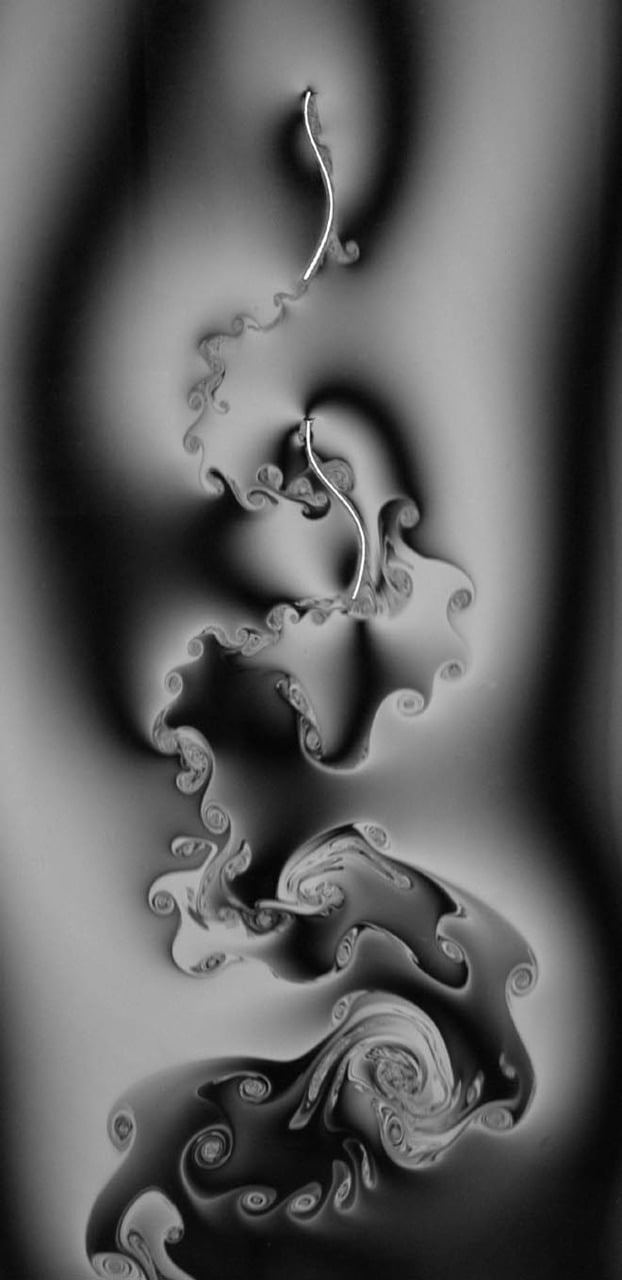
This image shows two flags oriented in line with a film flowing top to bottom. The second flag interrupts the wake of the first one, which reduces the drag experienced by the first flag and increases that on the second. This is called inverted drafting and occurs because the flags are passive objects that bend to every change in the flow. #
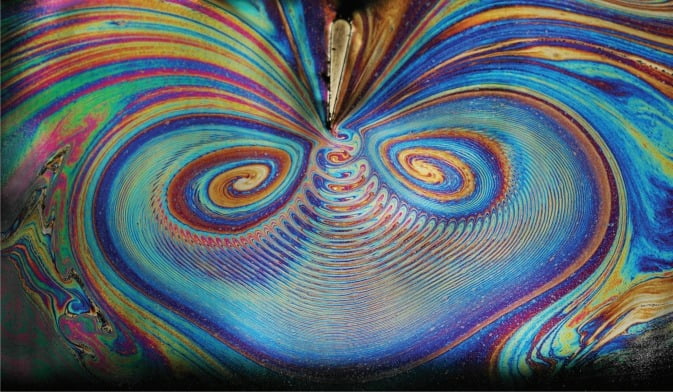
A stationary soap film disturbed by a flapping foil (seen in the top center) creates a butterfly-like double spiral roll. Two vortices form at the tip of the foil each time it changes direction; look carefully and you can see those tiny vortices all the way through the spirals. (From the 2010 Gallery of Fluid Motion; pdf)