Tag: supersonic

  • Featured Video Play Icon

    Underwater Gunfire

    When a projectile is fired from a gun or other firearm, it is propelled by the expansion of high-temperature, high-pressure gases resulting from the combustion of a propellant, like gunpowder, inside the weapon. The explosive expansion of these gases transfers momentum to the bullet; however, the gases will continue to expand outward from the gun even after the bullet is fired. They do so in the form of a supersonic blast wave; it’s this blast wave that’s responsible for the noise of the firearm. Firing a gun underwater is one way to see the blast wave, though it is far from the only way. In fact, a blast wave viewed underwater is not equivalent to one in air.  The differences in density and compressibility between the two fluids mean that, while the general form may be similar, the specifics and the results may not be. In general, a blast wave underwater is much more damaging than one in air. (Video credit: destinsw2/Smarter Every Day; requested by nikhilism)

  • Featured Video Play Icon

    Supersonic Bubble Shock Waves

    Supercomputing has been an enormous boon to fluid dynamics over the past few decades. Many problems, like the interaction between a supersonic shock wave and a bubble, are too complicated for analytical solutions and difficult to measure experimentally. Numerical simulation of the problem, combined with visualization of key variables, adds invaluable understanding. Here a shock wave strikes a helium bubble at Mach 3, and the subsequent interactions in terms of density and vorticity are shown. This situation is relevant to a number of applications, such as supersonic combustion and shockwave lithotripsy–a medical technique in which kidney stones are broken up inside the body using shock waves. After impact, an air jet forms and penetrates the center of the structure while the outer regions mix and form a persistent vortex ring. (Video credit: B. Hejazialhosseini et al.; via Physics Buzz)

  • Featured Video Play Icon

    Unsteady Rocket Nozzle

    This numerical simulation gives a glimpse of flow inside an unsteady rocket nozzle.  The nozzle is over-expanded, meaning that the exhaust’s pressure is lower than that of the ambient atmosphere. A slightly over-expanded nozzle causes little more than a decrease in efficiency, but if the nozzle is grossly over-expanded, the boundary layer along the nozzle wall can separate and induce major instabilities, as seen here. In the first segment of the video, turbulent structures along the nozzle wall boundary layer are shown; note how the boundary layer becomes very thick and turbulent after the primary shock wave (shown in gray). This is due to the flow separating near the wall.  The second half of the video shows the unsteadiness this can create. The primary shock wave splits into two near the wall, creating a lambda shock wave, named for the shape of the lower case Greek letter. This shock structure is indicative of strong interaction between the boundary layer and shock wave. (Video credit: B. Olson and S. Lele)

  • Vapor Cone

    Vapor Cone

    This stunning National Geographic photo contest winner shows an F-15 banking at an airshow and a array of great fluid dynamics. A vapor cloud has formed over the wings of the plane due to the acceleration of air over the top of the plane. The acceleration has dropped the local pressure enough that the moisture of the air condenses.  Some of this condensation has been caught by the wingtip vortices, highlighting those as well. Finally, the twin exhausts have a wake full of shock diamonds, formed by a series of shock waves and expansion fans that adjust the exhaust’s pressure to match that of the ambient atmosphere. (Photo credit: Darryl Skinner/National Geographic; via In Focus; submitted by jshoer)

  • Featured Video Play Icon

    Homemade Hybrid Rocket Engine

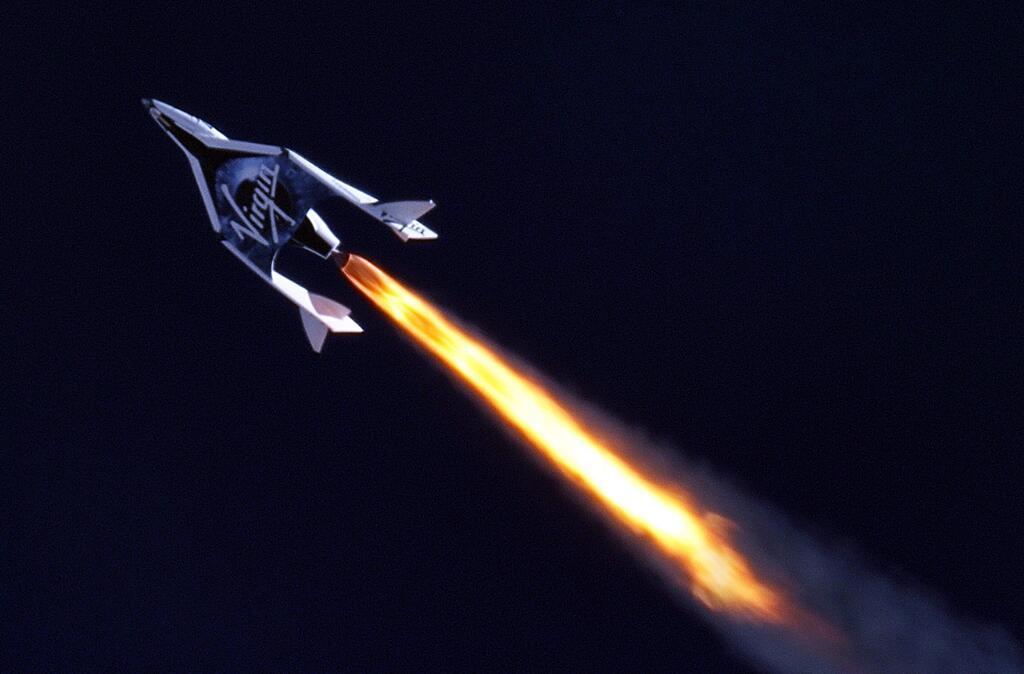
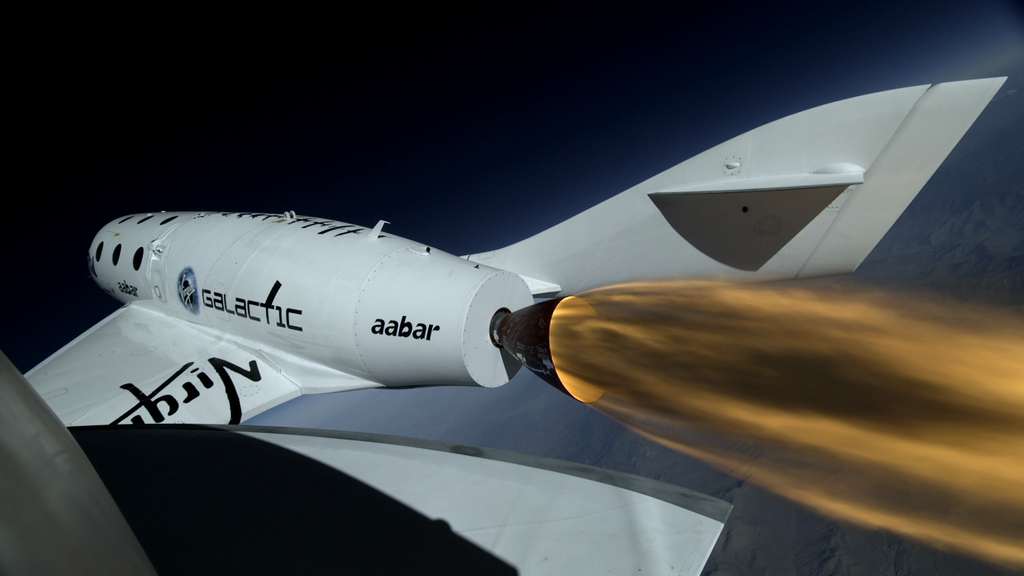
    In this video, Ben Krasnow details and demos a small hybrid rocket engine he built in his workshop. Hybrid rockets utilize propellants that are two different states of matter, in this case gaseous oxygen as the oxidizer and solid acrylic as the fuel. Krasnow’s verbal explanation of a convergent-divergent nozzle, used to accelerate flow to supersonic speeds is not quite right. In reality, a compressible fluid like air reaches the sonic point (i.e. Mach 1) at the narrowest point of the nozzle, also called the throat. The divergent portion of the nozzle causes the compressible fluid to expand in volume, which drops the temperature and pressure while the velocity increases beyond the speed of sound.

    Krasnow says he did no calculations for his rocket, but I decided to have a little fun by doing some myself. Supersonic flow through the nozzle is only achieved if the flow is choked, meaning that the mass flow rate through the nozzle will not increase if the downstream pressure is decreased further relative to the upstream pressure. For Krasnow’s rocket, the downstream pressure is atmospheric pressure (14.7 psi) and the upstream pressure is provided by the oxygen canister, which he notes was at most 80 psi. Fortunately, the upstream pressure necessary to choke the nozzle is only 27.8 psi, so even with the ball valve partially closed, Krasnow’s rocket is definitely capable of supersonic speeds.

    The Mach number achievable by any given supersonic nozzle is related to the ratio of the nozzle throat to its exit diameter (#). Krasnow gives the throat diameter as ¼-inch and the exit diameter as 5/8-inch. This means that the Mach number at the exit of the nozzle, assuming choked supersonic flow, is about Mach 3.4. (Video credit: Ben Krasnow; via Universe Today; submitted by jshoer)
  • The Supersonic Plonk

    The Supersonic Plonk

    Everyone knows the familiar plonk of a stone falling into a pond but few realize the complexity of the physics.  When a solid object falls into a pool, a sheet of liquid, the crown splash, is sent upward.  Simultaneously, the object pulls a cavity of air down with it. As the water moves inward, this cavity is pinched, creating an hourglass-like shape reminiscent of the shape of a rocket’s nozzle. As the diameter of that pinched cavity shrinks, the velocity of the upward escaping air increases, resulting in the formation of an air jet moving faster than the speed of sound. This air jet is followed by a slower liquid jet that may rebound to a height higher than then original height of the dropped object. So next time you throw a stone into a pond, enjoy the knowledge that you’ve broken the sound barrier. (Photo credit: D. van der Meer; see also Physics World)

  • Martian Landing Physics

    Martian Landing Physics

    A little over a week ago, NASA’s Curiosity rover landed on Mars, the culmination of years of engineering. The mission’s landing, in particular, was the subject of intense scrutiny as Curiosity’s size necessitated some new techniques in the final segments of the landing sequence. As it hit the Martian atmosphere at 13,000 mph, the compression of the carbon dioxide behind the capsule’s shock wave slowed the descent.  At roughly 1,000 mph–speeds still large enough to be supersonic–Curiosity deployed its parachute. Shown above are the parachute in numerical simulation (from Karagiozis et al. 2011), wind tunnel testing at NASA Ames, and during descent thanks to the Mars Reconnaissance Orbiter. The simulation shows contours of streamwise velocity at different configurations; note the bow shock off the capsule and the additional shocks off the parachute. These help generate the drag needed to slow the capsule. For an interesting behind-the-scenes look at the wind tunnel testing for Curiosity’s parachute check out JPL’s fourpart video series. Congratulations to all the scientists and engineers who’ve made the rover a success. We look forward to your discoveries! (Photo credits: K. Karagiozis et al., NASA JPL, NASA MRO)

  • Featured Video Play Icon

    Traffic Fluid Dynamics

    What does traffic have to do with fluid dynamics? Rather a lot, actually! Many parallels exist between traffic and compressible fluid flow. One such example, the concept of a shock wave, is demonstrated in the video above. As the traffic jam develops, the cars experience sudden changes in their velocity and relative distance (in a fluid, this would be density). This change travels backward through the traffic in the form of a shockwave, just the same as discontinuous changes in a fluid.

    Road construction provides another common example of compressible-flow-like behavior in cars.  For an incompressible fluid like water, reducing the area of a pipe would increase the velocity, but just the opposite happens when a road is reduced from two lanes to one.  Traffic slows down and clumps together. When the road opens back up from one lane to two, suddenly the speed and the distance between cars increases. This is exactly what happens in a rocket nozzle–it’s the expanding bell-like shape that causes air to accelerate supersonically. (Video credit: New Scientist)

  • Rocket Engine Test

    [original media no longer available]

    In this static test of XCOR Aerospace’s Lynx rocket engine, Mach diamonds (shown at the top of the frame) are visible in the rocket exhaust. The distinctive pattern is a result of the over- or under-expansion of the exhaust jet with respect to the ambient air; in other words, the gases exiting the rocket are either too high or too low in pressure relative to the surrounding air. A series of shock waves and expansion fans forms in the exhaust jet until the pressure is equalized to ambient. It is these compressions and expansions that form the diamond pattern. (Video credit: XCOR Aerospace)

  • Featured Video Play Icon

    Supersonic Flow

    This video shows a sphere in a small supersonic wind tunnel at Mach 2.7. Once the tunnel starts, a curved bow shock forms in front of the sphere, close to but not touching the model’s surface. Areas of low pressure are visible behind the sphere, as is a weak shock wave caused by overexpansion in those low pressure areas. Contrast this with a sharp cone in the same tunnel at the same Mach number. In the case of the cone, the shock wave is attached at the nose of the model. The attached shock follows the body more closely, resulting in a shock that impacts the walls of the tunnel further downstream than in the sphere’s case.