A drop of blue-dyed glycerine impacts a thin film of isopropanol, creating a spectacular splash and breakup. The drop’s impact flings a layer of the isopropanol into the air, where air currents make the thin sheet buckle inward and break into a spray of droplets. Meanwhile, the liquid from the drop forms a thick, blue crown that rises and expands outward. When tiny droplets of the isopropanol hit the splash crown, their lower surface tension causes the blue glycerine to pull away, due to the Marangoni effect. This opens up holes in the crown, which grow quickly, until the entire sheet breaks apart. (Image and research credit: A. Aljedaani et al., source)
Tag: splashes

A Hot Tub, Turned Fluidized Bed
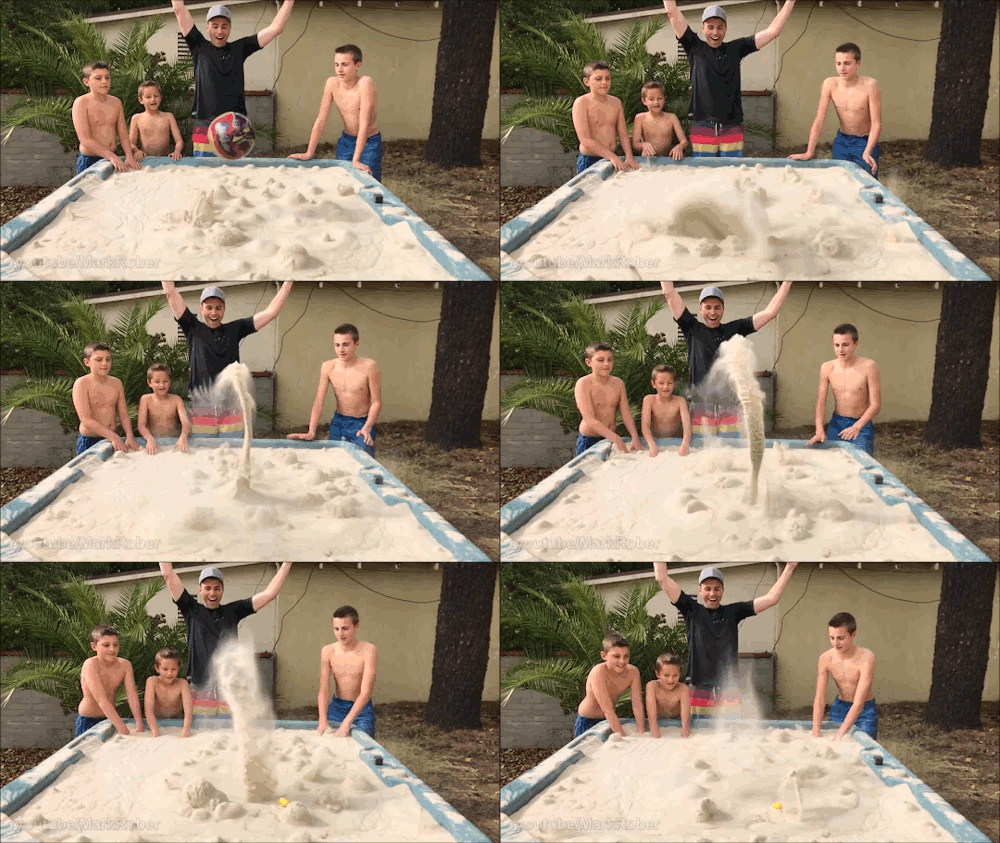
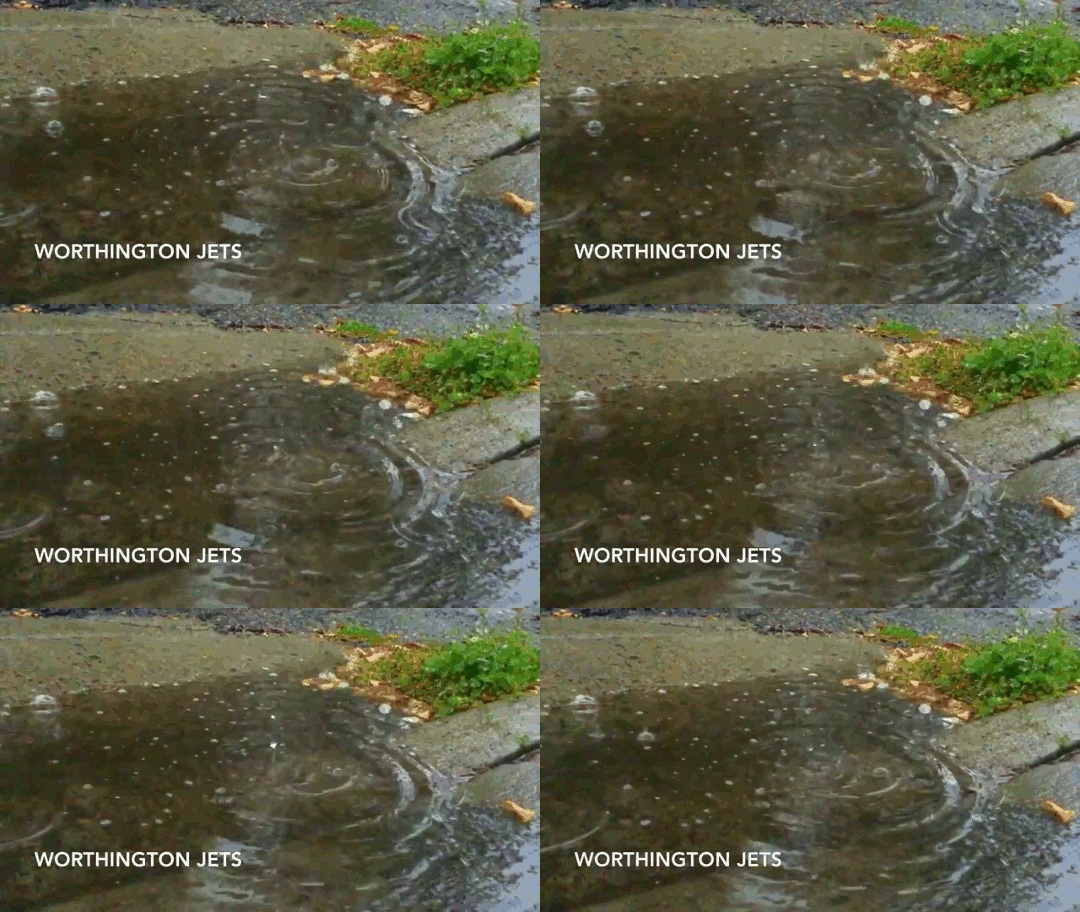
Fluidized beds continue to be all the rage among science YouTubers, but Mark Rober supersizes his by turning a broken hot tub into a massive bath of bubbling sand. His video includes a nice explanation of how a granular material like sand gets fluidized as well as how to make your own miniature bed. One of my favorite moments is shown in the animation below. When Mark drops a bowling ball into the fluidized bed, it creates a remarkably liquid-like splash. The ball sprays a splash curtain of sand up on impact and sinks into its own cavity. When the cavity seals behind the ball, it shoots up a tall jet of sand, just like a Worthington jet in water. Even with air fluidizing it, the sand doesn’t have surface tension, though, so the jet breaks up quite differently than water! (Video and image credit: M. Rober; submitted by clogwog)

Water Music of Vanuatu
In the Pacific Island nation of Vanuatu, women have a tradition of water music, accompanying their singing with a percussive use of water. This video explores the physics behind this music. Performers use three basic motions – a slap, a plunge, and a plow – that each have distinctive acoustics thanks to the interaction of hand, water, and air. High pitches come from the initial impact on the water, whereas lower pitches come mostly from the collapse of the air cavity in the hand’s wake. By altering the rhythms and patterns of these three building blocks, the musicians create a rich harmony to accompany their singing. (Video credit: R. Hurd et al.)
Paintball Collisions


In their latest video, the Slow Mo Guys collide paintballs in mid-air, creating some pretty great paint splashes. The high-speed video does a nice job of revealing some of the typical stages a splash goes through. Initially, the paint spreads in a liquid sheet. As it expands and (necessarily) thins, holes form and grow, driving the paint into string-like ligaments. These ligaments are also stretching and eventually break up into an spray of droplets, much like the jet dripping from your faucet does. If you’d like to see some more awesome high-speed liquid collisions, check out what happens when a solid projectile hits a falling drop and then look at when a laser pulse hits a droplet. (Image and video credit: The Slow Mo Guys; submitted by Omar M.)

Squishy Impacts
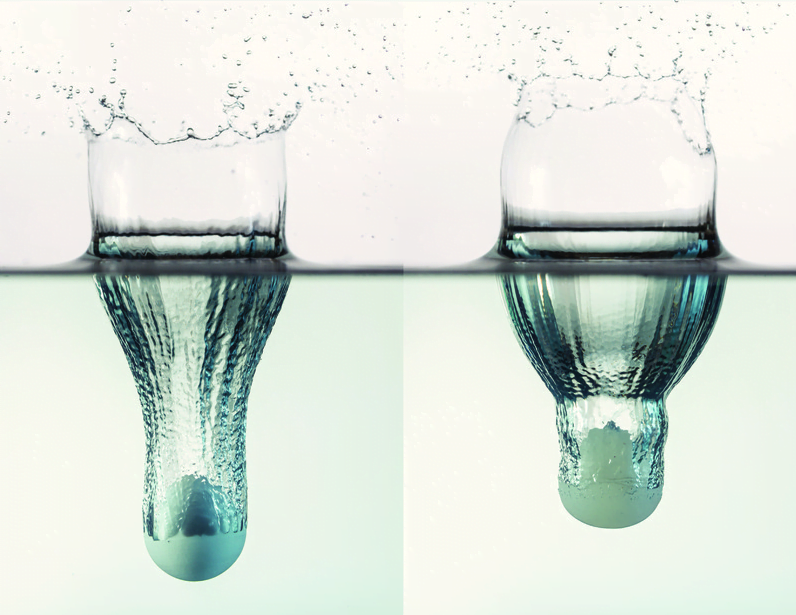


How spheres impact water has been studied for more than a century. The typical impact for a rigid sphere creates a cavity like the one on the upper left – relatively narrow and prone to pinching off at its skinny waist. If the sphere is elastic –squishy – instead, the cavity ends up looking much different. This is shown in the upper right image, taken with an elastic ball and otherwise identical conditions to the upper left image. The elastic ball deforms; it flattens as it hits the surface, creating a wider cavity. If you watch the animations in the bottom row, you can see the sphere oscillating after impact. Those changes in shape form a second cavity inside the first one. It’s this smaller second cavity that pinches off and sends a liquid jet back up to the collapsing splash curtain.
From the top image, we can also see that the elastic sphere slows down more quickly after impact. This makes sense because part of its kinetic energy at impact has gone into the sphere’s shape changes and their interaction with the surrounding water.
If you’d like to see more splashy stuff, be sure to check out my webcast with a couple of this paper’s authors. (Image credits: top row – C. Mabey; bottom row – R. Hurd et al., source; research credit: R. Hurd et al.)
Burning a Rocket Underwater
In a recent video, Warped Perception filmed a model rocket engine firing underwater. Firstly, it’s no surprise that the engine would still operate underwater (after its wax waterproofing). The solid propellant inside the engine is a mixture of fuel and oxidizer, so it has all the oxygen it needs. Fluid dynamically speaking, though, this high-speed footage is just gorgeous.
Ignition starts at about 3:22 with some cavitation as the exhaust gases start flowing. Notice how that initial bubble dimples the surface when it rises (3:48). At the same time, the expanding exhaust on the right side of the tank is forcing the water level higher on that side, triggering an overflow starting at about 3:55. At this point, the splashes start to obscure the engine somewhat, but that’s okay. Watch that sheet of liquid; it develops a thicker rim edge and starts forming ligaments around 4:10. Thanks to surface tension and the Plateau-Rayleigh instability, those ligaments start breaking into droplets (4:20). A couple seconds later, holes form in the liquid sheet, triggering a larger breakdown. By 4:45, you can see smoke-filled bubbles getting swept along by the splash, and larger holes are nucleating in that sheet.
The second set of fireworks comes around 5:42, when the parachute ejection charge triggers. That second explosive triggers a big cavitation bubble and shock wave that utterly destroys the tank. If you look closely, you can see the cavitation bubble collapse and rebound as the pressure tries to adjust, but by that point, the tank is already falling. Really spectacular stuff! (Video and image credit: Warped Perception)

Venturi Splashes
Diving can generate some remarkable splashes. Here researchers explore the splashes from a wedge-shaped impactor. At high speeds, they found that the splash sheet pushed out by the wedge curls back on itself and accelerates sharply downward to “slap” the water surface (top). Studying the air flow around the splash sheet reveals some of the dynamics driving the slap (bottom). The splash sheet quickly develops a kink that grows as the sheet expands. This creates a constriction that accelerates flow on the underside of the sheet. That higher velocity flow means a low pressure inside the constriction, which pulls the thin sheet down rapidly, making it slap the surface. For more, check out the full video. (Image and research credit: T. Xiao et al., source)
Living Fluid Dynamics
This short film for the 2016 Gallery of Fluid Motion features Montana State University students experiencing fluid dynamics in the classroom and in their daily lives. As in her previous film (which we deconstructed), Shanon Reckinger aims to illustrate some of our everyday interactions with fluids. This time identifying individual phenomena is left as an exercise for the viewer, but there are hints hidden in the classroom scenes. How many can you catch? I’ve labeled some of the ones I noticed in the tags. (Video credit: S. Reckinger et al.)
Reader Question: Splashes
Reader effjoebiden asks:
So is the crown splash the curving wave of water on either side of the tire, the spikes of water in the middle behind the tire, or both? And is the Worthington jet also the same phenomenon that can happen with a massive meteorite impact?
Here the term “crown splash” refers to the curving sheets of water spreading on either side of the tire. Those liquid sheets (or lamella) break down at the edges into spikes and droplets just like the ones seen when a drop falls into a pool, which is the traditional source of the term “crown splash” because it resembles a crown.
And, yes, enormous meteor impacts can create Worthington jets (that column of fluid that pops up after a droplet impacts)! This is why some craters have peaks in the middle. There are actually some surprising similarities between meteor impacts and fluid dynamics.
(Image credits: S. Reckinger et al., original post)
Daily Fluids, Part 4
Inside or outside, we encounter a lot of fluid dynamics every day. Here are some examples you might have noticed, especially on a rainy day:
Worthington Jets
After a drop falls into a pool, there’s a column-like jet that pops up after it and sometimes ejects another small drop. This is known to fluid dynamicists as a Worthington jet, but really it’s something we all see regularly, especially if you watch rain falling onto puddles or look really closely at your carbonated drink.Crown Splash
Like the Worthington jet, crown splashes often follow a drop’s impact into another liquid. But they can also show up when slicing or stomping through puddles!Free Surface Dynamics
Anytime you have a body of water in contact with a body of air, fluid dynamicists call that a free surface. How the interface between the two fluids shifts and transforms is fascinating and complicated. Waterfalls are a great example of this, but so are ocean waves or even the ripples from tossing a rock into a pond.Hydrophobic Surfaces
Water-repellent surfaces are called hydrophobic. Water will bead up on the surface and roll off easily. While many manmade surfaces are hydrophobic, like the teflon in your skillet, so are many natural surfaces. Many leaves are hydrophobic because plants want that water to fall to the ground where their roots can soak it up. Keep an eye out as you wash different vegetables and fruits and see which ones are hydrophobic!Check out all of this week’s posts more examples of fluid dynamics in daily life. (Image credit: S. Reckinger et al., source)