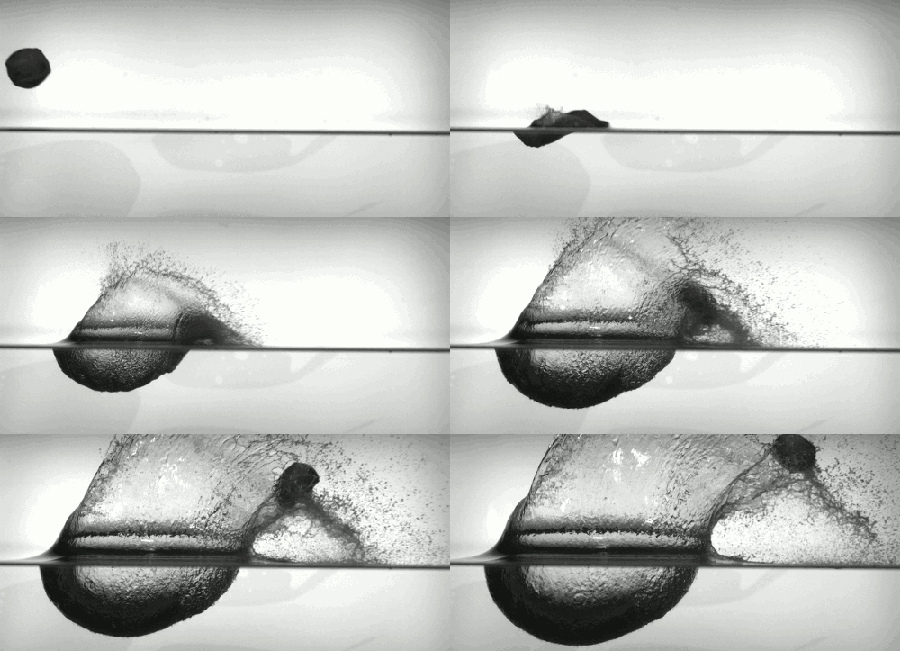
A sphere falling into water generates a spectacular crown
splash at the surface. The object’s impact ejects a thin sheet of fluid
that rises vertically. The air pulled down into the cavity by the
sphere’s passage makes the air pressure inside the sheet lower than the
ambient air pressure on the exterior of the sheet. This pressure
difference is part of what draws the crown inward to seal the cavity. As
the splash collapses inward and seals, the liquid sheet starts to
buckle and wrinkle, leaving periodic stripes around the closing neck.
This so-called buckling instability occurs when the radius of the neck
collapses faster than the vertical speed of the splash. For more, see
the research paper or this award-winning video. (Image credit: J. Marston et al., source)
Tag: splashes

Crown Splash Sealing

Skipping Squishy Spheres

Skipping a stone on water requires a flat, disk-like stone thrown at a shallow angle, but elastic spheres are remarkable skippers, too, even at higher impact angles. Researchers at the Splash Lab have just published their work on why these balls skip so well. As seen in the top animation, the elastic spheres deform on impact, flattening to a more disk-like shape that rides at an angle of attack relative to the air-water interface. Both features are important to the spheres’ enhanced skipping. By flattening, the sphere comes into greater contact with the water and by orienting at a larger angle of attack, the sphere increases the vertical component of force the water generates on the sphere. It’s this vertical force that lifts the sphere up and lets it keep bouncing.
Because the ball is soft, it keeps deforming after its impact and bounce (see top animation). For some skips, the timescale of the sphere’s elastic waves is smaller than the length of time the sphere is in contact with the water. When this is the case, the sphere’s elastic waves will affect the impact cavity in the water, forming what the researchers call a
matryoshka cavity, after the Russian nesting dolls. An example is shown in the second animation. For more, check out the USU press release, the original paper, or the award-winning video they made a few years ago. (Image credits: J. Belden et al./The Splash Lab)
If you enjoy FYFD and want to help support it, please consider becoming a patron!

Raindrops in Puddles
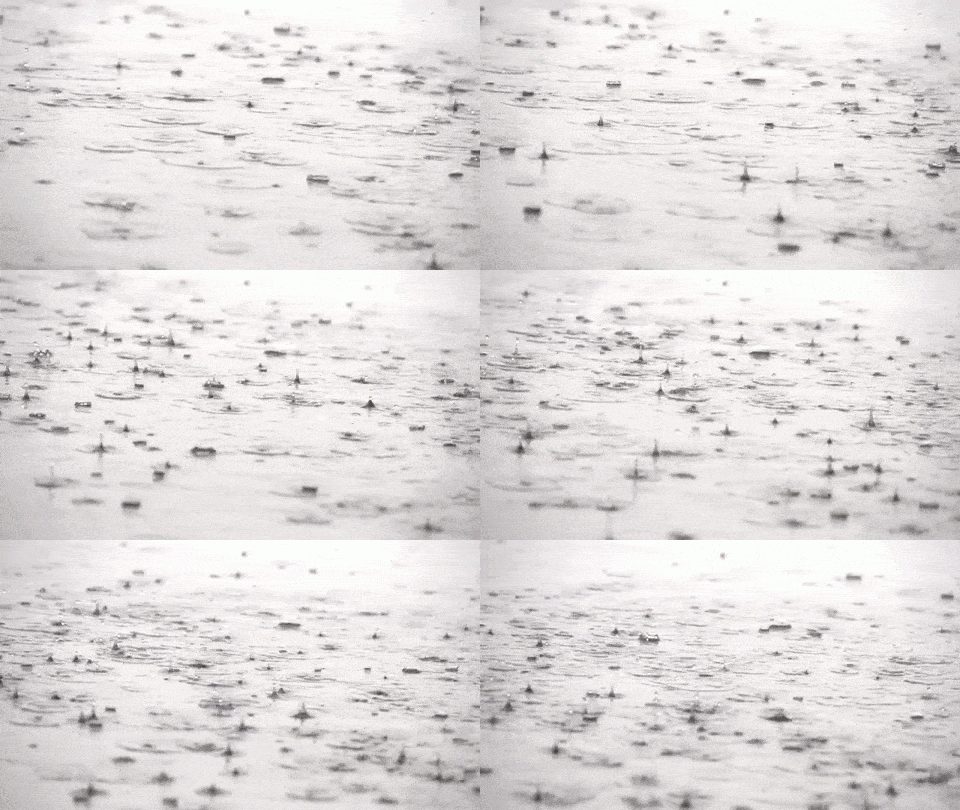
Watching rain drops hit a puddle or lake is remarkably fascinating. Each drop creates a little cavity in the water surface when it impacts. Large, energetic drops will create a crown-shaped splash, like the ones in the upper animation. When the cavity below the surface collapses, the water rebounds into a pillar known as a Worthington jet. Look carefully and you’ll see some of those jets are energetic enough to produce a little satellite droplet that falls back and coalesces. Altogether it’s a beautifully complex process to watch happen over and over again. (Image credit: K. Weiner, source)
——————
Help us do some science! I’ve teamed up with researcher Paige Brown Jarreau to create a survey of FYFD readers. By participating, you’ll be helping me improve FYFD and contributing to novel academic research on the readers of science blogs. It should only take 10-15 minutes to complete. You can find the survey here.

Rain-spread Pathogens
Like humans, plants can spread pathogens to one another. Although scientists had observed correlations between rainfall and the spread of diseases among plants, this study is one of the first to look at the fluid dynamics of leaf and rainfall interaction. When a raindrop hits a leaf, it doesn’t simply splash as it would against an immobile surface. The impact of the drop deforms the leaf, and the plant’s rebound significantly affects the trajectory and size of the resulting droplets. Depending on factors like the leaf’s stiffness, a large drop, carrying many pathogens, may rebound and splatter onto a neighboring leaf. Other leaves tend to catapult out many smaller droplets, which may fly farther afield but carry fewer pathogens. For more, check out the press release or the original research paper. (Video credit: Massachusetts Institute of Technology; research credit: Bourouiba Research Group)
Drops on a Porous Surface
The splashing of a drop upon impact is a remarkably complicated phenomenon. Perhaps surprisingly, the air around the impacting drop plays a major role in determining which drops splash and which don’t. Lowering the air pressure, for example, stops a drop from splashing. The layer of air that gets trapped beneath the spreading edge of a drop during impact seems to be responsible for splashing. As seen in the video above, drops that impact on a leaky surface, where air can escape, do not splash. By varying where leakage is possible on the surface, the researchers can localize where trapping the air matters most. There’s a critical radius during the drop’s spread where, without leakage, air will be trapped and cause the drop to splash. (Video credit: Y. Liu et al.)

The Milk Crown
This frequently imitated photograph of a drop of milk splashing was taken by engineer Harold Edgerton in 1934. Edgerton pioneered the application of stroboscopic photography to everyday objects, allowing him to capture images with an effective shutter speed much faster than could be mechanically achieved. The photo captures the crown or coronet of a splash. The momentum of the incoming drop flings a thin sheet of liquid radially outward. The rim of this sheet breaks down into thin ligaments that eject tiny droplets at their tips when surface tension can no longer hold the milk together. (Image credit: H. Edgerton, via The Art Reserve; submitted by Vince G)

Splashy Heroines




In his latest work, photographer Jaroslav Wieczorkiewicz used splashing liquids to create fantastical superheroine costumes. The splashes are all real, composited together in post-production from hundreds of individual splashes. He uses cold whole milk as his base liquid, sometimes supplementing with dye or paint for color. There’s also a behind-the-scenes video showing how the pictures are made, but, fair warning, it’s in German with some English subtitles and does contain nudity (link). (Image credits: J. Wieczorkiewicz; via Gizmodo)
Crown Sealing
Objects falling into a liquid pool create a beautiful splash, and, in this beautiful, award-winning video, the Splash Lab explores a peculiar instability that occurs just as the splash closes. The buckling instability they describe involves distinctive ridges that form along the splash’s ejecta sheet as it domes over and closes. The number of ridges depends both on the object size and the liquid’s properties. (Video credit: J. Marston et al.)
What’s in a Splash?
A droplet falling onto a solid, dry surface seems like a simple situation, one that would be easy to understand. But splashes can be unpredictable. Velocity, viscosity, and surface tension all play clear roles, but the surrounding air also has an impact – drop the air pressure low enough and a droplet won’t splash. A new paper has tackled the problem, producing a mathematical model in agreement with experimental results. So why do some drops splash and others don’t? When a drop falls, its momentum flattens it into a pancake shape while surface tension struggles to hold it together. The spreading edge, called the lamella, can pull away from the surface. When it does, a pocket of high pressure forms beneath it due to lubrication effects, and the faster airflow over the top of the lamella creates a suction effect. This is analogous to a wing producing lift. Like the momentum that spread the droplet, the lift force pulls the lamella and ejecta sheet further up and outward, overcoming the restoring force of surface tension and tearing the droplet apart. For more on the effect, check out the research paper or this Inside Science article. (Video credit: G. Riboux and J. Gordillo; via Inside Science)

Inside a Splash

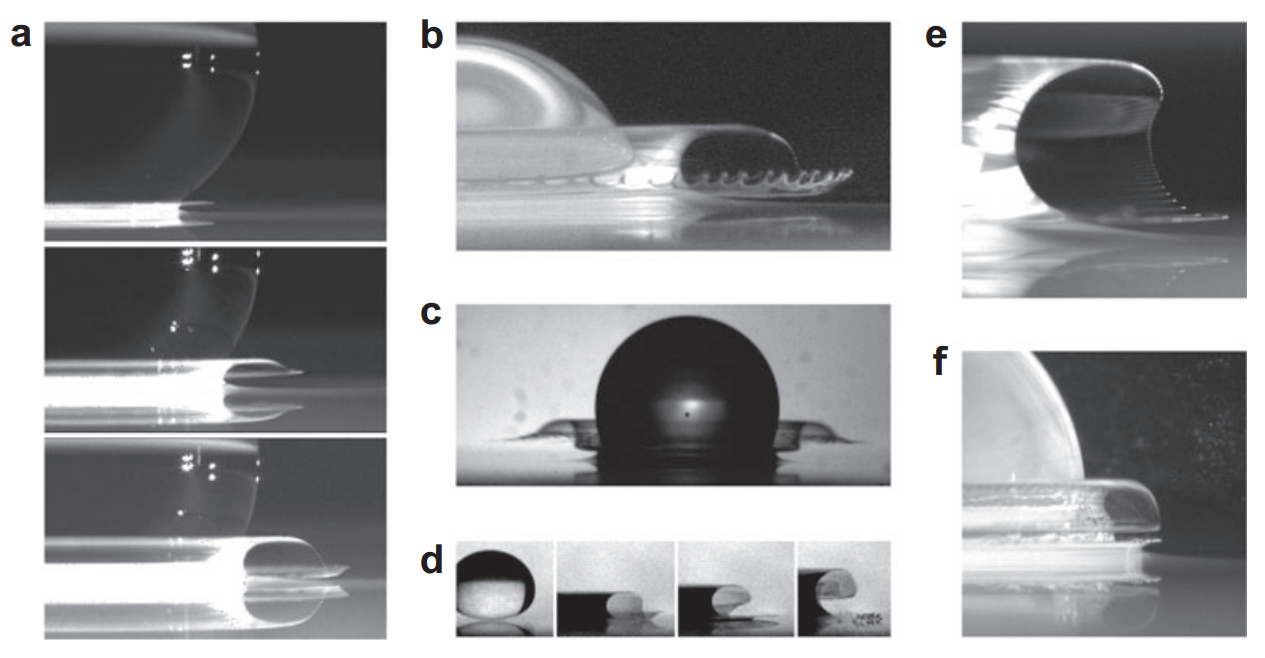
When a droplet strikes a pool, a thin, fast-moving sheet of liquid expands outward from the region of contact. These ejecta sheets come in many forms depending on surface tension, viscosity, air pressure, and droplet momentum. When the ejecta sheet curls downward to touch the pool, it can spray microdroplets outward or trap a layer of air underneath the droplet. For more, see this video by S. Nagel et al., and the papers Thoroddsen (2002) and Thoroddsen et al. (2008). (Photo credits: S. Thoroddsen et al.; GIF from this video by S. Thoroddsen et al.)