
Tag: solid mechanics

  • Rolling Down Soft Surfaces

    Rolling Down Soft Surfaces

    Place a rigid ball on a hard vertical surface, and it will free fall. Stick a liquid drop there, and it will slide down. But researchers discovered that with a soft sphere and a soft surface, it’s possible to roll down a vertical wall. The effect requires just the right level of squishiness for both the wall and sphere, but when conditions are right, the 1-millimeter radius sphere rolls (with a little slipping) down the wall.

    Rolling requires torque, something that’s usually lacking on a vertical surface. But the team found that their soft spheres got the torque needed to roll from their asymmetric contact with the surface. More of the sphere contacted above its centerline than below it. The researchers compared the way the sphere contacted the surface to a crack opening (at the back of the sphere) and a crack closing (at the front of the sphere). That asymmetry creates just enough torque to roll the sphere slowly. The team hopes their discovery opens up new possibilities for soft robots to climb and descend vertical surfaces. (Image and research credit: S. Mitra et al.; via Gizmodo)

    Fediverse Reactions
  • Featured Video Play Icon

    Chaotic Hose Instability

    Steve Mould is back with another video looking at wild fluid behaviors. This time he’s considering hose instabilities like the one that makes a water-carrying hose beyond a certain length to whip wildly back and forth. He tries to track down the reasoning for these flexible hoses snapping and whipping. In truth, both the hoses and the wind dancers do their thing due to interactions between the elasticity of the hose and the fluid dynamics of the flows within. These applications are ripe for a few control volume thought experiments. (Video and image credit: S. Mould)

    Fediverse Reactions
  • Ultra-Soft Solids Flow By Turning Inside Out

    Ultra-Soft Solids Flow By Turning Inside Out

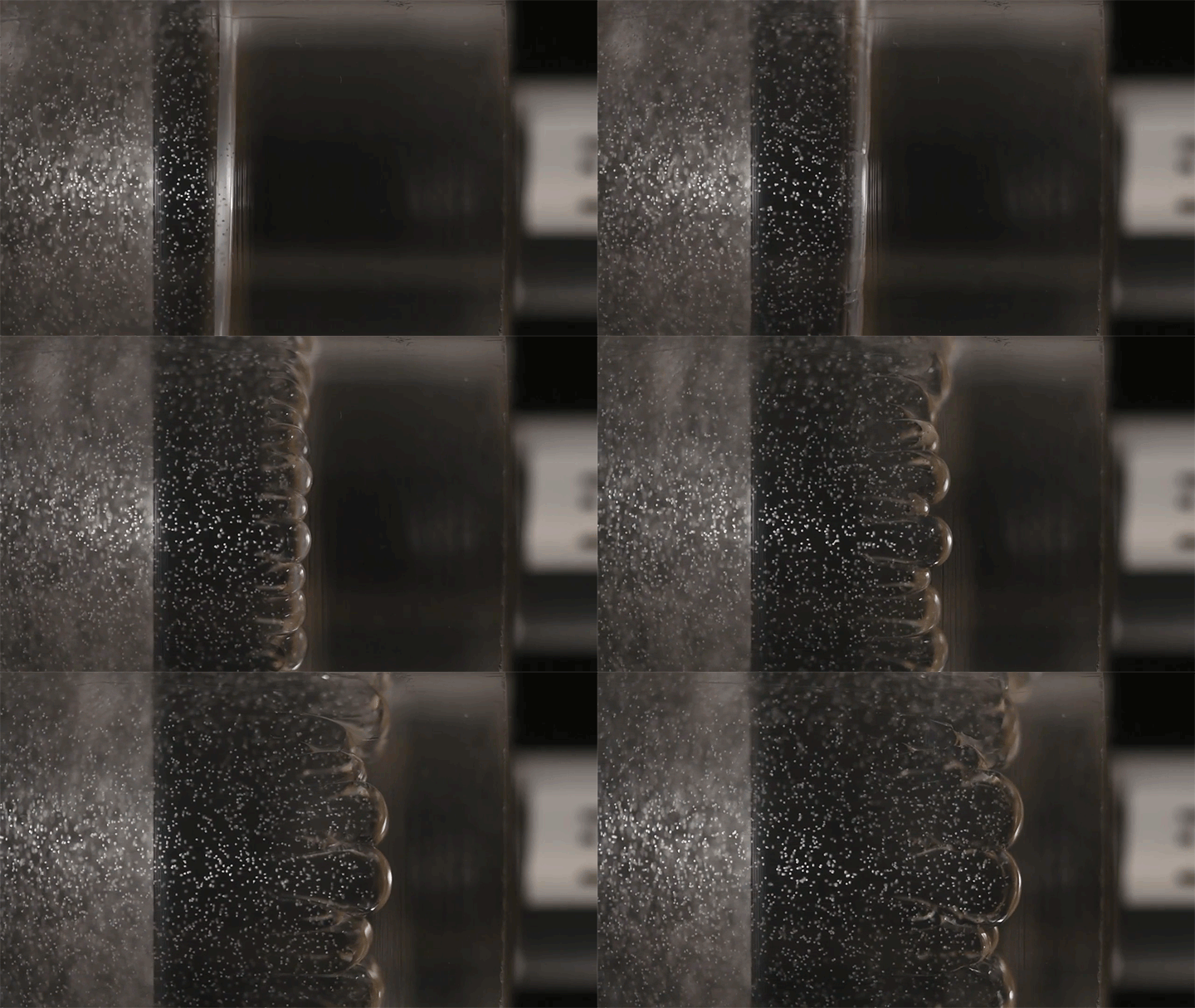
    Can a solid flow? What would that even look like? Researchers explored these questions with an ultra-soft gel (think 100,000 times softer than a gummy bear) pumped through a ring-shaped annular pipe. Despite its elasticity — that tendency to return to an original shape that distinguishes solids from fluids — the gel does flow. But after a short distance, furrows form and grow along the gel’s leading edge.

    Front view of an ultra-soft solid flowing through an annular pipe. The furrows forming along the face of the gel are places where the gel is essentially turning itself inside out.
    Front view of an ultra-soft solid flowing through an annular pipe. The furrows forming along the face of the gel are places where the gel is essentially turning itself inside out.

    Since the gel alongside the pipe’s walls can’t slide due to friction, the gel flows by essentially turning itself inside out. Inner portions of the gel flow forward and then split off toward one of the walls as they reach the leading edge. This eversion builds up lots of internal stress in the gel, and furrowing — much like crumpling a sheet of paper — relieves that stress. (Image and research credit: J. Hwang et al.; via APS News)

    Fediverse Reactions
  • Saving Screens with Shear-Thinning Fluids

    Saving Screens with Shear-Thinning Fluids

    These days glass screens travel with us everywhere, and they can take some big hits on the way. Manufacturers have made tougher glass, but they continue to look for ways to protect our screens. Recently, a study suggested that non-Newtonian fluids are well-suited to the task.

    The team explored the physics of sandwiching a layer of fluid between a glass top layer and an LCD screen bottom layer, mimicking structures found in electronic devices. Through simulation, they searched for the fluid characteristics that would best minimize the forces felt by the solid layers during an impact. They found that shear-thinning fluids — fluids that, like paint or shampoo, get runnier when they’re deformed — provided the best protection. Having the impact energy go into reducing the local viscosity of the fluid stretches the length of time the impact affects the glass, which lowers the bending forces on it and helps avoid breakage. (Image credit: G. Rosenke; research credit: J. Richards et al.; via Physics World)

  • Unsticking in Jumps

    Unsticking in Jumps

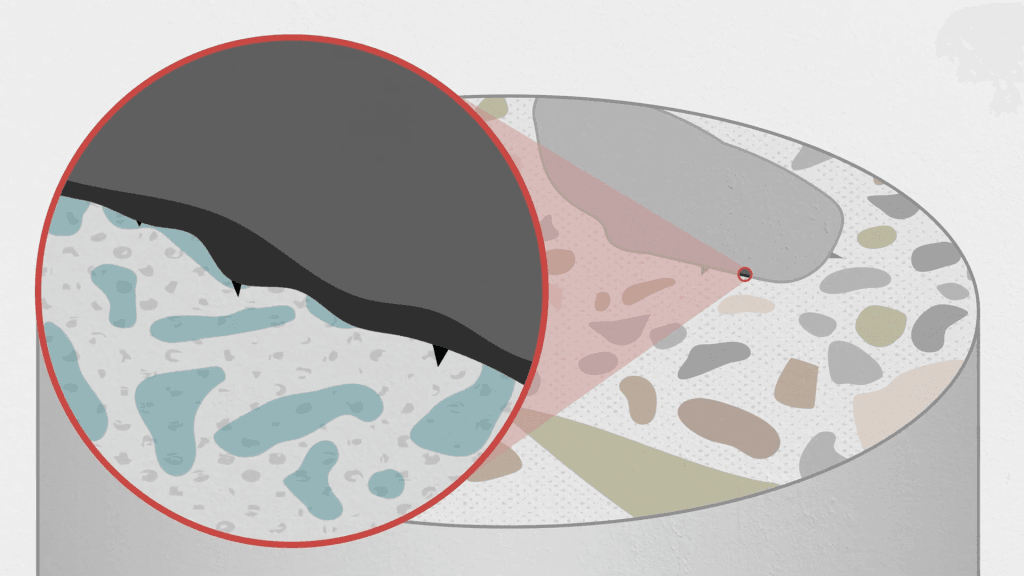
    Soft materials tend to be sticky, and once they’re adhered to a surface, they’re often harder to remove than they were to attach — think of Scotch tape stuck to a desk. This difficulty separating sticky things — known as adhesion hysteresis — has been attributed to various causes, like energy lost to viscoelasticity or age-related chemical bonding. But a new study shows that both those explanations are unnecessary.

    Instead, the difficult removal comes from the way two surfaces separate in fits and starts. No two surfaces are perfectly smooth, and soft surfaces are able to conform to all the nooks and crannies of their partner surface. That molding results in a lot of surface contact, all of which must break for the materials to detach. That peeling doesn’t take place smoothly. Instead, the two surfaces part a little at a time in discrete jumps, as shown in the image above. The colors in the illustration show how much energy is dissipated in each jump, with darker colors indicating higher energy. The team found that this stick-slip mechanism is enough to account for the struggles we have un-sticking objects. They’re now looking at how water affects these narrow meeting places between sticky surfaces. (Image and research credit: A. Sanner et al.; via Physics World)

  • Featured Video Play Icon

    Kirigami Parachutes

    To fly stably, parachutes need to deform and allow some air to pass through their canopy. In this video, researchers investigate kirigimi parachutes, inspired by a form of paper art that uses cuts to create three-dimensional shapes. After laser-cutting, these disks are dropped — or placed in a wind tunnel — to observe how they “fly” at different speeds. Sometimes they flutter or bend; other shapes elongate in the flow. (Video and image credit: D. Lamoureux et al.; via GoSM)

  • Why Inkjet Paper Curls

    Why Inkjet Paper Curls

    Printed pages from inkjet printers tends to curl up over time. Researchers found that this long-term curl correlates with the migration of glycerol — one of the solvents used in inkjet ink — through the paper’s fiber layers toward the unprinted side. The glycerol migration makes the cellulose fibers in the paper swell up, causing the curl. Changing the solvent used in inkjet inks could stop the curl but would likely lead to printing issues, since the glycerol helps the tiny droplets wind up in the right place on the page. Another solution? Print on both sides of the page! (Image credit: Lunghammer – TU Graz; research credit: A. Maass and U. Hirn; via Physics World)

  • Bending in Bubbles

    Bending in Bubbles

    Inside a cavity with a square cross-section, bubbles form an array. The shapes of their edges are determined by surface tension and capillarity (lower half of center image). Adding an elastic ribbon into the bubbles (upper half of center image) means that the bubbles’ shapes are determined by a competition between the elasticity of the ribbon and the capillarity of the fluid. Researchers found that they could tune the rigidity of the ribbon to dictate the shape of the bubble array, or, conversely, they could use the bubbles to set the shape of a UV-curable ribbon. (Image and research credit: M. Jouanlanne et al., see also)

  • Rain-Driven Prey Capture

    Rain-Driven Prey Capture

    Pitcher plants often entice their insect victims with sweet nectar before trapping them in inescapable viscoelastic goo. But some species go even further. Nepenthes gracilis, a species native to Southeast Asia uses its leafy springboard to lure its prey. Once an ant crawls to the underside of the leaf, a falling rain drop will spell its doom. When drops hit the leaf, it deflects down and jerks up, thanks to its shape and stiffness. The motion catapults insects into the pitcher, where digestive fluids await. While we’ve seen some fast-moving plants before, this is a rare example of a plant with an externally-driven speed mechanism. With it, the pitcher plant doesn’t have to wait or expend any metabolic effort to reset for the next insect. (Image credit: GFC Collection/Alamy; research credit: A. Lenz and U. Bauer; via New Scientist)

  • Featured Video Play Icon

    Squishy Actuators

    Hard materials don’t always work well in robotics. Here, researchers build soft actuators that can bend, curl, and tighten in order to manipulate objects. They begin by injecting liquid elastomer into a tube (Image 1), followed by a bubble of air. Buoyancy makes the air bubble rise within the tube, creating an asymmetric cross-section where the solidified elastomer has a thin shell along one side and a thicker wall along the other (Image 2). When high-pressure air is pumped into the soft tubes, their asymmetric cross-section makes them bend and twist (Image 3). The team found that they can tune the elastomer tubes to form complex shapes good for gripping and flexing — perfect for a soft robot! (Video and image credit: T. Jones et al.; research credit: T. Jones et al.)