In the summer months, a breeze can set long grasses waving in an impressive display. Similar behaviors are seen in aquatic plants during tides. Researchers simulate the behavior in two-dimensions using a flowing soap film and nylon filaments. Flow visualization reveals the strong differences between flow above and between the grass. Vortices recirculate between the filaments at speeds much slower than the flow overhead. The instantaneous interaction of the high-speed freestream, the unsteady vortices, and the resistance of the grass results in familiar synchronous waves of grain. (Video credit: R. Singh et al.)
Tag: soap film

Holiday Fluids: Santa’s Aerodynamics
Today we have some holiday-themed fluid dynamics: visualization of flow around Santa’s sleigh! This is a flowing soap film visualization at a low speed (author Nick Moore has some other speeds as well). Santa’s sleigh is what aerodynamicists call a bluff body–a shape that is not streamlined or aerodynamic–and sheds a complicated wake of vortices. Like any object moving through a fluid, Santa’s sleigh generates drag forces made up of several components. There is viscous drag, which comes from friction between the sleigh’s surface and the fluid, and form drag (or pressure drag), which comes from the shape of the sleigh. That wake full of complicated vortices significantly increases the sleigh’s pressure drag, requiring Rudolph and the other reindeer to provide more thrust to counter the sleigh’s drag. Speaking thereof, the visualization does not take into account the aerodynamics of the reindeer, who, in addition to providing the sleigh’s thrust, would also affect the flowfield upstream of the sleigh. This post is part of this week’s holiday-themed post series. (Video credit: N. Moore)
Collapsing Soap Bubbles
The colors of a soap film are directly related to their thickness. If a film becomes thin enough (~10 nanometers), it appears black. (Here’s why.) This video shows the thinning of a vertical soap film. Normally, this is a linear process, with gravity pulling the fluid downward and progressively thinning the film from top to bottom at a constant rate. At 0:20 a cold rod slowly contacts the film, adding a thermal driver for the film’s thinning. Two large counter-rotating convection cells form underneath the rod, with weaker secondary vortices in the lower corners of the film. This drastically increases mixing in the film. Gradually small black spots, indicating very thin areas of the film, form and advect. Eventually these spots stretch, forming long tails. The thinning of the film kicks up to an exponential rate until the film becomes uniformly thin. (Video credit: M. Winkler et al.)

How Fast Do Holes Grow?
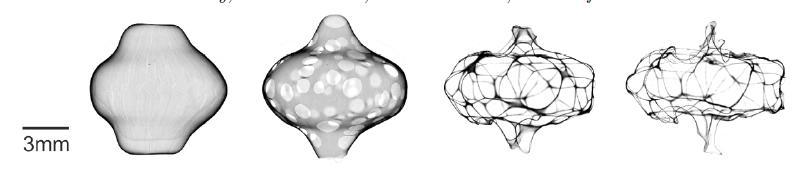
Taylor and Culick predicted a constant velocity for the rim of an opening hole in a soap film of uniform thickness. Unfortunately, it is difficult to experimentally produce a soap film of uniform thickness. It is much easier to create films of uniform thickness with liquid crystals in their smectic-A phase, in which the molecules are ordered in layers along a single direction. When smectic-A bubbles burst, however, it bears little resemblance to a soap bubble. Smectic-A bubbles burst spontaneously during oscillations, the holes in the film growing until a network of filaments is left behind. The filaments themselves will rapidly break up into droplets due to the Plateau-Rayleigh instability. (Photo credit: R. Stannarius et al.)

Soap Film Butterfly
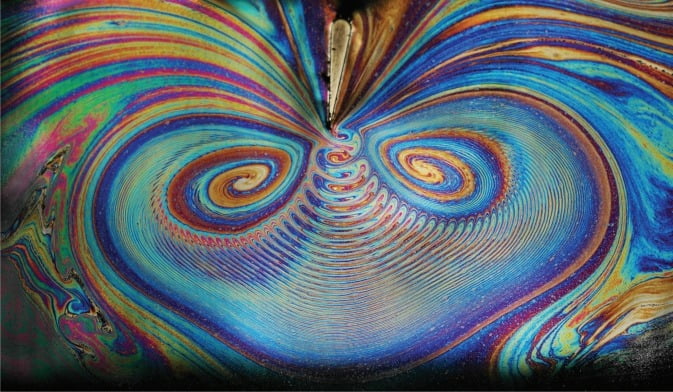
Originally posted: 14 Jan 2011 This gorgeous butterfly-like double spiral roll takes place on a horizontal soap film. The foil (seen top center) inserted in the film flaps back and forth. Each time the foil changes direction a vortex forms at the tip and gets advected away. The vortices stretch and distort in the roll, but if you look at the photograph closely, you’ll see the tiny shed vortices persisting throughout the roll structure. The bright colors that make this flow visible are due to interference patterns related to the local thickness of the film. (Photo credit: T. Schnipper et al.)
Reminder: If you haven’t already, please fill out our reader survey and help us improve FYFD!

The Colors of Soap
The brilliant and beautiful colors of a bubble are directly related the the thickness of the soap film surrounding it. When light shines on the soap film, some rays are reflected from the upper surface of the film, while others are refracted through the film and reflect off its lower surface. These reflected rays have different phase shifts and their interference is what causes the colors we observe. The color patterns themselves reveal the interior flow of the soap film, in which gravity tries to thin the film and surface tension tries to distribute the film evenly. (Photo credit: R. Kelly, A. Fish, D. Schwichtenberg, N. Travers, G. Seese)
Pendulum Soap Flow Viz
Soap films are a handy way to create nearly two-dimensional flow fields. Previously we’ve seen them used to show wake structures of pitching foils, flapping flags, and multiple bodies. In this video, we see the dynamics of a pendulum in a soap film. Initially its length is quite long, and the ring end of the pendulum bobs side-to-side in a figure-8 motion. There are two rotational effects here: one is the standard oscillation of a pendulum about its pivot, the other is the rotation of the pendulum’s ring about its attachment point. Interestingly, they have the same frequency. The major destabilizing force for the pendulum is the periodic shedding of vortices we see off the ring. By shortening the pendulum length, the pendulum’s behavior shifts; first it loses the stationary node in its string. Eventually, the string becomes so short that the pendulum no longer oscillates. (Video credit: M. Bandi et al.)
Self-Healing Soap Films
Some soap films are capable of self-healing after a solid object passes through them, as shown in the video above. The behavior is primarily dependent on Weber number–a nondimensional ratio of the film’s inertia to its surface tension. Although demonstrated for positive curvature in the video, the same behavior is observed in negatively curved soap films as well. For a look at how the behavior varies with projectile velocity and size, check out this video. (Video credit: J. Bryson, BYU Splash Lab)
Detonation in a Bubble
Accidental releases of combustible gases in unconfined spaces can be difficult to recreate in a laboratory environment. Here researchers simulate the conditions using detonation inside a soap film bubble. Combustible gases are pumped inside the soap film and then a spark creates ignition. The resulting flame propagation is visualized using high-speed schlieren photography, making the density gradients in the flame visible. When the mixture of hydrogen fuel to air is balanced, the flame is spherically symmetric with a high flame speed. In contrast, weaker mixtures of fuel/air produce slow flame speeds and mushroom-like flames that leave behind unreacted fuel. This is due to buoyant effects; the time scale associated with buoyancy is smaller than that of the flame speed and chemical reactions when the fuel/air mixture is lean. (Video credit: L. Leblanc et al.)

Chronoscapes

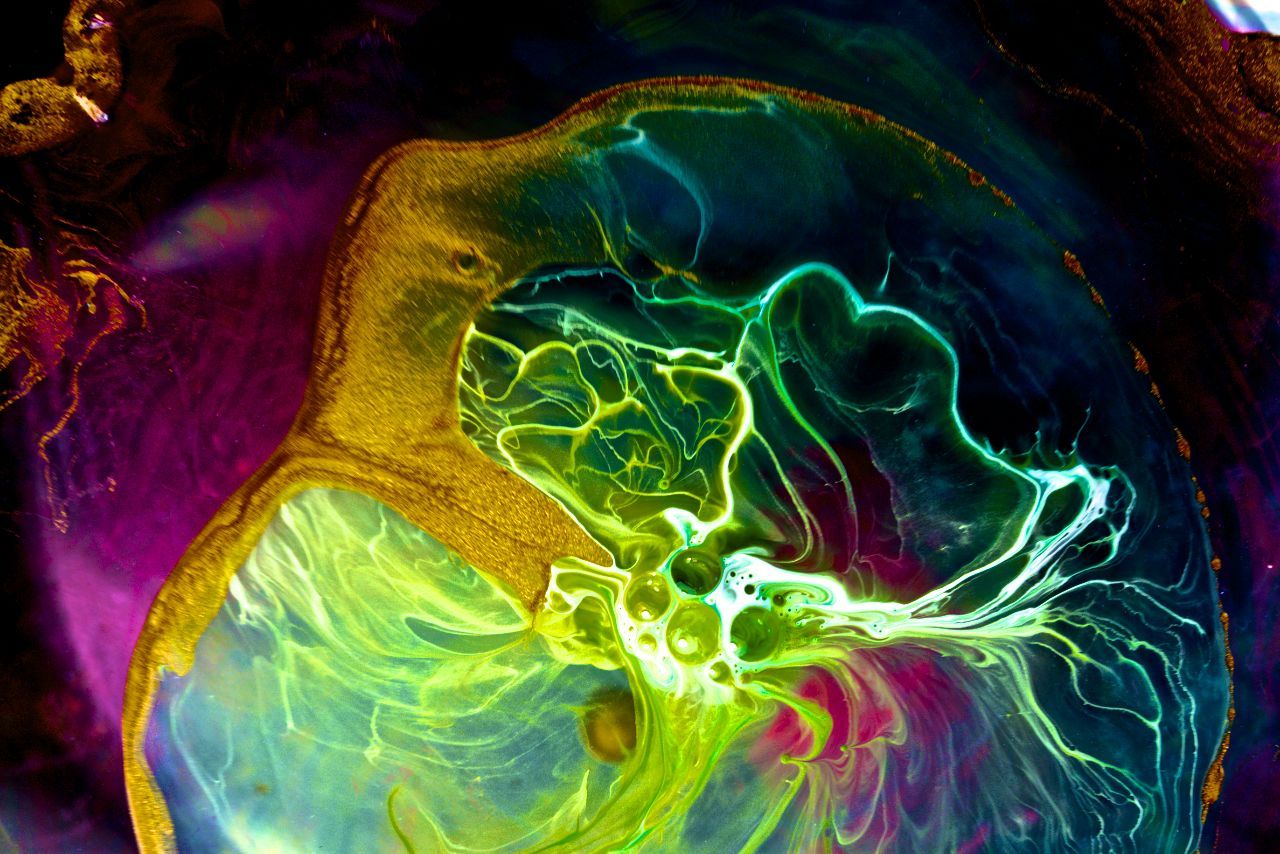
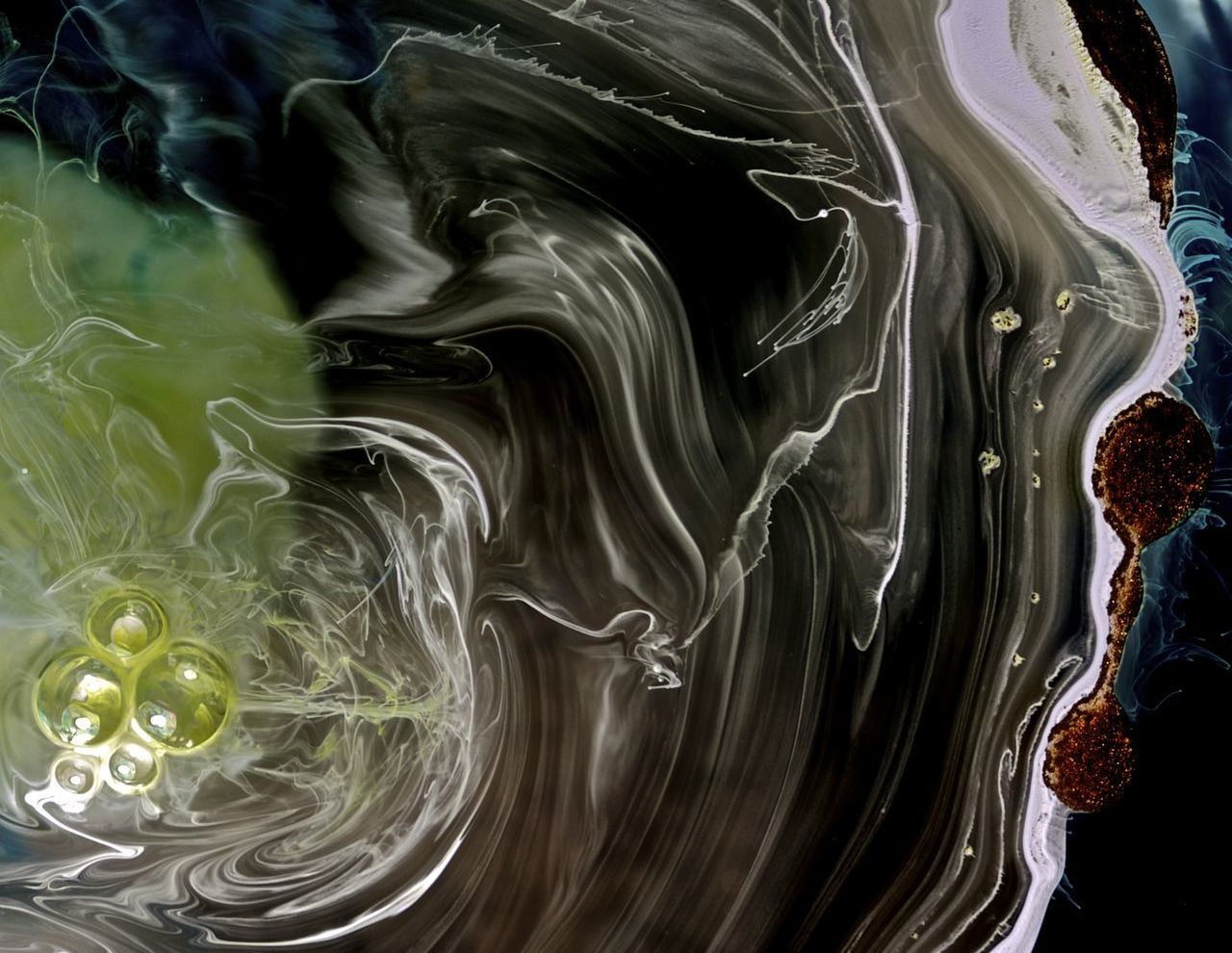
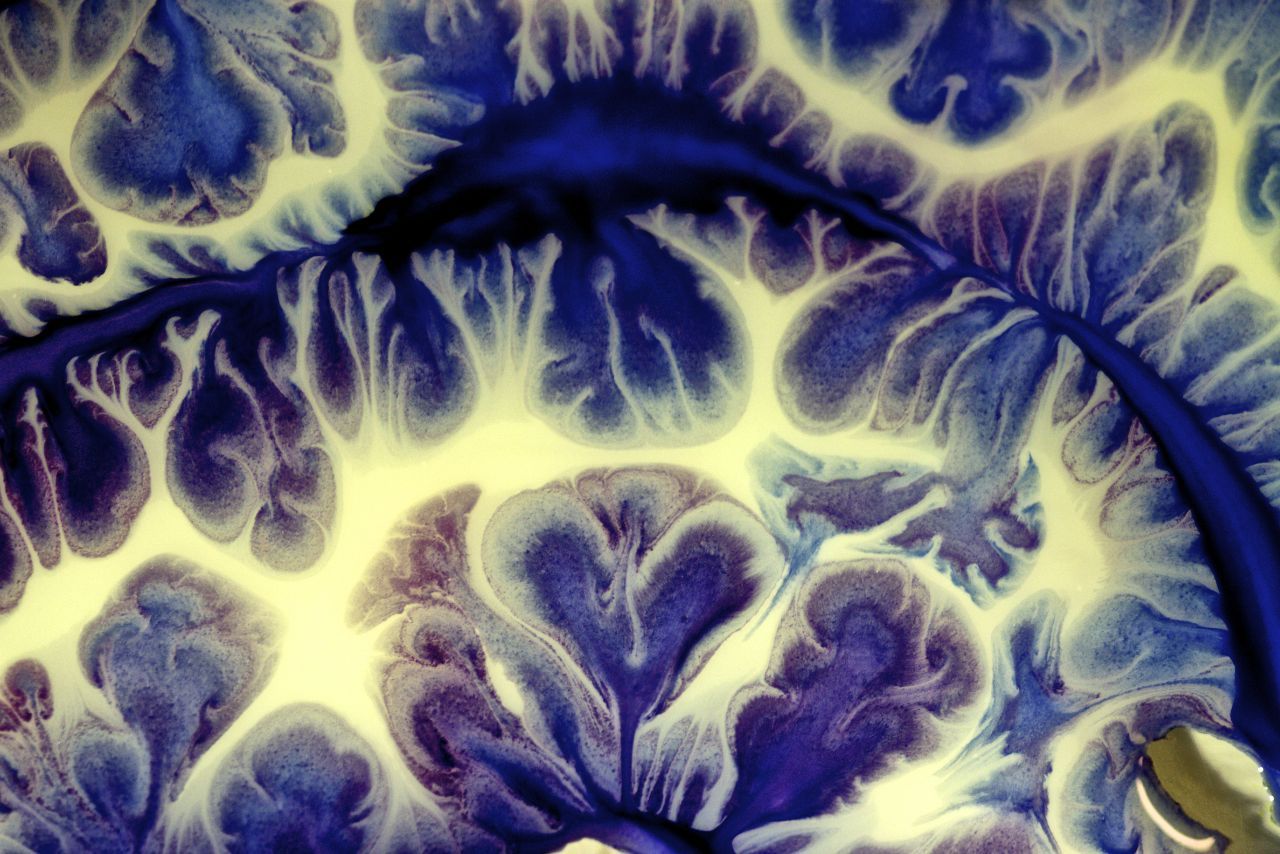
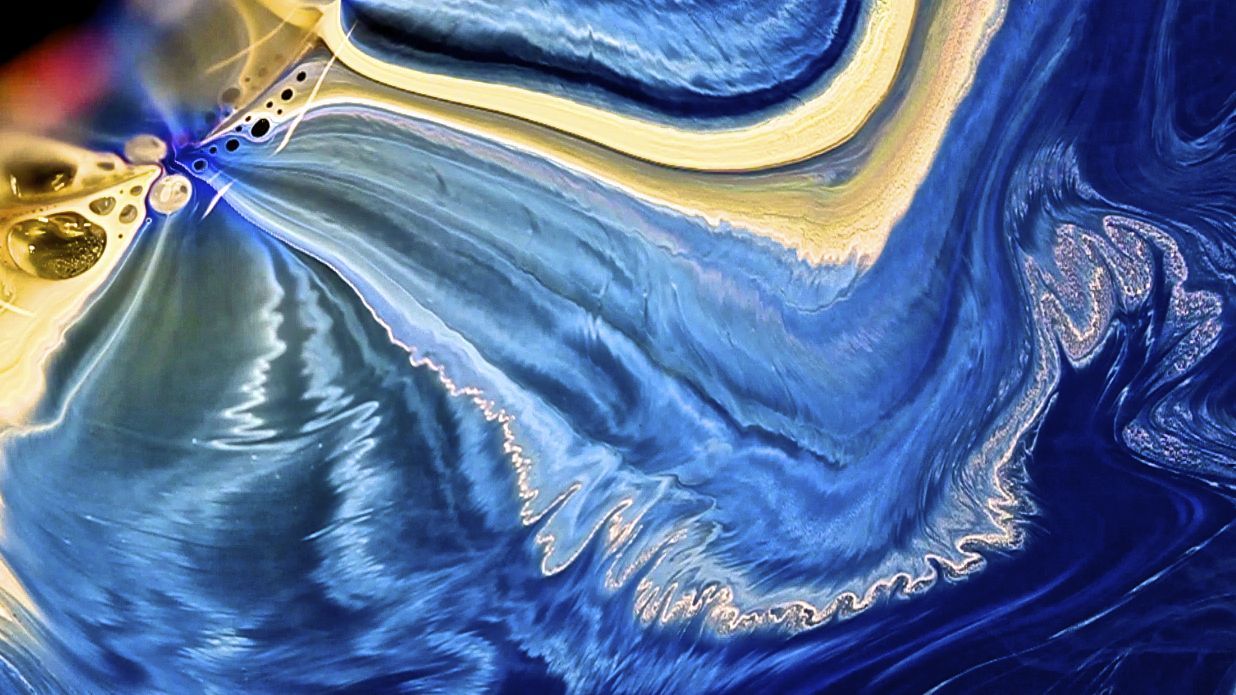
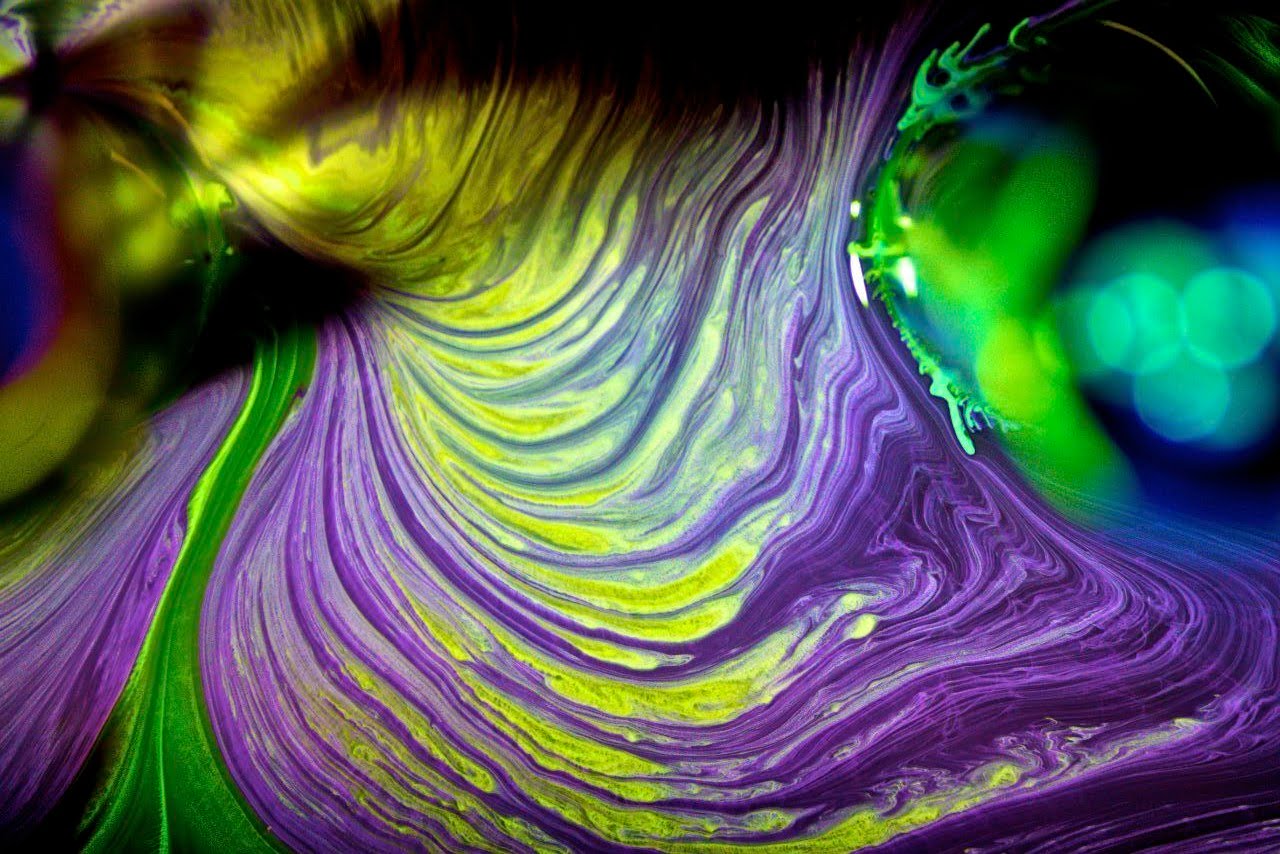
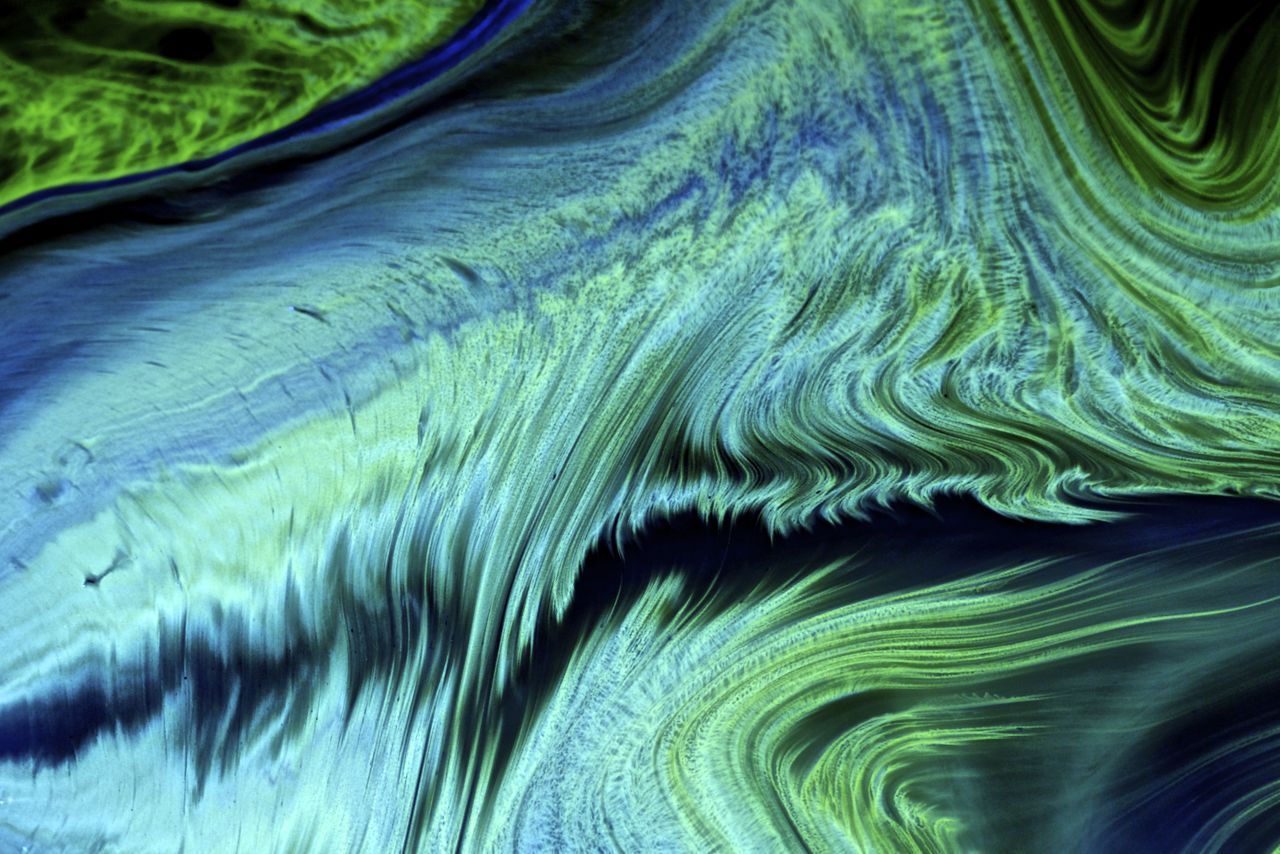
Exeter University artist-in-residence Pery Burge uses ink, water, soap films, and other fluids to create her spectacular “artistic flow visualization”. Looking closely, one sees the influence of bubbles, vortices, diffusion, and many fluid instabilities, all combined to create psychedelic and dream-like landscapes. For more on her work and additional galleries, see her website Chronoscapes. (Photo credit: Pery Burge)