You may think of soap bubbles as a childhood plaything, but there’s a lot to be learned from them. In her newest video, Dianna of Physics Girl explores some of the fascinating research scientists use soap bubbles for and how you can recreate some of their experiments at home. Scientists have used bubbles to explore how atmospheric vortices behave, how to tie knots in fluids, how grass waves in the wind, and even how explosive detonations occur. Just modeling bubbles and foams can be incredibly complex. It turns out the humble bubble has quite a lot to teach us. (Video credit: Physics Girl/PBS Digital Studios)
Tag: soap bubbles

Soap Bubble Coalescence
Droplets falling onto a bath of the same liquid will sometimes coalesce via a series of increasingly smaller droplets in a process known as the coalescence cascade. Soap bubbles, it turns out, can exhibit a similar partial coalescence. When a bubble nears a soap film and the air between them drains away, coalesce can begin. If the the soap film beneath the bubble ruptures, some air from the inside of the bubble can escape. Part of the bubble coalesces with the soap film and a smaller daughter bubble is left behind. The researchers observed this process happen up to three times before the bubble coalesced completely. Alternatively, if the soap film did not rupture, the air inside the bubble had no escape, and the bubble would coalesce into a hemispherical lens atop the soap film. (Video credit: G. Pucci et al.; via KeSimpulan)
——————
Don’t forget about our FYFD survey! I’ve teamed up with researcher Paige Brown Jarreau to create a survey of FYFD readers. By participating, you’ll be helping me improve FYFD and contributing to novel academic research on the readers of science blogs. It should only take 10-15 minutes to complete. You can find the survey here. Please take a few minutes to participate and share!
Healing Bubbles
Soap bubbles are ephemeral creations. The slightest prick will send them tearing apart in the blink of an eye. It may come as a surprise, therefore, that dropping a water droplet through a bubble will not break it. Instead, the bubble will heal itself using the Marangoni effect. In a soap bubble, the soap molecules act as a surfactant, lowering the surface tension of the water and allowing the fragile structure to hold together. When the water drop impacts the bubble, the local surface tension increases because of the relative lack of soap molecules. This increase in surface tension pulls at the rest of the bubble, drawing more soap molecules toward the point of contact. The effect evens out surface tension across the surface and stabilizes the bubble. You can test the effect at home, too. If you wet your finger, you can poke a soap bubble without popping it. (Video credit: G. Mitchell; via io9)
Giant Bubbles
In their latest video, Gavin and Dan of The Slow Mo Guys demonstrate what giant bubbles look like in high-speed video from birth to death. Surface tension, which arises from the imbalance of intermolecular forces across the soapy-water/air interface, is the driving force for bubbles. As they move the wand, cylindrical sheets of bubble film form. These bubble tubes undulate in part because of the motion of air around them. In a cylindrical form, surface tension cannot really counteract these undulations. Instead it drives the film toward break-up into multiple spherical bubbles. You can see examples of that early in the video. The second half of the video shows the deaths of these large bubble tubes when they don’t manage to pinch off into bubbles. The soap film tears away from the wand and the destructive front propagates down the tube, tearing the film into fluid ligaments and tiny droplets (most of which are not visible in the video). Instead it looks almost as if a giant eraser is removing the outer bubble tube, which is a pretty awesome effect. (Video credit: The Slow Mo Guys)
Bursting a Bubble
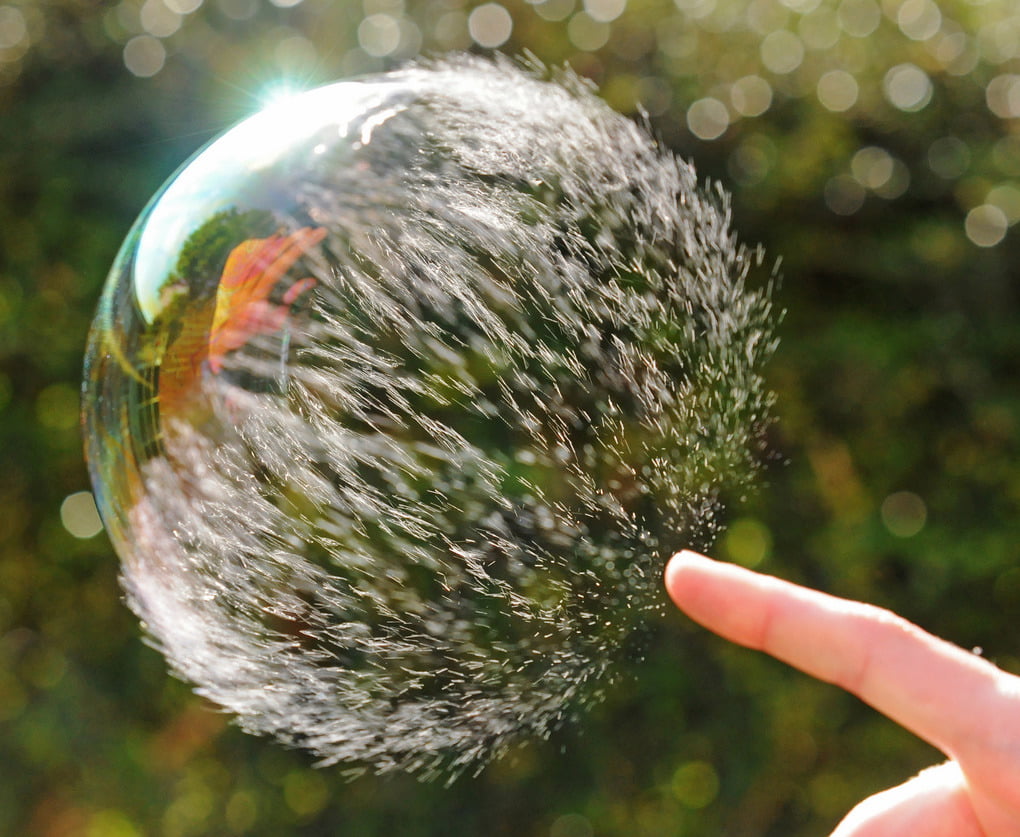
Though seemingly instantaneous to the naked eye, the bursting of a soap bubble is fascinating when slowed down. Here it is at about 2200 frames per second. Initially, the bubble is approximately spherical – its shape determined by a balance between surface tension, gravity, and pressure. The prick of a pinpoint disrupts the balance, and surface tension pulls the thin film away from the defect. The liquid sheet of the bubble retracts swiftly into a filament of fluid and a cloud of tiny droplets. (Video credit: soapbubble.dk)

Frozen Bubbles

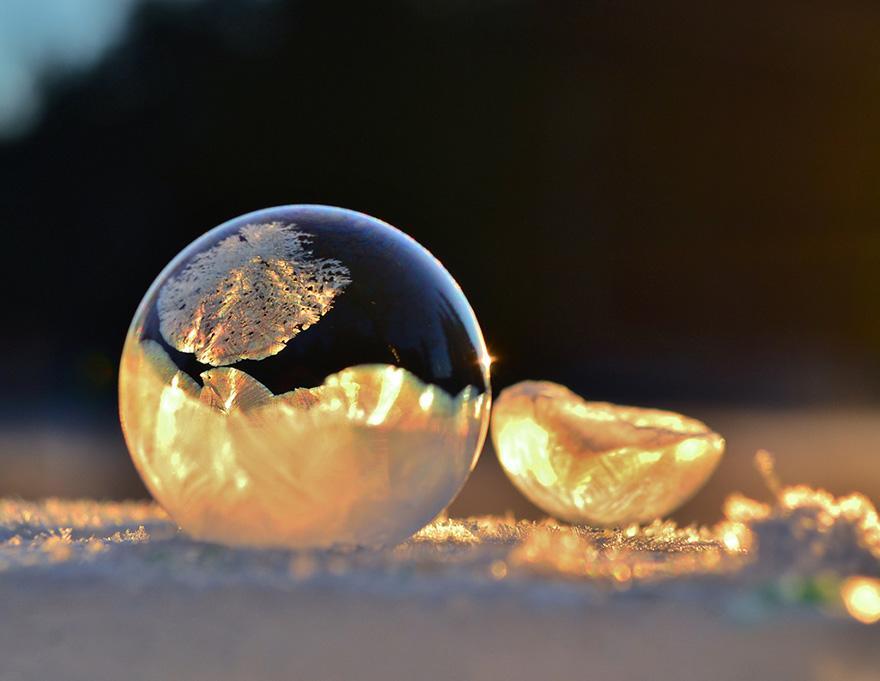
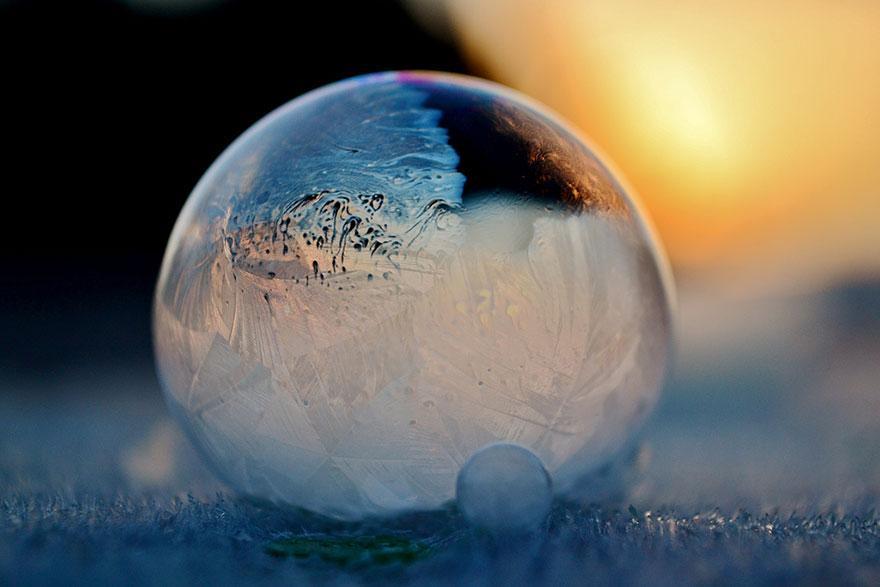
Snowflakes aren’t the only frozen crystals to play with outside in the winter. Photographer Angela Kelly recently posted a series of frozen soap bubbles made by her and her son. In temperatures well below freezing, the thin film of the soap bubble does not survive long before it begins to freeze. The bubbles do not freeze all at once; instead the frost creeps gradually across it. For bubbles sitting on a surface, the ice front expands upward, much the same as with a freezing water drop. Once frozen, the bubbles crack or rip when touched instead of melting and popping. (Photo credit: A. Kelly; via BoredPanda; submitted by jshoer)

Bullet Through a Bubble
A bullet passes through a soap bubble in the schlieren photo above. The schlieren optical technique is sensitive to changes in the refractive index and, since a fluid’s refractive index changes with density, permits the visualization of shock waves. A strong curved bow shock is visible in front of the bullet as well as weaker lines marking additional shocks waves around the bullet. Impressively, the bullet’s passage is so fast (and the photo’s timing so perfect) that there are no imperfections or signs of bursting in the soap bubble. The photo’s caption suggests that the bubble may be filled with multiple gases. If they are unmixed and of differing densities, this may be the source of the speckling and plume-like structures inside the bubble. Incidentally, if anyone out there has high-speed schlieren video of a bullet passing through a soap bubble, I would love to see it. (Photo credit: H. Edgerton and K. Vandiver)

Bursting Bubble
Originally posted: 24 Aug 2011 That soap bubbles burst in the blink of an eye is a pity considering how fascinating their disappearing act is. This photo set from photographer Richard Heeks captures the bubbles mid-burst. Once the bubble’s film is breached, surface tension rips the smooth film back like a broken balloon, causing the liquid that used to be part of the bubble to erupt into droplets. (Photo credit: Richard Heeks)
Reminder: Many thanks to those who have filled out the survey! There are some great responses so far. If you haven’t done so, won’t you please fill out our reader survey?
Freezing Bubbles
If you find yourself some place really cold this holiday season, may I suggest stepping outside and having some fun freezing soap bubbles? The crystal growth is quite lovely, as seen in this photograph. If you live in warmer climes, fear not, you can always experiment in your freezer. It would be particularly fun, I think, to see how a half-bubble sitting on a cold plate freezes in comparison to a droplet like this one. (Video credit: Mount Washington Observatory)
Self-Healing Soap Films
Some soap films are capable of self-healing after a solid object passes through them, as shown in the video above. The behavior is primarily dependent on Weber number–a nondimensional ratio of the film’s inertia to its surface tension. Although demonstrated for positive curvature in the video, the same behavior is observed in negatively curved soap films as well. For a look at how the behavior varies with projectile velocity and size, check out this video. (Video credit: J. Bryson, BYU Splash Lab)