Accidental releases of combustible gases in unconfined spaces can be difficult to recreate in a laboratory environment. Here researchers simulate the conditions using detonation inside a soap film bubble. Combustible gases are pumped inside the soap film and then a spark creates ignition. The resulting flame propagation is visualized using high-speed schlieren photography, making the density gradients in the flame visible. When the mixture of hydrogen fuel to air is balanced, the flame is spherically symmetric with a high flame speed. In contrast, weaker mixtures of fuel/air produce slow flame speeds and mushroom-like flames that leave behind unreacted fuel. This is due to buoyant effects; the time scale associated with buoyancy is smaller than that of the flame speed and chemical reactions when the fuel/air mixture is lean. (Video credit: L. Leblanc et al.)
Tag: soap bubbles

Didgeridoo Soap Bubble
This high-speed video shows a soap bubble being blown via didgeridoo, a wind instrument developed by the Indigenous Australians. The oscillations of the capillary waves on the surface of the bubble vary with the frequency of note being played. High frequency notes excite small wavelengths, whereas lower notes create large wavelength oscillations. For more fun, check out what you can do with didgeridoos in space. (submitted by Christopher B)
Soap Bubbles Bursting
To the human eye, the burst of a soap bubble appears complete and instantaneous, but high-speed video reveals the directionality of the process. Surface tension is responsible for the spherical shape of the bubble, and, when the bubble is pierced, surface tension is broken, causing the soap film that was the bubble to contract like elastic that’s been stretched and released. Droplets of liquid fly out from the edges of the sheet until it atomizes completely.
Bursting Bubbles
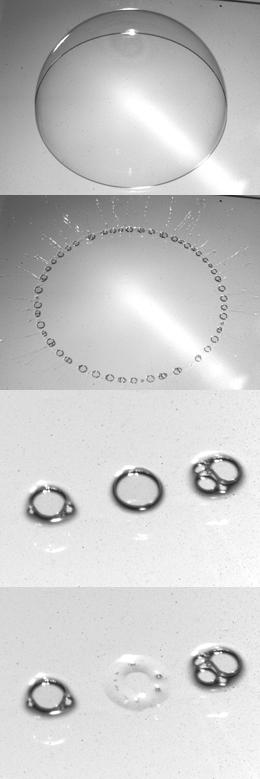
Sometimes bursting one bubble just leads to more bubbles. This high-speed video shows how popping a bubble sitting on a fluid surface can lead to a ring of daughter bubbles. When the surface of the bubble is ruptured, filaments of the liquid that made up the surface are drawn back toward the pool by surface tension, trapping small pockets of the air that had been inside the bubble. A dimple forms on the surface and rebounds as a jet that lacks the kinetic energy to eject droplets. Watch as the jet returns to the interface, and you will notice the tiny bubbles around it. At 56 ms, one of the daughter bubbles on the left bursts. See Nature for more. (Video credit: J. Bird et al)
Tornado in a Bubble
In this video, a miniature tornado-like vortex is created inside a soap bubble. Here’s how it works: after the first bubble is formed and the smoke-filled bubble is attached to the outside, he blows into the main bubble, creating a weak angular velocity, before breaking the interface between the two bubbles. As the smoke mixes in the main bubble, note how it is already spinning slowly due to the free vortex he created. Then, when the top of the bubble is popped, surface tension pulls the bubble’s surface inward. Because the bubble radius is decreasing, conservation of angular momentum causes the angular velocity of the fluid inside to increase, pulling the smoke into a tight vortex, much like a spinning ice skater who pulls her arms inward.
Soap Bubble Burst
High-speed video of a soap bubble being popped reveals the directionality of the process. Like a the rubber of a bursting balloon, the soap film rushes away from the point of rupture, disintegrating as the information about a sudden lack of surface tension is propagated across the remaining film surface. In this regard, it is much like what happens when you drop a slinky toy.

Fluid Sculpture
Droplet collisions captured instantaneously create beautiful fluid sculptures that, though common, are too fast for the human eye. Here a bubble was blown onto the surface of the fluid, then a droplet was released to fall into the center of the bubble, bursting it. As that droplet rebounded in a Worthington jet, a second droplet was released and impacted the jet, creating the umbrella-like shape in the center. See Liquid Droplet Art for more photos. (Photo credit: Corrie White and Igor Kliakhandler) #
“Compressed 02”
This timelapse video shows the spreading of food coloring and a ferrofluid through soap suds surrounding a magnet. Capillary action, the same force that enables sap to flow up through a tree against gravity, helps draw the fluids through the interfaces between the soap bubbles without disturbing the suds. The magnet’s field provides a preferred direction for the ferrofluid flow. (via Gizmodo)

Bursting Bubbles
A soap bubble bursts when its surface tension is broken, and, although from our perspective, the bubble bursts instantly, the process is actually directional. The bubble disintegrates from the point of contact outward. See it in high-speed video here or see more photos here. (Photo credit: Richard Heeks) #
Freezing Soap Bubbles
This is what it looks like when a soap bubble freezes. Perhaps not strictly fluid mechanical in nature, but it’s a nice thermodynamics demonstration.