Soap bubbles are wonderfully ephemeral, their surfaces constantly in motion as air currents, surface tension variations, and temperature differences make them dance. In this video, though, photographer Paweł Załuska focuses on freezing soap bubbles. Watching the growth of ice crystals across the bubbles’ thin surface is mesmerizing. Snowflake-like crystals can nucleate anywhere on the film and, as in the sequence at 0:48, those crystals can float around on the bubble’s surface like snowflakes drifting on a breeze until enough of the film solidifies to bring the bubble to a halt and, then, a collapse. (Video credit: P. Załuska/ZALUSKart; via Gizmodo)
Tag: soap bubbles

Soap Bubbles Up Close
Watching soap bubbles up close is endlessly fascinating. The iridescent colors reflect the soap film’s thickness, or, in the case of black spots, its lack thereof. The dancing of the colors shows the soap film’s flow and the ever-shifting balance of surface tension necessary to keep the film intact. Even the junctures of the bubbles–so precise and mathematically perfect in structure–reflect the molecular interactions that govern them. (Video credit: Stereokroma; via R. Weston)
Coarsening in a Soap Film
Flow in a soap film is driven by gravity’s efforts to thin the film and surface tension’s attempts to stabilize variations in thickness. Because evaporation guarantees that the soap film will eventually dry out, gravity typically wins the battle and causes a soap film to rupture. This video takes a close look at what happens in the film just before it ruptures. Black dots form in the thinnest region of the flow. These areas are not holes, but they appear black because they are thinner than any wavelength of visible light. Before rupture, the black dots begin coalescing with one another, first due to diffusion and later more rapidly due to convection in the soap film. Ultimately, the black dots are the harbingers of doom for the fragile bubble. (Video credit: L. Shen et al.)

Daily Fluids, Part 2
We play with fluid dynamics all the time, though we don’t always think of it as such. Here are a few ways it shows up in the ways we play:
Aerodynamics
This is the study of air moving past an object. Whether you’re throwing a paper plane, flying a kite, or riding a bike, aerodynamics has an impact on what you’re doing.Lift
Skipping a rock won’t work unless its impact generates some lift, but we see lift in lots of other places, too, from birds and planes to racecars and sailboats.Magnus Effect
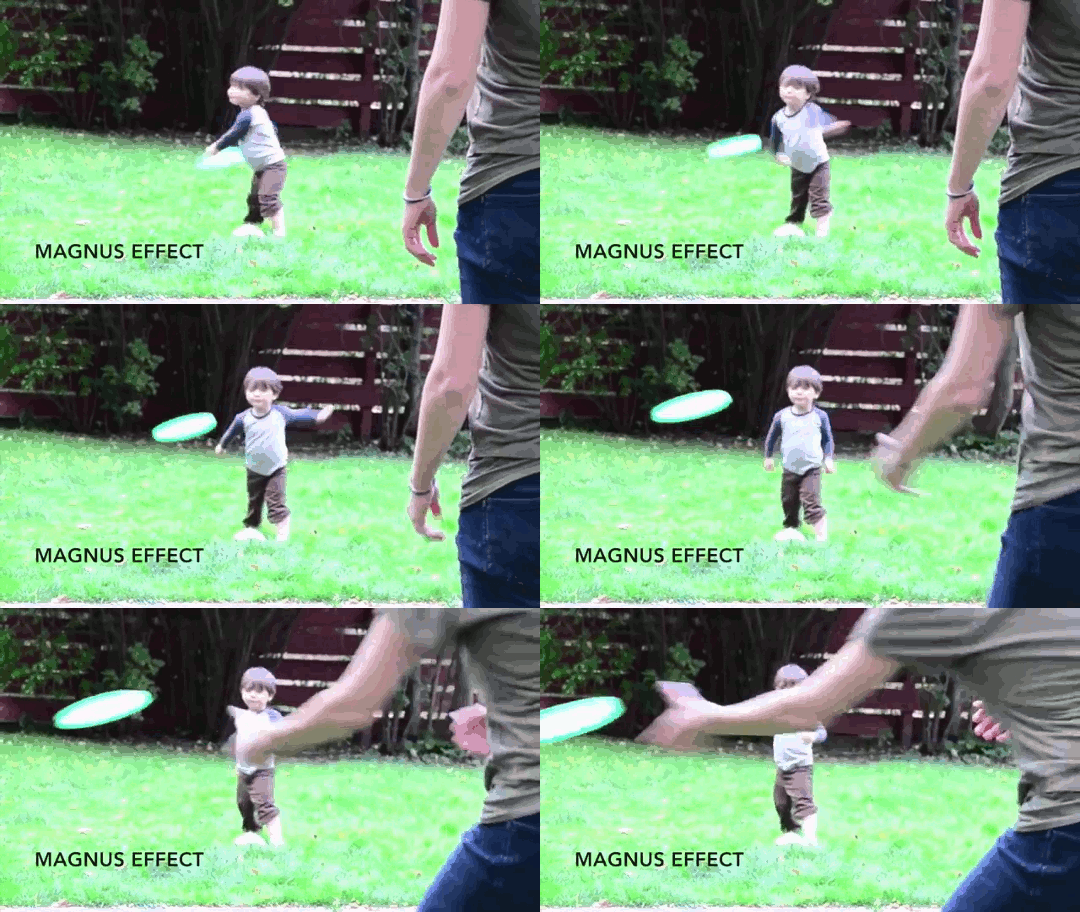
The Magnus effect relates to lift forces on a spinning object. It can affect the way a frisbee flies, but we see it a lot in ball-related sports, too. The flight of golf balls, volleyballs, baseballs, and soccer balls can all be significantly impacted by the Magnus effect. Check out these videos for a primer on the Magnus effect and the reverse Magnus effect.Bubbles
Everybody loves playing with bubbles. But they may have more of a impact than you realize, whether it’s in making the foam on your latte, enhancing the aroma of your champagne, or making your joints pop.Tune in all week for more examples of fluid dynamics in daily life. (Image credit: S. Reckinger et al., source)
Bubble Tricks
[original media no longer available]
Everyone remembers playing with soap bubbles as a child, but most of us probably never became as adept with them as magician Denis Lock. In this video, Lock shows off some of the clever things one can do with surface tension and thin films. My favorite demo starts at 1:25, when he constructs a spinning vortex inside a bubble. He starts with one big bubble and adds a smaller, smoke-filled one beneath it. Then, using a straw, he blows off-center into the large bubble. This sets up some vorticity inside the bubble. When he breaks the film between the two bubbles, the smoke mixes into the already-swirling air in the larger bubble. Then he pokes a hole in the top of the bubble. Air starts rushing out the deflating bubble. As the air flows toward the center of the bubble, it spins faster because of the conservation of angular momentum and a miniature vortex takes shape. (Video credit: D. Lock/Tonight at the London Palladium/ via J. Hertzberg)

Bubbles and Films Merging
As we’ve seen before, a water droplet can merge gradually with a pool through a coalescence cascade. It turns out that the coalescence of a soap bubble with a soap film can follow a similar process! Initially, the bubble and film are separated by a thin layer of air. Once that air drains away and the bubble contacts the fluid, it starts to coalesce. But the bubble pinches off before its entire volume merges, leaving behind a daughter bubble with about half the radius of the previous bubble. This process repeats until the bubble is small enough that it merges completely. To see more great high-speed footage of this bubble merger, check out the full video below. (Image/video credit: D. Harris et al.)
Freezing Soap Bubbles
I’m not a winter person, but there’s something almost magical about the way water freezes. From instant snow to snow rollers and weird ice formations to slushy waves, winter brings all kinds of bizarre and unexpected sights. The video above is an artistic look at one of my favorites – freezing soap bubbles. Normally, the thin film of a soap bubble is in wild motion, convecting due to gravity, surface tension differences, and the surrounding air. Such a thin layer of liquid loses its heat quickly, though, and, as ice crystals form, the bubble’s convection and rotation slow dramatically, often breaking the thin membrane. Happily photographer Paweł Załuska had the patience to capture the beautiful ones that didn’t break! (Video credit: P. Załuska; via Gizmodo)
If you enjoy FYFD and want to help support it, please consider becoming a patron!
Inside a Popping Bubble
Popping a soap bubble is more complicated than what the eye can see. In high-speed video, we find that the action is very directional, with the soap bubble film pulling away from the point of rupture. As it does so, waves, like those in a flapping flag, appear along the surface and strings of fluid form along the edge of the film before breaking into droplets. This video takes matters a step further, looking at what happens to air inside a bubble when it pops. Those subtle waves and strings of fluid we see in the high-speed rupture have a distinctive effect on air inside the bubble. As the film pulls away, it leaves behind a rippled, wavy surface rather than a smooth sphere of foggy air. (Video credit: Z. Pan et al.)
Deforming Soap Films
It’s the time of year when new Gallery of Fluid Motion videos start popping up online. We’ve already featured several and no doubt there will be more to come. Today’s post is a submission from Saad Bhamla, who gave this introduction to the work:
Soap bubbles occupy the rare position of delighting and fascinating both young children and scientific minds alike. Sir Isaac Newton, Joseph Plateau, Carlo Marangoni and Pierre-Gilles de Gennes, not to mention countless others, have discovered remarkable results in optics, molecular forces and fluid dynamics from investigating this seemingly simple system.
This video is a compilation of curiosity-driven experiments that systematically investigate the surface flows on a rising soap bubble. From childhood experience, we are familiar with the vibrant colors and mesmerizing display of chaotic flows on the surface of a soap bubble. These flows arise due to surface tension gradients, also known as Marangoni flows or instabilities. In this video, we show the surprising effect of layering multiple instabilities on top of each other, highlighting that unexpected new phenomena are still waiting to be discovered, even in the simple soap bubble.
As illustrated in the video, raising a bubble beneath the soap film moves surfactants in the film, which causes local differences in surface tension. Any time a difference in surface tension exists, fluid will flow from areas of low surface tension to ones with higher surface tension. This is called the Marangoni effect. On a soap bubble, this is visible in the chaotic swirling colors we see. In this system, Bhamla and his co-author found that by raising the bubble in steps, they could “freeze” the Marangoni-induced patterns created by the previous motion. (Video credit and submission: S. Bhamla et al.)

Healing Soap Films
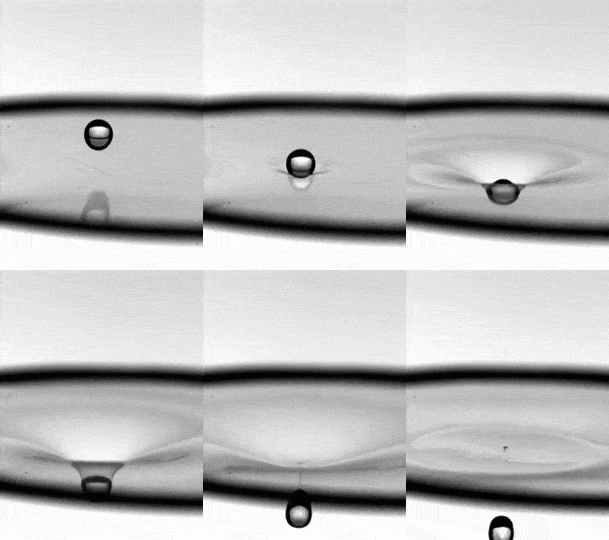
As fragile as a soap bubble seems, these films have remarkable powers of self-healing. The animation above shows a falling water droplet passing through a soap film without bursting it. An important factor here is that the water droplet is wet–passing a dry object through a soap film is a quick way to burst it, as those who have played with bubbles know. The droplet’s inertia deforms the soap film, creating a cavity. If the drop’s momentum were smaller, the film could actually bounce the droplet back like a trampoline, but here the droplet wins out. The film breaks enough to let the drop through, but its cavity quickly pinches off and the film heals thanks to the stabilizing effect of its soapy surfactants. (Image credit: H. Kim, source)