Tag: smoke

  • Seeding Clouds With Wildfire

    Seeding Clouds With Wildfire

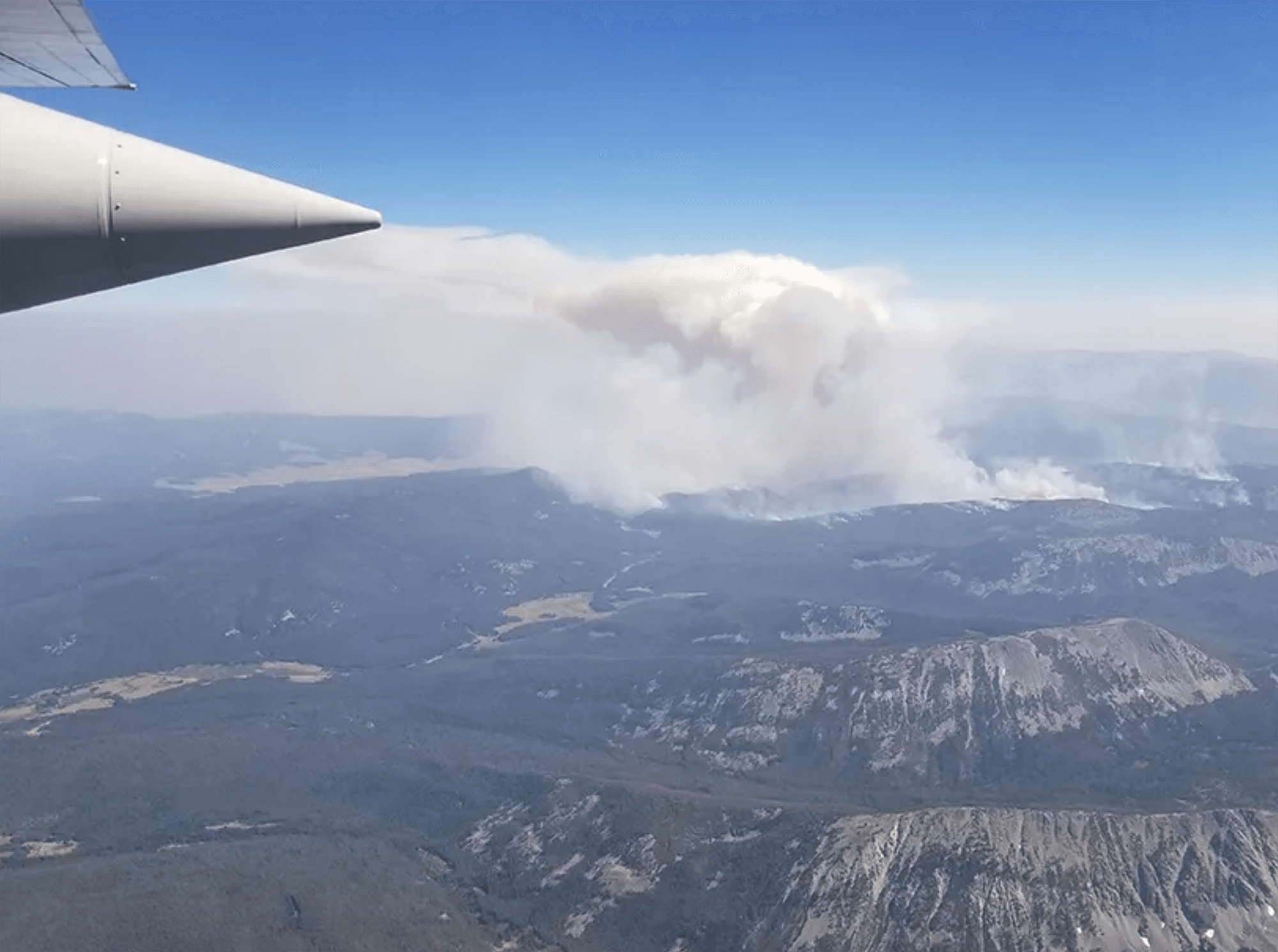
    Raging wildfires send plumes of smoke up into the atmosphere; that smoke is made up of tiny particles that can serve as seeds — nucleation sites — where water vapor can freeze and form clouds. To understand wildfire’s effect on cloud growth, researchers sampled air from the troposphere (the atmosphere’s lowest layer) both in and around wildfire smoke.

    The team found that smoke increased the number of nucleating particles up to 100 times higher than the background air, but the exact make-up of the smoke varied significantly by fire. Smoke particles were mostly organic, though inorganic ones appeared as well. The temperature of a fire, as well as what materials it was burning, made a big difference; the fire where they measured the highest particle concentrations included lots of unburned plant material, thought to be carried aloft by turbulence around the fire. (Image credit: K. Barry; research credit: K. Barry et al.; via Eos)

    Fediverse Reactions
  • Stratospheric Effects of Wildfires

    Stratospheric Effects of Wildfires

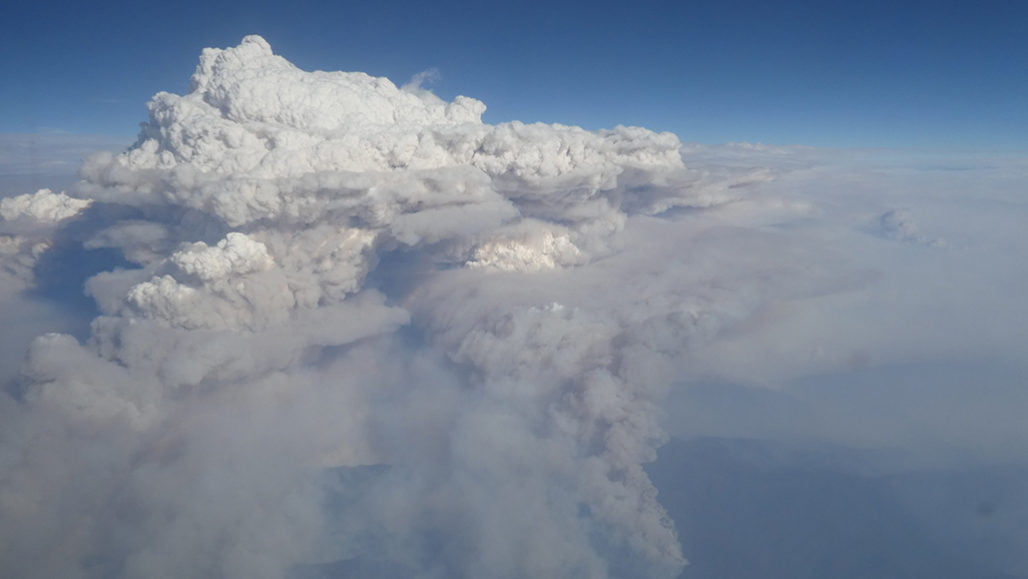
    Australia’s bushfires from earlier this year are offering new insights into how pyrocumulonimbus clouds can affect our stratosphere. A massive, uncontrolled blaze between December 29th and January 4th generated a towering, turbulent cloud of smoke like the one shown above.

    Using meteorological data, a new study shows this enormous cloud initially rose to 16 km in altitude, then began a months-long trek that circled the globe. The smoke plume ultimately stretched to over 1,000 km wide and reached a record altitude of over 31 km. Inside the plume, concentrations of water vapor and carbon monoxide were several hundred percent higher than normal stratospheric air.

    Researchers found the plume extremely slow to dissipate, possibly due to strong rotational winds surrounding it. This is the first time scientists have observed these shielding winds, and work is still underway to determine how and why they formed. (Image credit: M. Macleod/Wikimedia Commons; research credit: G. Kablick III et al.; via Science News; submitted by Kam-Yung Soh)

  • Incense in Transition

    Incense in Transition

    A buoyant plume of smoke rises from a stick of incense. At first the plume is smooth and laminar, but even in quiescent air, tiny perturbations can sneak into the flow, causing the periodic vortical whorls seen near the top of the photo. Were the frame even taller, we would see this transitional flow become completely chaotic and turbulent. Despite having known the governing equations for such flow for over 150 years, it remains almost impossible to predict the point where flow will transition for any practical problem, largely because the equations are so sensitive to initial conditions. In fact, some of the fundamental mathematical properties of those equations remain unproven. (Photo credit: M. Rosic)

  • Mercedes-Benz Tornado

    Mercedes-Benz Tornado

    The world’s most powerful artificial tornado is part of the Mercedes-Benz Museum in Stuttgart, Germany. Though popular enough with visitors that the staff will bring out smoke generators to make it visible, the tornado was not built as an attraction – It’s actually part of the building’s fire protection system. The modern open design of the museum meant that conventional smoke removal systems were inadequate. Instead vorticity is generated in the central lobby with 144 wall-mounted jets. The angular velocity created by the jets is strongest at the middle, in the vortex core, due to conservation of angular momentum – exactly the way a spinning ice skater speeds up by pulling his arms in. The core of the vortex is a low pressure area, which draws outside air toward it – this is how the tornado pulls in smoke when there is a fire. The fan on the ceiling provides the pressure draw necessary for the smoke to be pulled up and out of the building at a supposed rate of 4 tons per minute. See the tornado in action here. (Photo credit: Mercedes-Benz Passion; submitted by Ivan)

  • Lift on a Paper Plane

    Lift on a Paper Plane

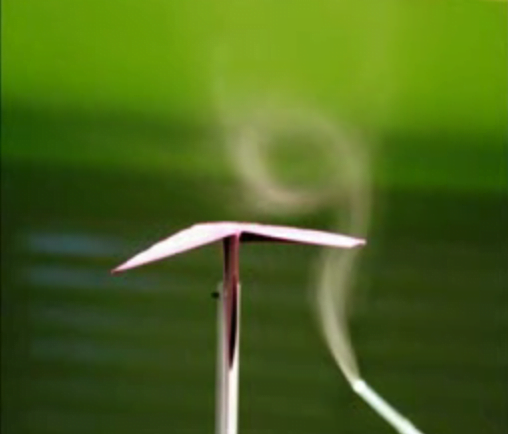
    In this still image from a student experiment, smoke visualization shows the formation of a vortex over the wing of a paper airplane during a wind tunnel test. This wing vortex is mirrored on the opposite wing, though there is no smoke to show it. At high angle of attack, the delta-wing shape of the traditional paper air plane creates these vortices on the upper surface, which helps generate the lift necessary to keep the plane aloft. (Photo credit: A. Lindholdt, R. Frausing, C. Rechter, and S. Rytman)

  • Featured Video Play Icon

    Canyon Fire Timelapse

    Wildfires continue to burn across Colorado and other parts of the United States. This timelapse video shows 5 days worth of the Waldo Canyon fire. Smoke billows through the night and day, with diurnal temperature changes and winds affecting whether the turbulent plumes rise high or hover on the horizon. It is hard to describe the eeriness of watching a fire burn uncontrollably on the horizon; we hope those fighting the fires stay safe and that those affected by the fires are able to return and recover soon. (Video credit: Steve Moraco; submitted by Chris P)

  • Transition to Turbulence

    Transition to Turbulence

    Smoke introduced into the boundary layer of a cone rotating in a stream highlights the transition from laminar to turbulent flow. On the left side of the picture, the boundary layer is uniform and steady, i.e. laminar, until environmental disturbances cause the formation of spiral vortices. These vortices remain stable until further growing disturbances cause them to develop a lacy structure, which soon breaks down into fully turbulent flow. Understanding the underlying physics of these disturbances and their growth is part of the field of stability and transition in fluid mechanics. (Photo credit: R. Kobayashi, Y. Kohama, and M. Kurosawa; taken from Van Dyke’s An Album of Fluid Motion)

  • Smoke-Wire Visualization

    Smoke-Wire Visualization

    One common simple form of flow visualization is the smoke-wire technique. A thin wire is coated in oil, then heated. The resulting smoke flows over and around the object of study, providing a useful tracer for the flow. While not necessarily helpful as a quantitative measure, smoke-flow visualization helps researchers get a sense of what is going on in the flow. (Photo credits: TAMU Hypersonics Lab)

  • Smoke Visualization on an F-16

    Smoke Visualization on an F-16

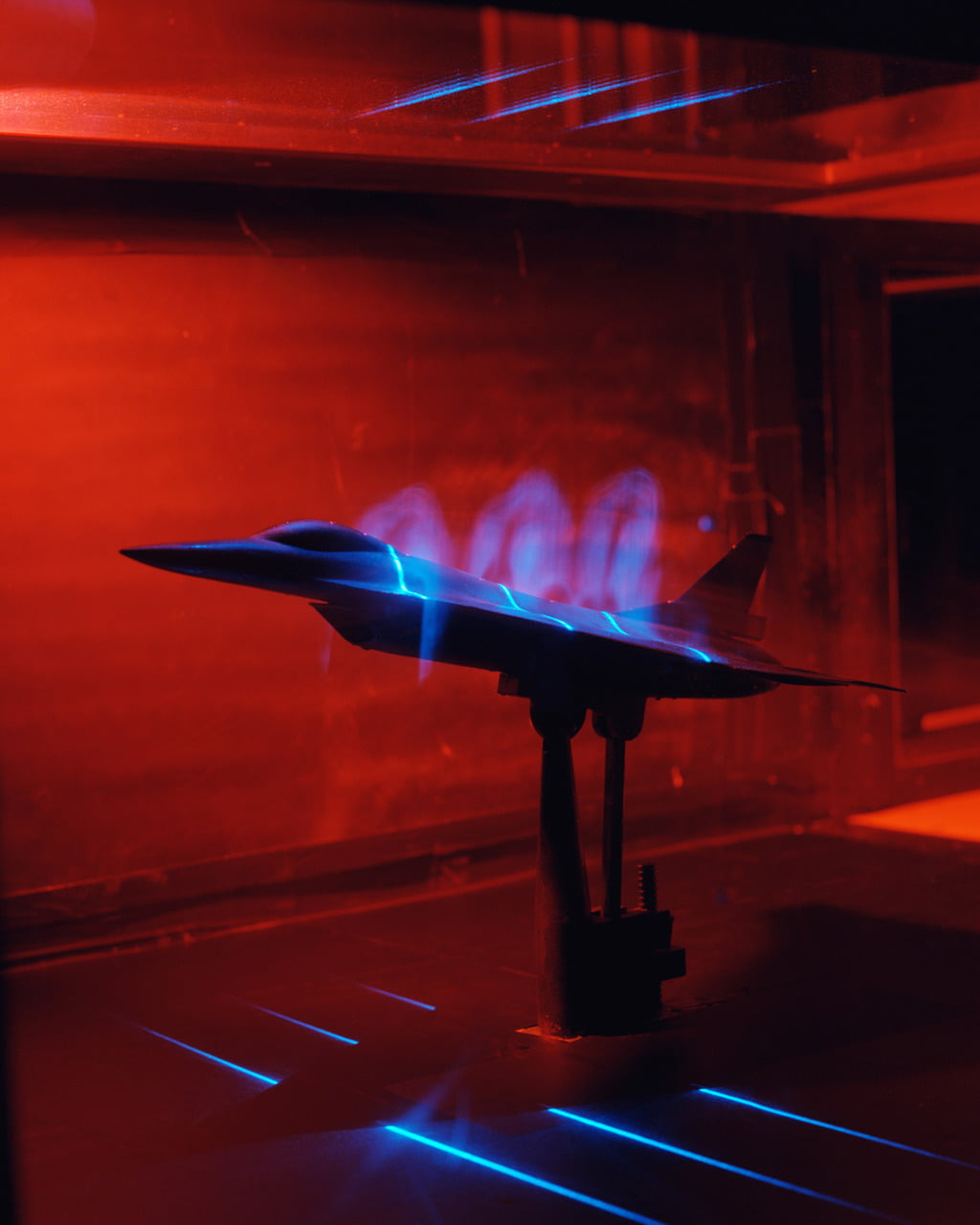
    Flow around an F-16XL Scamp model is visualized using smoke illuminated by laser sheets. Lasers are common equipment in fluids laboratories; they’re useful for flow visualization and for many velocimetry techniques.

  • Three Flows in One

    Three Flows in One

    These plumes of smoke demonstrate the three types of fluid flow: laminar, transitional, and turbulent. At the bottom of the photo, the plumes are smooth and orderly, as is typical for laminar flow. At the top, the smoke’s movement is chaotic and intermittent, full of turbulent eddies. Between these two stages, the flow is in transition; there is still some semblance of order to it, but disturbances in the plume are getting amplified and breaking down into turbulence.

    Photo credit: J. Russo