Tag: science

  • Listening to a Bubble’s Pop

    Listening to a Bubble’s Pop

    Sound is an important aspect of many flows, from the scream of a rocket engine to the hum of electrical wires vibrating in the wind. Critically, those sounds carry important information about the flow. A new study extends these acoustic diagnostics to the popping of soap bubbles.

    When a hole opens in a soap bubble, it throws the surface-tension-driven capillary forces of the bubble into disarray. The rim around the hole retracts, pushing fluid away from the expanding hole. At the same time, air is pushed out of the collapsing bubble. Using microphone arrays, the researchers found they could measure and distinguish sound from both sources — the escaping air and the expanding hole.

    From the sound, they developed a model that predicts the rupture location, bubble thickness profile, and other properties of the bubble. They confirmed the model’s results by comparing with high-speed photography. The authors hope their new acoustic technique will shed light on bubble bursting events that are hard to observe visually, like the bubbling of magma. (Image and research credit: A. Bussonnière et al.; via Science News; submitted by Kam-Yung Soh)
  • Featured Video Play Icon

    The Cricket’s Chirp

    Growing up, my summer nights often featured a chorus of crickets and bull frogs. Even now, the sound of those chirps reminds me of home. So how do crickets make their calls? As this video shows, it’s a matter of scraping the hard edge of one wing along a tiny series of spines, similar to the teeth of a comb, that sit on the other wing.

    How fast the cricket’s wings move affects how frequently the chirps are heard. Being cold-blooded, the insects’ speed is affected by the external temperature, which is why you can count cricket chirps to estimate the temperature. Essentially, the chemical reactions necessary to regulate wing movement are temperature-dependent, so colder crickets produce slower chirps. (Video and image credit: Deep Look)

  • Frozen Wavelets

    Frozen Wavelets

    Photographer Eric Gross captured these surreal alpine landscapes in Colorado’s Rocky Mountains. Although the lake’s surface appears to have frozen waves, the prevailing theory is that these mounds and divots occur when snowdrifts form atop the lake, melt and refreeze. Over multiple melting and freezing cycles, the lake builds up with what appear to be wind-driven waves frozen in time. (Image credit: E. Gross; via Colossal)

  • Spin Cycle

    Spin Cycle

    Rotational motion is a great way to break up liquids, as anyone who’s watched a dog shake itself dry can attest. That same centrifugal force is what allows this rotary atomizer to break liquids into droplets. Relative to the photos above, the atomizer spins in a counter-clockwise direction. This motion stretches the fluid flowing off it into skinny, equally-spaced ligaments, which eventually break down into droplets.

    Just how and when that break-up occurs depends on the fluid, as well as the characteristics of the spin. For Newtonian fluids like silicone oil — shown in the first two pictures — the break-up is driven by surface tension and happens relatively quickly. But with a viscoelastic fluid — shown in the last image — the elasticity of polymers in the fluid allow it to resist break-up for much longer. Instead, the ligaments form the beads-on-a-string instability. See more flows in action in the video below. (Video, image, and research credit: B. Keshavarz et al., video)

  • Featured Video Play Icon

    Colorful Dissipation

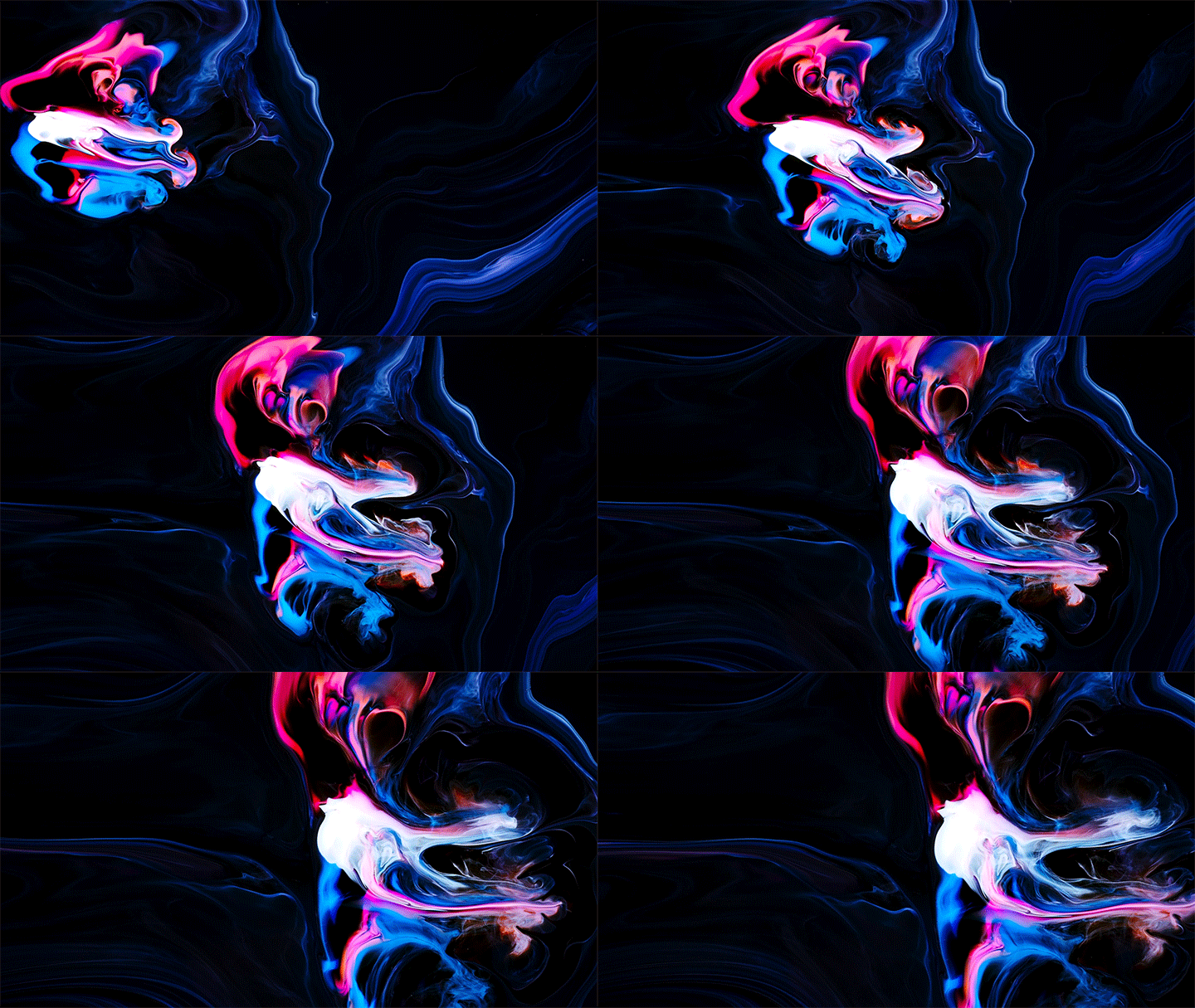
    Colorful eddies swirl in this short video from photographer Karl Gaff. Formed near the boundary at the bottom of the frame, these eddies act to dissipate some of the energy in the flow. Structures like these are key in turbulent flows, where energy must pass from large eddies to smaller and smaller ones until they reach a size where viscosity can extinguish them. (Video, image, and submission credit: K. Gaff)

    P.S. – Today’s post is FYFD’s 2,500th! Crazy, right? That means we have a pretty enormous archive. Want to explore? Click here for a random post.

  • Nitro Bubble Cascades

    Nitro Bubble Cascades

    Animation of nitrogen bubbles cascading in Guinness

    Fans of nitro beers — particularly Guinness’ stout — have probably noticed the fascinating cascade of bubbles that form as the beer settles. It’s a non-intuitive behavior — bubbles rise since they’re lighter than the surrounding fluid. So why do the bubbles appear to sink in these beers?

    There are several effects at play here. Firstly, overall the bubbles in the beer are rising; even mixing nitrogen gas into a beer in place of carbon dioxide doesn’t change that. But pint glasses typically flare so that they’re wider at the top than at the bottom. Since the bubbles rise essentially straight up, this causes a bubble-less film to form near the upper walls. And as that heavier fluid sinks, it pulls some of the tiny nitrogen bubbles with it. (You don’t see this effect in typical beers because the bubbles there are larger and thus too buoyant to get pulled down by the falling fluid.)

    As for the cascading waves we see in the bubbles, this, too, comes from the shape of the glass. Hydrodynamically speaking, what’s happens as the fluid film slides down the pint glass is similar to what happens when rain runs downhill. Beyond a certain angle, the flow becomes unstable and will form rolls and waves of varying thickness instead of sinking in a thin, uniform layer. As the film goes, so go the bubbles being dragged along, giving everyone at the bar a brief but entertaining fluid dynamical show. (Image credits: pints – M. d’Itri; bubble cascade – T. Watamura et al.; research credit: T. Watamura et al.)

  • Featured Video Play Icon

    Fluid Dynamics and Disease Transmission

    Right now people around the world are experiencing daily disruptions as a result of the recently declared coronavirus pandemic. There is a lot we don’t know yet about coronavirus, though researchers are working around the clock to report new information. Today’s video, though a couple years old, focuses on an area of medical knowledge that’s historically lacking but extremely relevant to our current situation: the mechanics behind disease transmission through sneezing or coughing.

    High-speed imagery of a sneeze cloud.

    Lydia Bourouiba is a leader in this area of research. Her studies have focused not on the size range of droplets produced but on the dynamics of the turbulent clouds that carry these droplets and what allows them to persist and spread. If you’ve wondered just why healthcare providers are recommending masks for sick people, keeping large distances between individuals, and frequent hand-washing, the image above hopefully helps explain why. Droplets carried in these turbulent clouds can travel several meters, and the buoyancy of the cloud’s gas components can help lift droplets toward ceiling ventilation. Right now, social distancing is one of our best tools against this disease transmission.

    My goal in posting this is not to panic anyone. Rather, I hope you leave better informed as to why these precautions are needed. With coronavirus, our detailed knowledge of its characteristics — how long it remains viable in the air or on surfaces, how much is needed for an infection to take hold, etc. — is limited. But from research like Bourouiba’s, we know that coughing and sneezing are remarkably efficient ways to deliver respiratory pathogens, and that’s why caution is warranted. Stay safe, readers. (Video credit: TEDMED; image credit: Bourouiba Research Group, source; research credit: L. Bourouiba et al., see also S. Poulain and L. Bourouiba, pdf)

  • Featured Video Play Icon

    Tranquilizer Darts in Slow Mo

    Like most syringes, tranquilizer darts use pressure to drive flow. But where a typical syringe has that pressurization provided by a human driving the piston, tranquilizer darts must deploy without any hands-on action. As shown in the video above, this is achieved by pressurization prior to firing.

    The tranquilizer dart has a few key features. Its needle, though sharp, does not have a hole in the end. Instead, it has a hole partway down the barrel of the needle, which is covered before launch by a rubber sleeve. The dart also contains two chambers. One is filled with the medicine being deployed. The other gets pressurized with air through a one-way valve. As long as the rubber sleeve stays over the needle’s hole, the dart is then pressurized, but the fluid has nowhere to go.

    Until it’s fired, of course. On impact, the rubber sleeve is pushed away, and the higher pressure inside the air chamber drives the medicine out of the needle and into the animal. (Video and image credit: The Slow Mo Guys)

  • Submarine Canyons Focus Waves

    Submarine Canyons Focus Waves

    In winter months Toyama Bay in Japan can get hammered by waves nearly 10 meters in height. These waves, known as YoriMawari-nami, pose dangers to both infrastructure and citizens, and, thus far, are not captured by typical forecasting models.

    A new study indicates that these waves have their origin in the particular topography of Toyama Bay and the physics behind the double-slit experiment. The shape of Toyama Bay is such that only waves from the north-northeast can propagate all the way to shore. That restriction essentially creates a single, coherent source for waves in the bay.

    The bay is also home to submarine canyons that stretch like underwater valleys from the continental shelf down toward the deeper ocean. To the incoming waves, these canyons act much like the slits in the double-slit experiment, creating two sets of waves whose fronts can interfere. In some positions, a wave crest will combine with a wave trough, cancelling one another out. But in other spots, two wave crests will meet and combine, creating the much larger YoriMawari-nami wave.

    Diagram illustrating the similarity of the YM-wave phenomenon to Young's double-slit experiment. By H. Tamura et al.

    Toyama Bay is not the only spot in the world where this phenomenon happens. The same physics is behind some of the most popular surf spots in the world, including Half-Moon Bay in California and Nazaré, Portugal. In all of these cases, properly predicting wave heights requires tracking an extra variable — wave phase — that most models leave out. That’s why forecasters have struggled with Toyama Bay’s waves. (Image credit: wave – M. Kawai, diagram – H. Tamura et al.; research credit: H. Tamura et al.; via AGU Eos; submitted by Kam-Yung Soh)

  • Pearls On a Puddle

    Pearls On a Puddle

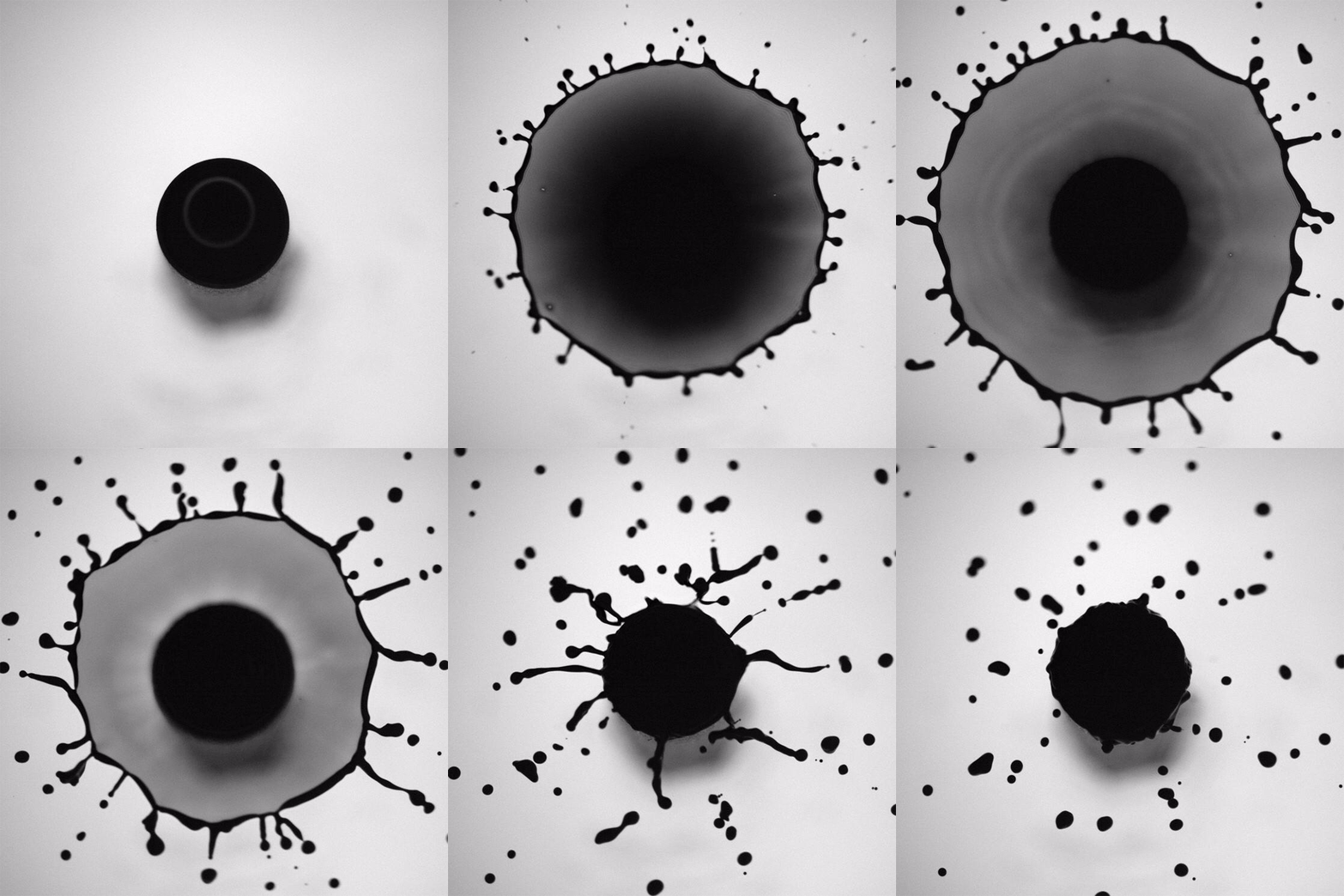
    Leave a drop of coffee sitting on a surface and it will leave behind a ring of particulates once the water evaporates. But what happens to a droplet made up of multiple liquids that evaporate differently? That’s the subject of this new study. Researchers mixed a volatile drop (isopropyl alcohol) with a smaller amount of a non-volatile liquid and observed how this changed the droplet’s splash rim and evaporation pattern.

    When the surface tension difference between the two liquids was large, the researchers found that the splash formed fingers along its rim (Image 1). The fingers consist almost entirely of the non-volatile component, driven to the outskirts of the drop by Marangoni forces. The dark and light bands you see in the image are interference fringes, which the researchers used to track the film’s thickness.

    When the researchers used liquids with similar surface tensions, the droplet rim instead formed pearl-like satellite droplets. Once the volatile liquid evaporated away, the remaining liquid merged into a thick film. (Image and research credit: A. Mouat et al.; via APS Physics; submitted by Kam-Yung Soh)