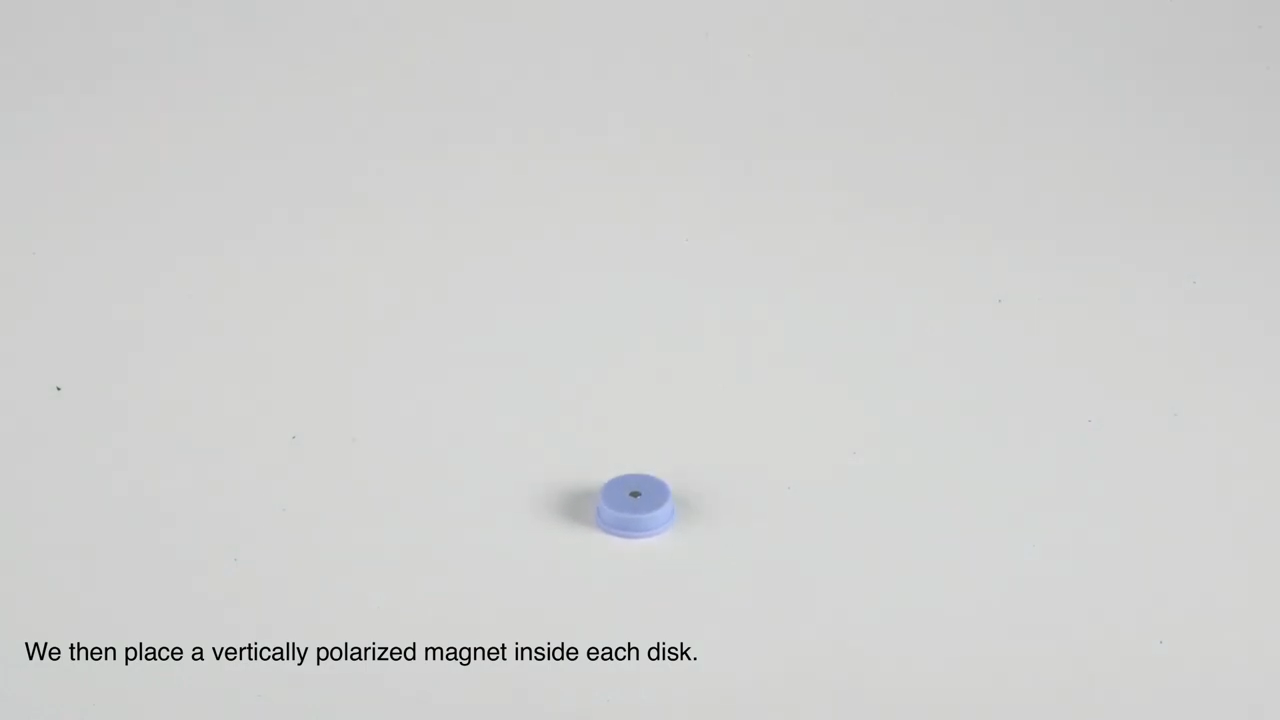
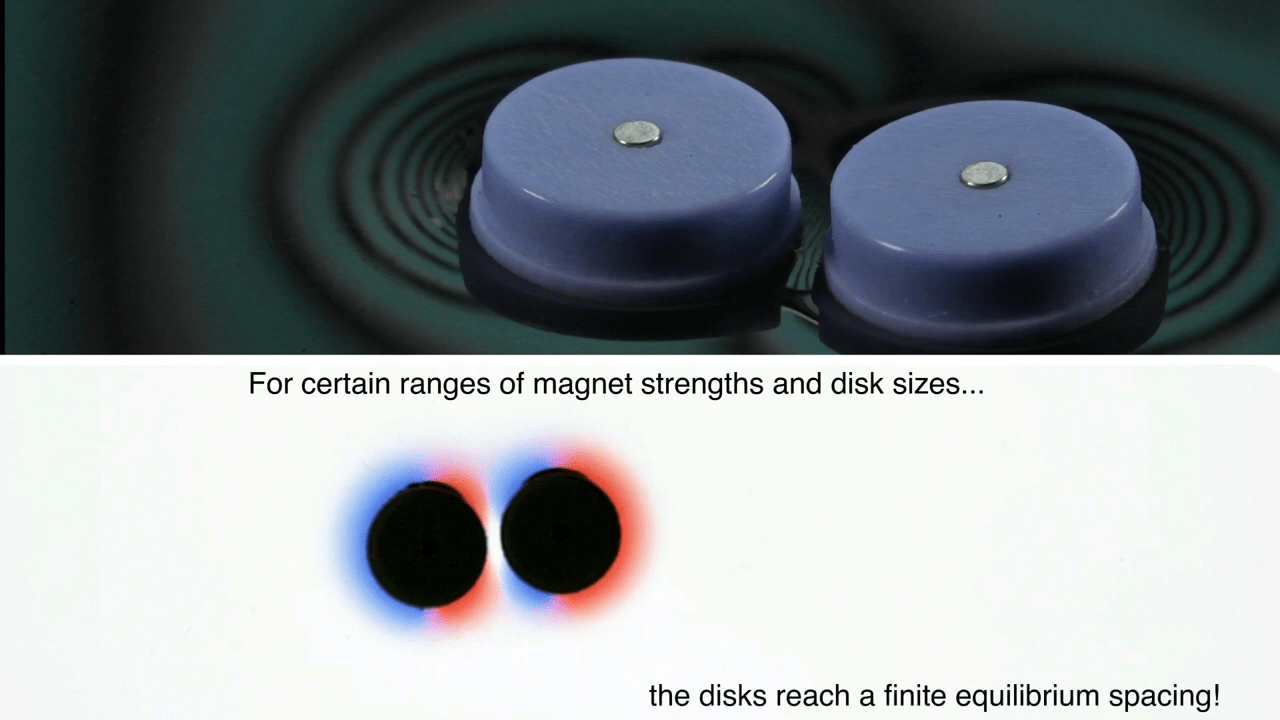
In the Cheerios effect, floating objects can fall into one another due to capillary attraction — just like Cheerios link up in a cereal bowl. Here researchers play with that effect by adding repulsive magnets to their “cereal” pieces. They find that their so-called mermaid cereal falls into preferential spacing, with pieces pairing up but never touching. Adding lots of these pieces in a confined space creates interesting crystalline and striped patterns, as seen later in the video. (Video credit: A. Hooshanginejad et al.)
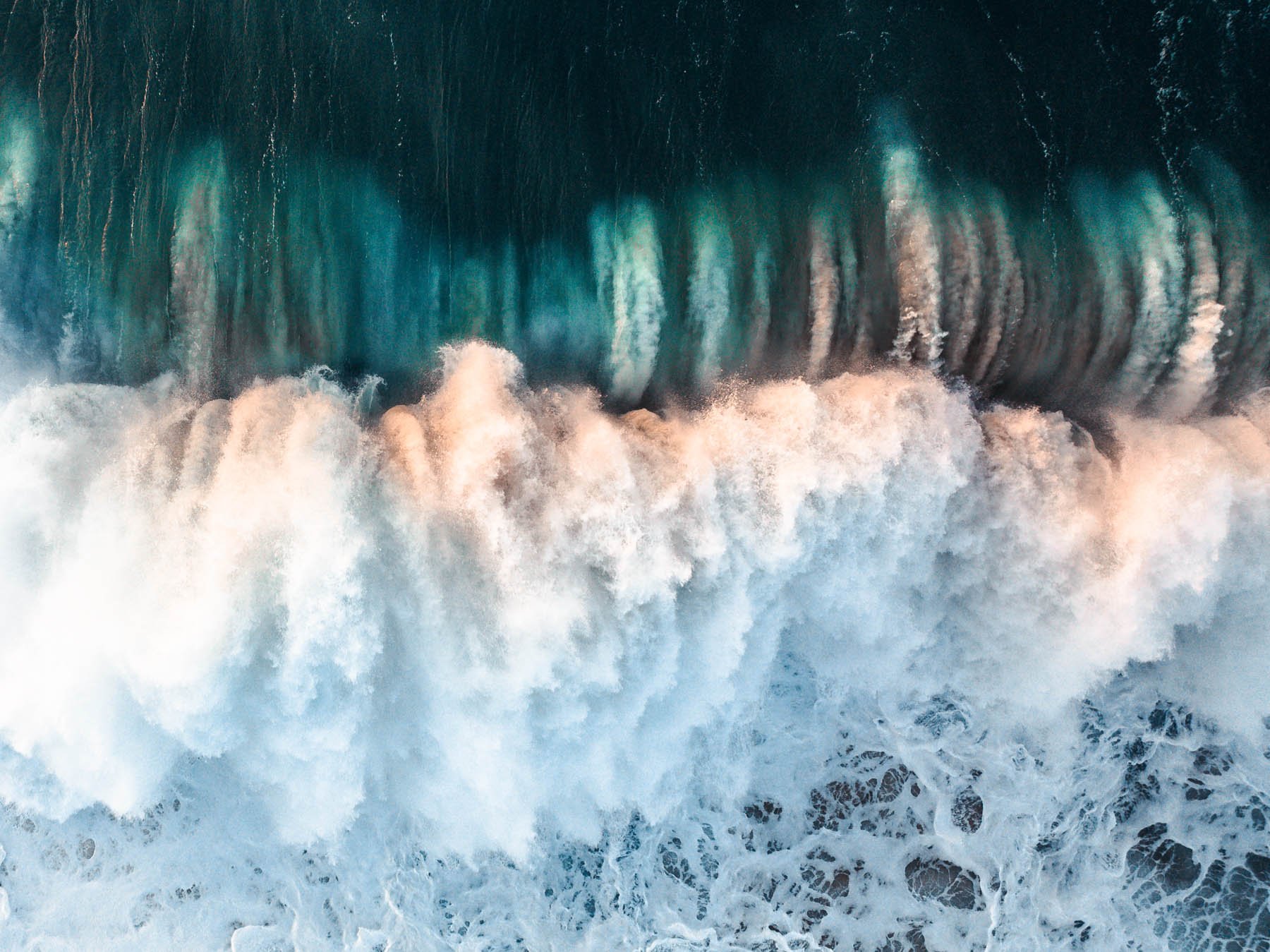
On the north shore of O’ahu, Hawaii, Banzai Pipeline is known for some of the most thrilling and deadly surfing in the world. The area’s barrel rolls are triggered when incoming waves break over the shallow reef. Photographer Kevin Krautgartner captures the waves from above, showcasing the incredible energy inherent in the ocean. The motion and texture of the water is mesmerizing. I feel like I could stare at these all day long! (Image credit: K. Krautgartner; via Colossal)
Explosives are used in many fields, including mining and demolition, but storing these devices is difficult and dangerous. Hundreds of accidents — many resulting in fatalities — have happened over the decades, simply because there is no true “off-switch” for explosive devices. But a group out of Los Alamos believe they’ve changed that.
Without water in the device, the outer surfaces burn, but no explosion takes place.
Using 3D-printing, the researchers built an explosive lattice filled with empty voids. With air in these gaps, any attempt to light the explosive fizzle. The outer layers of the explosive burn, but there’s no detonation. It is, relatively speaking, safe for storage.
When the voids are filled with water, the explosive detonates when lit.
But once the device is filled with water (or another liquid), the story is different. In this situation, the blast wave propagates and the explosive detonates, releasing 98% more energy than in its “storage” mode. Changing the liquid inside the device can enhance the explosive energy, too, which could allow users to tune the discharge. (Image credit: S. Moses; video and research credit: C. Brown et al.; via APS Physics)
Mussels live in rough conditions, constantly pummeled by waves and turbulent currents. They hold themselves fast in the flow using dozens of byssel threads (commonly called a mussel’s beard) that anchor them to rocks and other mussels. The threads get built within the mussel’s foot, the tongue-like protrusion mussels use to drag themselves. The threads are similar to our ligaments: strong and stretchy. Each one is cemented securely using an adhesive that hardens in water. If engineers could replicate that adhesive, it would be fantastic for use in medicine. (Video and image credit: Deep Look)
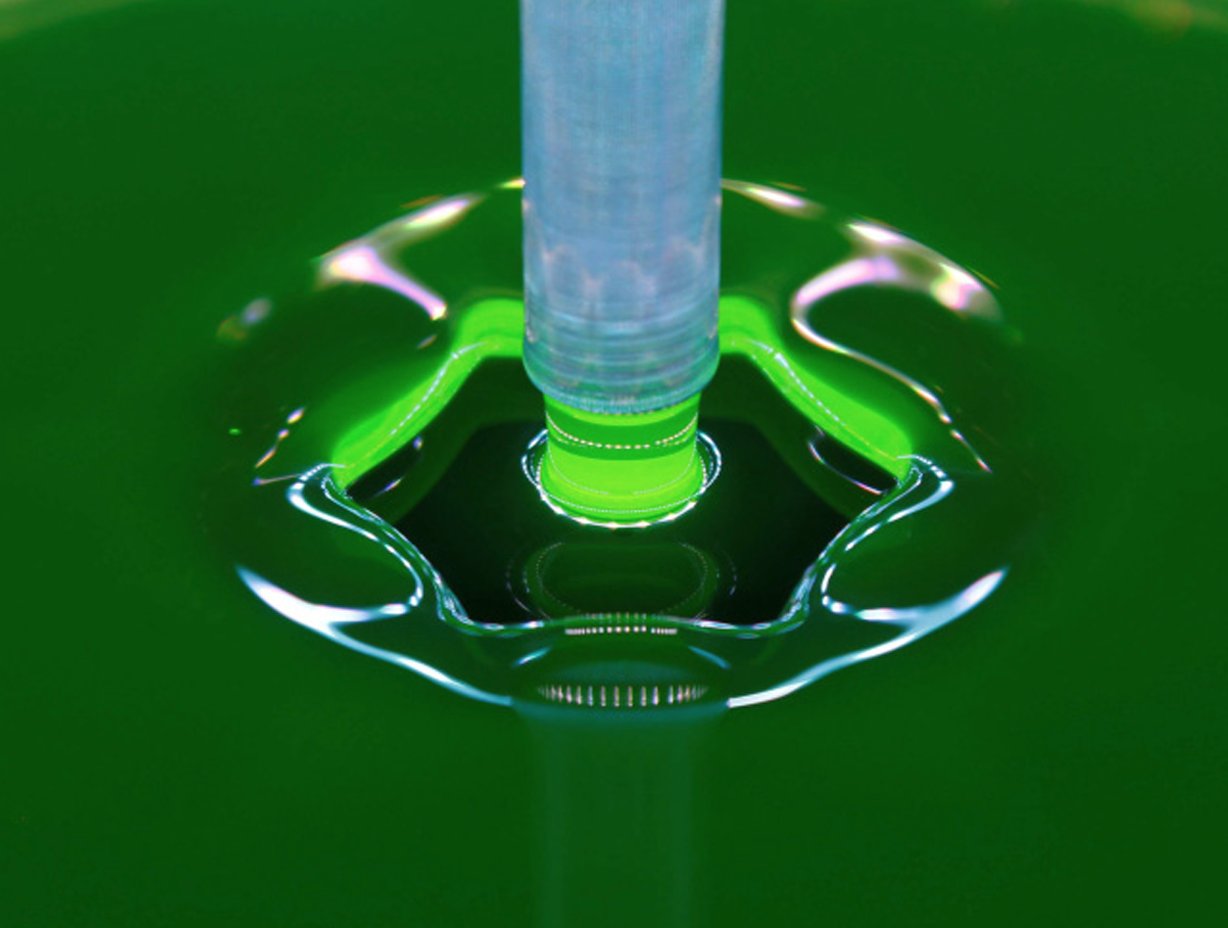
When you turn on your kitchen faucet, you may have noticed a big circle that forms on the bottom of the sink. This is a hydraulic jump, a region where fast-moving, shallow flow shifts to a slower-moving, deeper flow. Although these jumps start out circular, if the fluid is deeper than a critical value, the jump will break down and form polygons, like the one above. Exactly what shape the jump forms depends on many factors: flow speed, fluid depth, and flow history. The same flow conditions can even form more than one shape. But all of these shapes have one thing in common: their corners are universally around 114 degrees with a radius of 3.5 millimeters. (Image and research credit: S. Tamim et al.; via PRF)
A cylinder in a flow produces a series of alternating vortices known as a von Karman vortex street. Changing the flow speed and rotating the cylinder both allow researchers to tune the frequency of these shed vortices. What happens to an object in the wake?
For a simple hydrofoil tethered to the cylinder, the object wends back and forth along the vortices. But when that hydrofoil sits at the end of a double-pendulum, something very interesting happens. The whole apparatus follows a consistent trajectory similar to a human walking gait. Researchers are using this motion to build a robot that will help physical therapy patients regain a natural walking style. (Image and video credit: A. Carleton et al.)
One hundred photographers of all genres are coming together this month to raise money for ocean conservation in “100 For the Ocean.” Through the end of this month, they’re selling prints of these and other images, starting at $100 apiece. All proceeds will go to ocean conservation. Check out all the prints here, and if your wall has a bare spot, now’s a great time to add some artwork on a fluidsy nature. (Image credits: 100 For the Ocean, individual photographers listed in gallery titles; via Colossal)
Disclosure: I have no affiliation whatsoever with this fundraiser. I just like great photos and preserving nature.
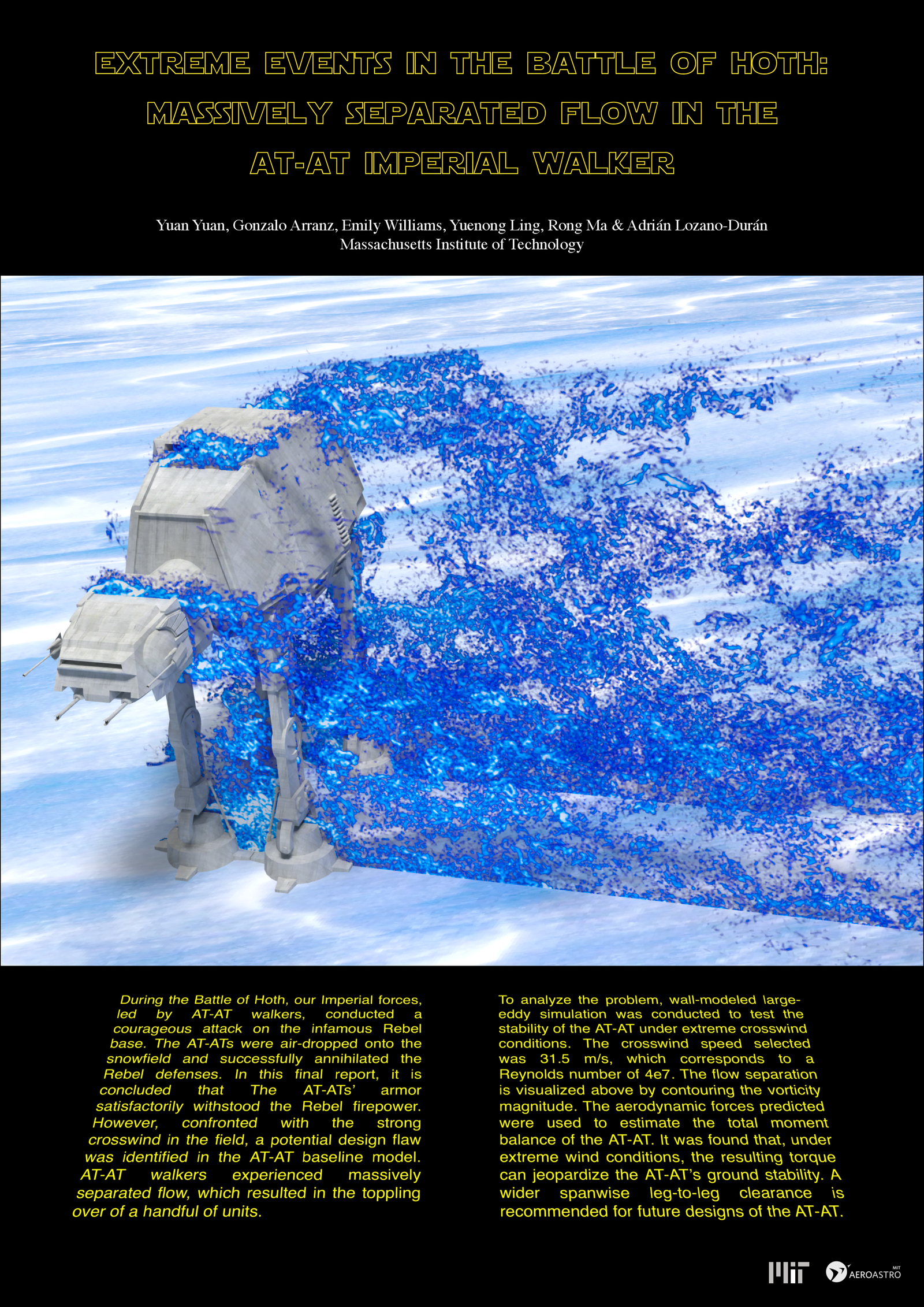
Having previously examined the re-entry characteristics of an X-Wing, a group of engineers are back to look at Imperial vehicle physics. In this poster, they look at what happens to the AT-AT walker when strong crosswinds, like those seen in the Battle of Hoth, blow across the vehicle’s path. Given its boxy body and gangly legs, it will come as no surprise that the AT-AT is not at all streamlined and instead causes lots of separated flow. Those flow separations come with strong side forces that can tip the walkers.
Be sure to take a closer look at the text on the poster. It’s written from the perspective of Imperial engineers, complete with recommendations for the next generation of AT-AT. (I don’t think those got built, at least not by the Empire!) May the 4th be with you! (Image credit: Y. Yuan et al.)
When droplets get larger than 0.27 cm, they no longer stay spherical as they fall. Here, researchers look at very large droplets (equivalent to 3.06 cm in diameter) falling into water. On their way to the pool, the droplets oscillate — some lengthening, some flattening, and some bulging into a bag. The droplet’s shape at impact (and its speed) determine what shape of splash and cavity form. Wider drops make wider and shallower cavities. (Image credit: S. Dighe et al.)
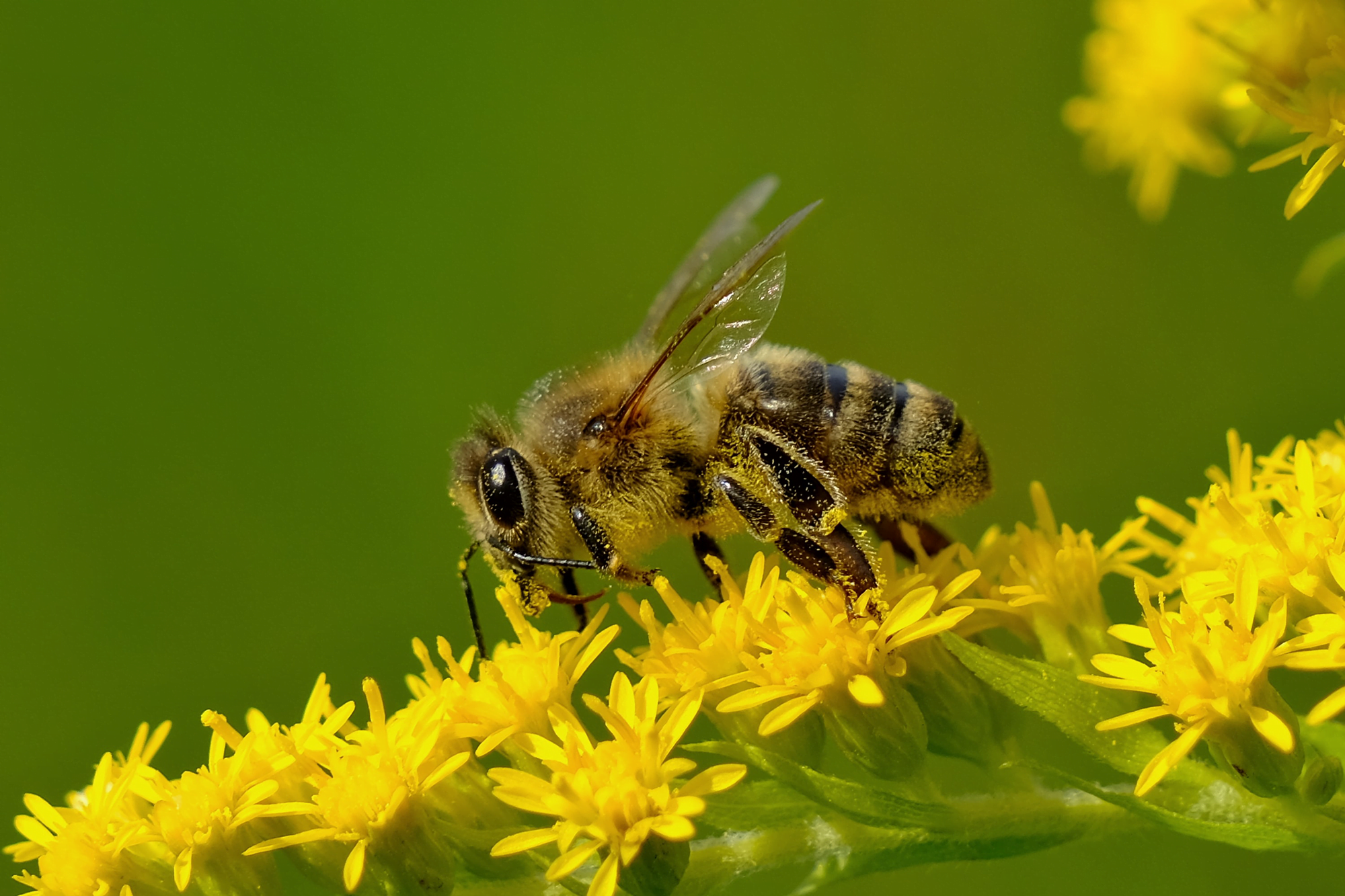
Busy bees feed on millions of flowers for each kilogram of honey they produce. To gather nectar, bees use their hairy tongues, which project out of a sheath-like cover. Protraction (i.e., sticking their tongue out) is relatively fast because all the hairs on the tongue initially lie flat. In the nectar, those hairs flare out, creating a miniature forest that traps viscous nectar and drags it back into the bee during retraction.
Bees feed by projecting their tongues into nectar. Tongue extension is faster because the tongue’s hairs lie flat. During the slower retraction phase, the hairs flare out, trapping nectar and pulling it back into the bee.
Through modeling and experiments, researchers found that the time it takes a bee to retract its tongue depends on the bee’s overall mass. Smaller bees are slower to the retract their tongues, likely to allow enough time for their shorter tongues to capture enough nectar. With bee populations on the decline, the team’s predictions may help communities select flowers with nectar concentrations that best fit their local bees’ needs. (Image credits: top – J. Szabó, bee eating – B. Wang et al.; research credit: B. Wang et al.; via APS Physics)