Tag: physics

  • Rio 2016: Rugby

    Rio 2016: Rugby

    The sport of rugby returns to the Olympics in Rio this year. Rugby’s ball is somewhat similar in size and shape to an American football, but it is a little wider and more rounded. Aerodynamically, this means that the rugby ball has  more drag, but it is also more stable in flight, allowing players to pass and kick accurately, with or without a spiral.

    As seen in the flow visualizations above, air travels up and around the ball before separating on the far side. The more the ball is tilted, the larger this separated region is and the greater the drag. At the same time, though, that tilt provides lift on the ball. The ideal orientation is the one with the largest ratio of lift force and drag force. For a rugby ball, this occurs at about 40 degrees.(Image credits: Planet Rugby; A. Vance et al.)

    Previously: The aerodynamics of the American football

    Join us throughout the Rio Olympics for more fluid dynamics in sports. If you love FYFD, please help support the site!

  • Rio 2016: Swimming

    Rio 2016: Swimming

    Strange as it seems, elite swimmers are faster when swimming underwater than they are at the surface. So much so, in fact, that they’re restricted to being underwater only 15 m after a dive or turn. To see just how stark a difference this makes, check out this crazy video.  (I know, right?!)

    To understand how this is possible, it helps to look at the three types of drag a swimmer experiences: pressure drag, skin friction, and wave drag. Pressure drag is probably the most familiar; it’s the drag that comes from the swimmer’s shape and how the fluid moves around it. Skin friction is the drag that comes from viscous friction between the swimmer and the water. The final type, wave drag, comes from the energy expended to create waves at the surface of the water. As you might expect, energy that goes into splashing is energy that isn’t going into propulsion.

    When swimming at the surface, swimmers experience a lot of wave drag. At least one experiment showed that wave drag accounted for most of a surface swimmer’s drag. In contrast, at a depth of more than 0.5 m, a swimmer’s wave drag is virtually negligible. The submersion does come at the cost of higher skin friction (since more of the swimmer is in contact with the water), but there is also more opportunity for useful propulsion since both sides of a kick can move water (and not air.) Bonus read for those interested in more: Is the fish kick the fastest stroke yet? (Image credits: AP; B. Esposito)

    Previously: what makes a pool fast?

    Join us throughout the Rio Olympics for more fluid dynamics in sports. If you love FYFD, please help support the site!

  • Rio 2016: Cycling

    Rio 2016: Cycling

    Today marks the official start of the 2016 Summer Olympics in Rio. Here at FYFD we’ll be celebrating by taking a look at how fluid dynamics affects Olympic sports. You can check out our previous series on the London Olympics here. Since this weekend features the men’s and women’s cycling road races, we’ll get started with cycling!

    In road cycling, equipment and race strategy are all built around aerodynamic efficiency. It’s understood that following a car or motorbike gives a cyclist an unfair advantage, and officials can be quick to punish infractions. What the rules don’t account for, though, is the advantage a cyclist gets when they’re followed by a motorbike (or car). These vehicles are significantly larger than a cyclist, and when they are trailing a cyclist, they have a significant upstream effect. Essentially the higher pressure traveling ahead of the motorbike will counter the low pressure region immediately behind the cyclist. The result is that the cyclist, despite being in front, experiences less drag than they would if the motorbike weren’t there.

    The difference isn’t tiny either: if a motorbike follows a rider at a distance of 0.5 m for just 1 km, the rider saves more than 2 seconds. When events can be won or lost by fractions of a second, those gains are significant. (Image credits: DCMS; B. Blocken et al., GettyImages, Reuters; research credit: B. Blocken et al.; submitted by Marc A.)

  • Sharks Swimming Sideways

    Sharks Swimming Sideways

    Like many sharks, the great hammerhead shark is negatively buoyant, meaning that, absent other forces, it would sink in water. To compensate, sharks generate lift with their pectoral (side) fins to offset their weight. Their dorsal (top) fin is used to generate the horizontal forces needed for control and turning. However, both captive and wild great hammerhead sharks tend to swim rolled partway onto their sides. The reason for this unusual behavior is hydrodynamic – it is more efficient for the shark. Unlike other species, the great hammerhead has a dorsal fin that is longer than its pectoral fins. By tipping sideways, the shark effectively creates a larger lifting span and is able to induce less drag than when it swims upright. Models show that swimming on their sides requires ~8% less energy than swimming upright! (Image credit: N. Payne et al., source)

  • Spillway Waves

    Spillway Waves

    Earlier this summer, the spillway of the Banja Dam was opened for the first time, releasing a stream of excess water from the reservoir. As you can see above, waves quickly formed at the surface of the falling water. You’ve likely noticed this yourself in the run-off along the street after a storm. It turns out that shallow water running down an incline is unstable. A disturbance to the flow – from surface roughness, vibration, or a change in curvature – will grow, just like a ball sitting at the top of a hill will roll down as soon as it’s prodded. For more about this kind of instability, check out this post or my video about boundary layer stability and the Space Shuttle. (Image credit: Guillaume TYTECA, source; via Gizmodo)

  • Featured Video Play Icon

    Starting a Lighter

    Lots of fluids are transparent, which makes it hard for us to appreciate their motion. One technique for making these invisible motions visible is schlieren photography, which makes differences in density visible. Here it’s combined with high-speed video to show what happens when you use a lighter (minus the spark!). When the fuel starts flowing, it’s unstable and turbulent, but after that initial start-up, you can see the jet settle into a smooth and laminar flow. Wisps of fuel diffuse away from the jet as the fluid disperses. As the valve shuts off, the flow becomes unstable again, and the remains of the lighter fluid diffuse away. (Video credit: The Missing Detail)

  • Hagfish Escape Mechanisms

    Hagfish Escape Mechanisms

    The hagfish is an eel-like creature that has not changed much in the past 300 million years in part because the hagfish is very good at escaping would-be predators. When attacked, the hagfish excretes mucins that combine with seawater to form slime. This gel-like viscoelastic fluid forms quickly and has some handy properties. For example, when stretched, the slime becomes extremely viscous. Many fish feed using a suction method, in which they thrust their jaws forward and enlarge their mouths to suck water and prey inside. This strong unidirectional flow stretches the slime, which thickens it and clogs the fish’s gills. Suddenly, the fish is much more concerned with being unable to breathe, allowing the hagfish to flee.

    Being surrounded by all that slime could smother the hagfish, too, if it were not for another clever feature of the slime. When sheared, hagfish slime collapses, losing its viscosity. The hagfish actually ties itself in a knot to create this shear and slide the slime right off. (Image credit: V. Zintzen et al.; L. Böni et al., source)

  • The Evaporation of Ouzo

    The Evaporation of Ouzo

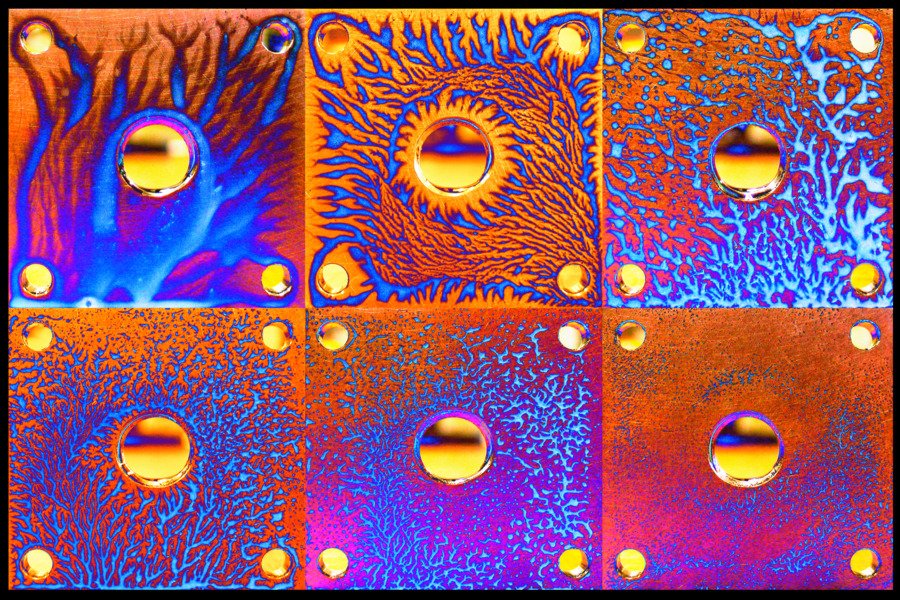
    Ouzo is an aperitif made up of ethanol (alcohol), water, and anise oil. This three-part, or ternary, mixture undergoes an intriguing evaporation process thanks to the characteristics of its components. An ouzo drop’s evaporation can be divided into four phases, each shown above. Initially, the drop is well-mixed and transparent (upper left). 

    Since ethanol is the most volatile of ouzo’s components, it evaporates the most quickly. As the ethanol evaporates, the drop becomes oversaturated with oil (upper right). Oil droplets form, giving the ouzo a milky appearance. At the same time, the ethanol evaporating causes gradients in surface tension, which drive a vigorous Marangoni flow inside the drop. 

    Eventually, the ethanol finishes evaporating and the oil drops collect in a ring around the outside of the drop (lower left). Slowly, the water inside the drop evaporates. Eventually, a tiny microdroplet of water is left to dissolve in the anise oil (lower right). (Image and research credit: H. Tan et al., source; via Inkfish)

  • Crisscrossing Clouds

    Crisscrossing Clouds

    This natural-color satellite image shows crisscrossing cloud patterns off coastal Africa. These distinctive lines in the sky are gravity waves, and they form when air masses get displaced upward by terrain or other conditions. In this case, dry air cooled overnight on land before moving out over the ocean. That displaced warm, humid air above the water and forced it upward, where it eventually cooled and condensed into clouds. Gravity created the ripple-like waves; as the moist air cooled, gravity again pulled it downward – leaving behind a clear sky. Once the humid air sank, the dry air pushed it up again, creating another line of clouds and continuing the cycle.  (Image credit: NASA; via NASA Earth Observatory)

  • Featured Video Play Icon

    Crash Course Fluids

    Crash Course Physics returns to the subject of fluids with their video on fluid dynamics. They stick with ideal fluids (i.e. incompressible, inviscid, laminar flows) for simplicity and cover some of the basics by discussing conservation of mass (also called continuity) and a simple form of Bernoulli’s equation. Despite keeping things basic, the video does a nice job introducing these topics; I especially like that they explain Bernoulli’s equation as a form of conservation of energy. Sometimes it’s easy to let the terminology in fluid dynamics mask the fact that the equations we use are just alternative forms of the classical equations for conserving mass, momentum, and energy. As with their fluids at rest video, the information is densely packed, so expect to pause and rewind. (Video credit: Crash Course)