Tag: physics

  • When Jets Collide

    When Jets Collide

    Two liquids that collide don’t always coalesce. The image above shows two jets of silicone oil colliding. On the left, the jets collide and bounce off one another. On the right, at a slightly higher flow rate, the two jets coalesce. This bouncing, or noncoalescence, observed at lower speeds is due to an incredibly thin layer of air separating the two jets. This air layer is constantly being replenished by air that gets dragged along by the flowing oil. But if the oil flows too quickly, that air layer becomes unstable–in the same way that a droplet that falls too quickly will splash on impact. When the separating air layer becomes unstable and breaks down, the jets collide and merge. (Image credit: N. Wadhwa et al., pdf)

  • Featured Video Play Icon

    Simulating the Earth

    Computational fluid dynamics and supercomputing are increasingly powerful tools for tracking and understanding the complex dynamics of our planet. The videos above and below are NASA visualizations of carbon dioxide in Earth’s atmosphere over the course of a full year. They are constructed by taking real-world measurements of atmospheric conditions and carbon emissions and feeding them into a computational model that simulates the physics of our planet’s oceans and atmosphere. The result is a visualization of where and how carbon dioxide moves around our planet.

    There are distinctive patterns that emerge in a visualization like this. Because the Northern Hemisphere contains more landmass and more countries emitting carbon, it contains the highest concentrations of carbon dioxide, but winds move those emissions far from their source. As seasons change and plants begin photosynthesizing in the Northern Hemisphere, concentrations of carbon dioxide decrease as plants take it up. When the seasons change again, that carbon is re-released.

    These visualizations underscore the fact that these carbon emissions impact everyone on our planet–nature does not recognize political borders–and so we share a joint responsibility in whatever actions we take. (Video credit: NASA Goddard; h/t to Chris for the second vid)

  • Falling Atop Sheets

    Falling Atop Sheets

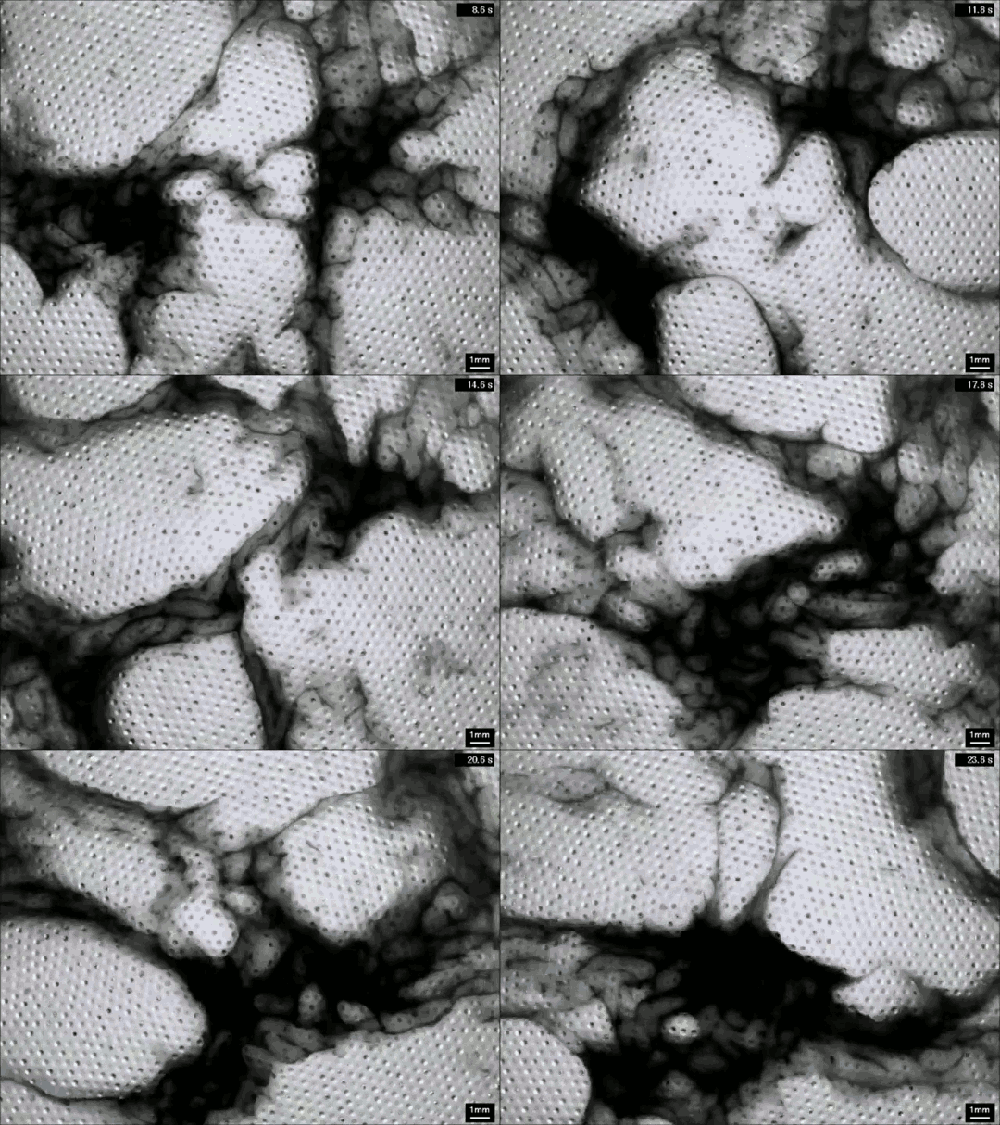
    A sphere falling into water is a classic problem in fluid dynamics, but scientists are becoming increasingly interested in what happens when they introduce new dimensions to the problem. Here researchers float an extremely thin elastic sheet atop water and study how it wrinkles when a steel sphere impacts it. Despite its elasticity, the sheet does not stretch when the ball hits. Instead it compresses and forms wrinkles. Some of those wrinkles deepen into folds, but the wrinkle pattern that forms right at impact determines the way the film will bunch up. If the ball is heavy enough, it will drag the sheet entirely underwater; if not, the sheet will catch the ball and continue floating. Scientists are interested in these interactions between liquids and thin solids because sheets could be used to encapsulate liquids for applications like targeted drug delivery. (Image credit: M. Inizan et al., source)

  • Resonating with the Windows Down

    Resonating with the Windows Down

    Ever roll down your window a bit while driving and immediately hear a terrible, rhythmic noise? That awful whum-whum-whum is–oddly enough–an example of the same physics that allows you to make an open bottle whistle by blowing over it. Fluid dynamicists call it Helmholtz resonance. Air flowing over the bottle neck or around the car makes the air inside the container vibrate with a frequency that depends on the bottle or car’s characteristics. That vibration generates noise that we hear as a hum or whistle for a bottle or a lower frequency whum-whum for a car window.

    The images above show flow past different open windows on a car. Air flow remains relatively steady past the side-view mirror and front window of a modern car, so the noise from opening the front window is not usually too bad. But flow separation and reconnection near the rear window of a car creates very unsteady airflow there which exacerbates this resonance issue. This is why lowering the rear window usually causes more noise. Fortunately, the solution is relatively simple: open more than one window and it disrupts the resonance! (Image credit: Car and Driver; submitted by Simon H.)

  • Featured Video Play Icon

    Visualizing Flow with Snowfall

    One of the challenges in engineering and operating wind turbines is that full-scale turbines rarely behave as predicted in smaller-scale laboratory experiments and simulations. One way to reconcile these differences (and discover what our experiments and simulations are missing) is to take the experiments out into the field. One research group has done this by using snowfall to visualize the flow around wind turbines. In this video, they share some of their observations, which include interactions of tip vortices with one another and with the vortex from the tower. My favorite part starts around 1:50 where you can observe tip vortices leap-frogging one another behind the wind turbine! (Video credit: Y. Liu et al.)

  • CYGNSS

    CYGNSS

    Yesterday marked the launch of a new constellation of eight microsatellites, the Cyclone Global Navigation Satellite System (CYGNSS), designed to monitor hurricanes in Earth’s tropics. The constellation will provide unprecedented capability to monitor conditions inside hurricanes–information that will hopefully help scientists improve hurricane prediction models. Each CYGNSS microsat monitors GPS signals that it receives from the GPS satellite system and from the reflection of that signal off the Earth. By comparing these signals, the satellites can determine wave heights in the ocean, and from that wave information, they can measure surface wind speeds. By peering inside the hurricane as it forms and travels, scientists hope they will be better able to estimate not only a hurricane’s path but how strong it will be when it makes landfall. (Image credits: NASA)

  • The Sound of a Balloon Popping

    The Sound of a Balloon Popping

    The pop of an overfilled balloon is enough to make anyone jump, but you’ve probably never seen it like this. The photo above uses an optical technique known as schlieren photography that reveals changes in density of a transparent gas like air. The shredded rubber of the balloon is still visible in black, and around the balloon there’s an expanding spherical shock wave. It’s the sudden release of energy when the balloon ruptures and the gas inside begins to expand that causes the shock wave. Notice, though, that the gas from the balloon is still clearly visible and balloon-shaped–much like a water balloon that’s just popped. From that clear delineation, I would say that this balloon was filled with a different gas than air–otherwise the density shouldn’t be different enough to make the interior gas distinguishable.  (Image credit: G. Settles)

  • Featured Video Play Icon

    Freezing Drops

    A water droplet deposited on a cold surface freezes from the bottom up. As anyone who has made ice cubes knows, water expands when it freezes. But watch the outline of the drop carefully. The drop isn’t expanding radially outward while it freezes. Instead the remaining liquid part of the drop forms what’s known as a spherical cap, a shape like the sliced-off top of a sphere. Surface tension creates that spherical shape, but the water still has to expand when it freezes. The result? The last bit of the drop freezes into a point! This means that surface tension maintains the drop’s spherical shape, for the most part, and all the expansion the water does takes place vertically. (Video credit: D. Lohse et al.)

  • “Oil Spill”

    “Oil Spill”

    In “Oil Spill” artist Fabian Oefner explores the shapes and colors of oil floating atop water. An old adage tells us that oil and water don’t mix, but this is not perfectly true. Especially in low concentrations, oil can mix slightly with water, which is why the edges of Oefner’s creations become fuzzy and break down. For the most part, though, the thin layer of oil spreads across the water’s surface, its slight variations in thickness casting the different iridescent colors we observe – just the same as a soap bubble’s iridescence. The colorful patterns are a snapshot of motion in the oil; in some places it radiates outward, pulled by the stronger surface tension of water. In other places it forms plumes and swirls that may be the result of temperature variations or other disquiet motion in the surrounding water or air.  (Image credits: F. Oefner)

  • Inside Cavitation

    Inside Cavitation

    Cavitation bubbles live a short and violent life. It begins when a low-pressure void forms in a fluid–for example, when a liquid is accelerated so that the pressure drops below the vapor pressure, which can happen at the tips of a boat’s propeller or when striking a bottle. The bubbles that form expand and then collapse rapidly as the higher pressure of the liquid surrounding them squeezes them down. That collapse of the bubble is so violent that it heats the fluid inside the bubble to temperatures hotter than the surface of the sun, generating both a flash of light and a shock wave. It’s these shock waves that cause much of the damage associated with cavitation in engineering, but they can be used for good as well. Shock wave lithotripsy uses cavitation-induced shock waves to break down kidney stones. (Image credit: O. Supponen et al., source)