Most cooks have experienced the unpleasantness of getting splattered with hot oil while cooking. Here’s a closer look at what’s actually going on. The pan is covered by a thin layer of hot olive oil. Whenever a water drop gets added – from, say, those freshly washed greens you’re trying to saute – it sinks through the oil due to its greater density. Surrounded by hot oil and/or pan, the water heats up and vaporizes with a sudden expansion. This throws the overlying oil upward, creating long jets of hot oil that break into flying droplets. These are what actually hit you. This is a small-scale demonstration, but it gets at the heart of why you don’t throw water on an oil fire. (Image credit: C. Kalelkar and S. Paul, source)
Tag: physics

Symmetric Wakes
Nature is full of remarkable patterns and moments of symmetry. This image shows the wake behind two rotating cylinders. Half of the cylinders are visible at the far left. The flow moves left to right. The cylinders are rotating at the same rate but in opposite directions, clockwise for the cylinder on top and counter-clockwise for the bottom one. At this speed relative to the freestream, there is a beautiful symmetry to the vortices in the wake, but the researchers found that even a slight deviation from this condition quickly destroyed the pattern. The flow is visualized here by introducing tiny hydrogen bubbles via electrolysis. The bubbles are small enough that their buoyancy has no appreciable effect. (Image credit: S. Kumar and B. Gonzalez)

Schooling Together

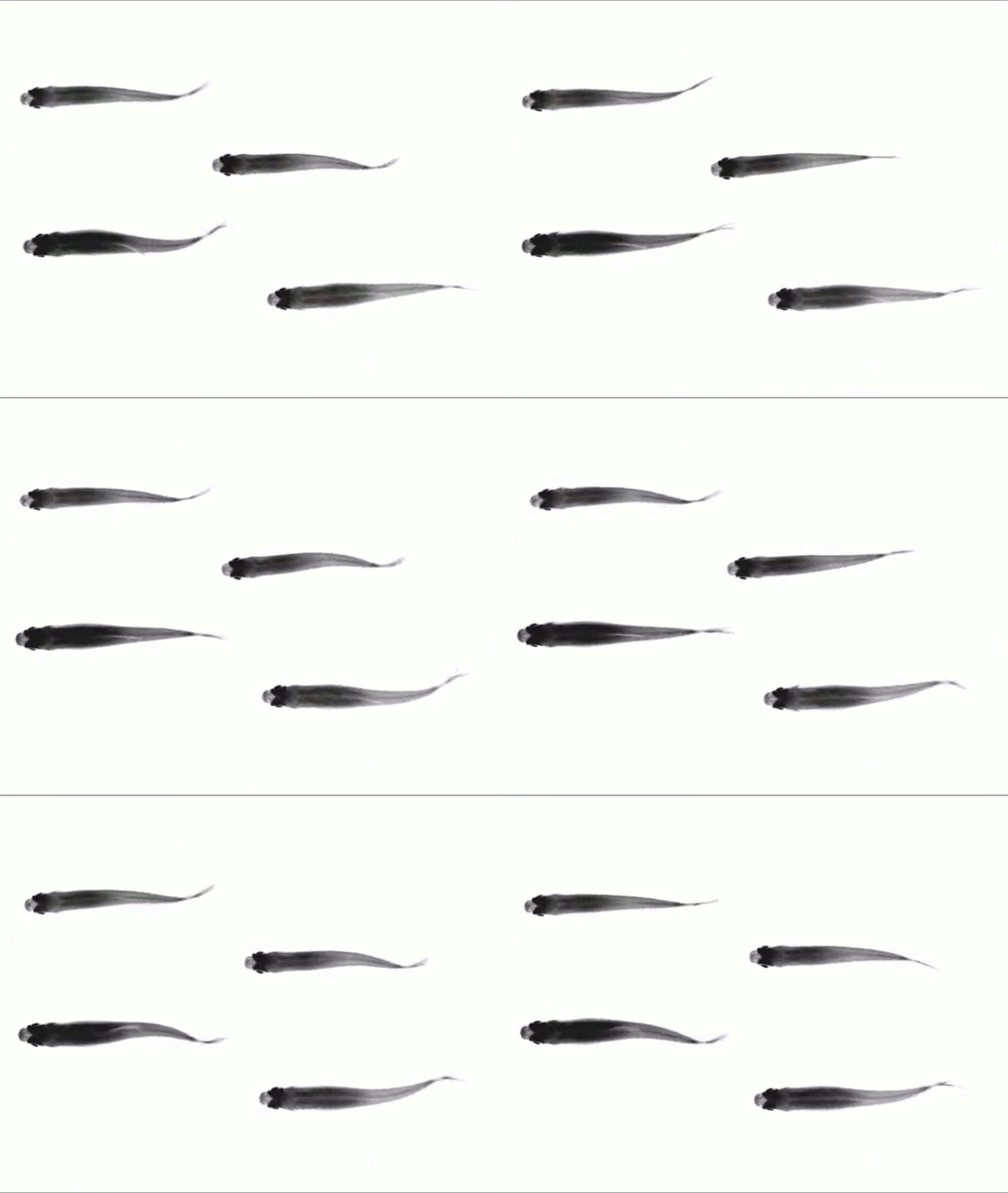

Since the 1970s, fluid dynamicists have chased the idea that fish swim in schools for hydrodynamic advantage. The original 2D conception of the idea placed fish in a diamond pattern so that their wakes would constructively interfere and improve swimming efficiency. In nature, that exact pattern is rarely seen, possibly due to 3D effects or the difficulty of maintaining the exact orientation. Fish do, however, show signs of grouping themselves for efficiency – especially when they’re forced to swim quickly.
A recent study found that tetras, a type of small fish often used as pets, prefer a staggered diamond configuration (left) when free-swimming at low speeds around one body length per second. At higher speeds, around four body lengths per second, groups of tetras preferred a side-by-side or “phalanx” configuration (right). Here the fish tended to synchronize their tail-beat frequency with their neighbors, essentially working together for a mutually beneficial wake structure. The researchers found that this configuration was much more efficient than a lone swimmer or uncoordinated group, implying that fish do school for energy-savings when they’re swimming fast. (Image and research credit: I. Ashraf et al., source; via Hakai; submitted by Kam-Yung Soh)

Convection Without Heat
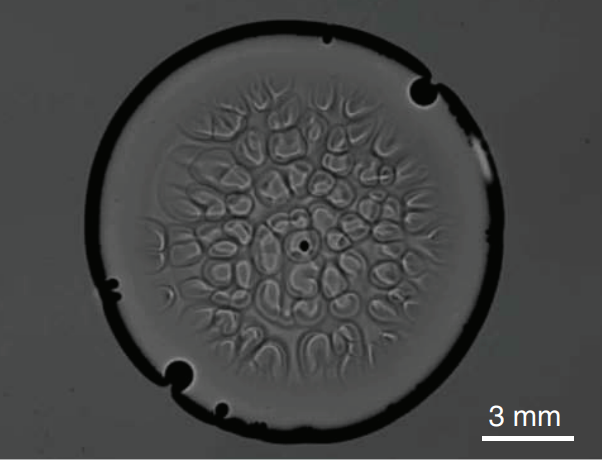
Glycerol is a sweet, highly viscous fluid that’s very good at absorbing moisture from the ambient air. That’s why a drop of pure glycerol in laboratory conditions quickly develops convection cells – even when upside-down, as shown above. This is not the picture of Bénard-Marangoni convection we’re used to. There’s no temperature or density change involved; in fact, there’s no buoyancy involved at all! This convection is driven entirely by surface tension. As glycerol at the surface absorbs moisture, its surface tension decreases. This generates flow from the center of a cell toward its exterior, where the surface tension is higher. Conservation of mass, also known as continuity, requires that fresh, undiluted glycerol get pulled up in the wake of this flow. It, too, absorbs moisture and the process continues. (Image credit: S. Shin et al., pdf)

Bubbles Sliding


Two-phase flows involve more than one state of matter – in this case, both gas and liquid phases. Flows like this are common, especially in applications involving heat transfer. In some heat exchangers, bubbles will rise and then slide along an inclined surface, as shown above. The motion of these bubbles is a complicated interplay between the surface, the bubble, and the surrounding fluid. The bubble’s wake, visualized here using schlieren imaging, is unsteady and turbulent. Although the bubble oscillates in its path, the wake spreads even wider, and its turbulence stirs up the liquid nearby, increasing the heat transfer. (Image and research credit: R. O’Reilly Meehan et al., source)

Build Your Own Fluidized Bed
Previously, we featured some GIFs of bubbling, fluidized sand (below). Inspired by the same video, Dianna from Physics Girl decided to build her own set-up, discovering along the way that it’s a little tougher than you might think. To work well, you’ll need very fine, dry particles and a good way to uniformly distribute the air so it doesn’t simply bubble up in one spot. And if you accidentally apply too much air pressure, you may get a face full of sand. The final results are very fun, though, and hopefully Dianna’s lessons learned will help any other DIYers interested in trying this experiment at home. For a little more on the physics here and in related topics, check out some of our previous posts on fluidization, soil liquefaction, quicksand, and dam failures. (Video credit: Physics Girl; image credit: R. Cheng, source)


Bioluminescent Plankton


In nutrient-rich marine waters, dinoflagellates, a type of plankton, can flourish. At night, these tiny organisms are responsible for incredible blue light displays in the water. The dinoflagellates produce two chemicals – luciferase and luciferin – that, when combined, produce a distinctive blue glow. The plankton use this as a defense against predators, creating a flash of blue light when triggered by the shear stress of something swimming nearby. The dinoflagellates respond to any sudden application of shear stress this way, so they glow not only for predators, but for any disturbance – mobula rays (above), sea lions, boats, or even just a hand splashing in the water. In person, the experience feels downright magical. I had the opportunity to experience bioluminescence in the Galapagos last year. The light from the dinoflagellates is incredibly difficult to film because it can be so dim, but as the BBC demonstrates, it’s well worth the effort it takes to capture. (Image credit: BBC from Blue Planet II and Attenborough’s Life That Glows; video credit: BBC Earth)

Cavitating Inside a Tube
Cavitation – the formation and collapse of low-pressure bubbles in a liquid – can be highly destructive, shattering containers, stunning prey, and damaging machinery. Inside an enclosure, cavitation can happen repeatedly. Above, a spark is used to generate an initial cavitation bubble, which expands on the right side of the screen. After its maximum expansion, the bubble collapses, forming jets on either end that collide as the bubble shrinks. Shock waves form during the collapse, too, although in this case, they are not visible.
Those shock waves travel to either end of the tube, where they reflect. The reflected waves behave differently; they are now expansion waves rather than shock waves. Their passage causes lower pressure. The two expansion waves meet one another toward the left end of the tube, in the area where a cloud of secondary cavitation bubbles form after the first bubble collapses. Pressure waves continue to reflect back and forth in the tube, causing the leftover clouds of tiny bubbles to expand and contract. (Image credit: C. Ji et al., source)

Peering Between Particles


Turbulence is not the only way to mix fluids. Even a steady, laminar flow can be an effective mixer if geometry lends a hand. Above, two dyes, fluorescein (green) and rhodamine (red), are injected into a porous flow through packed spheres. The flow runs from bottom to top in both images. Seeing the flow in such a crowded geometry is challenging. Here researchers used spheres with an index of refraction that matches water – that helps them avoid refraction that would prevent them from looking through spheres to the flow on the other side. They also lit a narrow plane of the flow using a laser sheet to isolate it. Together, this allowed the researchers to track the mixing of the two initially separate streaks of dye as they randomly mix in the spaces between spheres. (Image and research credit: M. Kree and E. Villermaux)
“Macrocosm”
In “Macrocosm” artist Susi Sie explores a liquid world of black and white. The two colors diffuse and mix to a soundtrack of “space sounds” recorded by NASA. (Most of these are probably ionic sound rather than sound as we’re used to, but even that is somewhat fluid dynamical.) The result is beautiful, surreal, and more than a little creepy. Happy Halloween! (Video and image credit: S. Sie)