Tag: physics

  • Explaining the Swirl of Wildfire Smoke

    Explaining the Swirl of Wildfire Smoke

    In recent years, smoke from powerful wildfires has raised questions among atmospheric scientists by always swirling in the same direction. The confounding structures were observed in the stratosphere, where smoke injected at around 15 kilometers in altitude absorbed sunlight and rose further, up to about 35 kilometers of altitude. The rising column of fluid would stretch, causing any residual rotation to get stronger and form vortices.

    None of this was a surprise. What was surprising is that all of the observed vortices were anticyclones, when theory–at least for a heat-driven vortex from a stationary heating source–called for a cyclone-anticyclone pair.

    Researchers looked at how a self-heating (and, therefore, moving) source would rotate. They concluded that this, too, would create a pair of vortices–one cyclonic and one anticyclonic–but the anticyclone would be stronger than the cyclone that trailed behind it. By further considering the vertical shear the vortex pair would encounter, the researchers found that the trailing cyclone could get stripped away, leaving behind only the anticyclone–matching our wildfire observations. (Image credit: J. Stevens/NASA Earth Observatory; research credit: K. Shah and P. Haynes 1, 2; via APS)

    Fediverse Reactions
  • Crowned Jets

    Crowned Jets

    If you fill a test tube with water and drop it, the impact causes a pressure wave that travels up from the bottom and creates a focused jet (left). If the impact is strong enough, cavitation bubbles form at the bottom and generate a sheet-like jet around the central one, like a crown (center and right). (Image credit: H. Watanabe et al.)

    Research poster with black and white images of jets with a crown-like liquid sheet around them.
  • “Quiet Pulse” and “Another World”

    “Quiet Pulse” and “Another World”

    Light shines dimly through the wall of an ice cave in this photograph by Marie-Line Dentler. Shaped by melting, pressure, freezing, and fracture, these structures are dynamic and ethereal. (Image credit: M. Dentler; via Colossal)

    Detail of an ice cave in Iceland, by Marie-Line Dentler.
    View in an ice cave by Marie-Line Dentler.
    Fediverse Reactions
  • Observing Ice Giant Atmospheres

    Observing Ice Giant Atmospheres

    Uranus is one of our solar system’s oddest inhabitants, stuck spinning on its side with a tilted and offset magnetosphere. To better understand it, a team observed the planet for 17 hours with JWST. The near-infrared measurements gave new insight into the planet’s ionosphere, where auroras form. They found that temperatures peaked between 3,000 and 4,000 kilometers, while ion densities peaked at 1,000 kilometers. They also confirmed previous observations that Uranus’s upper atmosphere is cooling down. (Image and video credit: ESA/Webb/NASA/CSA/STScI/P. Tiranti/H. Melin/M. Zamani; research credit: P. Tiranti et al.; via Gizmodo)

    Fediverse Reactions
  • Featured Video Play Icon

    Bioconvection

    Convection isn’t always driven by temperature. Here, researchers explore the convective patterns formed by Thiovulum bacteria. These bacteria are negatively buoyant, meaning they will sink if they aren’t swimming. They also have an asymmetric moment of inertia, so any flow moving past them tends to affect their swimming direction.

    When let loose in a Hele-Shaw cell with a oxygen levels that decrease with depth, the bacteria create complex convection-like patterns. They swim slowly upward in wide, slow plumes and sink in denser, narrow plumes. In other areas, they form large-scale rotating vortices. (Video and image credit: O. Kodio et al.)

    Fediverse Reactions
  • Turbulence and Bioluminescence

    Turbulence and Bioluminescence

    If you’ve ever seen crashing waves glowing blue, you’ve been treated to bioluminescence. Although many creatures can bioluminesce, tiny dinoflagellates–a type of marine phytoplankton–are one of the easiest to spot. These microscopic organisms create a flash of light in response to viscous stresses. Their response to flow-induced stresses is so robust that they can be used to visualize stress fields.

    In a new study, researchers explored how turbulence affects the dinoflagellate’s luminescence. They mathematically modeled the dinoflagellate as an elastic dumbbell that emitted light based on its extent and rate of deformation. Then they explored how this model dinoflagellate behaved in different types of turbulent flows. They found that the fluctuations and intermittency of turbulent flows both encouraged the radiant displays. (Image credit: T. McKinnon; research credit: P. Kumar and J. Picardo)

    Fediverse Reactions
  • Colorful Tides

    Colorful Tides

    The colorful coastline of the Bazaruto Archipelago extends off East Africa. Regions of shallow waters, seagrass meadows, and coral reefs appear in shades of tan, green, and turquoise. Deeper waters appear blue. The coastlines, deltas, and tidal flats are shaped by moderate tides that rise and fall a few meters each day; strong currents run in the channels between islands, carving and reshaping the sediment. (Image credit: W. Liang; via NASA Earth Observatory)

  • Featured Video Play Icon

    “The Haboob”

    Haboobs are a dust storm driven by the strong winds at the forefront of weather fronts and thunderstorms. Those powerful winds pick up dust in arid and semi-arid landscapes, creating billowing, turbulent clouds that appear downright apocalyptic.

    This particular haboob formed in Arizona in August 2025 and was caught in timelapse by photographer and storm chaser Mike Olbinski. The visuals–as always–are incredible. Definitely watch to the very end, as the haboob advances on the runway at Sky Harbor Airport. The tension is palpable as you watch flights line up and try to make it off the ground before the haboob swallows them. (Video and image credit: M. Olbinski)

    Fediverse Reactions
  • Thunderstorms Make Trees Glow

    Thunderstorms Make Trees Glow

    Scientists have long hypothesized that the high electrical charge of thunderstorms could produce an opposite charge in the ground that would discharge from the forest canopy. But this phenomenon, known as a corona, had never been observed on actual trees. A new study, however, has observed this ghostly ultraviolet (UV) glow from the tips of sweetgum leaves and loblolly pine needles during thunderstorms.

    Catching these coronae in action required a new kind of UV detector that was ultra-sensitive to the particular band of UV-light emitted by coronas, hot fires, or mercury lamps. Since the latter two weren’t present during the team’s field observations, they were able to conclude that the light they detected came from coronae.

    The group observed that corona discharges were transient, jumping from leaf to leaf and branch to branch across the forest canopy. For any creature capable of detecting that glow by eye, it must be incredible to watch the treetops lit by their own ever-shifting auroras during every thunderstorm. (Image credit: W. Brune; research credit: P. McFarland et al.; via SciAm)

    A UV corona forms on tree leaves beneath a thunderstorm.
  • Featured Video Play Icon

    Making Sound Visible

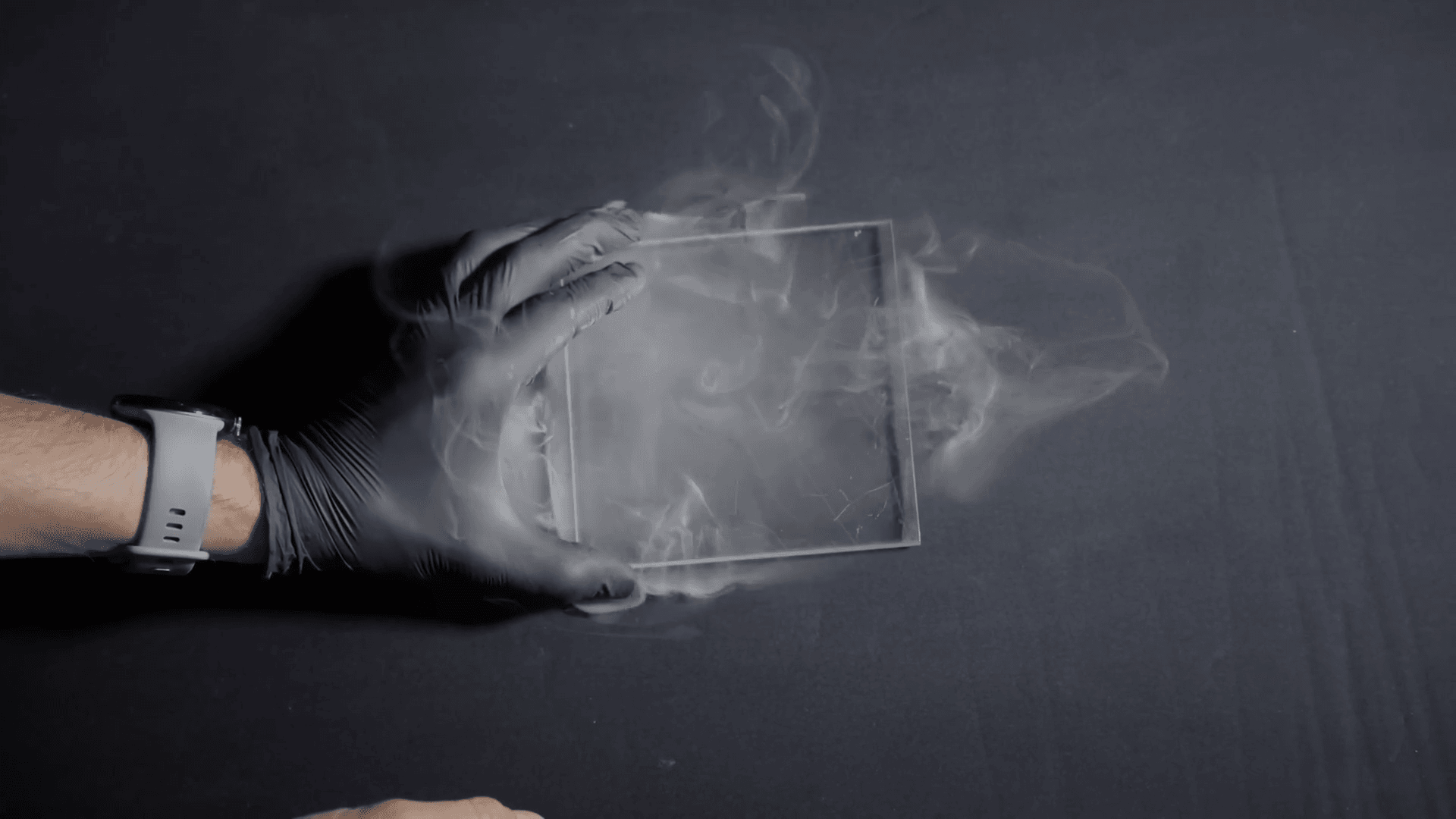
    Sound is not something we can typically see, though there are ways to visualize it, including cymatics and special acoustic cameras. This video pursues a different tactic: using schlieren photography and stroboscopic lighting to show how sound waves reflect and deflect. It’s no easy feat, but one worth enjoying–especially when others have already done the hard part for you! (Video and image credit: All Things Physics; submitted by David J.)