Tag: physics

  • Aging Salty Ice

    Aging Salty Ice

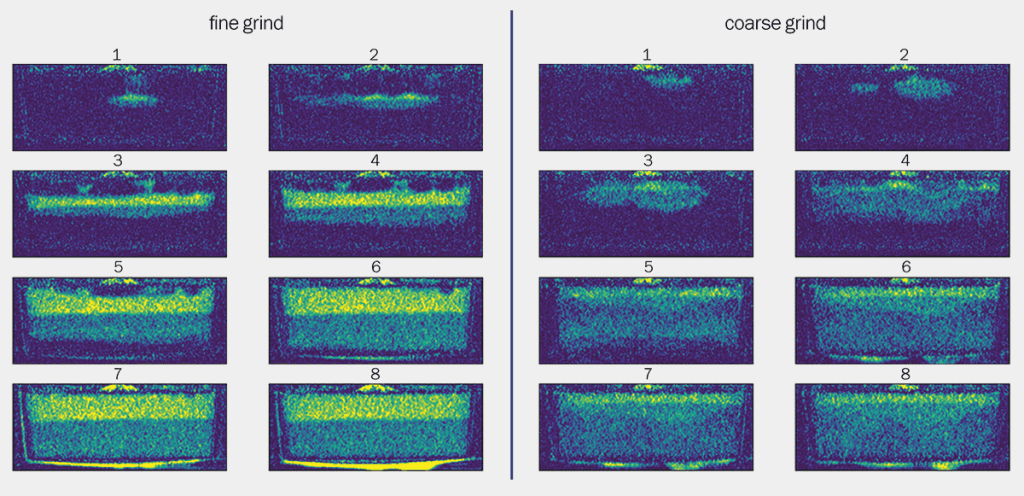
    When ice forms in salty water, it starts out mushy and porous. Salt does not freeze neatly into ice’s crystalline structure, so the forming ice has pores and gaps where salty brine gathers. As the ice ages, more brine is pushed out and gradually convects downward, due to its greater density. Over time, this makes the ice layer thinner but more solid, with fewer pores. You can see a timelapse of the process in a laboratory experiment below. (Image credit: sea ice – C. Matias, experiment – F. Wang et al.; research credit: F. Wang et al.)
    Timelapse of ice forming and aging in salt water over the course of ~16 days.
  • Mixing Bubble Caps

    Mixing Bubble Caps

    When bubbles form atop the ocean or in our cups, they typically live short lives. Although the bubble can exchange fluid with the pool below, this only happens at the foot of the bubble cap. There, thinner patches form and, due to their buoyancy, rise up along the bubble’s surface. Over time, these lighter, thinner patches reduce the amount of fluid in the cap–causing the bubble to thin and eventually burst.

    A research poster showing how external turbulence affects the plumes that thin a bubble cap.

    Here, researchers show that thinning–visible in the dark blue plumes rising up the bubble cap–when there’s no turbulence in the surrounding air. But as turbulence outside the bubble increases, the thinner patches stretch and deform across the cap. In the image series, turbulence increases moving from top to bottom. (Image credit: T. Aurégan and L. Deike)

  • “Arctic Fox in Blizzard”

    “Arctic Fox in Blizzard”

    A blue arctic fox bears the wind and snow of a Norwegian blizzard in this image by photographer Klaus Hellmich. The wind is strong enough to move snowflakes several centimeters in the time the camera’s shutter is open. This leaves the image full of streaklines that reveal the paths taken by the wind and snow. This visualization technique is useful in the lab, too. (Image credit: K. Hellmich; via Colossal)

    "Arctic Fox in Blizzard" by Klaus Hellmich.
    Fediverse Reactions
  • Richtmyer-Meshkov Instability

    Richtmyer-Meshkov Instability

    If you send a shock wave through a magnetized plasma–something that happens in both supernova explosions and inertial confinement fusion–it can trigger an instability known as the Richtmyer-Meshkov instability. The image above shows a form of this, taken from a simulation. Rather than treating the plasma as a single idealized fluid, the researchers represented it as two fluids: an ion fluid and an electron fluid. This allowed them to better capture what happens when certain components of the plasma react to changes faster than others do.

    The image itself shows the electron number density across the fluid, where darker colors represent higher electron number density. The interface between high and low-densities shows a roll-up instability that resembles the Kelvin-Helmholtz instability, but there are also regions of mushroom-like plumes that more closely resemble Rayleigh-Taylor instabilities.

    The authors note that these structures don’t appear in simulations that represent a plasma as a single fluid; you need the two-fluid representation to see them. (Image and research credit: O. Thompson et al.)

  • Featured Video Play Icon

    Testing Structures Against Hurricane Storm Surge

    When hurricanes hit coasts, they bring with them incredible storm surge, which puts buildings right in the middle of ocean waves. To understand how to better protect against those conditions, engineers use facilities like the Directional Wave Basin to create smaller-scale versions of hurricanes. In this Practical Engineering video, Grady visited during a test that compared two identical one-third-scale houses subjected to the same storm conditions–except that one house had an additional foot (3ft at real-scale) of elevation. The results are pretty spectacular.

    This isn’t a short video, but it’s well-worth a watch. I think Grady does a great job of explaining why engineers need (admittedly) expensive facilities like this one to help guide both engineering and regulatory decisions. (Video and image credit: Practical Engineering)

    Fediverse Reactions
  • Improving Turbulence Models

    Improving Turbulence Models

    Calculating turbulent flows like those found in the ocean and atmosphere is extremely expensive computationally. That’s why forecasting models use techniques like Large Eddy Simulation (LES), where large physical scales are calculated according to the governing physical equations while smaller scales are approximated with mathematical models. Researchers are always looking for ways to improve these models–making them more physically accurate, easier to compute, and more computationally stable.

    In a new study, researchers used an equation-discovery tool to find new improvements to these models for the smaller turbulent scales. They started by doing a full, computationally expensive calculation of the turbulent flow. The equation-discovery tool then analyzed these results, looking to match them to a library of over 900 possible equations. When it found a form that fit the data, the researchers were then able to show analytically how to derive that equation from the underlying physics. The result is a new equation that models these smaller scales in a way that’s physically accurate and computationally stable, offering possibilities for better LES. (Image credit: CasSa Paintings; research credit: K. Jakhar et al.; via APS)

    Fediverse Reactions
  • Featured Video Play Icon

    Drag Reduction Via Bubbles

    To help reduce greenhouse emissions, businesses are exploring systems that reduce a container ship’s drag by releasing bubbles beneath them. But how do bubbles reduce drag? To find out, researchers simulated a bubbly flow that mimics the underside of a moving ship. By playing with the balance between inertial forces, buoyancy, and surface tension, they were able to sweep through conditions that the bubbles could experience.

    The best performance comes when bubbles stick together and coat the entire underside of the surface. In that case, they measured a nearly 40% reduction in the drag. But other conditions were not so fortuitous; in fact, with poorly chosen conditions, adding bubbles could actually increase the drag. (Video and image credit: S. Di Georgio et al.)

  • “Crystal Garden – Seasons”

    “Crystal Garden – Seasons”

    In this latest project, the Beauty of Science team explores colorful crystallization as chemicals precipitate out of evaporating solutions. The variety of shapes and colors is incredible. To see many more of these crystalline “gardens,” check out the video below and the project’s webpage. (Video and image credit: W. Zhu/Beauty of Science; via Colossal)

    Fediverse Reactions
  • Featured Video Play Icon

    Mimicking Quantum Effects

    Over the last 15 years or so, researchers have been exploring pilot-wave theory–originally proposed by De Broglie in the 1920s as a way to understand quantum mechanics–using hydrodynamic quantum analogs. In these experiments, researchers vibrate pools of silicone oil, which allows oil drops to bounce–and in some conditions, walk–indefinitely on the pool. By mixing in obstacles that mimic classic quantum mechanical experiments, they reproduce effects like the double-slit experiment in a macroscopic system.

    In this video and the accompanying papers, a team recreates the Kapitsa-Dirac effect where a standing electromagnetic wave diffracts electrons. Here, the standing wave is instead a Faraday wave in the surface of the pool. Yet the droplets, too, diffract in a manner resembling the quantum version. (Video credit: B. Primkulov et al.; research credit: B. Primkulov et al. 1, 2)

  • Featured Video Play Icon

    When the Meniscus Disappears

    When we first learn about states of matter, we’re taught about three: solid, liquid, and gas. In a solid, atoms are held close to one another–typically, but not always, in an orderly lattice structure. In liquids and gases, atoms are free to slip, slide, bounce, and move. So what really separates a liquid from a gas?

    Animation of liquid and gaseous carbon dioxide reaching the supercritical phase.

    That’s the question at the heart of this video by Steve Mould, in which he explores a weird fourth phase of matter: supercritical fluids. This phase has the diffusive properties of a gas and the solvent properties of a liquid–without really being either one.(Video and image credit: S. Mould)