Tag: meteorology

  • Wave Clouds in the Atacama

    Wave Clouds in the Atacama

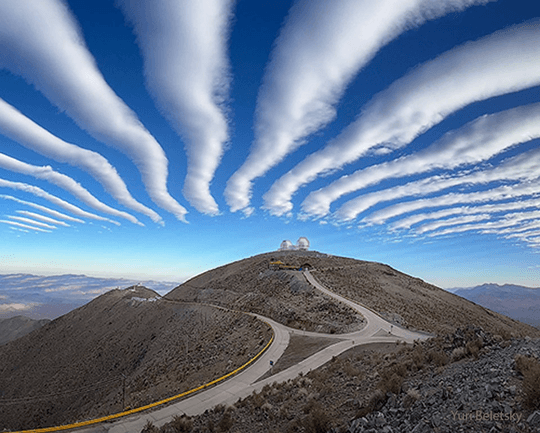
    Striped clouds appear to converge over a mountaintop in this photo, but that’s an illusion. In reality, these clouds are parallel and periodic; it’s only the camera’s wide-angle lens that makes them appear to converge.

    Wave clouds like these form when air gets pushed up and over topography, triggering an up-and-down oscillation (known as an internal wave) in the atmosphere. At the peak of the wave, cool moist air condenses water vapor into droplets that form clouds. As the air bobs back down and warms, the clouds evaporate, leaving behind a series of stripes. You can learn more about the physics behind these clouds here and here. (Image credit: Y. Beletsky; via APOD)

    Fediverse Reactions
  • Feeding Hurricanes

    Feeding Hurricanes

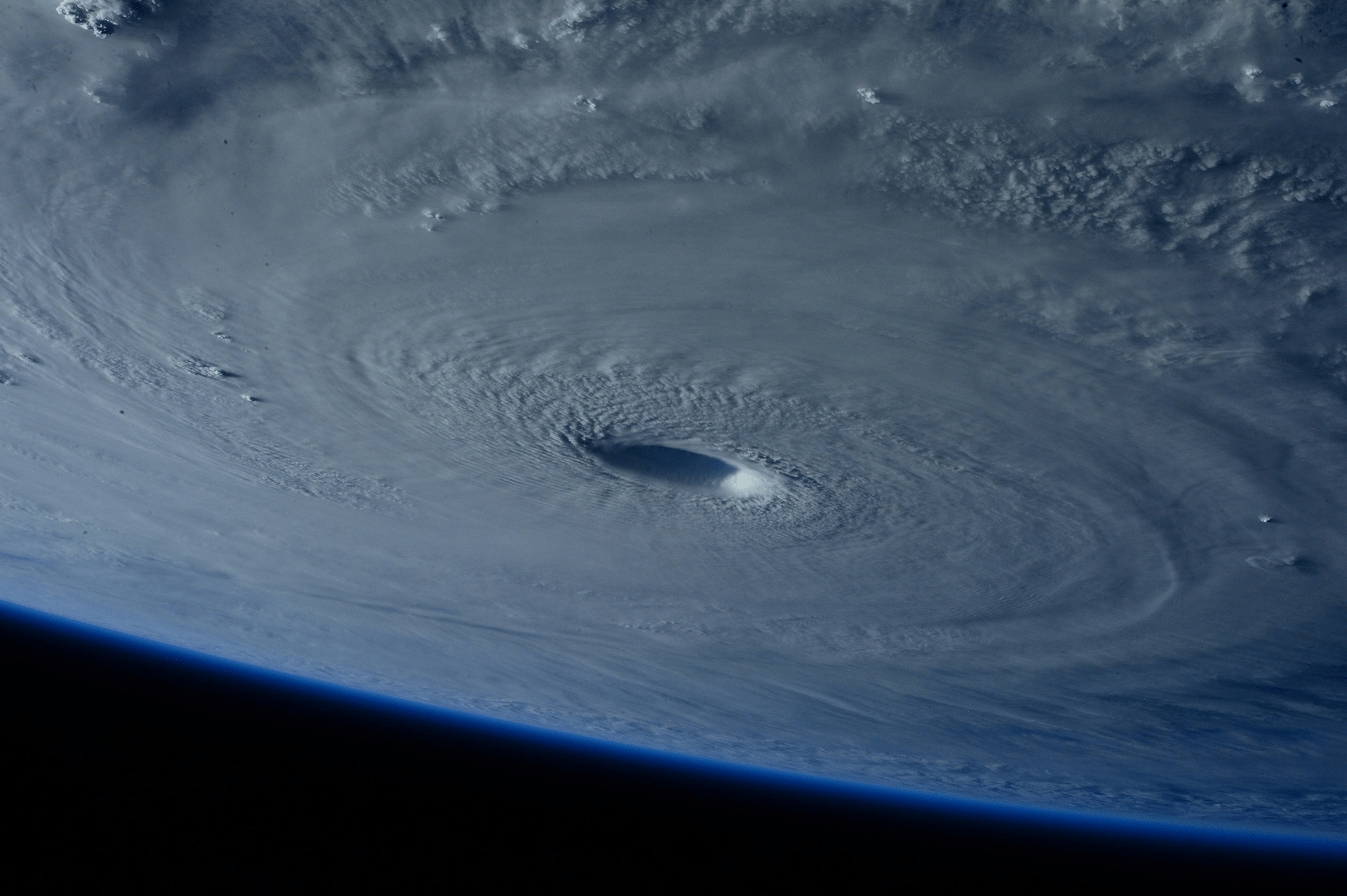
    With the strong hurricane season pummeling the southern U.S. this year, you may have heard comments about how warm oceans are intensifying hurricanes. Let’s take a look at how this works. Above is a map of ocean surface temperatures in late September, as Helene was developing and intensifying. For hurricanes, the critical ocean surface temperature is about 27 degrees Celsius — above this temperature, the warm waters add enough energy and moisture to the storm to intensify it. In this image, the waters colored from medium red to black are at or above this temperature. In fact Helene’s path — shown in a dotted white line — took it across particularly warm (and therefore dark) eddies with temperatures up to 31 degrees Celsius.

    Many factors affect a hurricane’s formation and intensification; understanding and predicting storms, their path, and their strength remains an active area of research. But warmer ocean temperatures are better at sustaining the hurricane’s warm core, and their moisture is easier to evaporate, thereby fueling the storm. Unfortunately, as the climate warms, we have to expect that warmer oceans will help rapidly intensify tropical storms and hurricanes. (Image credit: W. Liang; via NASA Earth Observatory)

  • More Gigantic Jets

    More Gigantic Jets

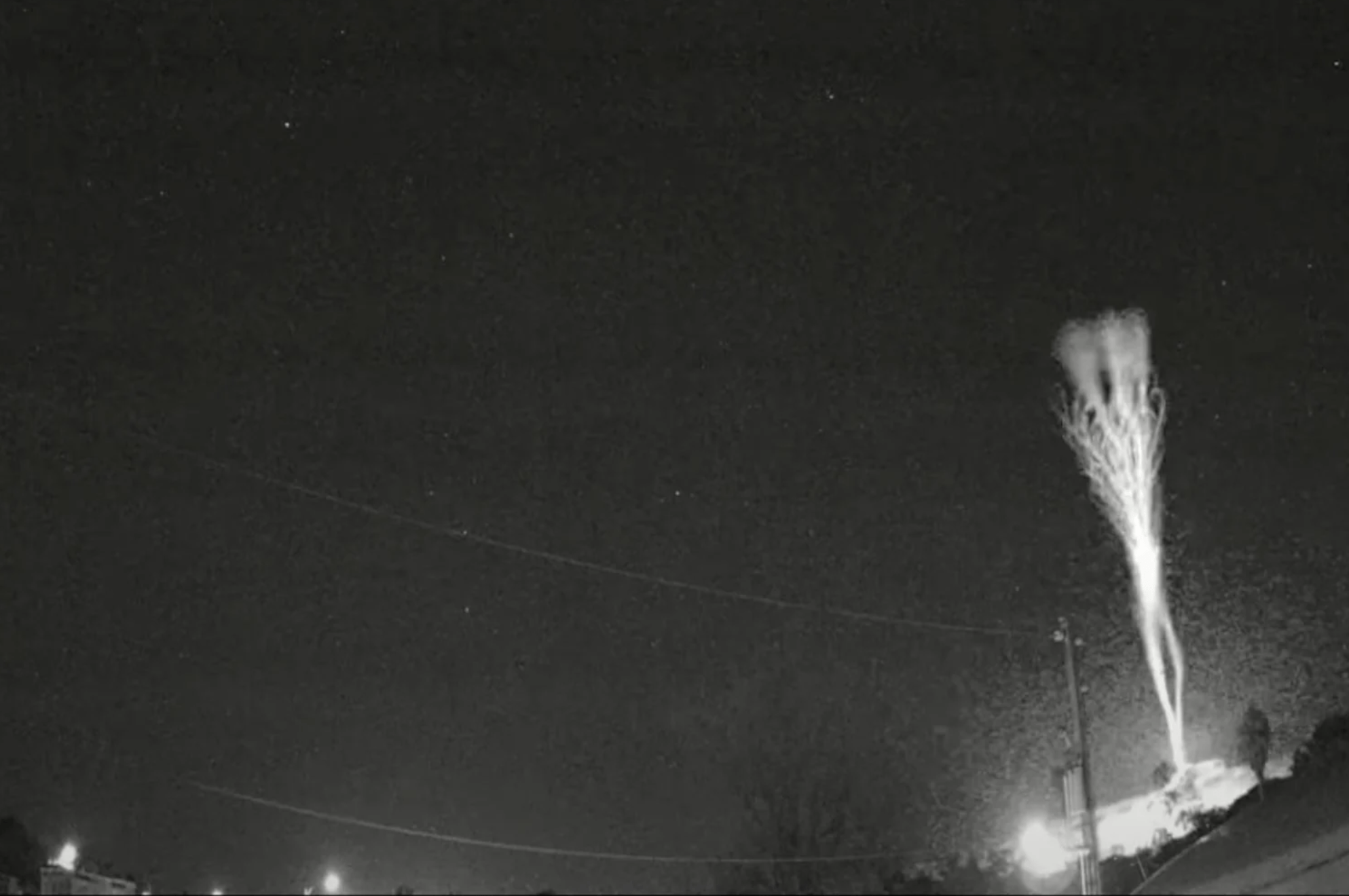
    It’s wild that we’re still discovering new weather phenomena, but the gigantic jets seen here were only identified in 2002. This uncommon type of lightning shoots up from the tops of thunderstorms into the ionosphere. The video/image above was caught by cameras normally used to monitor meteors. The jets themselves are red in color, a result of the electrical discharge interacting with nitrogen in the atmosphere. (Video and image credits: b/w – Caribbean Astronomy Society, color – F. Lucena; via Gizmodo)

  • Gigantic Jets

    Gigantic Jets

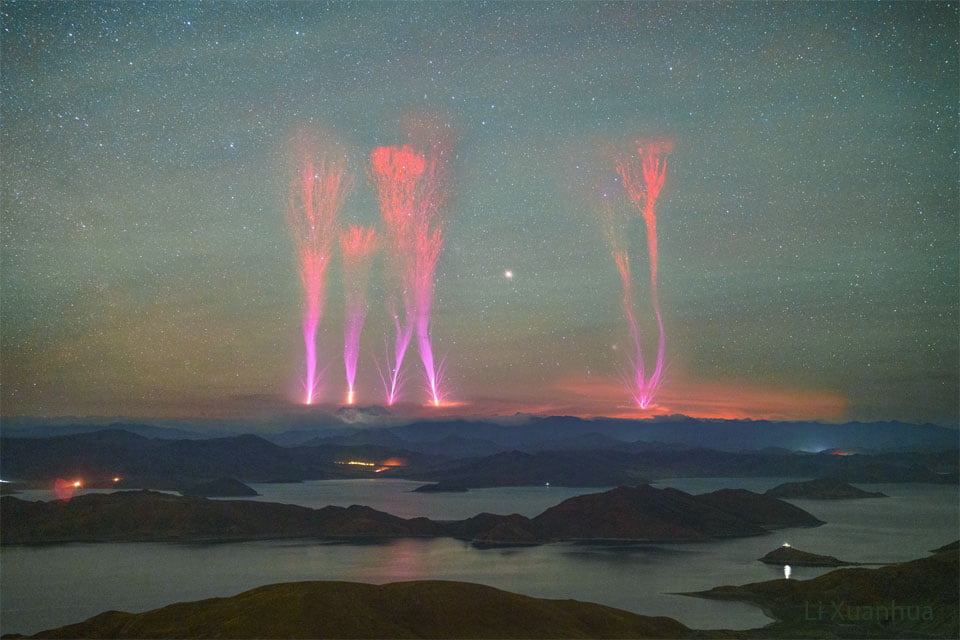
    Stormy skies feature much more than the forked cloud-to-ground lightning we’re used to seeing. This composite image shows a rare and recently-recognized type of lightning known as a gigantic jets. This type of lightning travels from the top of thunderclouds, around 16 km in altitude, up to the ionosphere at about 90 km. Their bottoms look a bit like blue jets, while their upper reaches look like red sprites, two other types of unusual lightning. The mechanism behind gigantic jets is a topic of ongoing research, but your best chance at seeing them is watching a distant thunderstorm from a clear vantage. (Image credit: Li X.; via APOD)

  • How a Storm Can Ruin Your Tea

    How a Storm Can Ruin Your Tea

    Last November, a windstorm, known as Storm Ciarán in the U.K., blew through Europe with wind speeds as high as 130 kilometers per hour. All that wind came with a significant drop in atmospheric pressure. Researchers found that the pressure drop was large enough to lower the boiling point of water more than full 2 degrees Celsius. That difference probably wouldn’t register for anyone waiting for their kettle to boil, but it could decidedly affect the final cup of tea. Tea flavor is quite sensitive to the temperature of the boiling water used to brew it, as it affects how well the tannins get extracted. According to the researchers, Ciarán’s conditions potentially ruined millions of cups of breakfast tea in the greater London area. (Image credit: E. Akyurt; research credit: G. Harrison et al.; via Gizmodo)

  • Why Tornado Alley is North American

    Why Tornado Alley is North American

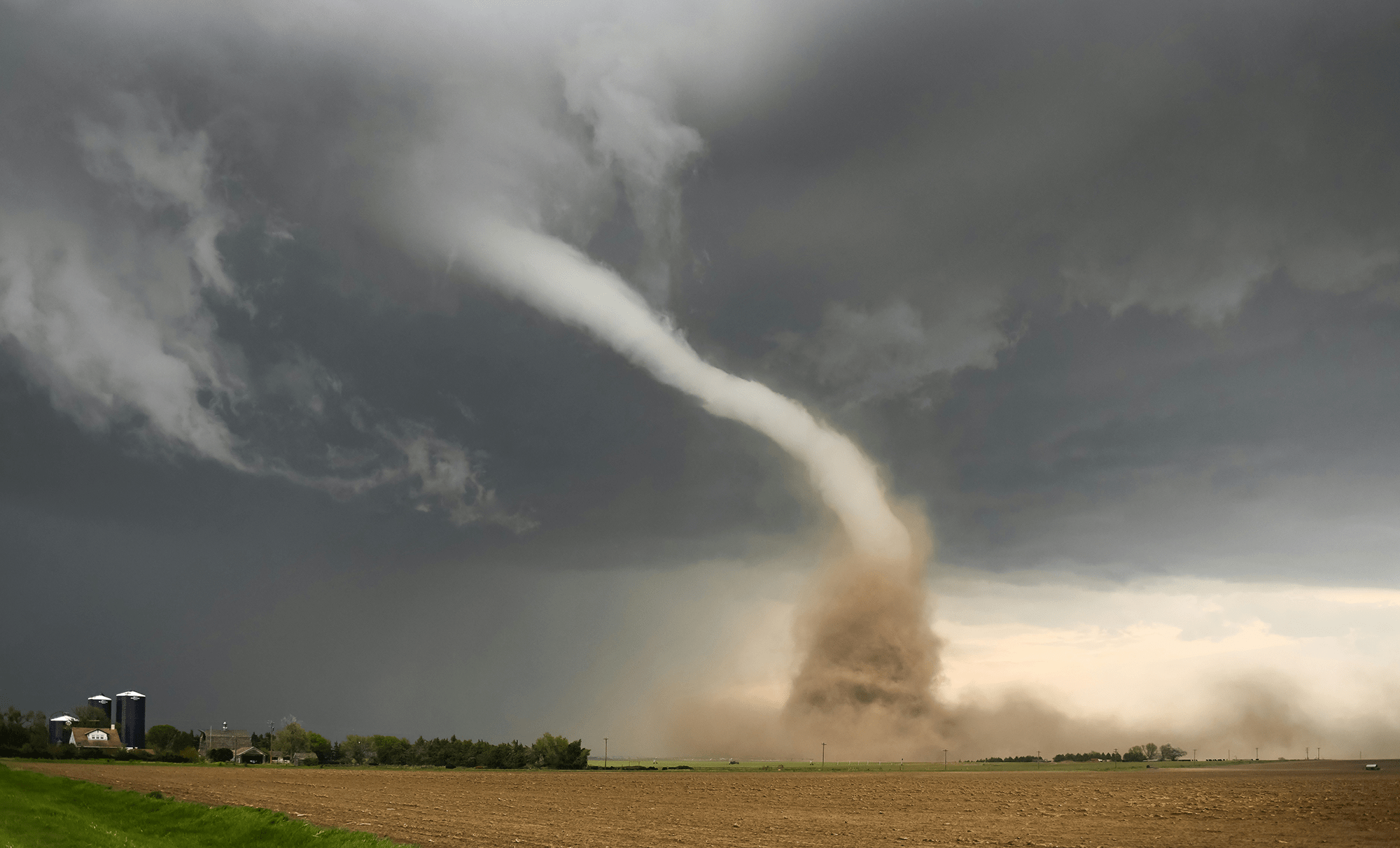
    Growing up in northwest Arkansas, I spent my share of summer nights sheltering from tornadoes. Central North America — colloquially known as Tornado Alley — is especially prone to violent thunderstorms and accompanying tornadoes. That’s due, in part, to two geographical features: the Rocky Mountains and the Gulf of Mexico. Trade winds hitting the eastern slope of the Rockies get turned northward, imparting a counterclockwise vorticity. At the same time, warm moist air carried from the Gulf feeds into the atmosphere, creating perfect conditions for powerful thunderstorms. By this logic, though, South America should see lots of tornadoes, too, courtesy of the Andes Mountains and the moist environs of the Amazon Basin. To understand why South America doesn’t have a Tornado Alley, researchers used global weather models to investigate alternate North and South Americas.

    They found that smoothness is a key ingredient for the upstream, moisture-generating region. Compared to the Amazon, the Gulf of Mexico is incredibly flat. With a flat Gulf, tornadoes abounded in North America, but their numbers dropped once that area was roughened to mimic the Amazon. The opposite held true, too: a smoothed-out Amazon Basin resulted in more simulated South American tornadoes.

    For those in Tornado Alley, the results don’t offer much hope for mitigating our summer storms — we can’t exactly roughen the ocean. But the study does sound a word for warning for South America; the smoother the Amazon region becomes — due to mass deforestation — the more likely tornadoes become in parts of South America. (Image credit: G. Johnson; research credit: F. Li et al.; via Physics World)

  • The Real Butterfly Effect

    The Real Butterfly Effect

    The butterfly effect — that the flapping of a butterfly’s wings in Brazil can cause a tornado in Texas — expresses the sensitivity of a chaotic system to initial conditions. In essence, because we can’t possibly track every butterfly in Brazil, we’ll never perfectly predict tornadoes in Texas, even if the equations behind our weather forecast are deterministic.

    But this interpretation doesn’t fully capture the subtleties of the situation. With fluid dynamics, the small scales of a flow — like the turbulence in an individual cloud — are linked to the largest scales in the flow — for example, a hurricane. For short times, we’re actually quite good at predicting those large scales; our weather forecasts can distinguish sunny days and cloudy ones a week out. But at smaller scales, the forecast errors pile up quickly. No one can forecast that an individual cloud will form over your house three days from now. And because the small scales are linked to the larger scales, the uncertainties from the small scale cascade upward, limiting how far into the future we can reliably predict the weather.

    And, unfortunately, drilling down to capture smaller and smaller scales in our models can’t fix the problem, unless our initial uncertainties are identically zero. To get around this problem, weather forecasters instead use ensemble forecasting, where they run many simulations of the weather with slightly different initial conditions. Those differences in initial conditions let the forecasters play with those initial uncertainties — how accurate is the temperature reading from that station? How reliable is the instrument reporting that humidity? How old is the satellite data coming in? Once all the forecasts are run, they can see how many predicted sunny days versus rainy ones, which ones resulted in severe weather, and so on. Often the probabilities we see in our weather app — like 30% chance of rain — depend on factors including how many of the forecasts resulted in rain.

    Unfortunately, this butterfly effect permanently limits just how far into the future we can predict weather — at least until we fully understand the nature of the Navier-Stokes equations. For much more on this interesting aspect of chaos, check out this Physics Today article. (Image credit: NASA; see also T. Palmer at Physics Today)

    Fediverse Reactions
  • Light Pillars

    Light Pillars

    These lovely pillars of light over the Mongolian grasslands are the result of tiny, suspended ice crystals. With the right weather conditions, ice crystals can align so that their largest faces are roughly parallel to the ground. In this orientation, the crystals collect and reflect artificial lights from the ground into these towering light pillars. It’s worth noting that the pillars aren’t located directly above the light source; instead, the column of crystals will lie roughly halfway between the light source and the observer. Next time you’re out on a cold winter night, see if you can find one! (Image credit: N. D. Liao; via APOD)

  • Extreme Weather and Climate Change

    Extreme Weather and Climate Change

    Extreme weather events like floods, hurricanes, atmospheric rivers, heat waves, and droughts are increasingly discussed in terms of the effects of climate change. Because complex systems have complex causes, it’s difficult to draw exact lines of causality between human-made climate change and a given weather event. But scientists have built an array of tools that help address two key questions: 1) how much more extreme was this weather due to climate change, and 2) how much more likely was this extreme event due to climate change?

    Comparing (a) the actual flooding from Hurricane Harvey with (b) the estimated flood that would have been without climate change. The depth of actual flood waters was about 1m greater due to climate change.
    Comparing (a) the actual flooding from Hurricane Harvey with (b) the estimated flood that would have occurred without climate change. The depth of actual flood waters was about 1m greater due to climate change.

    To answer the first question, scientists often use hindcasts. In these studies, scientists first build a simulation that mirrors the actual event, like Hurricane Harvey’s stall over Houston, Texas. Once their simulated storm reflects the actual one, they tweak the initial conditions to reflect a world without climate change and see how the storm differs. By comparing the actual and simulated floods (image above), scientists can estimate just how much worse climate change made things. In Harvey’s case, they found that human activity increased the overall precipitation by 19% and that 32% of the flooded homes in Harris county would not have flooded in a world without climate change. Detailed results from that particular study can be explored in the web portal here. (Image credits: Flooded street – J. Gade, Harvey flooding – M. Wehner; research credit: M. Wehner in Physics Today)

  • Dust Storms

    Dust Storms

    Hot, dry berg winds swept down from the Namibian highlands and sent these plumes of dust flying out to the Atlantic coast. Another plume — white instead of brown — marks salt dust from the Etosha Pan salt flat. The dust and salt become aerosol particles in the atmosphere — seeds for raindrops to form. Coastal towns sometimes need construction equipment to deal with the drifting sand from these storms, but these storms are small compared to Saharan dust storms. Those storms are so large that their dust influences the weather on the other side of the Atlantic. (Image credit: W. Liang; via NASA Earth Observatory)