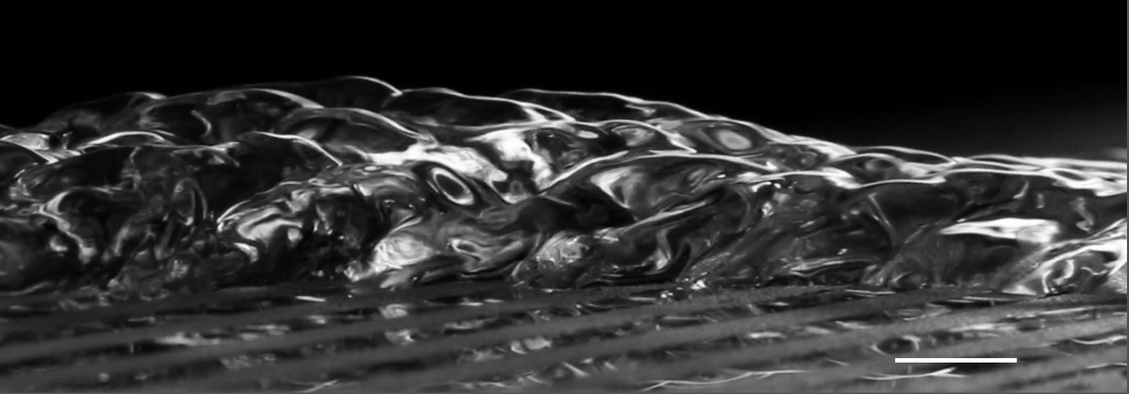
The characteristics of a surface can have a major impact on the form a flow takes. The photo above shows a corrugated, almost pinecone-like water surface. It’s the result of a sheet of water flowing over a surface with alternating bands of hydrophobic (water-repelling) and hydrophilic (water-loving) properties. The water sheet narrows over hydrophobic sections and expands over hydrophilic ones. Gravity, inertia, and surface tension compete to create the overall braided appearance. You can see a top-down view of the flow in the original poster. (Image credit: M. Grivel et al., source)
Tag: hydrophobic

When Fire Ants are a Fluid


Substances don’t have to be a liquid or a gas to behave like a fluid. Swarms of fire ants display viscoelastic properties, meaning they can act like both a liquid and a solid. Like a spring, a ball of fire ants is elastic, bouncing back after being squished (top image). But the group can also act like a viscous liquid. A ball of ants can flow and diffuse outward (middle image). The ants are excellent at linking with one another, which allows them to survive floods by forming rafts and to escape containers by building towers.
Researchers found the key characteristic is that ants will only maintain links with nearby ants as long as they themselves experience no more than 3 times their own weight in load. In practice, the ants can easily withstand 100 times that load without injury, but that lower threshold describes the transition point between ants as a solid and ants as a fluid. If an ant in a structure is loaded with more force, she’ll let go of her neighbors and start moving around.
When they’re linked, the fire ants are close enough together to be water-repellent. Even if an ant raft gets submerged (bottom image), the space between ants is small enough that water can’t get in and the air around them can’t get out. This coats the submerged ants in their own little bubble, which the ants use to breathe while they float out a flood. For more, check out the video below and the full (fun and readable!) research paper linked in the credits. (Video and image credits: Vox/Georgia Tech; research credit: S. Phonekeo et al., pdf; submitted by Joyce S., Rebecca S., and possibly others)
ETA: Updated after senoritafish rightfully pointed out that worker ants are females, not males.

Water Skiing Beetles
Waterlily beetles employ an unusual method of getting around: they skim across the water surface. The beetles are mostly covered in tiny hairs that help make their body hydrophobic (water-repellent) – a common adaptation for insects that spend their time sitting on the water’s surface – but the beetles also have hydrophilic claws on their legs that help anchor them to the water’s surface. When they need to move quickly, the beetles lean upright and start flapping their wings, creating thrust that helps push them along the interface. Between water’s viscosity and drag from the waves the insect generates, it has to expend a lot of energy for this method of travel – more than these insects do flying in air – but researchers suspect that staying at the surface could remain beneficial for the beetles because it’s easier to locate their floating food sources this way. (Image credit: H. Mukundarajan et al., source; via New Scientist)

Daily Fluids, Part 4
Inside or outside, we encounter a lot of fluid dynamics every day. Here are some examples you might have noticed, especially on a rainy day:
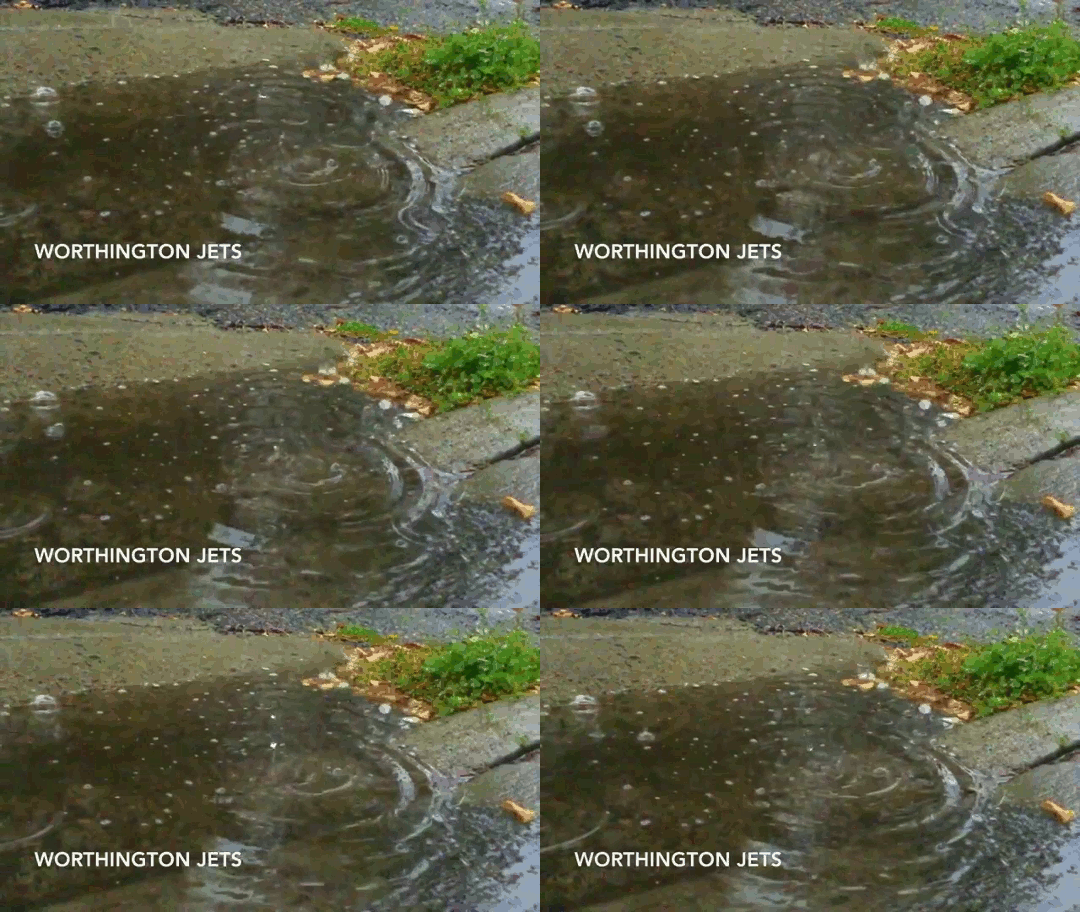
Worthington Jets
After a drop falls into a pool, there’s a column-like jet that pops up after it and sometimes ejects another small drop. This is known to fluid dynamicists as a Worthington jet, but really it’s something we all see regularly, especially if you watch rain falling onto puddles or look really closely at your carbonated drink.Crown Splash
Like the Worthington jet, crown splashes often follow a drop’s impact into another liquid. But they can also show up when slicing or stomping through puddles!Free Surface Dynamics
Anytime you have a body of water in contact with a body of air, fluid dynamicists call that a free surface. How the interface between the two fluids shifts and transforms is fascinating and complicated. Waterfalls are a great example of this, but so are ocean waves or even the ripples from tossing a rock into a pond.Hydrophobic Surfaces
Water-repellent surfaces are called hydrophobic. Water will bead up on the surface and roll off easily. While many manmade surfaces are hydrophobic, like the teflon in your skillet, so are many natural surfaces. Many leaves are hydrophobic because plants want that water to fall to the ground where their roots can soak it up. Keep an eye out as you wash different vegetables and fruits and see which ones are hydrophobic!Check out all of this week’s posts more examples of fluid dynamics in daily life. (Image credit: S. Reckinger et al., source)
“Bubble Circus”
The “Bubble Circus” is a delightful outreach device equipped for all manner of physics demos, as seen in the video above. Many of its exercises explore surface tension, a force observed at the interface of a fluid. Surface tension is what provides bubbles with their surface-minimizing spherical shape. That same property determines the minimal distance between the four vertices of a pyramid (0:54). Changing the surface tension causes fluid at the interface to move. At 1:16 adding a lower surface tension fluid makes the water and black pepper pull away; the same physics drives the boat away at 2:09. For more on the Bubble Circus, see here. (Video credit: A. Echasseriau et al.; via J. Ouellette)
Ode to Bubbles
Boiling water plays a major role in the steam cycles we use to generate power. One of the challenges in these systems is that it’s hard to control the rate of bubble formation when boiling. In this video, researchers demonstrate their new method for bubble control in a clever and amusing fashion. The twin keys to their success are surfactants and electricity. Surfactant molecules, like soap, have both a polar (hydrophilic) end and a non-polar (hydrophobic) end. By applying an electric field at the metal surface, the researchers can attract or repel surfactant molecules from the wall, making it either hydrophobic or hydrophilic depending on the field’s polarity. Since hydrophobic surfaces have a high rate of bubble formation, this lets the scientists essentially turn nucleation on and off with the flip of a switch! (Video credit: MIT Device Research Lab; see also: research paper, MIT News Video, press release)
Do you enjoy FYFD and want to help support it? Then please consider becoming a patron!
To Splash or Not to Splash?
Hydrophobic surfaces tend to repel water while hydrophilic ones attract it. This video explores the effects that hydrophobic and hydrophilic surface coatings can have on spheres when dropped in water. There are noticeable differences in splash formation and wake shape. For more, see this research paper.
Superhydrophobic Carbon Nanotubes
Carbon nanotubes form a superhydrophobic (super water repellent) surface that interacts with water droplets in interesting ways. The droplet is unable to wet the surface and thus the bounces along. When the impact velocities are too great for surface tension to hold the decelerating mass together, it breaks into many, smaller droplets that also bounce along the surface. # (via @JetForMe and @Vinnchan)