Tag: geophysics

  • Inside the Earth’s Mantle

    Inside the Earth’s Mantle

    Plate tectonics is a relatively young scientific theory, only gaining traction among geologists in the late 60s and early 70s. One key tenet of the theory is subduction where plates meet and one is forced down into the mantle, like in this illustration of the subduction zone near Japan. In early incarnations of the theory what happens to that subducting slab of rock once it’s in the mantle were ignored. But over the decades, geologists have built maps of the interior of our planet through the seismic waves they record. What they’ve found is that the continental chunks that break off and sink can have long-lasting effects.

    Beneath the Earth’s crust, the mantle behaves like an extremely slow-moving fluid under incredibly high temperatures and pressures. It can take tens of millions of years, but those broken slabs sink through the mantle, dragging fluid with them. This creates a large-scale flow known as a mantle wind, which can have far-reaching effects at the Earth’s surface. Through modeling and simulation, geologists have found these deep mantle flows may explain why mountain ranges like the Himalayas and Andes didn’t grow until millions of years after their plates collided and why earthquakes sometimes occur far from plate boundaries. For more, check out this great article from Ars Technica. (Image credit: British Geological Survey; via Ars Technica; submitted by Kam-Yung Soh)

  • Bay of Fundy Tides

    Bay of Fundy Tides

    Canada’s Bay of Fundy has some of the wildest tidal flows in the world. Every six hours, the flow direction through the strait shifts and tidal currents rise to several meters per second. This creates distinct jets a couple kilometers long that pour from one side of the strait to the other. 

    What you see here is a numerical simulation of the flow using a technique called Large Eddy Simulation (or LES, for short). It’s one method used by fluid dynamicists to model turbulent flows without taking on the complexity of the full Navier-Stokes equations. At large lengthscales, like those of the jets and eddies we see above, LES uses the exact physics. But when it comes to the smaller scales – like the flow nearest the shores or the bottom of the strait – the simulation will approximate the physics in order to make calculations quicker and easier. Models like these make large-scale problems – including modeling our daily weather patterns – possible. (Image credit: A. Creech, source)

  • Blowing Smoke

    Blowing Smoke

    It’s unusual – but not entirely unheard of – to see volcanoes blowing smoke rings during inactive periods. But given their unpredictability, scientists had not studied this phenomenon in much depth. In a recent presentation, though, a group unveiled results from numerical studies of volcanic vortex rings. They found that the decreasing pressure on rising magma allows dissolved gases to emerge as bubbles. If the magma has the right viscosity, those bubbles can merge into one big pocket that depressurizes explosively in the vent. As the hot gases burst upward, the walls of the vent cause them to curl up into a vortex ring, provided the vent is fairly circular and uniform. That sends the roiling vortex up into the atmosphere, where it cools, condenses, and becomes visible.

    The need for a circular vent matches observations of volcanic vortex rings in nature, like the infrared image shown above. Volcano watchers find that vortex rings only form from some vents, and the more circular the vent, the more likely it can produce vortex rings. (Image credit: B. Simons; research credit: F. Pulvirenti et al.; via Nat Geo; submitted by Kam-Yung Soh)

  • Rays in Craters

    Rays in Craters

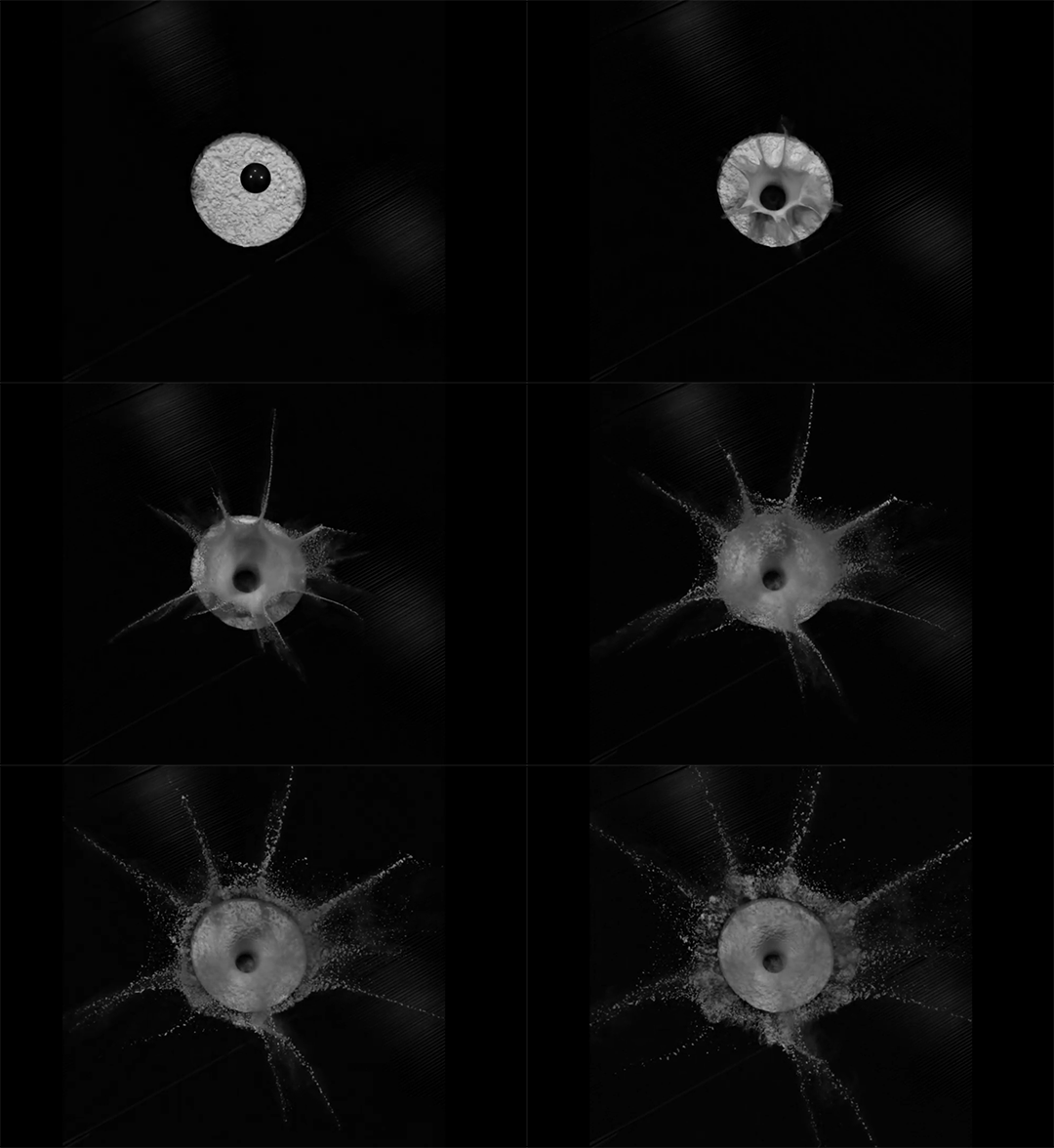
    On bodies around the solar system, there are craters marking billions of years’ worth of impacts. Many of these craters have rays–distinctive lines radiating out from the point of impact. But if you drop an object onto a smooth granular surface (upper left), the ejecta form a uniform splash with no rays. The impactor must hit a roughened surface (upper right) in order to leave rays. 

    Through experiment and simulation, researchers found that the rays emanate from valleys in the surface that come in contact with the impactor. Moreover, the number of rays that form depends only on the size of the impactor and the undulations of the surface. That means that, by knowing the topography of a planetary body and counting the number of rays left behind, scientists can now estimate what the size of the object that struck was! (Image, video, and research credit: T. Sabuwala et al.)

  • Anak Krakatoa Tsunami

    Anak Krakatoa Tsunami

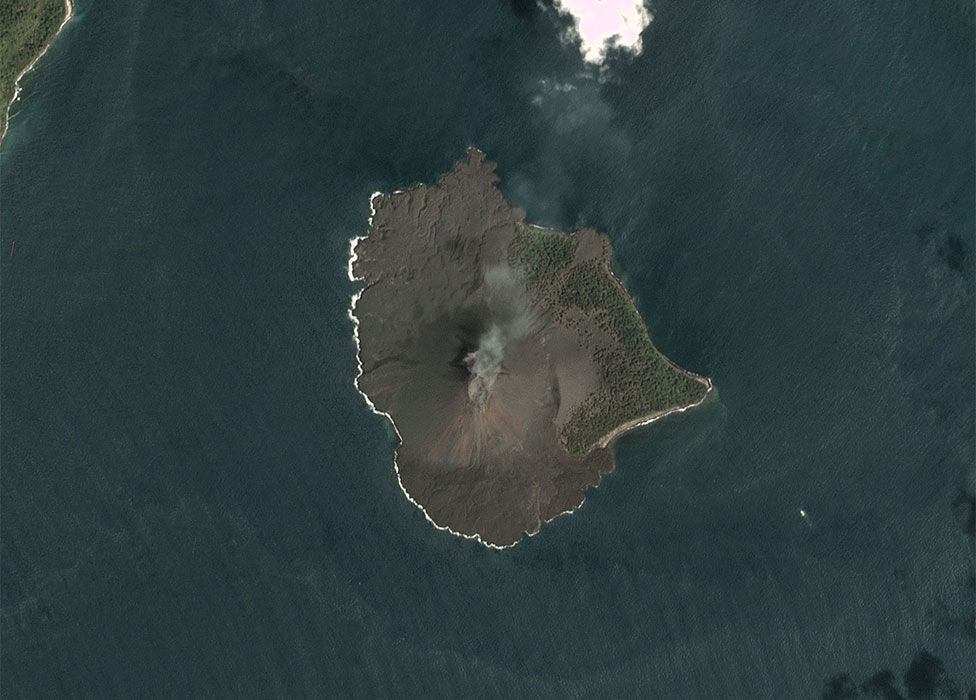
    In late December 2018, a landslide on the island Anak Krakatoa triggered a deadly tsunami in Indonesia. The island (upper left, pre-landslide) lost an estimated 300 meters of height in the landslide, dramatically altering its appearance (upper right; post-landslide). Much of the slide occurred underwater, dumping material into a crater left by the famous 1883 eruption of Krakatoa

    The slide displaced a massive amount of water, creating a tsunami that spread, refracting around nearby islands and reflecting off shorelines in complicated patterns. A new numerical simulation, shown above, models the post-slide tsunami based on terrain data and fluid physics. Its wave predictions match well with the high-water readings from nearby islands. The scientists hope that such models, combined with monitoring, will help save lives should a future eruption trigger more tsunamis.

    For a full picture of both the recent Anak Krakatoa eruption and its famous predecessor, check out this video. (Image credits: satellite views before and after landslide – Planet Labs; simulation – S. Ward, source; via BBC News; submitted by Kam-Yung Soh)

  • Forming a Waterfall

    Forming a Waterfall

    Many factors can affect a waterfall’s formation – changes in bedrock structure, tectonic shifts, and glacial motion, to name a few. But a new study suggests that some waterfalls may be self-forming. Using a lab-scale experiment, researchers created a homogeneous “bedrock” out of polyurethane foam, which they eroded with a combination of constant water flow and particulates. Even without external perturbations, the flow carved out a series of steps.

    As a pool deepened, particles built up inside, armoring the bed against further erosion. But further downstream, the chute continued to erode, steepening the area between them until a waterfall formed. On the timescale of the experiment, the waterfalls lasted only 20 minutes or so, but that’s equivalent to up to 10,000 years in geological time. (Image credit: M. Huey; research credit: J. Scheingross et al.; via EOS News; submitted by Kam-Yung Soh)

  • Magma Mixing

    Magma Mixing

    Magmas typically consist of a mixture of molten liquid, bubbles, and solid crystals. As they mix, those crystals can sink from one viscous layer into another. To investigate this sort of process, researchers studied solid particles sinking across an interface between two viscous liquids. This is what we see above. One fluid is clear; the other is dyed red, and gravity points toward the left so the particles fall from right to left.

    What happens when the particle reaches the interface between fluids depends on three main factors: the gravitational force acting on the particle, the surface tension at the interface, and the ratio of the viscosities of the two fluids. The researchers observed two main outcomes. In one (top), the particle slows at the interface and breaks through slowly, its surface wetted by the second fluid so that it drags little to none of the previous fluid with it. The researchers named this the film drainage mode. It tends to occur when the viscosity ratio between fluids is large.

    The second method, shown in the bottom image, is the tailing mode. As the particle approaches, the interface deforms. A thick layer of the first fluid coats the particle even as it pass through, forming a tail that destabilizes behind the falling particle. This mode occurs when the viscosity ratio is small or the gravitational force is large compared to the surface tension. (Image and research credit: P. Jarvis et al.)

  • Featured Video Play Icon

    Slow Mo Geyser

    Geysers are one of the most surreal wonders of our planet – pools of turquoise that periodically erupt into towers of water and steam. But what we see from the surface is only a small part of the story. Geysers require two main ingredients: an intense geothermal heat source and the right plumbing. Below ground, that plumping needs both a reservoir for water to gather and narrow constrictions that encourage the build-up of pressure.

    A cycle begins with water filling the reservoir; this can be both geothermally heated water and groundwater seeping in. As the geyser fills, the pressure at the bottom increases. Eventually, the water becomes superheated, meaning that it’s hotter than its boiling point at standard atmospheric pressure. That’s when the steam bubbles you see above rise to the surface. When they break through, it causes a sudden drop in the reservoir pressure. The superheated water there flashes into steam, causing the geyser to erupt. Check out the full video below for some awesome high-speed video of those eruptions, and, if you’re curious what the inside of an active geyser looks like check out Eric King’s video. (Image and video credit: The Slow Mo Guys; submitted by @eclecticca)

  • Inside Avalanches

    Inside Avalanches

    Avalanches have traditionally been difficult to model and predict because of their complex nature. In the case of a slab avalanche, the sort often triggered by a lone skier or hiker, there is a layer of dense, cohesive snow atop a layer of weaker, porous snow. The presence of the skier can destabilize that inner layer, causing a fracture known as an anticrack to propagate through the slab. Eventually, it collapses under the weight of the overlying snow and an avalanche occurs.

    What makes this so complicated is that the snow behaves as both a solid – during the initial fracturing – and as a fluid – during the flow of the avalanche. Researchers are making progress, though, using new models capable of simulating the full event (shown above) by leveraging techniques developed and used in computer animation for films. That’s right – the physics-based animation used in films like Frozen is helping researchers understand and predict actual avalanche physics! (Image and research credit: J. Gaume et al.; via Penn Engineering; submitted by Kam-Yung Soh)

  • Titan’s Dust Storms

    Titan’s Dust Storms

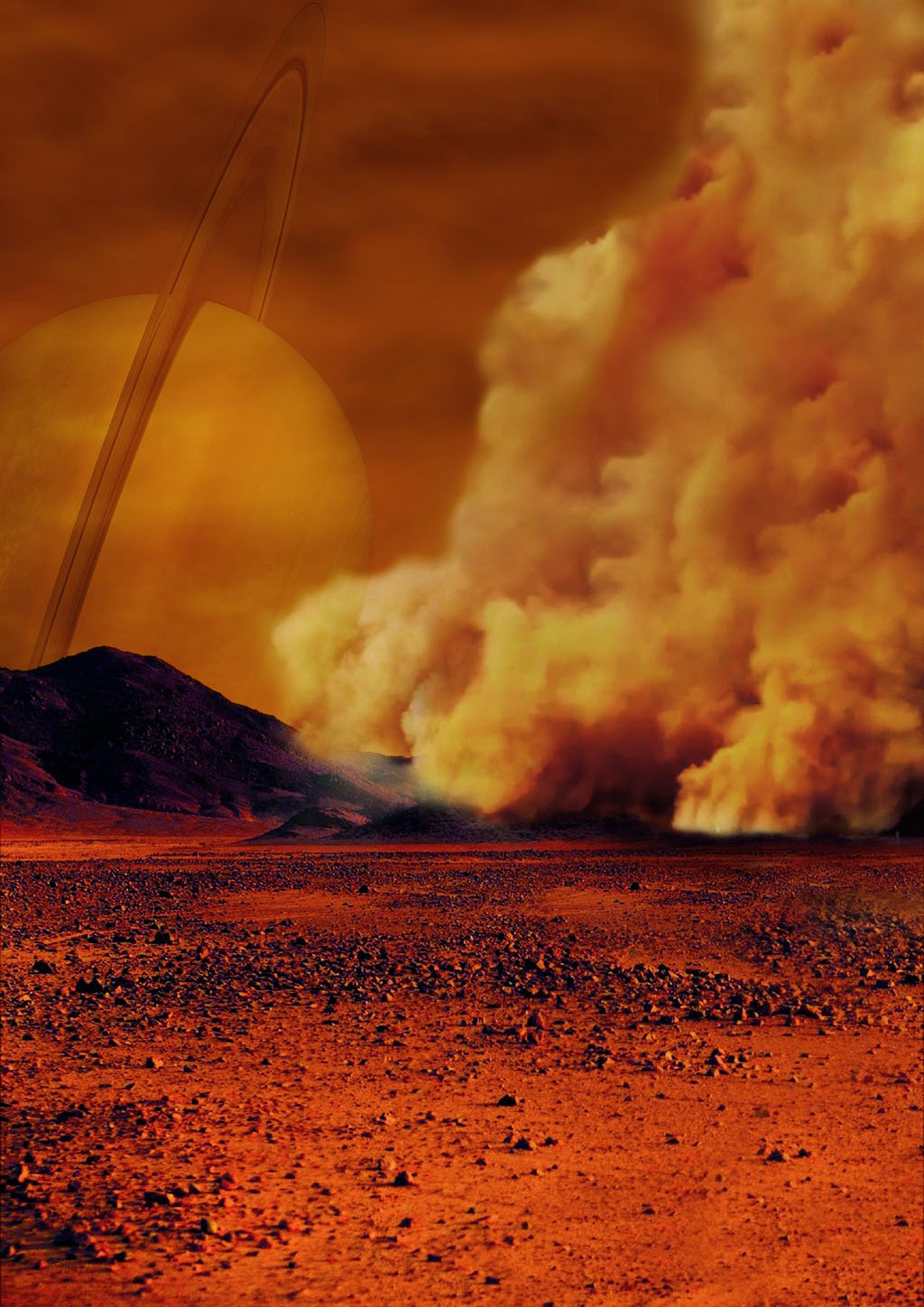
    Earth and Mars are well-known for their dust storms, but a new source of extraterrestrial dust storms is joining them: Saturn’s moon Titan. Titan already shares unusual similarities to Earth: it is the only other place known to currently have stable liquid bodies at its surface. On Earth, water makes up our lakes and oceans; on Titan, it’s methane.

    The evidence that Titan may also have dust storms dates from several Cassini flybys in 2009 and 2010. Cassini observed short-lived infrared bright spots in a dune-covered equatorial region. After considering several other possible sources for these temporary bright spots, researchers concluded that the most likely explanation was dust clouds suspended by high winds. This suggests that the dune fields on Titan are still actively changing, just like those on Earth and Mars! (Image credit: artist’s concept for Titan dust storm – NASA/ESA/IPGP/Labex UnivEarthS/University Paris Diderot; research credit: S. Rodriguez et al.; submitted by jpshoer)