Tag: geophysics

  • The Undisturbed Waters of Lake Kivu

    The Undisturbed Waters of Lake Kivu

    Deep in Africa lies one of the world’s strangest lakes. Lake Kivu, over 450 meters in depth, is so stratified that its layers never mix. The upper portion of Lake Kivu consists of less-dense fresh water, which sits upon deeper layers of saltier water full of dissolved carbon dioxide and methane pumped into the lake by volcanic activity.

    The lake’s lack of convection means that this deep water simply stays put for thousands of years as it collects gases that remain dissolved only thanks to the immense pressure of the water above. Should that deep water be disturbed — by an earthquake, climate changes, or simply oversaturation — the resulting eruption of carbon dioxide could be deadly for the millions of people living nearby. A similar eruption at smaller Lake Nyos in 1986 asphyxiated about 1,800 people.

    Fortunately, Lake Kivu is well-monitored, so such an upwelling should not catch observers off-guard. Learn more about Lake Kivu’s oddities over at Knowable. (Image and research credit: D. Bouffard and A. Wüest, via Knowable Magazine; submitted by Kam-Yung Soh)

  • A Colorful Portrait of Flow

    A Colorful Portrait of Flow

    This gorgeous, natural-color image shows Lake Balkhash in southeastern Kazakhstan. In early March, the ice on the lake was beginning to break up, revealing glimpses of swirling sediment below the water’s surface. In contrast, the smaller lakes and ponds of the surrounding area remained frozen amidst the wintery browns of the nearby desert and wetlands. (Image credit: J. Stevens/USGS; via NASA Earth Observatory)

  • Stratospheric Effects of Wildfires

    Stratospheric Effects of Wildfires

    Australia’s bushfires from earlier this year are offering new insights into how pyrocumulonimbus clouds can affect our stratosphere. A massive, uncontrolled blaze between December 29th and January 4th generated a towering, turbulent cloud of smoke like the one shown above.

    Using meteorological data, a new study shows this enormous cloud initially rose to 16 km in altitude, then began a months-long trek that circled the globe. The smoke plume ultimately stretched to over 1,000 km wide and reached a record altitude of over 31 km. Inside the plume, concentrations of water vapor and carbon monoxide were several hundred percent higher than normal stratospheric air.

    Researchers found the plume extremely slow to dissipate, possibly due to strong rotational winds surrounding it. This is the first time scientists have observed these shielding winds, and work is still underway to determine how and why they formed. (Image credit: M. Macleod/Wikimedia Commons; research credit: G. Kablick III et al.; via Science News; submitted by Kam-Yung Soh)

  • Featured Video Play Icon

    Centrifugal Instability

    When it comes to geophysics, there are all kinds of phenomena that depend on rotation. In this short video, researchers demonstrate one such phenomena — the centrifugal instability — in a tank on a turn table. The experiment begins once the fluid in the tank is all rotating together, like a solid body would. Then, they reduce the rotation rate of the turn table. Almost immediately, we see rolls encircle the tank.

    The rolls form due to the difference in momentum between fluid in the interior and near the wall. Friction with the wall slows the fluid there down much faster than that in the middle of the tank. As the faster-moving fluid gets centrifuged outward, it forms rolls. As the video demonstrates, these rolls can be relatively uniform and laminar, or, with enough change in rotation rate, they can become turbulent. (Image and video credit: UCLA Spinlab)

  • Internal Waves in the Andaman Sea

    Internal Waves in the Andaman Sea

    Differences in temperature and salinity create distinct layers within the ocean. When combined with flow over submerged topography — underwater canyons, mountains, and reefs — it makes waves. But those waves aren’t always apparent when sitting at the surface. Instead, they travel along those ocean layers as internal waves that can be as tall as hundreds of meters in height.

    When the sun glints just right off the ocean, these massive internal waves can be caught by satellite imagery, as shown in the above image of the Andaman Sea near Thailand and Myanmar. Even seemingly calm waters can roil in the deep. (Image credit: USGS; via NASA Earth Observatory)

  • Unifying Sediment Transport Theory

    Unifying Sediment Transport Theory

    On windy days, streaks of snowflakes snake in the air above a mountaintop snowfield. And when snorkeling in the surf, you can watch the inbound waves sculpt underwater ripples in the sand. Both are examples of sediment transport, and scientists have struggled to understand why the physics of these grains seems to differ between air and water. We observe certain behaviors, like saltation, in air and very different behaviors for grains underwater.

    One of the key differences is how much erosion occurs for a given amount of shear. In air, the relationship is linear; double the shear stress and you double the sediment transport rate. But in water, the relationship is nonlinear, meaning a small change in the shear stress can have a much larger effect on the rate of transport.

    A new study suggests that these differences are really only skin deep. Through detailed simulations, the researchers showed that what really matters is the energy dissipation caused by collisions between grains. Whether the medium is air or water, there are two important regions in the flow: the bed region where particles experience little movement, and the overlying region where grains are energized and lifted by the flow. In this framework, the researchers found no difference in how energy is dissipated, regardless of the medium.

    So why do measured sediment transport rates vary between air and water? The authors concluded that the relationship between shear and transport rate is, indeed, nonlinear. It’s just that the wind here on Earth is too weak to reach that nonlinearity. (Image credit: snow – wisconsinpictures, sand – J. Chavez; research credit: T. Pähtz and O. Durán; via APS Physics; submitted by Kam-Yung Soh)

  • Eroding Ice

    Eroding Ice

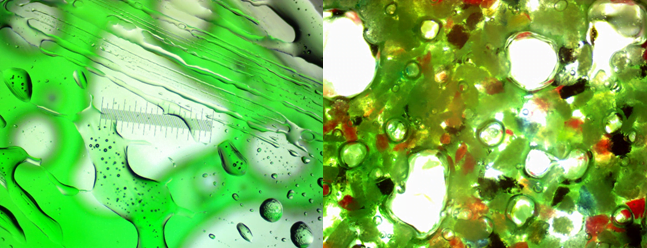
    When glaciers form, they do so in layers, with clear blue ice sandwiched between sediment and air-bubble-filled white ice. Because each of these layers absorbs sunlight differently, they don’t melt evenly. The spikes and ridges seen in this ice formed because of this differential melting between layers. The blue ice is particularly good at absorbing visible wavelengths of light, and so erodes more easily than the other layers.

    Although the results look somewhat similar to the penitente ice seen at high altitudes, the formation mechanisms are a little different. Penitentes rely heavily on sublimation — where their ice and snow change directly into a gas — rather than the melting seen here. That said, both eroded forms depend strongly on how different layers within them absorb and scatter sunlight. (Image credit: J. Van Gundy; via EPOD; submitted by Kam-Yung Soh)

  • Dunes Avoid Collisions

    Dunes Avoid Collisions

    The speed at which a dune migrates depends on its size; smaller dunes move faster than larger ones. That speed differential implies that small dunes should frequently collide into and merge with larger dunes, eventually forming one giant dune rather than a field of smaller separate ones. But that’s not what we observe in nature.

    To figure out why dunes aren’t colliding that often, researchers built a dune field of their own in the form of a rotating water tank. Inside the tank, their two artificial dunes can chase one another indefinitely while the researchers observe their interactions. What they found is that the dunes “communicate” with one another through the flow.

    As flow moves over the upstream dune, it generates turbulence in its wake, which the downstream dune then encounters. All that extra turbulence affects how sediment is picked up and transported for the downstream dune, ultimately changing its migration speed. For two dunes of initially equal size and close spacing, these interactions push the downstream dune further away until the separation between the dunes is large enough that they both migrate at the same speed. Even between dunes of unequal sizes, the researchers found that these repulsive interactions force the dunes away from collision and into migration at the same speed. (Image credit: dune field – G. Montani, others – K. Bacik et al.; research credit: K. Bacik et al.; via Cosmos; submitted by Kam-Yung Soh)

  • Submarine Canyons Focus Waves

    Submarine Canyons Focus Waves

    In winter months Toyama Bay in Japan can get hammered by waves nearly 10 meters in height. These waves, known as YoriMawari-nami, pose dangers to both infrastructure and citizens, and, thus far, are not captured by typical forecasting models.

    A new study indicates that these waves have their origin in the particular topography of Toyama Bay and the physics behind the double-slit experiment. The shape of Toyama Bay is such that only waves from the north-northeast can propagate all the way to shore. That restriction essentially creates a single, coherent source for waves in the bay.

    The bay is also home to submarine canyons that stretch like underwater valleys from the continental shelf down toward the deeper ocean. To the incoming waves, these canyons act much like the slits in the double-slit experiment, creating two sets of waves whose fronts can interfere. In some positions, a wave crest will combine with a wave trough, cancelling one another out. But in other spots, two wave crests will meet and combine, creating the much larger YoriMawari-nami wave.

    Diagram illustrating the similarity of the YM-wave phenomenon to Young's double-slit experiment. By H. Tamura et al.

    Toyama Bay is not the only spot in the world where this phenomenon happens. The same physics is behind some of the most popular surf spots in the world, including Half-Moon Bay in California and Nazaré, Portugal. In all of these cases, properly predicting wave heights requires tracking an extra variable — wave phase — that most models leave out. That’s why forecasters have struggled with Toyama Bay’s waves. (Image credit: wave – M. Kawai, diagram – H. Tamura et al.; research credit: H. Tamura et al.; via AGU Eos; submitted by Kam-Yung Soh)

  • Ice Rings Caused By Underlying Eddies

    Ice Rings Caused By Underlying Eddies

    Observations of strange ice rings on Lake Baikal, the world’s deepest lake, have puzzled scientists for decades. Surveys of satellite imagery have revealed rings on Baikal and two other lakes dating back to the 1960s and some of our earliest satellite images. The rings are roughly 5-7 km in diameter, with a dark layer of thin ice about 1 km wide around a brighter layer of thick ice.

    A new study, buoyed in part by on-the-ground observations during Siberian winter, argues that the ice rings observed on the surface are related to eddies of warmer water circulating below. The researchers were able to capture several eddies in their measurements, including one migratory one. The size, shape, and location of these sub-surface eddies are consistent with ice ring appearance. The kilometers’ wide eddies are several degrees warmer at shallow depths and rotate approximately once every 3 days.

    The researchers suspect the eddies form long before the ice does. Infrared observations in late autumn suggest the eddies form from a combination of wind and influx of river water into the lakes. Then, as ice does form, it’s affected by the underlying circulation. (Image credits: NASA, 1, 2; research credit: A. Kouraev et al.; via Gizmodo)