The daily ebb and flood of the tides results from the competing forces of the Earth’s rotation and the sun and moon’s gravitational pull on the oceans. In a few areas, the local topography funnels the incoming water into a tidal bore with a distinctive leading edge. The photo above comes from the Turnagain Arm of the Cook Inlet in Alaska, where bore tides can reach a height of 7 ft and move as quickly as 15 mph. For surfers, the bore can provide a long ride–40 minutes in this case–but they can be extremely dangerous as well. Bore tides are associated with intense turbulence capable of ripping out moorings and structures; the waves are often accompanied by a roar caused by air entrainment, impact on obstacles, and the erosion of underlying sediment. (Photo credit: S. Dickerson/Red Bull Illume; via Jennifer Ouellette)
Tag: geophysics

Simulating Early Planetary Impacts
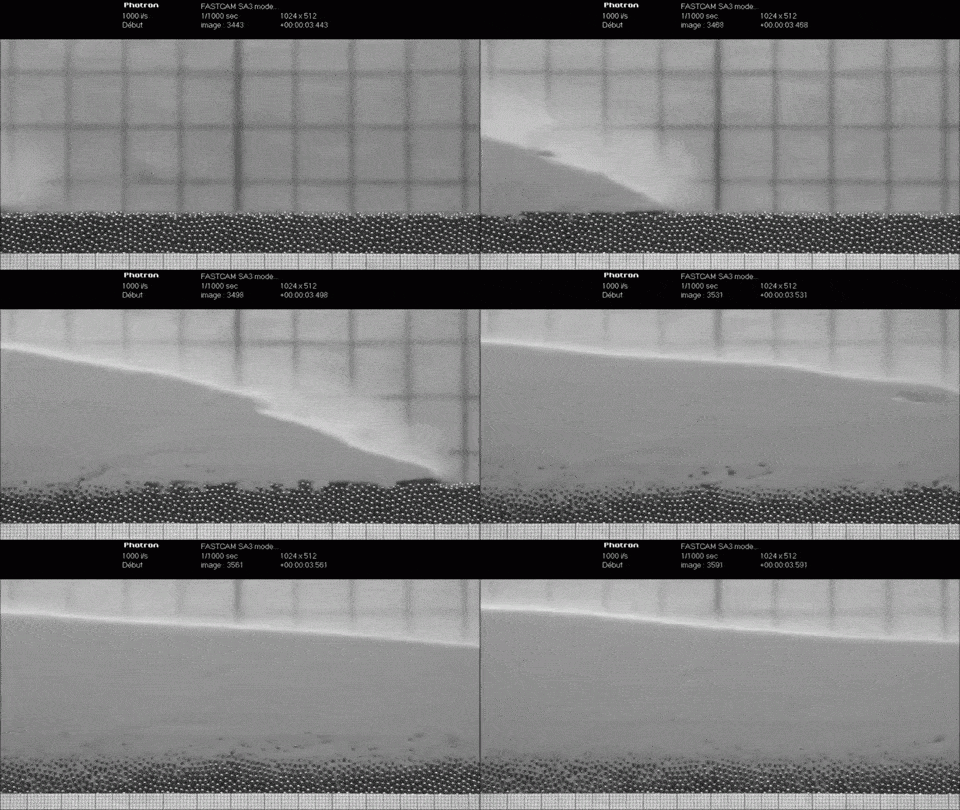
Early in our geological history, Earth was a hellish landscape of molten oceans into which metallic impactors would sometimes collide. Geophysicists have been curious how the impactors behaved after collision: did they maintain their cohesion, or did they break up into a cloud of droplets? Here the UCLA Spinlab simulates this early planetary formation by dropping liquid gallium through a tank of viscous fluid. As the video shows, the impactor’s behavior varies strongly with size. Smaller impactors stick together as a single diapir, but, as the initial size increases, the diapir becomes unstable, eventually breaking down into a cascade of droplets – a metallic rain through an ocean of magma. (Video credit: J. Wacheul et al./UCLA Spinlab; submitted by J. Aurnou)

Fluids Round-up – 7 December 2013
Fluids round-up time! I missed out last weekend because of the holidays, so this is a long list of links. There’s a lot of really great stuff here, including some neat fluidsy geophysics and astronomy.
- xkcd’s Randall Munroe explains why you can’t boil your tea by stirring it.
- LATimes describes a flying jellyfish robot.
- Wired takes a detailed look at archerfish physics, including some of the fluid dynamics we’ve discussed previously. (via iamaponyrocket)
- Several readers have also pointed out this ASCII CFD simulator, seen in action in this video.
- New models suggest that Europa’s chaotic terrain features may be due to turbulence in its lower latitudes.
- In a similar vein, nearby Jupiter’s Great Red Spot may owe its longevity to existing in three-dimensions.
- NASA revealed new movies and images of Saturn’s polar hexagon this week. For more, see some of the earlier photos and laboratory recreations of the hexagon and this summary from io9. (submitted by @AndrisPiebalgs)
- Continuing with the astronomical bent, check out Anders Sandberg’s musings on what a habitable planet twice the size of Earth would be like.
- Back here on Earth, NASA released some impressive images of global weather patterns as computed by their high-resolution models.
- PhysicsBuzz takes a look at the fluid dynamics of flying fish.
- I’ve seen plenty of videos of people doing crazy things with non-Newtonian fluids, but Hard Science adds an interesting new one: attempting to ride a bike across a pool of oobleck.
- PopSci reported from CES 2013 about a non-Newtonian fluid for protecting tech gadgets from impacts.
- Drummer Ali Siadat shows how to blow the perfect smoke rings using a bass drum. (via Jennifer Ouellette)
- Finally, this week’s lead image comes from the Grand Canyon where a strong temperature inversion created spectacular fog-filled vistas.
(Photo credit: E. Whittaker)