Remember the bullet time effect from The Matrix? This spectacular video gives you a similar effect with the turbulent flames created by firebreathers. To capture this level of detail, Mitch Martinez uses an array of 50 cameras placed around the performers, allowing him to reconstruct the full, three-dimensional representation of the flames. Similarly, some scientists use arrays of high-speed video cameras to collect 3D, time-resolved data about phenomena like combustion. Because these flows are so complex in terms of their fluid dynamics and chemistry, capturing full 3D data is important to help understand and model the flow better. (Video credit: M. Martinez; via Rakesh R.)
Tag: fluids as art

Pollock-Style Physics
Here on FYFD, we like to show off the artistic side of fluid dynamics. But some researchers are actively studying how artists use fluid dynamics in their art. In this video, they examine one of Jackson Pollock’s painting techniques, in which filaments of paint were applied by flinging paint off a paintbrush. Getting the technique to work requires a fine balance of forces and effects. Firstly, the paint must be viscous enough to hold together in a filament when flung. Secondly, the centripetal acceleration of the rotation must be high to both form the catenary filament and throw it off the brush. And, finally, the Reynolds number needs to be high enough to add some waviness and instability to the filament so that it looks interesting once it hits the canvas. Also be sure to check out the group’s previous work exploring Siqueiros’s painting techniques. (Video credit: B. Palacios et al.)
Sandscapes
Many of us have played with sand art–the rotating frames filled with water, sand, and air. In this video, Shanks FX demonstrates some of the realistic and surrealistic landscapes you can create using this toy. It also makes for a neat fluid dynamics demonstration. The buoyancy of the trapped air bubbles lets the sand sift slowly down instead of falling immediately. And the sand descends in a variety of ways–sometimes laminar columns and other times wilder turbulent plumes. (Video credit and submission: Shanks FX/PBS Digital Studios)
“The Chase”
Sometimes it takes timelapse photography to truly appreciate the dynamic behavior of our atmosphere. In “The Chase” Mike Olbinski, whose work we’ve featured previously, has captured some of the most incredible and stunning weather timelapse footage I have ever seen. Despite watching it repeatedly, I continue to be awed to the point that I have no words. Seriously, just watch it. Be amazed by the drama of our sky. (Video credit: M. Olbinski)
Turbulent Ink
Turbulence is found throughout our lives, but rarely is it as startlingly beautiful as in this Slow Mo Guys video. Here they show high-speed videos of ink being injected into water. The resulting plumes are turbulent from the very start, with innumerable folds and eddies billowing outward as the plume expands. The large difference in length scales–from the millimeter-sized curls to the meter-sized length of the plume–is one of the classic characteristics of turbulence and part of what makes turbulent flows so difficult to model computationally. Energy in these flows is generated at the large scales, but it’s dissipated at the very smallest scales through viscosity. This means that to properly model a turbulent flow, you have to capture the largest scales, the smallest scales, and everything in between in order to represent this energy cascade from large to small. It’s a problem that engineers, mathematicians, meteorologists, and physicists have struggled with for more than a century. But, here, at least, we can all just sit back and enjoy the beauty. (Video credit: The Slow Mo Guys)

Flow Around a Delta Wing
Colorful streaks of dye wrap like ribbons along the leading edge of a delta wing. At an angle of attack, this triangular wing forms a set of vortices that run along its edge, providing much of the low pressure–and therefore lift–on the upper surface of the wing. In contrast, the red streaks of dye in the middle of the wing demonstrate clean, laminar flow. Highly swept delta wings are popular for aircraft traveling at supersonic speeds, but they can also work well subsonically, as shown here. For more incredible and beautiful examples of flow visualizations by Henri Werlé, check out his 1974 film Courants et couleurs. (Photo credit: H. Werlé; via eFluids)
“En Plein Vol”
Artist Antoine Terrieux’s “En Plein Vol” exhibit shows off the power of hair dryers. Parts of the exhibit, like the floating ball at 0:16, rely on Bernoulli’s principle and the moving stream of air the dryers generate. Others, like the smoke tornado at 0:39 or the (suspended) paper airplane at 0:56, use the hair dryers to generate vorticity essential to the installation. It’s a neat concept and very well executed. (Video credit: A. Terrieux; via io9; submitted by Joseph S. and Eliza M.)

Bubble Rupture
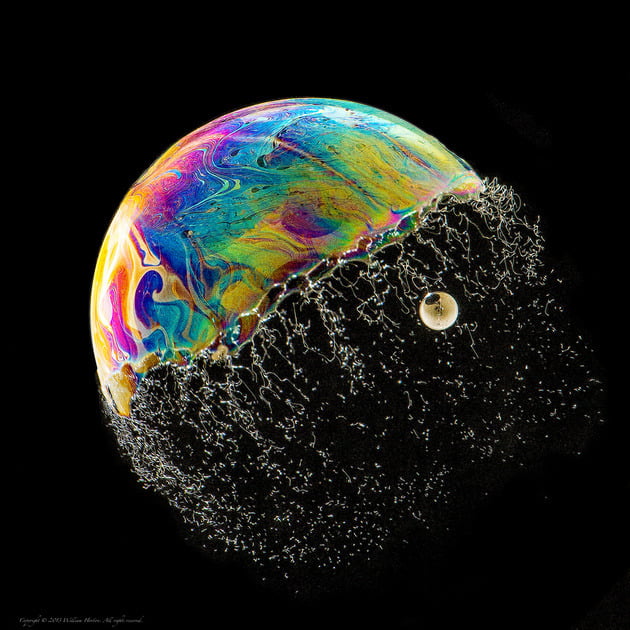
Surface tension draws bubbles into spheres, but the balance of forces holding the sphere together is delicate. When pierced by a projectile, sometimes soap films can heal themselves, but often the film ruptures. Once a hole forms in the bubble, the film’s integrity is lost. Instead of holding the bubble together, surface tension pulls the soap film apart in a spray of thread-like ligaments that break into droplets. In the blink of an eye, the bubble is gone. (Image credit: W. Horton)
Calbuco
Filmmaker Martin Heck captured incredible timelapse footage of the Chilean volcano Calbuco erupting earlier this year. Fluid dynamics on these enormous geophysical scales is always awe-inducing. In the beginning, clouds bob gently and flow around the landscape. Then the volcano erupts, and the towering ash cloud of the eruption roils with turbulence, displaying eddies with length scales from hundreds of meters down to centimeters. And when the hot ash has risen and cooled, it forms a cap that spreads horizontally. Nature is a wonderful demonstrator of fluid dynamics, but what always amazes me is how very alike flows are whether they are confined to a laboratory or take up an entire planet. (Video credit: M. Heck; via It’s Okay To Be Smart)

Sea Foam

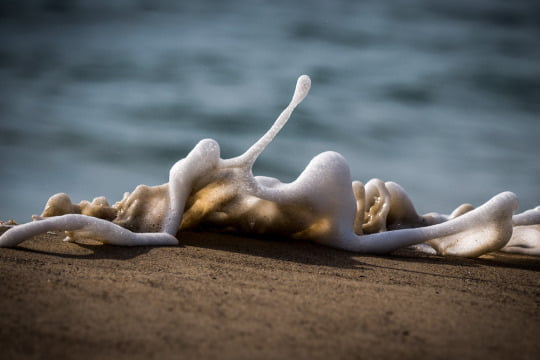

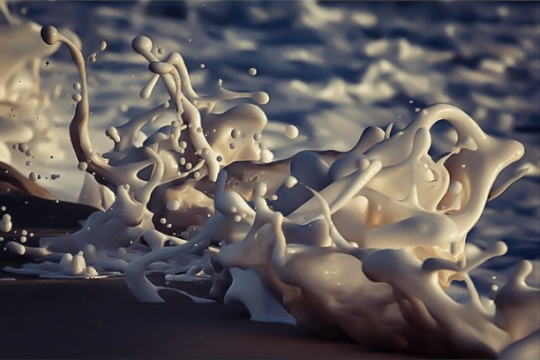
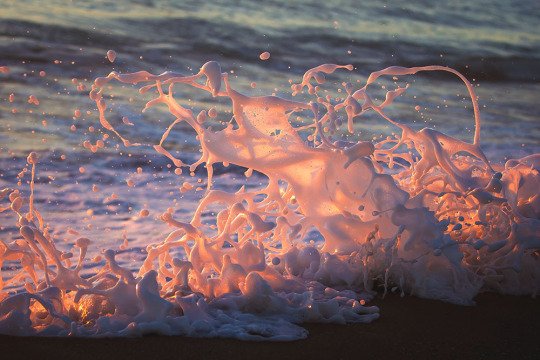
Photographer Lloyd Meudell captures surrealistic images of breaking sea foam.
Interestingly, the sea foam is essentially a three-phase fluid made up of air, water, and sand. Yet despite the surrealism of its forms, the foam bears strong resemblance to other flows. The shapes the foam forms are reminiscent of vibrated non-Newtonian fluids like paint or oobleck. Momentum deforms the foam into sheets and ligaments smoothed and held together by surface tension until droplets snap free. You can find more of Meudell’s work at his site. (Image credits: L. Meudell; via freakingmindblowing; submitted by molecular-freedom)