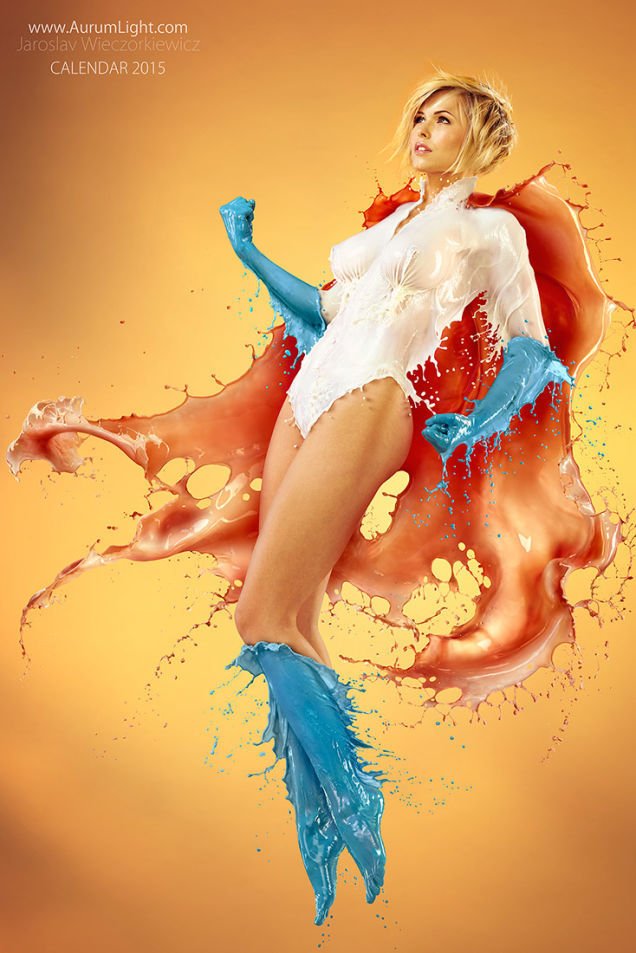
Tag: fluids as art

  • Featured Video Play Icon

    Crown Sealing

    Objects falling into a liquid pool create a beautiful splash, and, in this beautiful, award-winning video, the Splash Lab explores a peculiar instability that occurs just as the splash closes. The buckling instability they describe involves distinctive ridges that form along the splash’s ejecta sheet as it domes over and closes. The number of ridges depends both on the object size and the liquid’s properties. (Video credit: J. Marston et al.)

  • Featured Video Play Icon

    Van Gogh and Turbulence

    Turbulence is one of the great unsolved mysteries of classical mechanics. Many physicists and engineers have spent their careers trying to further our understanding of the subject and find the mathematical pattern that underlies its complex motions. But understanding turbulence and representing it artistically may be two different things. This video discusses some neat research that found that some of Vincent van Gogh’s paintings, like “The Starry Night”, display mathematical patterns like those of turbulence. (Video credit: TED Ed)

  • Featured Video Play Icon

    “Cymatics”

    Nigel Stanford’s new “Cymatics” music video is full of stunning science-inspired visuals. The entire video is set up around various science demos–many of which will be familiar to readers–that translate sound or vibration into visual elements. The video uses ferrofluids, vibrates vodka on a speaker to create Faraday waves, and visualizes resonant sound waves with a Rubens’ tube. I don’t want to give away all the awesome effects, so watch it for yourself, and then check out their behind-the-scenes page where they talk about how they created each effect. (Video credit: N. Stanford; submitted by buckitdrop)

    Also, today is the final day of voting for the Vizzies, an NSF-sponsored contest for the best science and engineering visuals. Head over to their website to check out the finalists and choose your favorites!

  • “Milky WaY”

    “Milky WaY”

    Photographer Paulo Stagnaro uses milk and food coloring in his series “Milky WaY”. Despite the simple ingredients, the photos illustrate the enormous variety of shape and form in fluid dynamics. Surface tensiondiffusion, and intentional mixing create abstract and ephemeral portraits of fluid motion. For similar work, see Pery Bruge’s art or just try browsing through FYFD’s “fluids as art” tag for more examples of science and art intersecting. (Photo credit: P. Stagnaro; submitted by Stephanie M.)

  • “Courants et Couleurs”

    Although flow visualization is a scientific technique, there is very much an art to it. Flow structures are, by their nature, ephemeral. To capture them, one must design an experiment that introduces dye into regions of interest without altering the flow significantly and without either ignoring or obscuring important physics. One of the great masters of this scientific art was Henri Werlé, whose extensive flow visualization work at France’s national aerospace lab is documented in the short film above. The film includes examples of simple geometries, full aircraft models, subsonic flow, shock waves, and more. eFluids has a whole gallery of Werlé images, too. Take a few minutes to enjoy the mesmerizing beauty of these experiments and appreciate the talents of those who made them possible. If you have questions about specific clips, feel free to ask! (Video credit: H. Werlé/ONERA; via J. Hertzberg)

  • Featured Video Play Icon

    “Cymatic Sun”

    “Cymatic Sun” from artist Lachlan Turczan uses vibrating fluids to generate mesmerizing and surreal visuals. At some points distinct Faraday waves are visible on the surface. At other times, there is simply a blur of motion and refracted light. Check out my “fluids as art” tag for many more great examples of fluid dynamics and art merging. (Video credit and submission: L. Turczan)

  • Hovering

    Hovering

    Designer Eleanor Lutz used high-speed video of five different flying species to create this graphic illustrating the curves swept out in their wingbeats. The curves are constructed from 15 points per wingbeat and are intended more as art than science, but they’re a fantastic visualization of several important concepts in flapping flight. For example, note the directionality of the curves as a whole. If you imagine a vector perpendicular to the wing curves, you’ll notice that the bat, goose, and dragonfly would all have vectors pointing forward and slightly upward. In contrast, the moth and hummingbird would have vectors pointing almost entirely upward. This is because the moth and hummingbird are hovering, so their wing strokes are oriented so that the force produced balances their weight. The bat, goose, and dragonfly are all engaged in forward flight, so the aerodynamic force they generate is directed to counter their weight and to provide thrust. (Image credit: E. Lutz; via io9)

  • Featured Video Play Icon

    Freediving

    The freediving del Rosario brothers have created a real treat with this underwater film. There are no computer-generated special effects, just some clever tricks with camera angles, perspective, and buoyancy. The end result is slightly surrealistic and captures some of the fluid beauty of the ocean. And don’t miss the excellent bubble ring vortices. (Video credit: The Ocean Brothers; via Gizmodo; submitted by jshoer)

  • “Smoke”

    “Smoke”

    Ethereal forms shift and swirl in photographer Thomas Herbich’s series “Smoke”. The cigarette smoke in the images is a buoyant plume. As it rises, the smoke is sheared and shaped by its passage through the ambient air. What begins as a laminar plume is quickly disturbed, rolling up into vortices shaped like the scroll on the end of a violin. The vortices are a precursor to the turbulence that follows, mixing the smoke and ambient air so effectively that the smoke diffuses into invisibility. To see the full series, see Herbich’s website.  (Image credits: T. Herbich; via Colossal; submitted by @jchawner@__pj, and Larry B)

    P.S. – FYFD now has a page listing all entries by topic, which should make it easier for everyone to find specific topics of interest. Check it out!

  • Featured Video Play Icon

    Soap Film Physics

    Soap films consist predominantly of water, yet their thin, virtually two-dimensional nature is impossible for water alone to achieve. The small amount of added soap acts as a surfactant, lowering the surface tension of the fluid and preventing it from bursting into droplets. When forming a film, the soap molecules align themselves along the outer surfaces of the film, with their hydrophilic heads among the water molecules and their hydrophobic tails oriented outward. For the most part, the water molecules stay sandwiched between the surfactant layers, forming a film only about as thick as the wavelength of visible light. In fact, the psychedelic colors of a soap film are directly related to the film’s thickness with the black regions being the thinnest. The video above shows a horizontal soap film at the microscopic scale and some of the dynamics exist therein. (Video credit: J. Hart)