
Many chemical reactions produce gases as a stream of bubbles out of a solution. Here we see the electrolysis of an aqueous sodium hydroxide solution (NaOH), which produces hydrogen gas on the cathode (left) and oxygen gas on the anode (right). In timelapse, the gas bubbles nucleate on the electrode, slowly growing larger. Once the the bubbles are large enough to detach, though, they rise so quickly they look like they disappear! The large buoyant forces on them drive that brief journey to the surface. By contrast, the smaller bubbles rise slowly, held back by their lesser buoyancy and the viscous drag they experience. (Video and image credit: Beauty of Science)
Tag: fluids as art

Watery Veins


Glacial river veins wend and meander through these aerial photographs of Iceland by photographer Stas Bartnikas. Rivers naturally change their course over time, but here seasonal melts and the slow grinding of glaciers adds further chaos to the scene. Captured from above, these landscapes show the scars of past flows. (Image credit: S. Bartnikas; via Colossal)

“Hydrophytes”
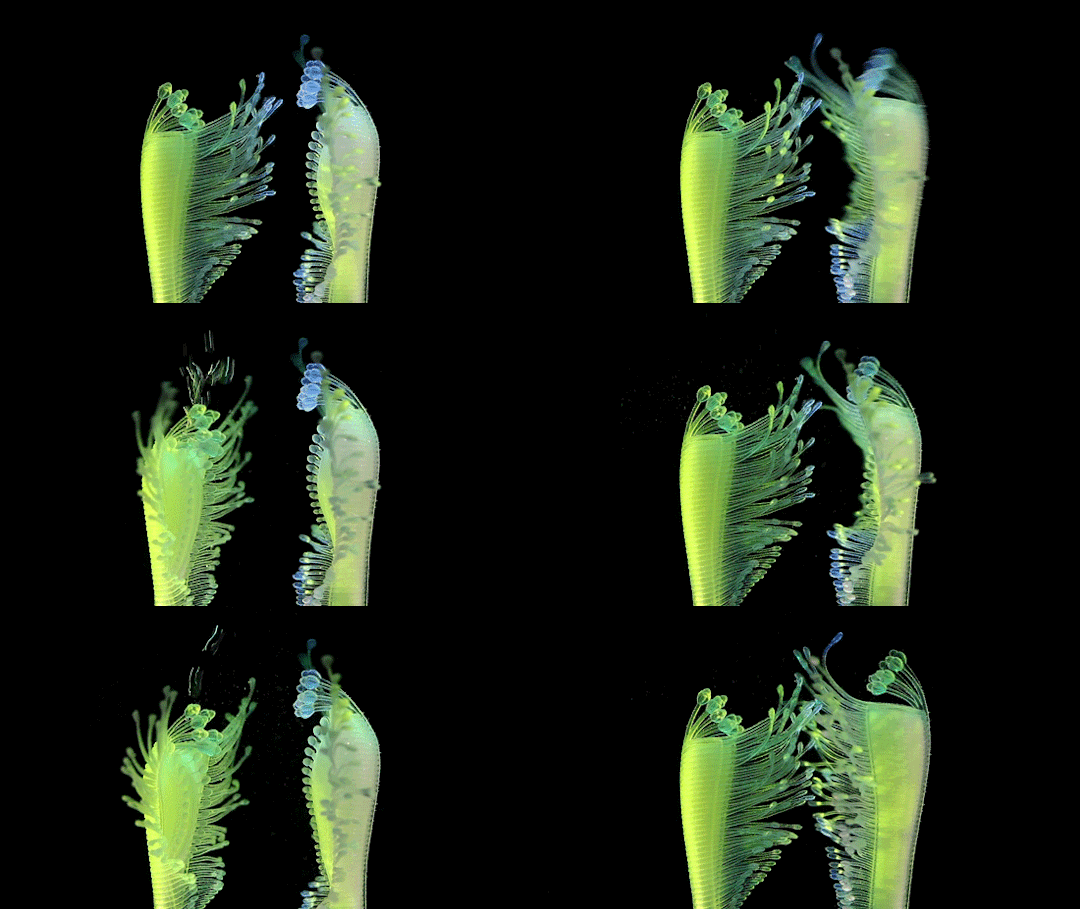


In “Hydrophytes,” industrial designer Nicole Hone imagines a future in which we’ve designed aquatic plants to counter some of the effects of climate change. To create her plants, Hone designed them with digital tools, then printed them with multi-material 3D printers. Their movements are brought to life with pneumatic pumps that fill and collapse them in response to external interactions. The motion and character of these imagined plants is astounding; they truly seem to be alive. It’s an incredible intersection of science, art, and technology. Check out the full film below. (Image and video credit: N. Hone; via Colossal)

Inside a Bubble Wall
Schlieren photography has an almost magical feeling to it because it enables us to see the invisible – like shock waves and the tiny currents of heat that rise from our skin. But it can also reveal new perspectives on things that aren’t invisible. Here we see soap bubbles viewed through the lens of a schlieren set-up. Schlieren is sensitive to small changes in density, so instead of appearing in their usual rainbow iridescence, the bubbles look glass-like and filled with tiny currents and bubbles. What we’re seeing are some of the many tiny flow variations across the surface of a soap bubble. They’re driven by a combination of forces – gravity, temperature, and surface tension variations, to name a few. Seen in video, you can really appreciate just how dynamic a thin soap film is! (Image credit and submission: L. Gledhill, video version, more stills)

“Muses”
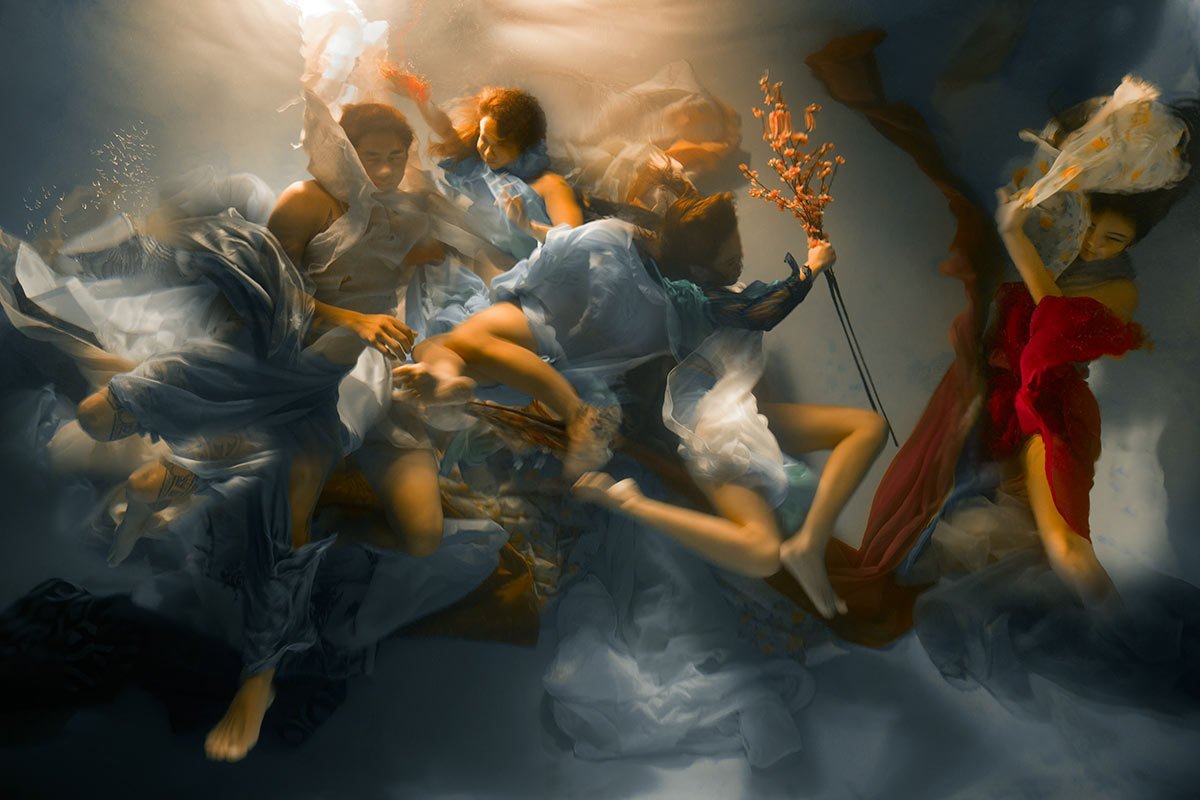


What looks like Baroque paintings are, in fact, underwater photographs in Christy Lee Rogers’ new “Muses” series. By photographing her models underwater at night, Rogers creates a unique, almost dream-like atmosphere that owes its effect to the interplay of light and water. The billowing fabric and chaotic motion come from the water itself, and the dramatic lighting relies on the reflection and refraction going on between the water and its surface. (Image credit: C. Rogers; via Colossal)

“Volumes”

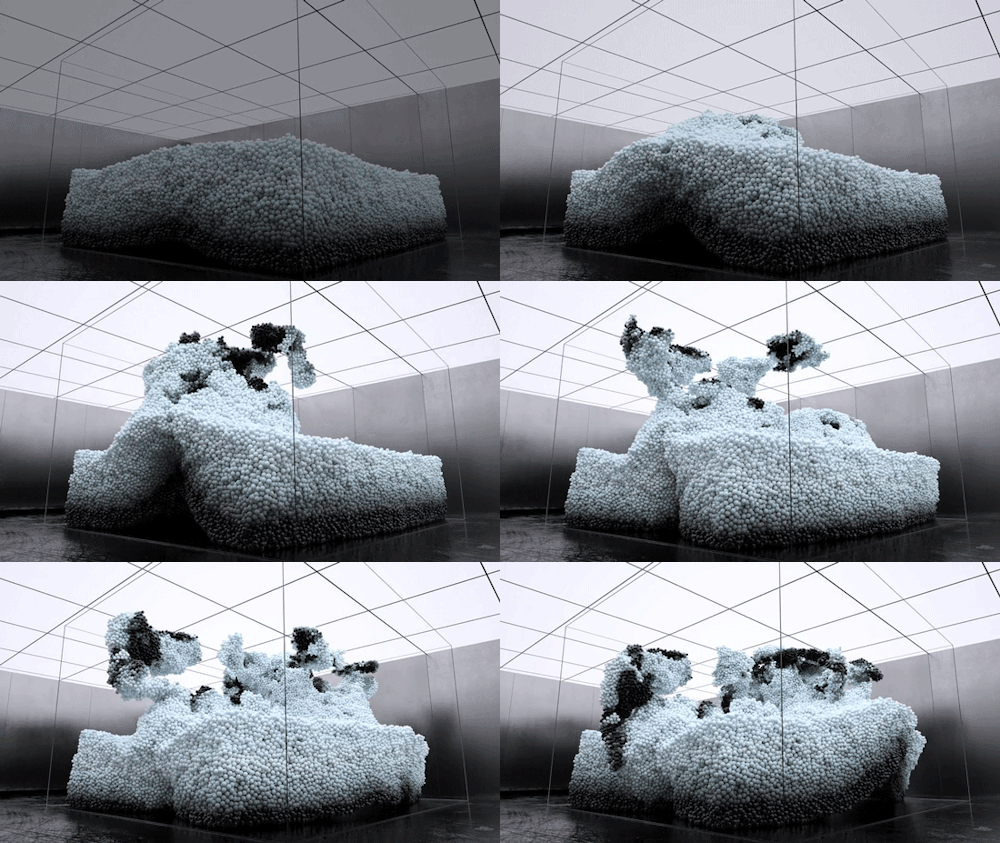
“Volumes” is an experimental art film by Maxim Zhestkov using physics-based particle animation. Waves and unseen forces send billions of color-changing particles aloft in the film. The motions – especially the way the particles seem to tear themselves – are reminiscent of a complex fluid, like yogurt. These substances have both liquid-like (viscous) and solid-like (elastic) properties depending on the forces they experience. Zhestkov’s particles are similar; they move like a fluid but tear more like a solid.
I particularly like the sequence beginning at 1:30. The upwelling of particles leaves behind a lower layer that looks like a snapshot of convection in a planetary mantle while the upper layer resembles the clash of ocean waves. The whole film is quite mesmerizing. Check it out! (Video and image credit: M. Zhestkov; GIFs via Colossal)
“Le Temps”


Thomas Blanchard is back with another beautiful music video. This one features ink cascading over various shapes underwater. Lots of tiny mushroom-shaped Rayleigh-Taylor instabilities here caused by the ink’s greater density compared to the surrounding water. There are also some lovely examples of transitional flow, especially around the spheres. Initially, flow over the spheres looks completely smooth and laminar. But, on the latter half of the sphere, where the flow is under increasing pressure, you see disturbances growing until little fingers of ink break away entirely. Be sure to watch the whole video; you don’t want to miss this! (Video and image credit: T. Blanchard)
Vortex Ring Collisions
One of the most enduringly popular submissions I receive is T. Lim’s experimental footage of two vortex rings colliding head-on. It’s an devilishly tough experimental set-up to master because perfectly aligning the rings is incredibly difficult. The pay-off, however, is huge because the breakdown of the colliding rings and their transformation into secondary rings is breathtaking. Destin at Smarter Every Day and his team have worked hard to recreate the experiment (top video), but they’re not the only ones – nor are they the first in decades – to do so.
Ryan McKeown and a team at Harvard have a set-up of their own for vortex ring collisions, and you can see a little of it in action in the middle video. Ryan’s set-up is, frankly, incredible. It scans a light sheet through the vortex rings at high-speed, allowing him to capture the collision and break-up in minute detail in both space and time. What you see in the latter half of his video is a digital reconstruction of that data – not a simulation but real data! His work is capturing vortex collisions in unprecedented detail, allowing researchers to probe the smallest scales of the phenomenon.
When two vortex rings approach one another, they can undergo what’s known as a vortex reconnection event. Bubbles rings are a great place to see this. The vortex cores get distorted when they’re close to one another due to the influence of the other vortex ring’s velocity field. This often stretches and flattens the vortex core. It’s impossible for the rings to simply break apart, though, (per Helmholtz’s second theorem). So when the original vortex rings thin to the point of breaking, they immediately reconnect to a piece of the other ring, creating a series of small vortex rings around the remains of the originals. The exact details of how this works are what investigators like Ryan and his colleagues are trying to understand. You can hear a little more about their work in my interview with Ryan in the bottom video, starting at ~2.54. (Video credits: Smarter Every Day, R. McKeown et al., and N. Sharp and T. Crawford; submission credit: a huge number of readers)
Bubble Art


Everyone loves soap bubbles, and bubble artist Melody Yang reveals how to make some pretty awesome ones in this video for Wired. The surface tension of bubbles makes them naturally seek a shape that minimizes their surface area relative to the volume they contain. For a single bubble, that’s a sphere. But once you start joining multiple bubbles, as Yang demonstrates, that minimal surface area can change, even to something unexpected like a cube.
Bubbles also have an impressive ability to self-heal. As long as whatever passes through them is wet – whether it’s a hand, a straw, or even a ball bearing – the soap film will probably heal itself rather than break. This is a key feature for many of Yang’s tricks, including the impressive planetary bubble. (Video credit: Wired; image credits: Wired/Colossal; via Colossal)
“Liquid Calligraphy”

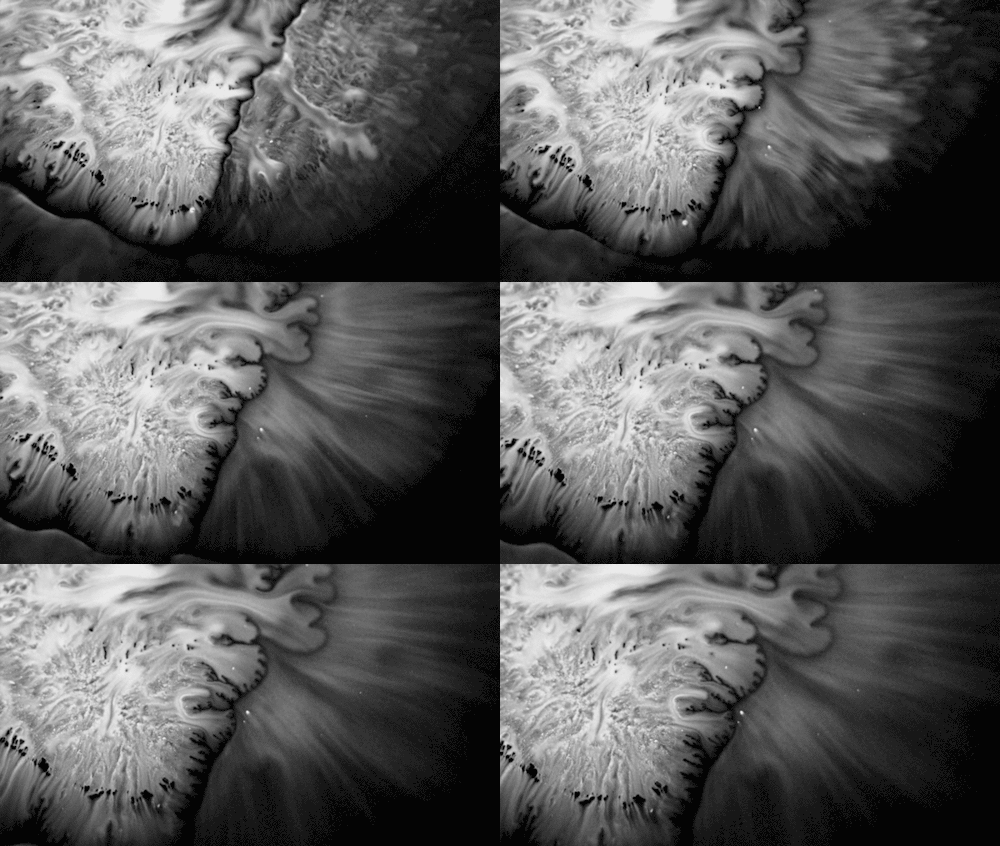
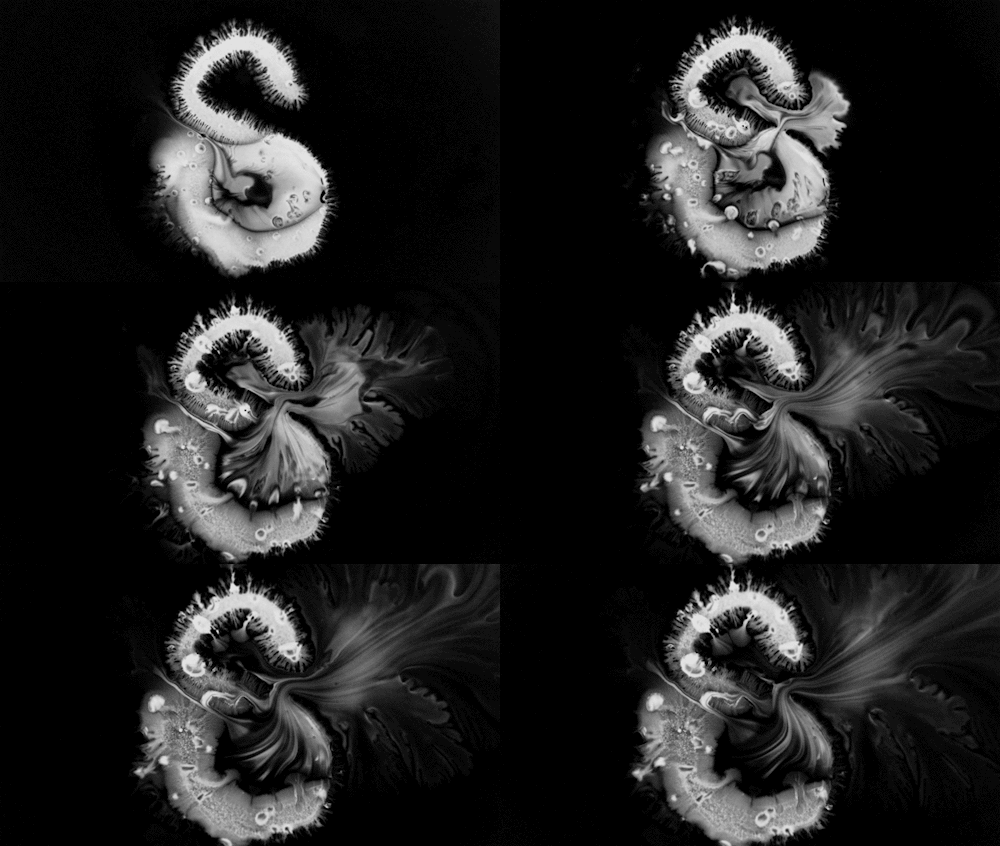
In “Liquid Calligraphy,” artist Rus Khasanov’s letters dissolve once he draws them. At first, the white ink spreads in narrow fingers, probably driven by a combination of surface tension gradients, capillary action, and simple diffusion. But then, in flashes, the letters morph faster and flow outward. My best guess is that each jump is a spray from a bottle full of a low surface tension liquid like alcohol. The spray triggers faster outflows than before, like those seen when a strong difference in surface tension activates the Marangoni effect. It’s a beautiful and different artistic take on these important fluid forces. Check out more of his videos here or enjoy high-resolution stills and wallpapers in this style from his Behance page. (Image and video credit: R. Khasanov; submitted by TBBQoC)

