Tag: fluids as art

  • Featured Video Play Icon

    Rainbow Paint on a Speaker

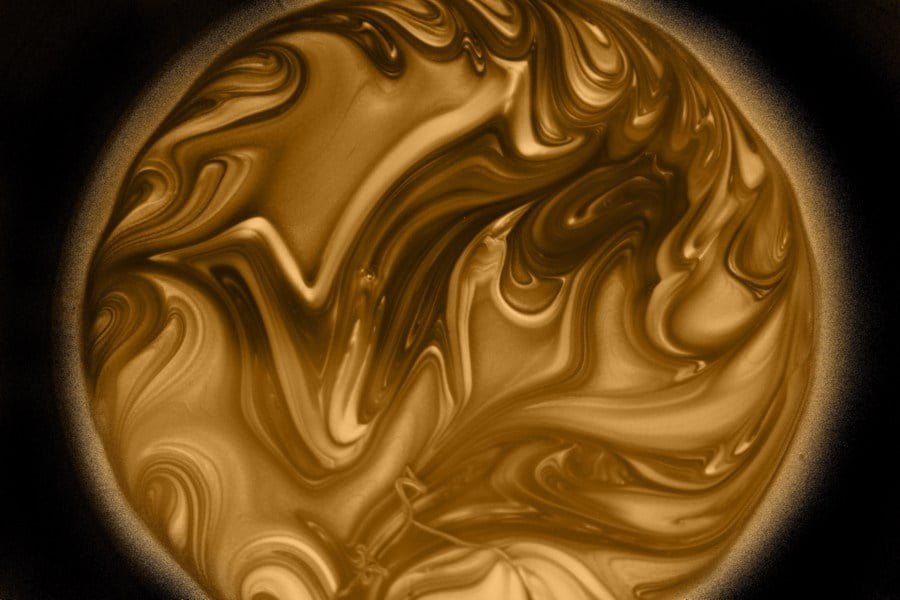
    Every year brings faster high-speed cameras and better quality imaging, so the Slow Mo Guys like to occasionally revisit topics they’ve done before, like paint vibrated on a speaker. The physics involved here are fantastic, so I’ll revisit the topic, too! In this version, Gav and Dan are using a pretty beefy speaker at a relatively high volume, so the paint gets a strong acceleration. As they note, the paint colors mix to brown almost immediately. In the high-speed footage, we can see why. 

    Watch how the individual strands of paint behave. As they fly upward, they stretch out and get thinner. That stretching has a side effect: it makes the paint spin. This is angular momentum of the paint being conserved. Just like a spinning ice skater who pulls his arms in, the paint spins faster as it gets thinner. This provides a lot of the mixing. Just look at how the different colors twist together! (Image and video credit: The Slow Mo Guys)

  • Featured Video Play Icon

    “Water Ballet”

    Artist Kamiel Rongen uses common substances like paint, oil, eggs, and even air freshener to create what he calls “water ballet.” His videos are full of ethereal and surreal landscapes full of color and motion. Buoyancy (or the lack thereof) plays a major role in his work – fluids often spurt upward like alien creatures emerging from a chrysalis. I’ve been debating with myself whether the fluids are actually rising or if they’re falling in front of an upside-down camera, and I’m not completely certain either way! I think that’s a testament both to Rongen’s artistry and to the awesome physics involved. Check out the full video below and you can see many more examples of Rongen’s work on his website. (Image and video credit: K. Rongen; h/t to James H.)

  • Fractal Fingers

    Fractal Fingers

    Dyed isopropyl alcohol atop a thin layer of acrylic medium spreads in a fractal fingering pattern. Although the shapes are reminiscent of the viscous fingers seen in in the Saffman-Taylor instability, these patterns are most likely a result of surface tension. The lower surface tension of the alcohol causes Marangoni forces to pull it outward. The branching shapes indicate an instability, likely driven by surface tension, but the details of the mechanism behind it are unclear. (Image credits: J. Nahabetian)

  • Impressionist Foams

    Impressionist Foams

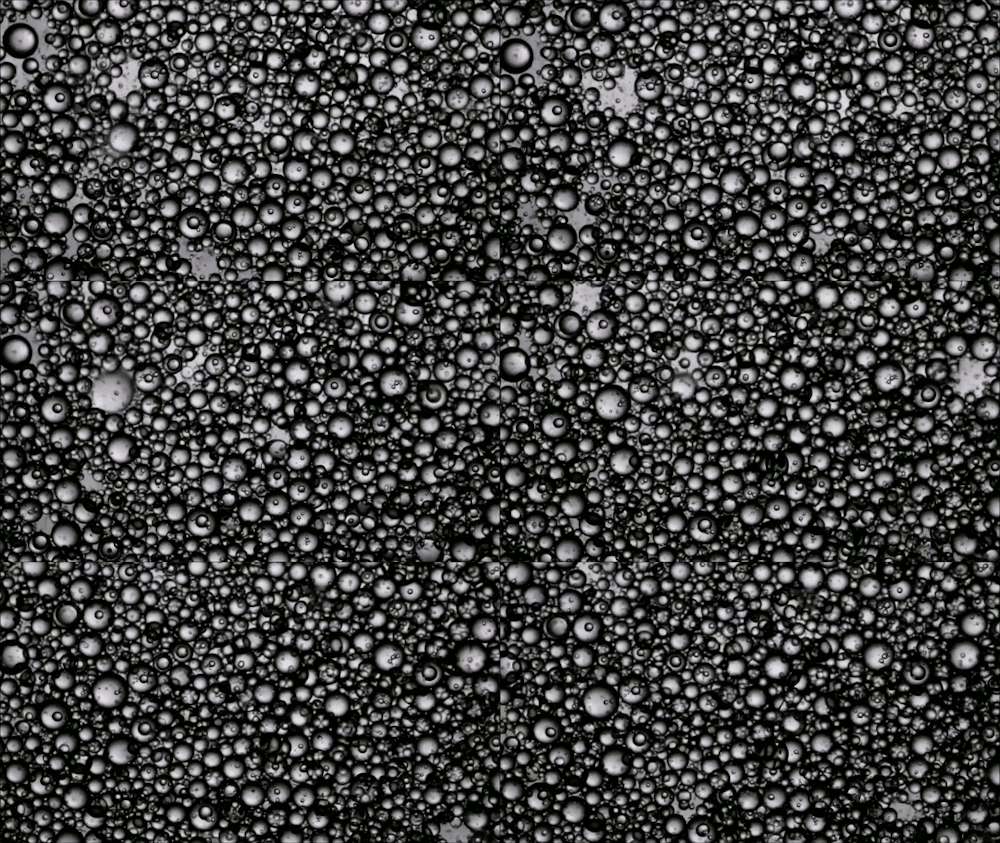
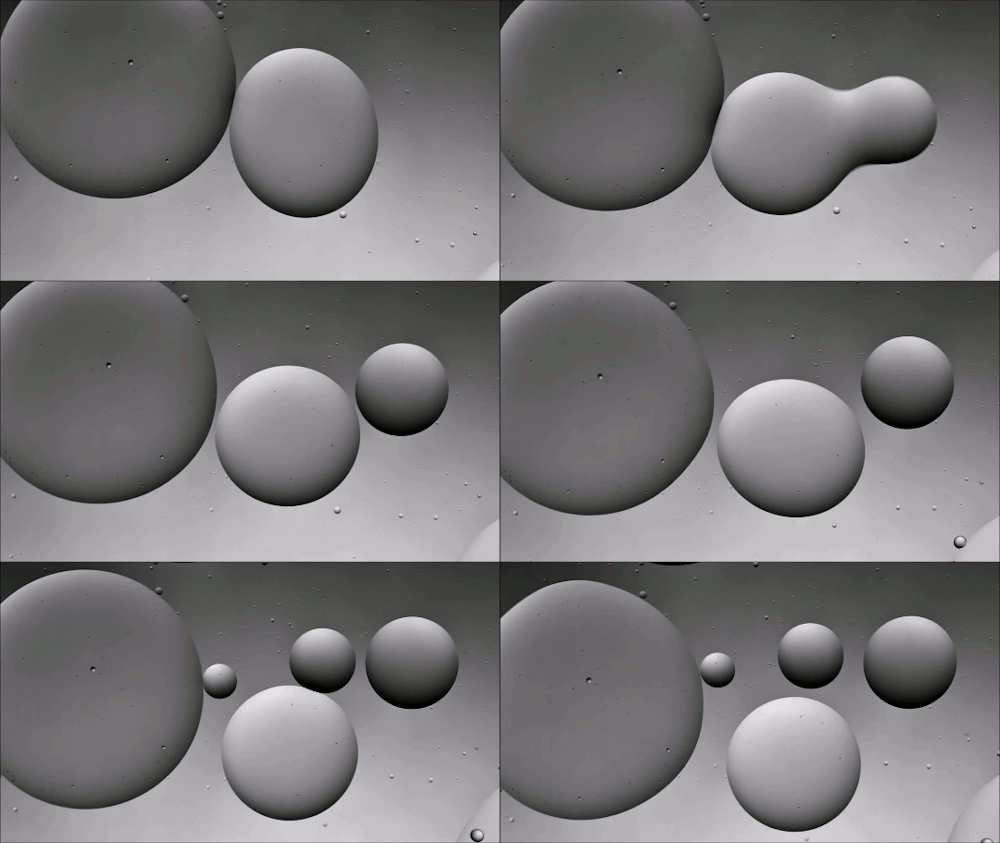
    Imagine taking two panes of glass and setting them in a frame with a small gap between them. Then partially fill the gap with a mixture of dye, glycerol, water, and soap. After turning the frame over several times, the half of the frame will be filled with foamy bubbles. When you flip it again, the dyed glycerol-water will sink and penetrate the bubble layer, creating complex and beautiful patterns as it mixes. Some of the bubbles may get squeezed together until they coalesce into larger bubbles that shoot upward thanks to their increased buoyancy. Other smaller bubbles will wend their way upward as neighboring fluid shifts. If you examine the tracks left by individual bubbles, you can find patterns reminiscent of Impressionist paintings, as seen at the end of this Gallery of Fluid Motion video. (Image credit: A. Al Brahim et al., source)

  • Skyglow

    Skyglow

    Timelapse can be a beautiful way to highlight slow-moving flows like those in the sky. But it can also be valuable in showing differences in speed, as in the latest SKYGLOW Project video, “Colorado Serenade”, which shows the Colorado River and the skies overhead simultaneously. Timelapse highlights the difference in time scales between the fast-moving river and slower-moving clouds.

    This mirrors an important phenomenon in fluid dynamics known as “separation of scales”. In a flow, there are often multiple effects at play and they may occur on different time (or length) scales. Which matters most in a given situation will depend on those scales. Consider a rocket engine. Combustion inside the engine ignites fuel and oxidizer, releasing heat. At the same time, the flow in the engine is key to mixing that fuel and oxidizer together so that all of the fuel and oxidizer ignites before it is sent downstream into the rocket nozzle. There are two important time scales here: the time it takes for the flow to mix fuel and oxidizer together and the time it takes for the combustive chemical reaction to take place. In an ideal world, engineers can balance those two time scales to maximize efficiency. But in the (admittedly less ideal) real world, this is not always possible. (Video and image credit: H. Mehmedinovic/SKYGLOW)

  • Spinning Paint

    Spinning Paint

    Several years ago Fabian Oefner started spinning paint, and it’s been a perennial favorite online ever since. Here the Slow Mo Guys revisit their own paint-spinning antics by super-sizing their set-up. In some respects, it’s a little dissatisfying; as with their first time around, they don’t moderate the drill speed at all, so after the initial spin-up, the centrifugal acceleration is so strong that it just shreds the paint instead of showing off the interplay between the acceleration and surface tension’s efforts to keep the paint together.

    In their largest experiment, though, the Slow Mo Guys get some interesting physics. Here there’s only a single slot for paint to exit, so the set-up doesn’t lose all its paint at once. The centrifugal acceleration flings the paint out in sheets that stretch into ligaments and then tear into droplets as they move further out. But there’s some more complicated phenomena, too. Notice the bubble-like shapes forming in the yellow paint on the lower right. These are known as bags, and they form because of the relative speed of the paint and the air it’s moving through. This is actually the same thing that happens to falling drops of rain! (Video and image credit: The Slow Mo Guys)

  • Sunset Flow

    Sunset Flow

    Day and night mix in this flow visualization of watercolor pigments and ferrofluid. The former, as suggested by their name, are water-based, whereas ferrofluids typically contain an oil base. This means the two fluids are immiscible. Like oil and vinegar in salad dressing, the only way to mix them is to break one into tiny droplets floating in the other. This is what happens near their boundary, where brightly-colored paint droplets float in a network of dark channels. To the right, the paint and ferrofluid have been swirled around to create viscous mixing patterns among the paint colors with occasional intrusions of thin ferrofluid fingers. (Image credit: G. Elbert)

  • Featured Video Play Icon

    Paint Balloons

    The Slow Mo Guys have a history of personal sacrifice in the name of cool high-speed footage, and their Super Slow Show is no exception. In a recent segment, both Dan and Gav were knocked flat by giant swinging balloons of paint, and, as you might expect, the splashes are spectacular. The speed is just right for some of the paint to form nice sheets before momentum pulls them into long ligaments. Eventually, that momentum overcomes surface tension’s ability to keep the paint together, and the paint separates into droplets, which, as you see below, rain down on the hapless victims. (Video and image credit: The Slow Mo Guys)

  • Featured Video Play Icon

    “Dance Dance”

    Artist Thomas Blanchard is no stranger to fluid dynamics. His previous short films focused on mixtures of oil and paint, but in “Dance Dance,” flowers are front and center. There are obvious splashes of color and clouds of diffusion toward the end of the video, but fluid dynamics are there throughout. The oozing, inexorable march of ice crystallizing over petals and leaves has a fluidity that’s heightened by timelapse. It’s a reminder that this phase change is unsteady and full of shifts too subtle to notice in real-time. In the second act, we see flowers blossoming in timelapse, bursting open dramatically before settling in with a subtle shift of their stamens. Motions like these are driven by the flow of fluids inside the plant. By shifting small concentrations of chemicals, plants drive the water in their cells via osmosis. This pumps up cells that cause the petals to spread and unfurl. (Video and image credit: T. Blanchard; via Colossal)

  • Chemistry in Infrared

    Chemistry in Infrared

    Many chemical reactions, and the flows that accompany them, are invisible to the human eye. But in infrared wavelengths those same events are vibrant and energetic. In this video from the Beauty of Science group, various chemical reactions are shown in visible and IR wavelengths, revealing very different perspectives on the same thing. Many of the reactions are exothermic, meaning that they produce heat as they occur. Because of this the thermal imaging shows where the most intense reaction is occurring at a given time. Other areas gradually darken as diffusion and flow move and dilute the heat energy released. (Video and image credit: Beauty of Science, source)