Tag: fluid dynamics

  • Superradiance in Fluids

    Superradiance in Fluids

    A group of excited atoms can collectively emit more photons than they could individually in a phenomenon known as superradiance. Now researchers have shown that vibrating fluids can produce superradiance as well.

    Two different wavefields used in the experiment, each with a different distance between the circular cavities.
    Two different wave fields used in the experiment, each with a different distance between the circular cavities.

    Similar to other hydrodynamic quantum analogs, the researchers vertically vibrated a pool of liquid at a frequency that produced Faraday waves. Beneath the pool, they placed two circular wells, varying the distance between them to observe how their wave fields interacted. With a large enough vibration, the two circular wells emitted droplets (top image), and the number of droplets they produced was higher than expected for two independent wells, indicating superradiance. The results suggest that it may be possible to build even more hydrodynamic analogs of quantum systems than previously thought! (Image and research credit: V. Frumkin et al.; via APS Physics)

  • Placental Fluid Dynamics

    Placental Fluid Dynamics

    The placenta, critical as it is to human life and development, is likely the least-studied organ in the body. Reasons for that abound, from the ethics of studying pregnant people to the historical marginalization of female bodies in medical studies. But what little we do know shows that the placenta is quite incredible.

    Shaped somewhat like a flattened cake, the placenta contains a tangle of fetal blood vessels — an estimated 550 kilometers’ worth — bathed in maternal blood. The enormous surface area — nearly 13 meters squared — enables the exchange of oxygen, glucose, and urea through diffusion. These exchanges don’t take place in still conditions, though; blood is always flowing through the vessel network. This means that each exchange depends on both the speed of diffusion and the speed of the flow, a relationship that’s captured with the dimensionless Damköhler number.

    Illustration of the intertwined blood vessels of the placenta.
    Illustration of the intertwined blood vessels of the placenta.

    Some exchanges, like carbon monoxide and glucose, are diffusion-limited, meaning that increased blood flow cannot speed up the process (though additional blood vessel surface area could). In contrast, carbon dioxide and urea are flow-limited exchanges. Fascinatingly, oxygen is close to being both diffusion- and flow-limited, suggesting that the organ has optimized for this exchange. Since pregnancy also involves a large increase in maternal blood volume and changes in lung capacity to help provide oxygen, it seems like the pregnant body heavily emphasizes delivering oxygen to the developing fetus. (Image credit: newborn – J. Borba, placenta – iStock/Sakurra; via Physics World; submitted by Kam-Yung Soh)

  • Exploding a Bubble

    Exploding a Bubble

    In this high-speed video, artist Linden Gledhill ignites a mixture of oxygen and hydrogen contained within a soap bubble. As neat as the video is, I decided to take a closer look at the initial detonation with this animation:

    The ignition sequence within the bubble, slowed down further.
    The ignition sequence within the bubble, slowed down further.

    Even here, it’s hard to appreciate just how fast ignition is; it lasts only a handful of frames, despite filming at 40,000 frames per second. But we can still pick out some very neat physics. The ignition begins with a spike-like jet but immediately forks into three ignition fronts that pierce the soap bubble. You can see the shadowy mist of the bubble bursting as the flame front expands. Watch the background carefully, and you can see a shock wave flying away from that moment of detonation.

    Once the soap bubble is gone, the expanding flames begin to wrinkle and deform. Turbulence takes shape, eddying through the flames at a much slower speed than the initial detonation. This is where most of combustion takes place, with turbulence mixing the hydrogen and oxygen together to better enable burning. (Image and video credit: L. Gledhill)

  • A Game of Toss

    A Game of Toss

    Over the past few years, we’ve seen lots of droplets bouncing and walking on waves. But today’s example is a little different. In this set-up, the wave is a large standing wave that sloshes from side-to-side in a narrow container. As it does, the wave catches and tosses a large ~3mm water droplet. The system is surprisingly stable, with this game of catch lasting for tens of thousands of cycles and up to 90 minutes before the droplet coalesces. The researchers found that, if the droplet tries to wander from its spot, the oscillating surface wave corrects it, guiding the droplet back to the optimal position. (Image and research credit: C. Sandivari et al.; via APS Physics; submitted by Kam-Yung Soh)

  • Cellular Clouds

    Cellular Clouds

    Though tough to make out from the surface, our oceans are often covered by cell-shaped clouds stretching thousands of kilometers. This satellite image shows off two such types of marine stratocumulus cloud. Open-celled clouds appear as thin wisps of vapor around an empty middle; in these clouds, cool air sinks through the center while warm air rises along the edges. Open-celled clouds are good rain producers.

    On the flip side, closed-cell clouds have a vapor-filled center and breaks in the cloud cover along each cell’s edge. These clouds don’t produce much rain, but they do lift warm, moist air through their middles and let cool air sink along their edges. Closed-cell clouds tend to last much longer than their open-celled counterparts; they can stick around for half a day, whereas open-celled clouds break up in only a couple hours. (Image credit: J. Stevens; via NASA Earth Observatory)

  • Breaking Clots With Sound

    Breaking Clots With Sound

    Clots that block blood flow away from the brain are one of the most common causes of strokes for younger people. If caught early, anticoagulants can sometimes resolve the issue, but the treatment fails in 20-40% of cases. Now researchers are investigating a new ultrasound technique capable of quickly and effectively removing these clots.

    An illustration of the vortex ultrasound technique breaking up a blood clot.
    An illustration of the vortex ultrasound technique breaking up a blood clot.

    The group attached a 2 x 2 array of ultrasound transducers to the tip of a catheter like those doctors feed through blood vessels in other interventions. The offset between each ultrasound transducer creates a vortex-like flow when the array is activated. The helical wavefront creates shear stress along the clot’s face, helping to break it up faster. In one test, the new technique broke up a clot and completely restored flow in just 8 minutes. Pharmaceutical treatments take at least 15 hours and average closer to 29 hours.

    The team is moving forward to animal trials next and hope, with success there, to bring the technique to clinical studies. (Image credit: abstract – C. Josh, illustration – X. Jiang and C. Shi; research credit: B. Zhang et al.; via Physics World)

  • Featured Video Play Icon

    Magnetic Soap Films

    Soap films naturally thin over time as fluid evaporates and differences in film thickness cause surface-tension-driven flows. In this video, researchers experiment with adding magnetic nanoparticles to the soap film. In the second image, the white structures near the center of the film contain nanoparticles, and they’re drawn toward the magnet that sits (out-of-frame) to the left of the film. With more nanoparticles and a stronger magnetic field (Image 3), the entire soap film takes on a distinctive profile that thins from left to right. The effect is so strong that the film quickly thins to the point of rupture. (Image and video credit: N. Lalli et al.)

  • Wreathed

    Wreathed

    A woman hides in silt and sediment in this award-winning underwater photo by Lee Jongkee. The motion of her plunge sends water spinning downward, where it picks up particles from the ground. Slow to settle, the sediment forms an ethereal mask for the swimmer. See more of the 2023 Sony World Photography winners here. (Image credit: Lee Jongkee)

  • Rocket-Like Supercooled Drops

    Rocket-Like Supercooled Drops

    Many droplets can self-propel, often through the Leidenfrost effect and evaporation. But now researchers have observed freezing droplets that self-propel, too. The discovery came when observing the freezing of supercooled water drops inside a vacuum chamber. The researchers kept losing track of drops that seemingly disappeared. Upon closer inspection, though, they found that the drops weren’t shattering; they were flying away as they froze.

    Inside a drop, freezing starts at a point, the nucleation point, and spreads from there. But the nucleation point isn’t always at the center of the drop. This asymmetry, the researchers found, is at the heart of the drop’s propulsion. When ice nucleates, the phase change releases heat that increases the drop’s evaporation rate, which can impart momentum to the drop. For an off-center nucleation, that momentum is enough to send the drop shooting off at nearly 1 meter per second. (Image credit: SpaceX; research credit: C. Stan et al.; via APS Physics)
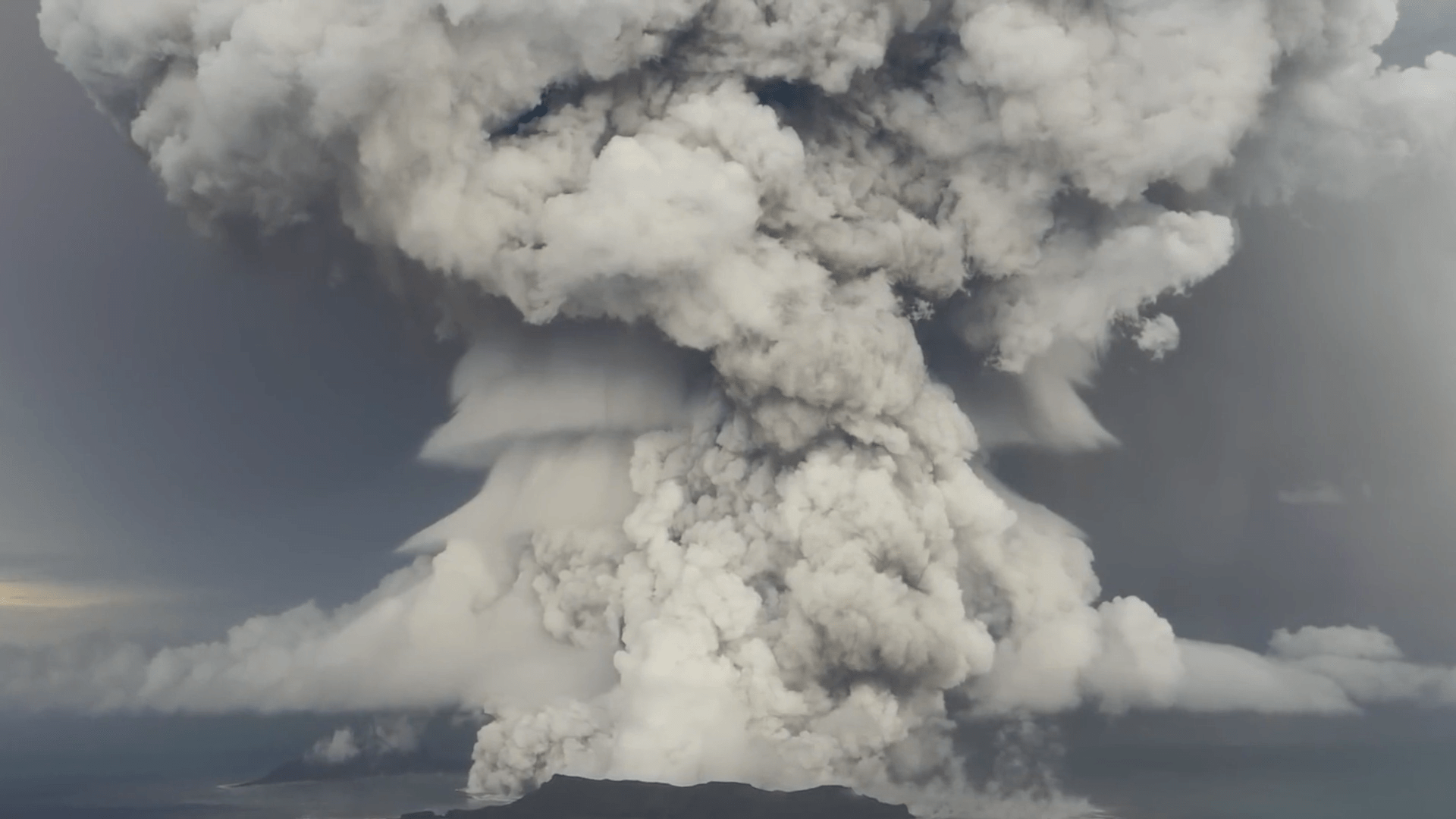
  • Submarine Volcano

    Submarine Volcano

    This pale green plume signals the activities of Kaitoku, an underwater seamount near Japan. Periodic activity picked up there in August 2022 and continued into the new year. The rising plume likely consists of superheated acidic seawater mixed with particulates, sulfur, and rock fragments. Underwater volcanoes like this one are thought to account for up to 80 percent of our planet’s volcanic activity. (Image credit: L. Dauphin; via NASA Earth Observatory)