Tag: fluid dynamics

  • Predicting Heat Waves

    Predicting Heat Waves

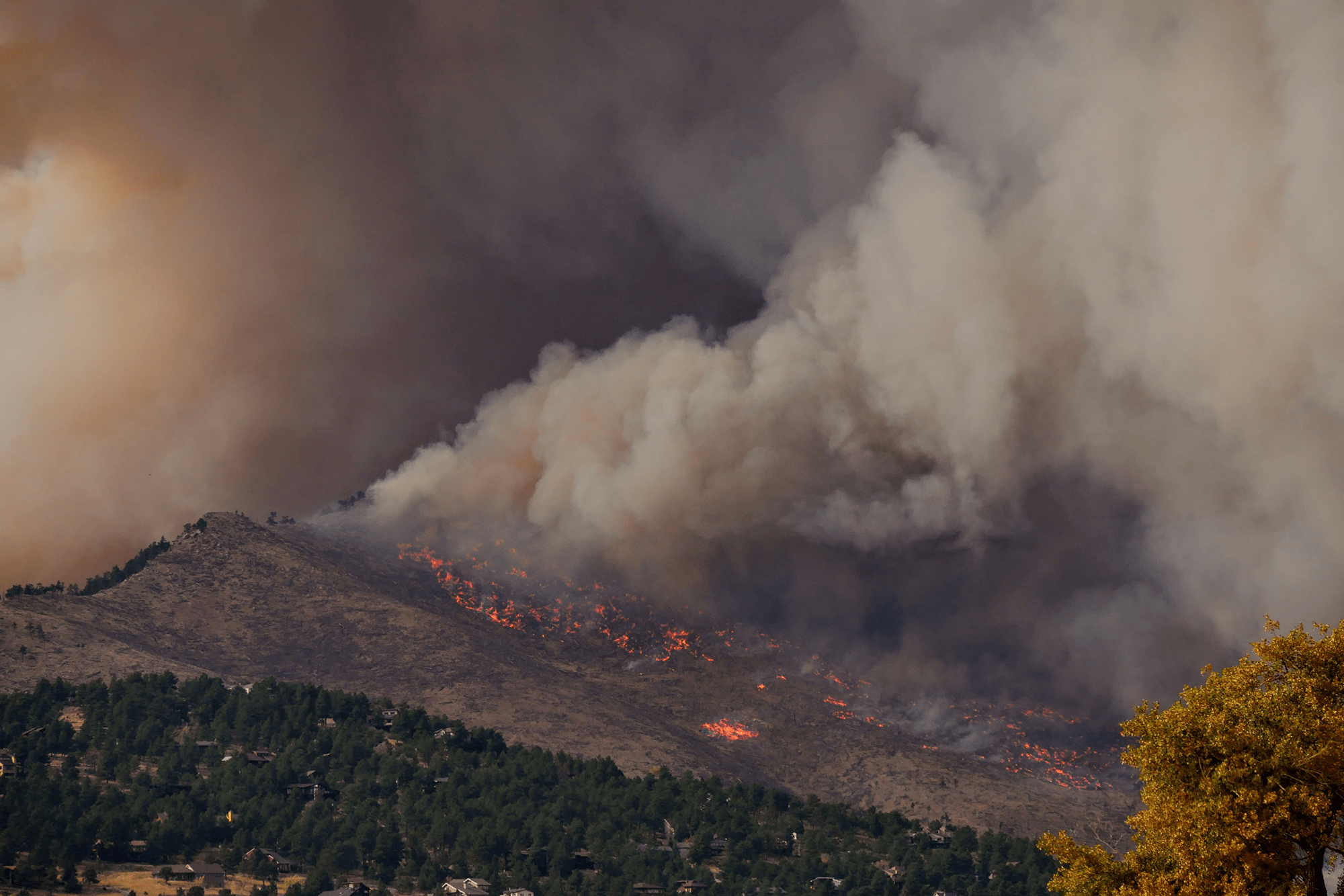
    The United States, Europe, and Russia have all seen deadly, record-breaking heat waves in recent years, largely in areas that are ill-equipped for sustained high temperatures. A new paper presents a theory that predicts how hot these heat waves can get and what mechanism ultimately breaks the hot streak.

    Heat waves start when an area of high-pressure air forms over land, with an anticyclone circulating around it. Air at the center of the zone warms and rises, and if the anticylone can’t move, temperatures will just keep rising. Despite the heat, there is still moisture in the rising air of a heat wave. The authors found that if that moist air can reach an altitude where the atmospheric pressure is 500 hPa (a typical altitude of 5-7 km), then the maximum daily temperature will stop rising. At that altitude, the moist air can condense into rain, and, even if that rain evaporates before reaching the ground, it is enough to cool temperatures.

    The key variable in the theory is the atmospheric temperature at 500 hPa, something that meteorological models are able to predict well up to three weeks in advance. That means this theory should enable meteorologists to give advanced warning of high temperatures, helping communities prepare. (Image credit: T. Baginski; research credit: Y. Zhang and W. Boos; via APS Physics)

  • Featured Video Play Icon

    Polymers and Fluid Sheets

    Even adding a small amount of polymers to a fluid can drastically change its behavior. Often polymer-doped fluids act more like soft solids, able to hold their shape like your toothpaste does when squeezed onto your toothpaste. Under a little stress, though, the fluids still flow; that’s why your toothpaste gets less viscous as you scrub.

    To study the changes polymers make, this research team collides two jets of fluid to create a liquid sheet. Depending on the flow rate and the added polymers, the break-up pattern of the sheet changes. By observing changes in the sheet thickness and the holes that form, they can draw conclusions about what the polymers are doing. (Video credit: C. Galvin et al.)

  • Bending in the Stream

    Bending in the Stream

    Nature is full of cilia, hairs, and similar flexible structures. Unsurprisingly, flows interact with these structures very differently than with smooth surfaces. Here, researchers investigate flow in a channel lined with flexible, hair-like plates. Initially, the channel is filled with oil and dark particles that help visualize the flow. Then, they pump water into the setup.

    As the water intrudes, it forms an interface with the oil. That interface is powerful enough to bend individual hairs in the system. When the hair bends far enough, it can touch its neighbor, sealing the oil inside the gap between them. Along the length of the channel, this behavior leads to trapped pockets of oil that never drain, no matter how much water flows by. (Image and research credit: C. Ushay et al.)

  • Featured Video Play Icon

    Why We Can’t Control Rivers

    Rivers are systems in a constant state of change, balancing flow speeds, path length, sediment deposition, and erosion, as seen in this previous Practical Engineering video. The next video in this mini-series considers what human interventions do to rivers. As convenient as it is for humanity to force a river into a straight and constant course, the long-term effects can be incredibly destructive both upstream and downstream.

    In this video, Grady takes a look at several types of interventions: stream straightening, dams, river crossings, and more. With the help of a stream table, he demonstrates just how these efforts shift the river’s balance and what effects — in terms of erosion, deposition, and flooding — each can cause. These disadvantages, along with habitat destruction, are part of why stream remediation projects are on the rise. (Video and image credit: Practical Engineering)

  • “Water in Dripping”

    “Water in Dripping”

    Zheng Lu’s stainless steel sculptures capture elaborate splashes in action. In some of the pieces, thousands of Chinese characters cover the sculpture’s surface; these are quotes from historical texts and poems, an homage to early Chinese philosophers who studied the principles of the natural world. See more examples of the artist’s work here. (Image credit: Z. Lu; via Colossal)

  • Hawaiian Magma Complex

    Hawaiian Magma Complex

    Few volcanoes are as well-studied as those of the Big Island of Hawai’i. With a host of seismic monitors and frequent eruptions, scientists know the near-surface region of Hawai’i well. But a recent study looked at nearly 200,000 seismic events after the 2018 collapse of Kilauea’s crater and found hints of what goes on much deeper.

    Mapping out earthquakes beneath the island revealed a cluster of activity near a village named Pahala. These earthquakes took place 36 to 43 kilometers below the surface and seem to be connected to magma filling a sill complex there. From that deep reservoir, the team was also able to map seismic activity leading upwards to both Kilauea and Mauna Loa volcanoes. Despite the 34 kilometers between those two volcanoes, they appear to be fed through the same web of magma! (Image credit: top – USGS, illustration – J. Wilding et al.; research credit: J. Wilding et al.; via Physics Today)

    This cartoon illustrates the web of magma linking Kilauea and Mauna Loa deep underground.
    This cartoon illustrates the web of magma linking Kilauea and Mauna Loa deep underground.
  • Finding the Red in the Red Tide

    Finding the Red in the Red Tide

    Blooms of the algae Karenia brevis — known as a red tide — bring havoc to Gulf Coast shores. The algae can kill fish and other marine life, and it causes skin irritation and even respiratory problems for humans. But in spite of the moniker, these algae can be hard to spot; they can add a green, brown, red, or black hue to the water.

    The false-color image above uses a new image processing technique that reveals the bloom. Using satellite images taken over multiple days, scientists can track and study the red tide in unprecedented detail. The new technique will be a boon to those trying to monitor and understand red tides. (Image credit: Y. Yao/USF/Planet Labs/L. Dauphin; via NASA Earth Observatory)

  • Hunting By Whisker

    Hunting By Whisker

    Seals and sea lions often hunt fish in waters too dark or turbid to rely on eyesight. Instead, they follow their whiskers, using the turbulence generated by a fish’s wake. The vortices shed by the fish cause the seal’s whiskers to vibrate, giving them sensory information. To better understand what a seal can derive from this, a recent experiment looked at what a thin whisker can pick up from an upstream cylinder.

    As expected, the strength of the whisker’s vibration fell off the farther away the cylinder was. But the researchers found that, if they moved the cylinder quickly — like a fish trying to dart away — the vibration of the whisker was stronger. They also found that the whisker was sensitive to misalignment. If the cylinder was placed ahead and to the side of the whisker, the whisker would still vibrate but would do so around a different equilibrium position. That result implies that a seal can get information both about the fish’s speed and direction, simply from the twitch of its whiskers. (Image credit: seal – K. Luke, illustration – P. Gong et al.; research credit: P. Gong et al.; via APS Physics)

    Illustration of a seal following a fish versus the experiment, a whisker following a cylinder's wake.
    Illustration of a seal following a fish versus the experiment, a whisker following a cylinder’s wake.
  • Featured Video Play Icon

    Can Water Solve a Maze?

    Inspired by a simulation, Steve Mould asks a great question in this video: can water solve a maze? Yes — with some caveats. Steve makes two different maze patterns — a simple and a complex path — in two different sizes. With the small, simple-path version, the water immediately follows the correct path without taking any wrong turns. What keeps it on the right path seems to be a combination of air pressure and surface tension. In the dead-end passages, the air has nowhere to go in order to allow the water in. So the pressure of the trapped air and the narrowness of the passages (which allows surface tension to help hold the water in place) keeps the water out of the false paths.

    With the larger mazes, the water is able to take some false turns as it seeks the lowest possible path. But after awhile the incorrect region fills and the water takes the next lowest path available, which eventually leads it to the outlet.

    Toward the end of the video, Steve notes that the large mazes sometimes stop flowing, even though water is still in the reservoir. I’ll quibble slightly here with his explanation, though; I don’t think surface tension is playing as much of a role in this stoppage as friction. The water is basically being driven through a long, narrow pipe, which means quite a lot of friction between it and the walls. Just as you need a certain driving pressure to keep water in a pipe flowing, the maze needs a high enough driving pressure to keep the water going. The point at which drainage stops is the point where the upstream pressure (caused by the depth of the reservoir above the maze) is equal to the pressure lost due to friction in the pipe. All in all, it’s a very cool experiment and a video well-worth watching! (Video and image credit: S. Mould)

  • Runescapes

    Runescapes

    Drying fluids can leave behind all kinds of fascinating patterns, as we’ve seen before with whiskey, coffee, and even blood. Here researchers study patterns left behind by lipids, dyes, and other fluids. They place their mixture in a rotating flask kept in a warm bath. For a few hours, the fluids mix, chemically react, and evaporate. The complex interactions that take place in that time leave behind fascinating, rune-like patterns, seen here under a microscope. It’s a bit like looking at photos of Martian landscapes! (Image credit: M. Murali and L. Shen)